
CEREBRAL LOCALIZATIONS. – The concept that the various somatopsychic functions have a precisely determined localization in the brain has undergone continual modifications over time and is still by no means a resolved problem; in recent decades, attempts to define the issue have increasingly been based on experimental and clinical data. Historically, leaving aside fantastic, aprioristic hypotheses and interpretations lacking a foundation of
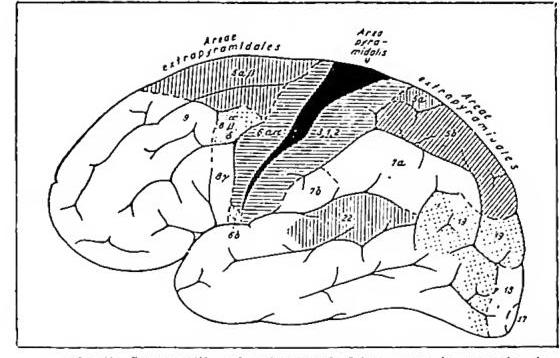
sound anatomical, physiological, and clinical knowledge (Hippocrates, Galen, Sommering, Descartes, Gall, and Spurzheim; V. FRENOLOGIA), the researches and conclusions of P. Broca (1861) on the importance of the foot of the third frontal convolution in aphasic disorders, and those of Fritsch and Hitzig (1870), who, by electrically stimulating the cerebral cortex of a dog in a particular region, observed movements of the contralateral limbs, while destruction of the same region produced a motor deficit, were the first to acquire scientific value.
From this first experiment, progress was made gradually (also thanks to the operative verification of experimental data and clinical inductions) toward the determination of true “maps,” or geographical charts, of the cerebral cortex, superimposed on the classical divisions into lobes, in which the various motor, somatic-sensory, and sensory localizations occupy clearly defined positions. Modern anatomical and physiological studies contributed to this result, through the work of von Economo, Campbell, and Brodmann on cortical areas according to the morphological appearance of the nerve cells and their arrangement in layers (cytoarchitecture), according to the progressive myelination of the different groups of nerve fibers (myeloarchitecture, C. Flechsig and O. Vogt), or according to their different electrical activity (electroarchitecture, Kornmüller).
With regard to the problem of cerebral localizations, one is confronted with two currents: that of the localizationists and that of the anti-localizationists. Among the former, there are in addition two tendencies: some go so far as to localize the psychic faculties themselves (Henschen, Wernicke, Kleist, Nielsen, Pavlov), while others, more prudently, establish relationships between delimited cerebral zones and specific clinical symptomatic patterns (Foerster, Penfield). In general, localizationists tend to abandon the concept of static centers linked to particular functions, recognizing in these centers instead dynamic organizers of functions, and replacing the term localization with the more appropriate term correlation. Anti-localizationists are likewise divided into two groups: those who maintain that the cortex functions globally, while admitting the concept of a peripheral part and a central part of the cortex itself (the former would be related to the peripheral parts of the human body and to the periphery as a whole, while the central part, comprising the remaining areas and corresponding approximately to Flechsig’s associative areas, would have predominantly psychic functions: Goldstein); and those who merely deny that particular cortical territories possess functional prerogatives in the strict sense (Monakov, Morgue).
Thus, the difficulty of interpreting even the simplest phenomena explains the variety of theories and the great divergence of conclusions. Indeed, when a lesion exists at a given cortical point, any symptomatology present can at most permit one to affirm the localization of a deficit and not of a function (Monakov), since one observes not only the disappearance of a particular function (negative symptom), but also a mixed pattern consisting of elements of this kind together with others caused by the release of other centers whose activity had been under the control of the injured center (positive symptom, according to Jackson). Moreover, the relationship between positive and negative symptoms should not be understood too schematically, since it varies from case to case.
An observation particularly well suited to understanding the coordinated activity of the various cortical areas is the comparison between what occurs during an experiment and what happens instead during a voluntary act, for example a motor act. If a particular cortical region is electrically stimulated, movements of particular muscle groups are obtained; if that same region is isolated from the surrounding areas, while stimulation produces the identical result, voluntary motility of those muscle groups is abolished. This is because voluntary movement cannot occur without the contribution of somatic-sensory and sensory information conveying a whole series of complex references to the aforementioned area from points distant from the organism and from the surrounding environment. The question of hemispheric dominance should also be mentioned: Marc Dax (1836) was the first to emphasize the importance of the left cerebral hemisphere, on the basis of the observation that speech disorders are much more frequent in individuals paralyzed on the right. At present, it is considered that left-hemisphere dominance in right-handed subjects is limited to certain functions, such as symbolic expression, visual recognition of objects, visual orientation in space, topographical memory, and knowledge of the body schema. Here too, however, these would not be isolated unilateral centers, since under abnormal conditions their functions may be taken over by the opposite hemisphere, by centers that in normal subjects probably perform a subordinate activity. There is, however, no hemispheric dominance for the cortical functions proper to the motor, somatic-sensory, and sensory apparatuses, nor for psychic phenomena in general.
With regard to the value to be assigned to the concept of cerebral localizations, it is advisable to examine the clinical results, from which different forms of localization emerge. Indeed, alongside zones (the so-called peripheral cortex) where anatomical, physiological, and clinical data make it possible to recognize a fairly precise relationship, without, however, adequately explaining the functional disorder, there are other zones where the relationship between lesion and symptomatology presents vaguer limits, such as, for example, the zones of agnosia, aphasia, and apraxia. At most, in these zones one can recognize certain nodal points of greater importance (as, in aphasia, the Broca center or the Wernicke center); but in general, identical lesions here correspond to variable symptomatology. The clinical outcome of a lesion will also depend on its nature (infectious, tumoral, degenerative, traumatic, vascular), on the patient’s condition (age), and on its course (progression, restoration, etc.).
Finally, the most important cerebral localizations are listed here, with reference to anatomo-clinical correlations. The frontal syndrome comprises disorders of muscle tone, denervation, reflexes, ocular motility, coordination, equilibrium, sensorimotor activities, autonomic functions, language, practical (praxic) activities, orientation, and, finally, psychic disorders. In the region of the fissure of Rolando, the motor centers for the individual movements of the face, trunk, and limbs are found. The parietal syndrome comprises sensory disorders (of the face, trunk, and limbs), praxic disorders, disorders of the body schema, language, equilibrium, ocular motility, trophism, and sensory functions (visual and gustatory). The temporal syndrome manifests itself through disorders of auditory language, sensory functions (gustatory, olfactory, and visual), ocular motility, and equilibrium. The occipital syndrome comprises visual disorders (hemianopsias, cortical blindness, hallucinations, and visual agnosias) and disorders of the perception of time and movement. Finally, corpus callosum syndrome comprises psychic, praxic, gnostic, linguistic, sensory, and motor disorders, as well as disorders of equilibrium.
The very fact that certain functions are located in several parts of the cortex demonstrates the extensive correlation among the various areas and suggests the complexity of the subject.