
PHRENOLOGY. — From φρήν = mind and λόγος = discourse. A theory put forward by F. J. Gall and his pupil and collaborator J. K. Spurzheim (1808–1809), which maintained that the cerebral cortex was topographically divisible into well-defined areas corresponding to the localization of the various psychic phenomena, more or less developed in proportion to the varying predominance of these phenomena and capable of shaping the overlying bony surface, so that, through cranial inspection (cranioscopy) of the corresponding prominences and protuberances, the subject’s psychological characteristics could be diagnosed and their particular intellectual aptitudes and moral tendencies determined with precision.
(by courtesy of 1870). G. de Nixon
FRENOLOGIA. — Gall’s cerebral localizations. Model of a skull in which the bumps indicating an inclination toward music are developed. The bumps correspond to the temporal lobes. From Gall and Spurzheim.
Even earlier, G. Gaspare Lavater (1741–1801), the leader of the “physiognomists,” by admitting a correlation between the external characteristics of the individual and his moral worth, had in some way prepared the concept and development of f. Gall arrived at the formulation of his theory following lengthy observations conducted on the various forms of the head and on the predominance of one or another instinctive or intellectual faculty, beginning in his school years (schoolmates with strong memories, who had eyes protruding from their heads); subsequently, he completed the elements of its construction by collecting and studying a large number of human and animal skulls. Gall sought to determine and list on the surface of the skull 27 zones of localization and corresponding bumps; Spurzheim perfected the system by raising the number to 35, classifying the faculties and inclinations into two orders: the first, of the effective faculties (1st kind: instincts; 2nd kind: feelings); the second, of the intellectual faculties (1st kind: external senses; 2nd: intellectual faculties that perceive being; 3rd: intellectual faculties that perceive the relations of external objects; 4th: reflective faculties that compare, judge, and distinguish). The areas, progressively numbered, thus each corresponded, for example, to amativeness, philoprogenitiveness, combativeness, self-esteem, cautiousness, veneration, firmness, the various external senses, order, comparison, etc., according to one or another of the 35 possible external irregularities of the skull.
The theory and practical applications of f. aroused, on the one hand, fanatical enthusiasm and, on the other, criticism, ridicule, and opposition, particularly in France, where Gall, born in 1758 in Württemberg, had moved in 1807,
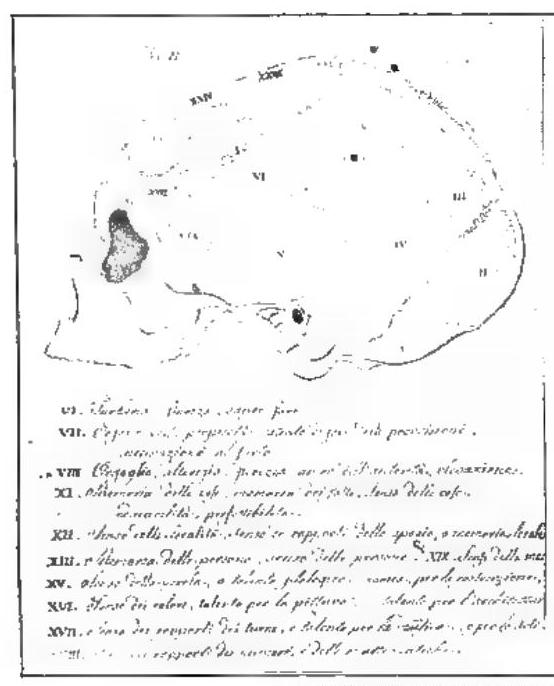
FRENOLOGIA - Cranial localizations according to Gall and Spurzheim. From an original drawing of the period preserved in the Museum of the History of Medicine of the University of Rome.
after being forced to leave Vienna and wander for two years through northern Europe. He was accused, in addition to being challenged by the scholars of his time on scientific grounds, by moralists of upholding an antisocial doctrine tending toward materialism; he defended himself against this accusation by writing, together with his pupil Spurzheim: On the Innate Dispositions of the Soul and the Spirit, or, Materialism, Fatalism, and Moral Freedom.
At present, the inferences of f. must be regarded as fanciful, but Gall and his pupil cannot be denied the merit of having founded the doctrine of cerebral localizations. Indeed, at first f. fell under the blows of Flourens (1823), who, through his research on the physiology of the nervous system and by means of the method of progressive experimental destruction of the cerebral hemispheres, seemed to demonstrate that the action of the brain is uniform, maintained throughout the entire complexity of its functions even by only a small portion of the organ, with only its intensity being proportionally diminished. But the later experiments of G. B. Bouillaud (1825), P. Broca (1861), Hitzig and Fritsch (1870), Ferrier (1873-1875), L. Luciani (1878), H. Krause (1884), Beavor and Horsley (1890), Grünbaum and Sherrington (1901-1903), etc., using the method of clinical observation combined with anatomopathological observation in human beings, or directly stimulating the various areas of the cerebral cortex in higher animals (dog, monkey) and even in human beings, demonstrated “that all the parts of the brain properly so called do not have the same functions, that the complex of convolutions does not constitute a single organ, but many organs or groups of organs, and that there are in the brain great distinct regions corresponding to the great regions of the spirit” (P. Broca, in L. Luciani, op. cit. in the bibliography, p. 674).
Thus, within little more than a century, after the cranial topography of f. had foundered in the ridicule of “Craniomania” (a satirical theatrical production by Kotzebue in Berlin), an entirely new architecture of cerebral localizations is seen to arise, so that today people speak of “areas” and “geographical maps” of the cerebral cortex, subdivided into 109 cytoarchitectonic fields by Von Economo, and into 50 by Brodmann. Nor can it be said that these concern merely motor localizations, as might be inferred from the research of the early experimenters, but rather functions which, by reason of the complexity of their mechanism and finality, take on a psychological content and significance (v. LOCALIZZAZIONI CEREBRALI).