
FANCIULLEZZA. – Lat. pueritia: life (v.) that adolescence (v.), preparing, in an apparent calm, for the latter’s overwhelming pubertal crisis. A phase of “turgor” extending approximately from the 7th to the 12th year of age, it should be regarded as one of those periods of potential enrichment of the organism and the mind that, according to the auxological law of alternation (Godin), always precede the dynamic morphological and psychological development of the phases of “proceritas.”
I. PSYCHOLOGY OF F
The phenomenal changes observable at that age, as indeed at every other age, are in particular causally linked to the new orientation of the endocrine constellation (v. ENDOCRINE, GLANDOLE, GLANDOLE), in which, toward the end of f., signs of epiphyseal deficiency begin to appear, while the thymus still promotes the progressive development of bodily mass. A progressive intensification of the function of the adrenal cortex and the anterior pituitary marks the characteristics of the endocrine equilibrium proper to f. This transition to new glandular orientations, together with the apparent organic and physiopsychological calm of this age—marked instead, in its depths, by a fervent accumulation of abundant material for subsequent constructions and differentiations—makes pueritia particularly delicate and in need of prudent caution. Especially at the beginning of this phase of life, it is necessary not to allow oneself to be tempted by considerations of a practical social nature or of family vanity, by urging the individual toward an early performance, whether physical or intellectual, before the so-called crisis of “little puberty” has completely ended in him: a critical period of “proceritas” and minor schizoidism which, between the 5th and 6th years (Pende), closes infancy (v.). The principle of physical and mental hygiene must be rigorously applied here: the individual should be spared efforts more appropriate to a later age—for example, beginning a new course of studies or changing educational direction—during the climacteric periods of life, before the transition from the developmental phase now completed has become fully and soundly balanced. Only at this point is the individual capable of maximum performance with minimum harm; introducing a discrepancy between the physical, intellectual, and moral demands of the moment and the performance possible at the degree of maturity attained may mean paying for precocity with irreparable present and future damage to the healthy evolution of subsequent ages.From the physical standpoint, f. requires careful medical supervision, precisely because hidden damage may be developing during it which laypersons would not perceive, but whose effects would become manifest in later ages. Particularly in the second part of f., or toward its conclusion, the subject may exhibit even very serious manifestations resulting from new glandular, pulmonary, or nervous invasions by the tubercle bacillus, especially if the individual, in poor hygienic conditions, has been subjected to an early and ill-advised exertion at the beginning of his studies.
From the psychological standpoint, f. should be regarded as an eminently assimilative, imitative, purposive, extroverted age, characterized by predominant emotional development, and therefore capable of assimilating and capitalizing sensations, sentiments, emotions, ideational orientations, and good or bad habits which, more or less elaborated, transformed, and at times rendered unrecognizable in subsequent periods, will constitute a basic patrimony, a rich hidden treasure for the emotional, intellectual, and even moral development of later ages. For this reason f. constitutes the predominant part of the educational age, which extends approximately from 7 to 17 years (Pende); its beginning usually marks entry into primary school, since approximately the 6th–7th year is the legal age for entering elementary studies, while the transition to secondary studies (middle school) is permitted only toward the end of pueritia, upon entering adolescence, at around 11–12 years.
As evidence of the importance of f. for the acquisition of the ideational patrimony, it may be recalled that at 7 years of age the brain has already attained a weight (1,128 g., average) quite close to that of the adult (1,370 g., average), and is thus already suited to its instrumental function with regard to the development of intellectual life.
From the educational and moral standpoint, f. is likewise precious. Through his first more intimate relations with the world outside the family (school), the subject begins to form his first circle of acquaintances and has his first experiences in an environment of which he had previously known almost nothing, observing and treasuring facts and circumstances that fascinate him by their novelty; in the contrast with the unfamiliar environment, he begins to feel more distinctly the impulse of sympathy and aversion; an increasingly lively curiosity drives him to seek causal relations, and his mind, following the path of concrete reasoning, begins to formulate abstractions; receptive to tenderness and desirous of being esteemed and loved, at school and in games he develops his first sense of justice.
From the standpoint of the passions (v.), in f. those of the so-called concupiscible appetite predominate, both in their positive form (love, desire, joy) and their negative form (hatred, aversion, sorrow), which, in fluctuating waves, betray the easy variability of his emotional life. Gluttony, envy, and acedia provide an easy outlet, often material rather than formal, for his faults.
For practical guidance, it is interesting to point out that the boundaries of f., like those of most other ages, may be more accurately marked by changes in the dental formula than by the theoretical limits established according to the number of years. In fact, at the beginning of f. there is a renewed eruption of teeth of the vegetative type (the “turgos” phase), with the appearance of the first large permanent molars (the so-called “seven-year teeth”) between the 5th and 7th–8th years, and the beginning of the shedding of the milk teeth (central incisors) between the 6th and 8th years; at the end of f. comes the replacement of the milk canines (teeth of animal life and relationship) by the robust permanent canines, at approximately 10–12 years of age.
BIBLI: H. D. Noble, Les passions dans la vie morale, I. Parisi 1931, pp. 91-104; N. Pende, Crestera e ortogenesi, Milano 1936; M. Barbara, Ortogenesi e biotrologia, Roma 1945; N. Pende, La scienza moderna della persona umana, Milano 1947.
Giuseppe de Nismo
II. THE PEDAGOGY OF F
The data offered by psychology concerning f. provide pedagogy with an opportunity to recall and insist upon certain normative laws, which aim to assist the development of the personality, making use of the positive sides and elements of this age and seeking to remove everything that might, in the near future, cause even serious harm.1. For intellectual activity
Since the child displays a pronounced realistic tendency, which gives him a special taste for everything involving mechanics, technology, construction, and the execution of models, in his reading too he will no longer seek fables and legends, but stories or novels in which the adventurous type predominates; accounts of journeys to countries which, before his imagination, are still enveloped in a cloud of mystery awaiting dissipation. Yet he does not yet possess a critical sense; he still cannot objectively distinguish the true from the invented and easily allows himself to be influenced and overwhelmed by his own subjective interpretations. Hence the need to supervise his reading, so that, in addition to recreation and instruction, there may not arise an excessively rapid and premature awakening of morbid instincts capable of leading to fatal consequences.2. For affective activity
The intense biological activity proper to this period, during which the two sexes begin to differentiate themselves distinctly and to notice, with a certain appreciative interest, their different physiopsychological characteristics—which no longer leave reciprocal behaviour quite so indifferent—has different consequences for the boy and the girl. The boy needs to express himself in games involving movement, all the better when encouraged by competition and contests; he feels for a longer time the social impulse toward his companions, while still retaining predominantly childish attitudes. The girl, on the other hand, who must face puberty considerably earlier than the boy, under the influence of changes that surprise her and whose meaning she does not always know how to understand, easily experiences melancholy, sadness, laziness, listlessness, and consequently feels more strongly drawn toward a kind of solitude in which she can dream at will and build golden castles; in short, she may become accustomed to a fictitious world that could produce unpleasant awakenings.Education, therefore, will take on the character of a vigilant art, yet a serene and unselfconscious one, open and ever richer in understanding and love. A common concern, both for boys and girls, besides encouraging them to study, will be to supervise the relationships they oppose or favour, the companions with whom they associate most assiduously, and their diligence and constancy in study; this is intended to prevent—or at least correct in good time—serious dangers of deviations or behaviours which, in the one case, may take the form of thoughtless chivalry and, in the other, of vain coquetry. In particular, the boy should begin to be given a serious conception of life and of the future, which will demand seriousness and culture from him; the girl, at the opportune moment and more or less extensively according to the circumstances, should be given an exact conception of the great mission entrusted to her by God, and of the efficacy and strength of a sound femininity, which must know how to keep each person in his or her proper place and make disappear the foolish conviction that woman is nothing but fragility and weakness.
3. For volitional activity
Since during this period there is not yet that psychological maturity which knows how to measure and assess the consequences of actions and habits, the art of education recommends making use of everything—environment, company, reading, amusements—that can help, support, and guide the child. Above all, it is important to educate him to will what is required when duty is involved, and from time to time to go beyond duty in order also to perform some supererogatory action; to correct slowly but steadily those aspects or ends of character which are displeasing. The conviction that energy, decisiveness of will, and volitional strength depend on nature and not on art, and therefore are neither educable nor attainable by everyone, does not withstand the light of serious experience. Any character initially weak, timid and feeble, or uncertain and irresolute, can gradually be led to attain possession of a strong and unshakable will (v. VOLONTÀ, EDUCAZIONE delle).4. For religious activity
Religion, in theory and practice, also provides f. with a programme of marvellous efficacy. The child, in fact, is already capable, if suitably adapted, of understanding the principal and deepest truths of Christianity, the divine life within him, the respect for his own soul and body that follows from it, and the efficacy of the Sacraments; he knows how to appreciate the beautiful Gospel and hagiographical narratives, understands the love of Jesus, and is also capable of responding to it through sublime acts of heroism; the history of the martyrs and of the missions is exceedingly rich in examples of this kind. Hence the insistence that religious instruction be imparted from the earliest years. Hence, too, the importance of profound religious instruction for parents themselves, so that they may instil it in the hearts and minds of their children, since the art with which they will one day know how to practise it, with an immediacy deriving, so to speak, from blood and from the life communicated, finds no counterpart—or only with difficulty—in the art of teachers and instructors who are strangers to them.BIBLI.: Pio XI, Divini illustri Magistri, encyclical of 21 Dec. 1929 (in AAS, 21 [1929], pp. 723–62); Pio XII, Disserti agli apti. 3 vols., Rome 1929–35, rich in observations and counsel on educational matters in general and on the education of f. in particular. Cf. also: F. Gay-L. Cousin, Comment s'élève mon enfant, Paris 1927; R. Biot, Le corps et l'âme, Paris 1938, pp. 134–220; Italian translation, Brescia 1939, pp. 153–268; R. Pius, Il Cristo al Teodoro, Italian translation, 2nd ed., Turin 1946, pp. 442–504; L. Guarnero, Iniziazione alla psicologia scientifica e pedagogica, Turin 1946, pp. 69–77; id., L'età difficile, ibid. 1946, pp. 85–132. Celestino Testore
III. THEOLOGY OF F
The recent beatifications of children and adolescents have raised a psychotheological question: is heroicity of virtue possible in a child after the attainment of the use of reason?In other words, the question is whether a child can know and love God heroically, appreciate a renunciation and understand its significance, overcome himself and triumph despite his inclinations or his age, solely out of love for God, whom alone he wishes to please. And whether he can exercise himself so thoroughly in the field of the Christian theological and cardinal virtues as to acquire a virtuous habit, by which he acts in a manner superior to the common average.
Among the opposing views recently expressed, the opinion of those who answer affirmatively appears more logical.
Divine Grace, illuminating the intellect and strengthening the will, can enable a soul to perform heroic actions with full awareness, anticipating for that soul, in the faculties of the soul itself, the time of normal development. Tender age is no obstacle to the wondrous effects of Grace, of any Grace, or of the gifts of the Holy Spirit, the endowment that God always grants to those whom he wishes to make saints.
If one admits—and the facts confirm this—that children have performed extraordinary actions at a tender age, with an intellectual openness and mastery of the will suited only to mature men (e.g., Mozart, Leopardi, etc.), how can one fail to admit that this may occur under the omnipotent action of God the Creator, who always acts while respecting the freedom of the creature? If prodigies occur in the natural order, there is no reason to consider them impossible in the spiritual order.
One should also bear in mind that the heroic act in a child may consist in a heroicitas of a lesser degree than that required in an adult. Giving up a game or a sweet, sitting still at one’s desk: these are acts that can attain the heroicity of relative virtue if performed out of love for God.
This possibility can be proved indirectly by starting from the sad reality of children who are already masters of vice and the refinements of guilt. If, then, a child’s soul can be clothed in the habit of vice, how could it not, when divine Grace and virtue intervene, be wrapped in the garment of the highest virtue? If by nature man, whether young or adult, is drawn toward evil, by Grace he is, provided he responds, almost swept toward the good. Just as the present world, in particular, knows how to furnish society with depraved children, so the Church and God, who acts within it, present great souls of children who have risen to the glory of the altars—true heroes—whose examples in the 20th century are Maria Goretti, the Saint of the Jubilee Year 1930, and also Domenico Savio, although in his case we are already further on, at the dawn of adolescence.
Even apart from this possibility, children may privately be invoked as blessed intercessors if they died after Baptism but before attaining the use of reason. For this propitiatory purpose, as well as for latreutic purposes and thanksgiving, the Holy Sacrifice of the Mass may be offered, insofar as spiritual and temporal benefits are requested from the Lord through their intercession. It follows that the Mass de Requie should not be said for them, but either the Mass of the day or, if the rite permits it, de Angelis, or also de Requie, but applied for all the deceased.
IV. CHILDREN AND THE CHURCH
The Church always exercises a maternal mission of protection toward children, in order to promote works of education and redemption; she watches particularly over their being instructed in Christian truths and receiving the Holy Sacraments. In this too she follows in the footsteps of the Divine Master, who accorded children the highest prestige, contrary to the rules, or at least the practice, of the pagan world, in which a child was accepted only insofar as he promised to become a citizen useful to society. The parallel Gospel passage of Mt. 19,13-15; Mc. 19,13-16; Lc. 18,15-19, which portrays Jesus embracing the children, is of an eloquence and freshness that enchant. The Greek word (τὰ τεσβέα) suggests especially the very young, the little children, in whom certain qualities of pre-malicious innocence are more evident—a symbol of another, intentional innocence, the fruit of combat and struggle against evil, which is known but not admitted. All this explains the reference to f., as a symbol of certain definite and most lovable qualities, especially docility and humility, which is the subject of another Gospel passage, likewise parallel in Mt. 18,1-5; Mc. 9,32-36; Lc. 9,46-48; and also explains the harshness of the language used against those who corrupt children, by Jesus himself, who, although so gentle, went so far as to say that being drowned at sea with a millstone around one’s neck would be a better fate than scandalizing «one of these little ones...» (Mt. 18, 6 and 10; Mc. 9, 41; Lc. 17, 2).Jesus does not overlook the faults proper to children either. He takes, for example, the occasion of certain childish whims, displayed in their games, to inveigh against the scribes and Pharisees (Lc. 7, 31-34; Mt. 11, 16-19). But in his eyes, with a just assessment, their faults are overshadowed by their merits; he therefore gladly sees these children beside him, to receive from them the simple and spontaneous homage that echoes the very voice of God (Mt. 21, 15-16); and he points to them as the objects of his predilection and of that of those who wish to be his disciples. He therefore declares that he will regard any benefit done to one of them as done to himself (Mt. 18, 5).
There are no few works that have arisen in the Church for the benefit of f., in response to this invitation of Jesus: works connected with Orders and religious institutes, and independent works born of the generous impulse of private individuals and organizations. This is perhaps one of the finest pages in the history of the Church. Among the initiatives that silent and fruitful experience has already tested in this field, the names emerge of a s. Ignatius, a s. Joseph Calasanz, a s. John Bosco, and many others whom it would be difficult to enumerate.
The Church has always jealously claimed this educational mission for the family and for herself, a mission that occupies a foremost place in ecclesiastical teaching (v. MUTUO INSEGNAMENTO, LIBERTÀ d'; SCUOLA, LIBERTÀ DELLA; cf. the encyclical of Pius XI, Divini illius Magistri, of 31 Dec. 1929).
V. I FANCIULLI E LA LEGISLAZIONE ECCLESIASTICA
The fruit of the teachings of the Divine Master, of a millennium of experience in the pedagogical field, and of psychological inquiry is also the ecclesiastical legislation concerning children.The term puer, synonymous with infans and parvulus according to can. 88 § 3, would appear to be reserved for the child before the age of 7, whereas the word impubes (impubere) is held, in the specific sense, to signify the child from 7 to 14 years of age if male, and to 12 if female.
But the terminology of the CIC is not always consistent, and often the term puer is used in a broader sense to indicate the child in general before puberty (cf. cann. 1331, 1353).
From birth to the age of 7, the child (infans, the term more commonly used in this specific sense) is held not to have the use of reason (non sui composi); the contrary presumption applies after the age of 7 (can. 88 § 3): in neither case does the presumption exclude proof to the contrary (presumptio iuris tantum). Although it is appropriate to accustom children from an early age to observing ecclesiastical laws, nevertheless, before the age of seven they are not bound by them, unless otherwise provided (can. 12), «unless they are ecclesiastical laws that interpret divine law: thus, as soon as they have attained the use of reason and have been duly instructed, they are bound to receive Baptism (can. 752 in relation to can. 745 § 2 n. 2), to receive Easter Communion (can. 859), the sacrament of Penance (can. 906; Pontificia Commissione, 3 genn. 1918, in Monitore Eccl., 43 [1918], 112), Viaticum (can. 854 § 2), and Extreme Unction (can. 940). On the obligation of Confession and Communion before the age of seven V. in particular: COMUNIONE. Children, even before the use of reason, can validly, though illicitly (for the person conferring it), receive the sacrament of Orders; whereas they are incapable of matrimonial consent and of consent for any contract in general, because they are incapable of a human act. Until they have attained the full use of reason, they are also incapable of making any valid vow (can. 1307 § 2).
Morally, children are guilty according to the degree of their use of reason. Where there is no use of reason, there is neither sin, nor delict, nor punishment (can. 2201 § 1). In the penal sphere, children are considered, in proportion to their age, capable of sin and of malice «and of the corresponding penalties (can. 2204); they are never, however, subject to penalties «latae sententiae» (can. 2230), but only to corrective and educational punishments «ferendae sententiae».
Many other legal provisions concern children without directly binding the children themselves. There is an obligation to confer Baptism upon them (can. 745 § 2 n. 3 «V. BATTESIMO); the same Confirmation (v.), which, for liceity, is to be conferred after the use of reason (can. 786). There is also an obligation to instruct them in Christian doctrine before and after First Communion (cann. 467 § 1, 1330, 1331), to care for them in a special manner, directing them toward piety and study if they show signs of an ecclesiastical vocation (can. 1353), and to bury them, if possible, in a section of the cemetery reserved for them, if they die before the age of seven (can. 1209 § 3). The Church also prescribes distinct funeral rites for them (Rit. Rom., tit. IV, cap. 6), in which she manifests joy at their eternal salvation more than sorrow.
If, however, they have died before the use of reason without Baptism (as regards their final fate, V. LIMBO), the Mass cannot be applied for them, because the Holy Eucharistic Sacrifice would benefit them in no way. For children who have died after the use of
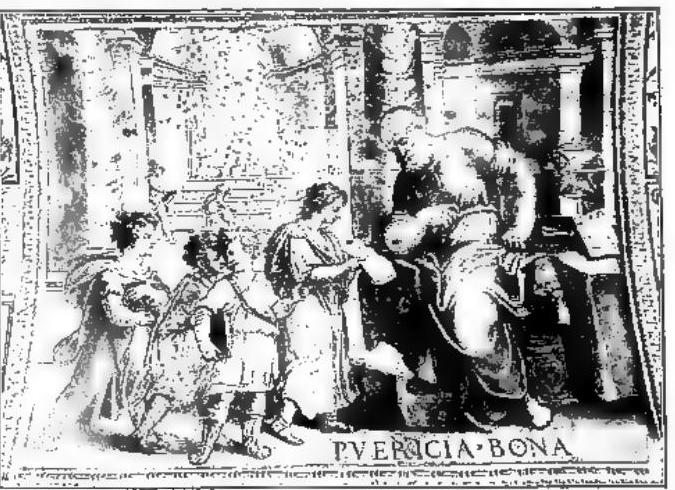
(phot. Gall. Maria Vaticana)
FANCIULLEZZA – Pueritia bona in the frescoes of the Terza Loggia Vaticana (16th century).
La Chiesa raccomanda inoltre al confessore di usare molto tatto con i più giovani, e quindi con i fanciulli nelle interrogazioni per quanto riguarda la materia del VI precetto del decalogo (can. 888 § 2), magari anche a scapito dell'integrità della confessione (cf. S. Congregazione del S. Uffizio, Norme del 16 maggio 1943). Esiste la proibizione di introdurre le donne di qualsiasi età (e quindi anche le fanciulle) nella clausura dei regolari e chiunque (anche fanciulli o fanciulle) nella clausura delle monache (can. 598 § 1, 600 e 2342).
Per i crimini contro i fanciulli, ed il trattamento del fanciullo nell'antichità V. ESPOSTI; INFANTICIDIO; INFANZIA ABBANDONATA; per la responsabilità enorme della loro corruzione, V. MINORANZE NAZIONALI. Per i fanciulli nella Crociate, V. CROCIATE; per i fanciulli offerti ai monasteri, V. OBLATI; per il lavoro dei fanciulli, V. LAVORO.
Pietro Palazzini
FANCIULLI CATTOLICI, ASSOCIAZIONE di:
V. UNIONE DONNE DI AZIONE CATTOLICA.