
UNIONE DONNE DI AZIONE CATTOLICA. — The Union of Catholic Action Women arose in 1908, when women’s organizations in Italy too were gradually asserting themselves with innovative programs and were necessarily affected by the anti-Christian social environment characteristic of that period.
It was the resolution adopted by the Congress of Italian Women against religious instruction in schools that determined the Catholics’ clear separation from that Association which, apparently neutral, was in fact secretly influenced by Freemasonry. It therefore became necessary to establish another organization which, while pursuing aims directed toward the advancement of the female masses, would nevertheless be Catholic in inspiration and, indeed, would openly take its stand in defense of Christian rights against every form of oppression.
Pope Pius X, to whom Princess Cristina Giustiniani Bandini submitted the idea of establishing a Union among the Catholic women of Italy, blessed the new Association, annotated its statutes in his own hand, and always supported it with his highest authority. In this, Pius X showed himself remarkably far-sighted, fully understanding the degree of maturity by then attained by women, who, recognizing the gravity of the historical moment and the needs of the Church, thus surpassed the centuries-old traditions that had seen them in their proper place only within the home and prepared to leave it, because defending the family now required working on a broader front and reconstructing a Christian society.
In his inaugural address of 21 Apr. 1909, he specified the purpose for which Italian Catholic women intended to unite: “to govern the family in a Christian manner, educate their children, and worthily fulfill a social mission.” In other words, the salvation of the family was from the outset the distinctive character of the Union of Catholic Women, even amid the many other charitable and social activities proper to women. The Association therefore followed the developments, forms, and programs of Catholic Action, through a presidium office in Rome and local committees in urban centers throughout all the regions of Italy.
The earthquake of Messina in Dec. 1908 brought to light the generous commitment of the Union of Catholic Women, which rushed to assist the stricken population. The long years of the 1914–18 war saw Catholic women take part in the Committees for Civil Preparedness, provide religious assistance to the troops, and organize nursing courses, refreshment stations, military hospitals, news offices, and various public and private initiatives of an assistance-related, economic, moral, charitable, and even trade-union and professional nature. From the beginning, wherever a committee of Catholic women arose, efforts were also made to establish a female workers’ association, with its own mutual-aid fund, in order to spare working women the anxiety of old age and illness. Action on a professional basis was advocated, with worker-apostles formed among their own companions. Professional unions (the present-day trade unions) were promoted for the defense of working women’s rights, not only economic but also spiritual and moral.
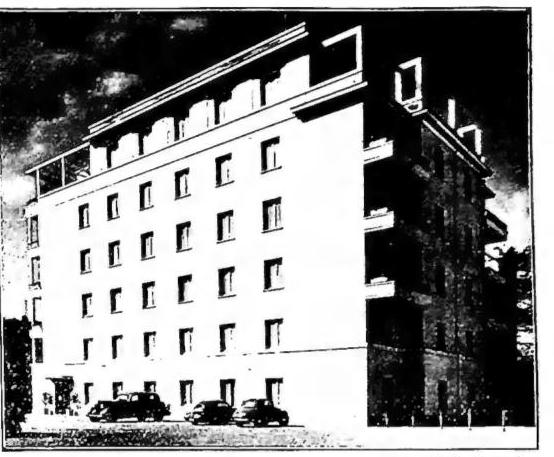
(phot. Vaseri)
UNIONE DONNE DI AZIONE CATTOLICA — The House of the Annunciation—in Rome, where courses of study for leaders and members are held, and where, during their honeymoon, newlyweds belonging to Catholic Action are accommodated—Rome.
became for them a home, a family, a providence, an oasis of serenity, sources of courage, centers of faith, prayer, and expectation for the day of resurgence.
The postwar period, with its aftermath of material and moral hardships and its demands for economic, social, and political stabilization, presented the U. Donne Cattoliche with new problems to study and new activities to undertake. And while the revolutionary forces of Bolshevik socialism pressed threateningly upon Italy, the U. Donne Cattoliche, in parallel with the other male movements of Catholic Action, took its stand in defense of Christian principles in every field. Worthy of mention are: the preparation of women for the exercise of the (administrative) vote; the resumption and resounding victory of the campaign against divorce; collaboration with the Holy See in the International Work for the Assistance of Abandoned Children; the legislative defense of the wives of those missing in the war; the struggle against illiteracy; schools of domestic economy; the study of labor problems, etc.
When, in the immediate postwar period (1919), it became urgent to gather the younger forces for the struggles of the hour and preparation for social life in the new era, it became necessary to organize the young women separately from the more mature women; thus the “Circles of Female Youth” were established (on a diocesan and parish basis) alongside the U. Donne Cattoliche. To these two branches, constituting the Catholic women’s union, was added that of the Women’s Secretariat of the F.U.C.I.
As the years passed, the distinctive character of the U. Donne Cattoliche became increasingly defined: it aimed particularly at the salvation of the family by caring for the inner health of souls (through a more thorough knowledge of religious truth), for external purification so that the social environment would not bring contagion to the family (dealing with public and private morality, abandoned children, juvenile delinquency, the rehabilitation of fallen women, hospitals of every kind, prisons, etc.), and for legitimate claims so that the family might have sufficient means for living and for its normal development (specific activities in the social field).
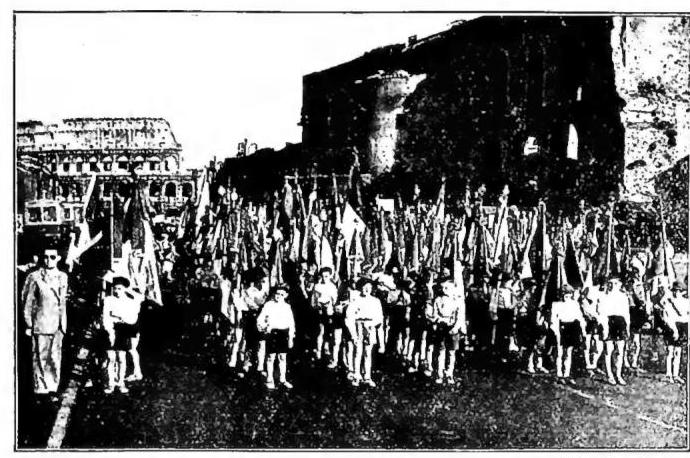
(photo by Giardani)
UNIONE DONNE DI AZIONE CATTOLICA — The children of the Catholic Action Association of Children set out to pay homage to the Altar of the Fatherland during the celebrations for the XXV (1952) — Rome.
The Sales booklets replaced the former Rivista di cultura e attività femminile. These publications were joined by the journal Il Solco and later Donna e Vita, dealing with domestic, educational, and social issues. Meanwhile, the presidency had passed successively to Emma Vallauri Lombardi (1922–23), Angelina Paternò Castello (1923–24), and Maria Rimoldi (1925–1949).