
LOUIS PHILIPPE, Duke of Orléans, King of the French. — Born 6 Oct. 1773 in Paris, died 26 Aug. 1850 at Claremont Castle, county of Surrey (England).
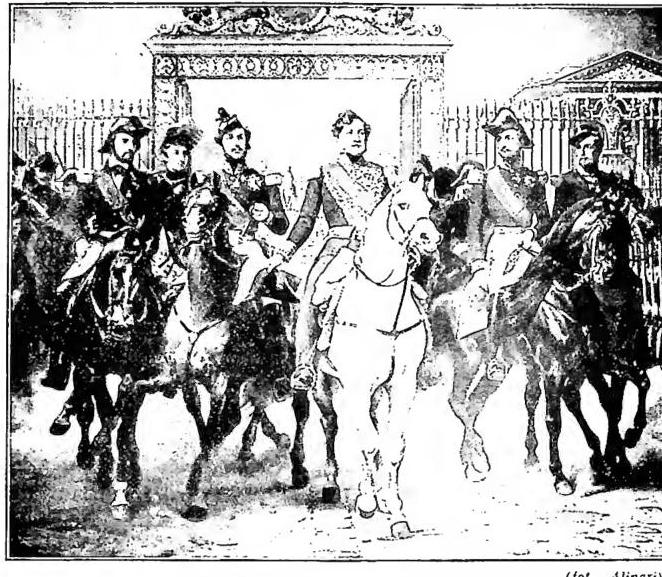
Son of Louis Philippe d’Orléans and Louise Marie Adélaïde de Bourbon-Penthièvre, he bore at birth the title of Duke of Valois. A Jacobin, he fought at Valmy, Jemmapes and Neerwinden in 1792–93. Proscribed, he took refuge in Switzerland, then in America and later in England. In 1809 he went to Palermo to marry Princess Marie Amélie, daughter of Ferdinand IV of Naples, and remained there until 1814, when he returned to France with the restoration of Louis XVIII, with whom he had been reconciled since 1799.
At the death of Louis XVIII, Charles X granted him the title of Royal Highness. After the promulgation of the Four Ordinances by Charles X, which sparked the July Revolution, the Duke of Orléans, with the support of Thiers, became regent on 30 July 1830. On 7 Aug., in a joint session of both Chambers, he was proclaimed King of the French and swore an oath on the new Constitution. The new King immediately faced two opponents, the legitimists and the republicans. To keep them in check he relied on ministries backed by the parliamentary majority, but after the Paris insurrection of June 1832, relying on the army, Louis Philippe increasingly interfered in political affairs and the governance of the country, settling into a form of conservatism aimed at safeguarding the advantages already secured for the bourgeoisie that had brought him to power, shunning any reformist agenda. Thus a rift opened between the legal nation and the real nation, between Parliament and public opinion, which led on 24 Feb. 1848 to the King’s abdication and the proclamation of the Republic.
The foreign policy of France underwent a similar evolution. Initially the monarch supported the national movements in Europe and, during the Italian uprisings of 1831, proclaimed the principle of non-intervention; later, however, after 1840, he drew closer to Austria (though in 1832 he had opposed Austrian armed intervention in the Papal States by occupying Ancona to counter Vienna’s political influence on the peninsula) and adopted in foreign policy the same rigid conservatism that characterised his domestic policy. Too sceptical to persecute, in his dealings with the Church Louis Philippe was in effect a prisoner of the political forces that had elevated him to power, to the point that in the latter part of his reign he was forced, in the school question and toward the Jesuits, to pursue a policy contrary to the Catholic religion and to the Holy See.