
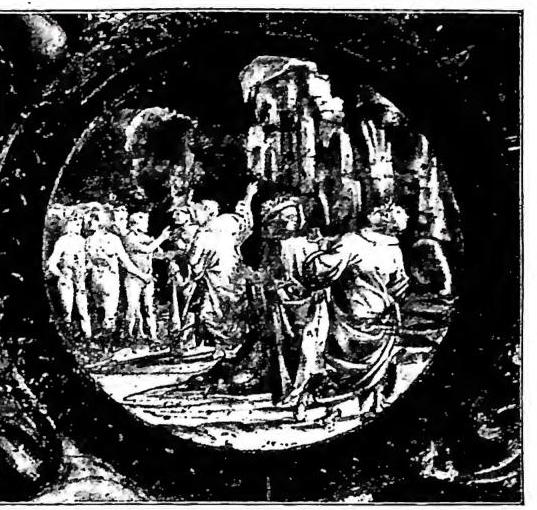
MANFREDI, KING OF SICILY — Dante’s reckless reference to M. in *Purgatory*, fresco by Luca Signorelli (1499–1503) — Orvieto, Duomo, Cappella di S. Brizio.
Manfredi, KING OF SICILY — Dante’s reckless reference to M. in *Purgatory*, fresco by Luca Signorelli (1499–1503) — Orvieto
He married in second nuptials Helena, daughter of Comnenus, despot of Epirus. Upon his father’s death he became prince of Taranto and regent of the Kingdom of Sicily until the arrival of Conrad IV. The latter vainly sought to remove him, for at his death (1254) the nobility clung even more firmly to M. Excommunicated by Innocent IV, who before recognizing Conradin’s rights of succession demanded open submission to the Church and acknowledgment of its claims, M. attempted resistance, then came to terms and was absolved and reinstated in his fiefs (27 Sept. 1254) on condition of accepting the office of papal vicar. Yet, as grave suspicions weighed upon him, he sought to clear himself with the Pope, then fled to the Saracens of Lucera who proclaimed him their lord (2 Nov. 1254). Raising a strong army, he defeated the papal forces. He governed two years in the name of Conradin, his nephew; but when the news of the latter’s death was artfully spread abroad, he assumed the royal title and was crowned at Palermo on 11 Aug. 1258, promising thereafter to hold power for Conradin and his successors.
He founded the city of Manfredonia in Apulia. With shrewd skill he navigated the new political life of Italy, forging alliances within and beyond the peninsula. He fought against Thomas of Savoy and Marquis William of Montferrat; took part in the crusade against Ezzelino da Romano and gave his daughter Constance in marriage to the eldest son of King Peter of Aragon. Seeking to expand his dominion by exploiting Italian discord, he intervened in the struggles between Guelphs and Ghibellines in Tuscany, and the victory at Montaperti (4 Nov. 1260) marked the zenith of his power. Yet as Guelph strength revived in Italy, Urban IV offered the Sicilian crown to Charles of Anjou. When Charles landed in Italy (1265), M. withdrew to Benevento and fell in battle there on 26 Feb. 1266. Buried at the foot of the bridge of Benevento, his body was disinterred because he had died excommunicate and cast beyond the kingdom’s borders along the Garigliano. Dante, while acknowledging his “most grievous sins,” showed great pity for a life so cruelly cut short (Purg., III, 103 ff.). He loved letters, music, and poetry in the manner of the troubadours. Some of his letters survive, two of which are included in the *Miscellanea* of E. Baluze (ed. Mansi, Lucca 1761), and a continuation of Frederick II’s treatise on hunting.