
MARCUS AURELIUS (Marcus Aurelius Antonius), Roman Emperor. — Emperor and philosopher, born in Rome on March 26, 121, died at Vindobona on March 17, 180. Of noble Spanish family, he was orphaned of his father and adopted and welcomed into the home of his grandfather Marcus Annius Verus. He had various teachers (Meditations, I, 1); particular influence on him was exerted by the Stoics (Diognetus, Rusticus), leading him to a strict austerity (ibid., I, 6). The Emperor Hadrian adopted him in 136. In 138 Hadrian designated Antoninus Pius as his successor, imposing upon him the adoption of the nephew, M. A., and L. Commodus; he then assumed the name of M. A. Verus. From 139 to 161 he pursued the cursus honorum, living at court under the effective and honest guidance of Antoninus. With Cornelius Fronto he long attended to rhetorical studies, until the strict Stoic Rusticus and the reading of Epictetus completely won him over. On March 7, 161, Antoninus Pius, dying, indicated him as his sole successor. He associated with himself L. Commodus, who, however, took no interest in government. Thus an immense task fell upon M. A. The Empire was sorely troubled: barbarian assaults, rebellions, plagues, floods, famines, financial difficulties. In 162 the barbarians of the north moved; from 161 to 166 the Parthians engaged considerable military forces; and upon their return they brought the plague, which wrought havoc throughout the Empire. In 166 the barbarians besieged Aquileia. The two Emperors conducted the campaign from 166 to 169, the year in which Commodus died. M. A., having returned to Rome, sold at auction the furnishings of the imperial palace, enrolled slaves and fugitives, and set out again in 170 for the harsh war that lasted until 175, and which is commemorated by the monumental column. To this war belongs the episode of the restorative rain, which pagan writers attributed to Jupiter Pluvius, while Christian writers transmitted it as a true miracle, due to the prayers of the Christian soldiers of the legio fulminata (q.v.).
Meanwhile, the lieutenant Avidius Cassius proclaimed himself emperor in the East; M. A. went there, arrived to suppress the rebellion by the killing of Cassius, pardoned the guilty, and began a journey to reorganize the eastern provinces. Having returned to Rome, he conferred the tribunician power upon his only surviving son, Commodus. In 178 the war recalled him to the north; the plague, which decimated the army, struck him and he died there, designating Commodus as his successor. His ashes were brought to Rome, amid universal mourning.
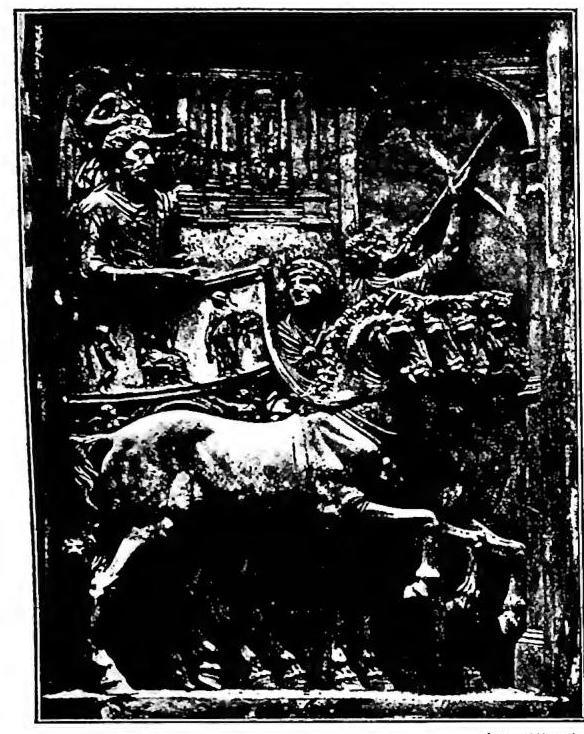
During the nineteen most agitated years of his reign, he attended to great reforms within the State, to works of public welfare, including the piae Faustinianae (from Faustina, wife of the Emperor) for the relief of needy youth. All his legislation is moreover inspired by a sincere Stoic humanitarianism toward the weak and slaves. There remains, incongruous and indelible stain, the persecution of Christians, which his attachment to traditional religion and his Stoic rationalism prevented him from understanding. Recalling them explicitly (Meditations, XI, 3), he mistook their serene and unshakable firmness for theatrical exhibitionism; perhaps indirectly alluding to them (ibid., III, 16), he considered them atheists and immoral. He did not, however, substantially alter the legal prescriptions regarding them. Among the most illustrious victims are the celebrated martyrs of Lyons (q.v.). There were also those condemned to the mines of Sardinia and Corinth (Eusebius, Hist. ecc., IV, 23, 10). The apologies of Justin (150), of Melito of Sardis (172), of Athenagoras (177), presented to the Emperor himself, did not succeed in changing his mind. The radical doctrinal antithesis between Stoicism and Christianity, despite the external consonance of some ethical norms, precluded any understanding and was bloodily fatal to Christians under the philosopher-emperor.
The Meditations (Τὰ εἰς ἑαυτόν = Discourses with Himself) seem to date from the last years of M. A. He, amidst wars and affairs, found time and way to withdraw into philosophical reflection. They are occasional notes, which M. A. elaborates in a most personal form, clothing Stoic theories he professed with profound humanity, desolate melancholy, and vivid religious sentiment. Life, with its anguish and tragedies, poses formidable problems, which demand an inevitable solution to be sought in knowing the essence of things, that is, in metaphysics. Reason frees one from superficial vanities, revealing the real, composed of cause and matter in necessary and rational evolution. In the harmony of the whole, individual dissonances disappear. The present world, and within it each individual, is an aspect and a moment of the universal and eternal order. The universe is animated by a λόγος-πνεῦμα that pervades and vivifies it; this λόγος is divine, it is God. Doubts and hesitations about the gods are frequent, in the alternative hypotheses between a spiritual and rational conception and an atomistic mechanism. The works of the gods are full of providence (Meditations, II, 3). The deity pervades and vivifies the world in an intrinsic union and dwells particularly in man, whose reason is a living part of the universal λόγος. The morality of M. A. is essentially and profoundly rational; insisting on the privileged situation of the mind, it leads to the valorization and exaltation of a markedly interior morality, which demands commitment, seriousness, and firmness. M. A., Roman and emperor, accentuates and develops the social aspects of Stoicism. What is valuable in man is the spirit, participation of the divine λόγος: the soul is mortal in its distinct individuality. The happiness of the sage lies in the continuous and vigilant mastery of self.
The exaltation of the spirit in Stoicism as interpreted by M. A. (as in Stoicism in general) is in reality only apparent, since the spirit is reduced, in its profound essence, to matter. Nor was the supreme ideal of the sage attained, as M. A. himself confesses in a series of unanswered questions (Meditations, XI, 1). The uncritically accepted metaphysics was in the end in contradiction with the ethics he professed, and the frequent accents of pessimistic inspiration are a confirmation of this inner discord. In M. A. is a further voice of the dramatic torment of the classical man suspended between the λόγος ardently sought and invoked and the πάθος lived and suffered.