MESSINA, ARCHDIOCESE OF. - A city in north-eastern Sicily, on the Strait of Messina which links the Mediterranean to the Tyrrhenian Sea. It is the seat of an archbishopric with three suffragan sees (Nicosia, Lipari and Patti). Despite the dismemberment of the archdiocese (19th century), the jurisdiction of its ordinary still extends over a vast territory.
Out of a population of 400,000, it has 399,000 Catholics distributed in 250 parishes, served by 294 diocesan priests and 160 regular clergy, one seminary, 25 male and 98 female religious communities (Ann. Pont., 1951, p. 269).
I. HISTORY
The origins of M. date back to about 755 B.C., when a group of pirates from the Chalcidian colony of Cumae laid the foundations of ancient Zancle, which was later populated by other groups of colonists coming directly from Chalcis and Euboea.The change of name from Zancle to Messene (c. 494 B.C.), confirmed by numismatic evidence, was brought about by the tyrant of Rhegium, Anaxilas. After freeing itself from its subjection after thirty years, M. governed itself (461–405), though it suffered the repercussions of broader political upheavals and internal factional conflicts. Thus, when Athens seized Mylae (Milazzo; 426 B.C.), the city sided with the Athenians, only to switch later (406) to the side of Syracuse when it waged war against Carthage; it then suffered the terrible Punic vengeance that razed it to the ground in 396 B.C. After the death of Dionysius of Syracuse (354 B.C.), the anti-Syracusan reaction led by Hippon, which aligned with Mamercus of Catania, was harshly punished, and the city had to submit to the hegemony of Timoleon first and then Agathocles. Only after the death of the latter (289 B.C.) did the state of anarchy into which the city had fallen provide Rome with the pretext to intervene. It was captured and held permanently in 263 B.C., but obtained the status of a civitas foederata.
Thanks to its strategic position, M. became the most important naval base of the Romans during the First Punic War, and after their final victory (241 B.C.) it received from Rome a privileged position that enabled it to
achieve an unusual material prosperity. In the administrative reorganization that followed Augustus’ triumph, while the rest of Sicily was divided into coloniae and municipia, M. had the unique privilege of being counted among the oppida civium Romanorum (Pliny, Hist. nat., III, 88).
After the fall of the Empire, it underwent the vicissitudes common to all of Sicily. Under the Goths, it had a military garrison and a comes civitatis (Cassiodorus, Variae, VIII, 26, 27); it was captured by Belisarius in 547 and suffered the siege of Totila two years later (Procopius, De bello Gotico, III, 30, 39).
The Byzantines, however, managed to hold it, and their dominion over the city and the rest of the island lasted until the Muslim conquest (10th century).
The Christian origins of M., and especially of its hierarchy, are obscure. The passage of St. Felix, bishop of Tibiuca (BHL, 2894–95), through M. is a late interpolation in the saint’s Passio. Nor is the Passio of SS. Peter and Paul by the Pseudo-Marcellus (BHL, 6657–62) reliable; according to this work, St. Paul, on his journey from Syracuse to Rome,
would have ordained the first bishop of M., named Bacchilus. For this reason, Pirri (V. BIBLICA., p. 316) rightly noted that no bishop of M. is known before Eucarpius, who attended the Roman Synod held by Pope Symmachus in 502 (Mansi, VIII, p. 252), while another Eucarpius (558–69) was entrusted by Pope Pelagius with the visitation of Catania, which lacked its own bishop (Jaffé-Wattenbach, 977, 982). Later, Gregory the Great’s Register reveals the existence of Felix (591–93) and Donus (595–603; Jaffé-Wattenbach, 1108, 1133, 1150, 1238, 1388, 1419, etc.). It is not, however, unfounded to suppose that M. already had a formed Christian community by the mid-3rd century.
Legend attributed to the Gothic period the martyrdom of Placidus, a disciple of St. Benedict, a fabrication by the forger Peter the Deacon (cf. E. Caspar, Petrus Diaconus und die Monte Cassiner Fälschungen, Berlin 1909, pp. 47–72), who conflated him with the homonymous martyr mentioned in the Martyrologium Hieronymianum (Martyr. Hieron., p. 451), which is at least a century older.
After falling into the hands of the Normans (1060), it became the starting point for the conquest of Sicily. Having been almost depopulated upon the arrival of the new conquerors (Amatus of Montecassino, Storia dei Normanni, V, 10), a century later it was an international emporium with a large population of about 70,000 inhabitants (cf. G. Pardi, Storia demografica di M., in Nuova rivista storica, 5 [1921], pp. 31–37), predominantly Greek (U. Falcando, Liber de regno Siciliae, ed. G. B. Siracusa, Rome 1879, pp. 144, 148). The policy of Latinization pursued by the Normans soon led to the establishment of Latin bishops in M., such as Robert (1096), the first bishop, followed by William (c. 1123) and Hugh (1130). The diocese, established in 1096 by transferring the see from Troia, was declared immediately subject to the Holy See and later made a metropolitan see by Alexander III (1166).
After the end of the Norman dynasty, relations between the city and the Swabians were not cordial. M. rebelled in 1232, but the uprising was bloodily suppressed.
(photo: Angeli, Terni)
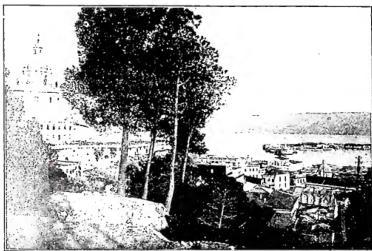
MESSINA - Panorama.
Messina experienced a turbulent political history that left its mark on the religious life of the diocese. During the conflict between Frederick II and Gregory IX, there were complaints about the interference of secular power in ecclesiastical administration and the vacancies in local church governance. A similar situation arose during the prolonged struggle between the Angevins and the Aragonese. Archbishop Francesco Fontana, elected in 1288 to succeed Rinaldo da Lentini (1272–85), was unable to reach his see due to the war, leaving the diocese vacant until 1304, when Benedict XI appointed Guidotto de Tabiatis (1304–33) as his chaplain. The war also caused material damage to many monasteries, which fell into ruin and were abandoned by their occupants, as Nicholas IV noted in 1290. There was also a rapid decline in the Greek rite and clergy, which had still been numerous at the end of the 13th century. After the Sicilian–Angevin war ended, further difficulties arose from the Great Western Schism; King Martin I sought to remain neutral, but the bishops of Messina (Maggiolo Lampugnano: 1382–92; Filippo Crispo: 1392–1426) remained loyal to Urban VI and his immediate successors.
The first proposal to divide the archdiocese was made to the Sicilian Parliament in 1799. Initial opposition was overcome by Pius VII in 1817, when he erected the new diocese of Nicosia, assigning it a third of Messina’s territory. A second division occurred in 1824, when 24 inhabited centers were transferred to the diocese of Patti.
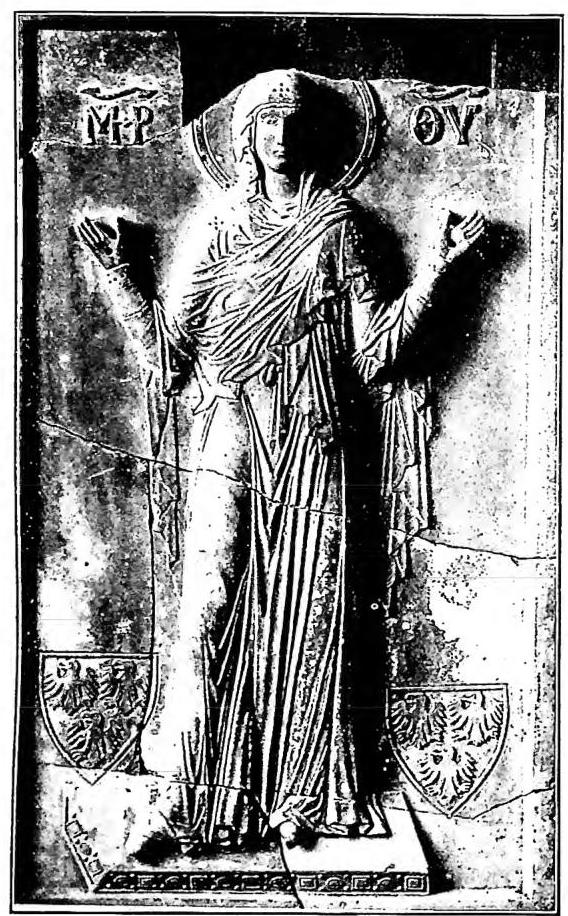
MESSINA - Madonna orante. Relief of Byzantine type (13th century). Messina, Museum, from the church of S. Filippo Neri.
In the last two centuries tragic events have severely tested the city and territory of M. The earthquake of 1783 destroyed, besides numerous public buildings, many ancient churches, including the old cathedral of S. Nicolò. The artistic heritage was further reduced by the earthquake of 1908, which levelled the city. The ruins, repaired by thirty years of restoration work, were again heaped up by the aerial bombardment of 1943, which destroyed the Cathedral. Yet reconstruction work is now in full swing.
II. CULTURAL INSTITUTIONS
From the beginning of the 15th century, Messina was home to grammar schools entrusted to the court master Bono de Mariscalco, who taught in the old church of SS. Peter and Paul of the Pisans, which fell into ruin in 1783.Later, the Calabrian abbot Filippo Ruffo, a professor of Greek for many years, was active in Messina. Around 1460, the city was distinguished by the teaching of Constantine Lascaris.
Already in the time of Alfonso the Magnanimous, the city had officially requested the establishment of a Studium generale (1439), which was only implemented a century later by the Jesuits, invited to Messina by the viceroy G. de Vega (1548). With the foundation of the university and the introduction of free tuition by the latter, the fortunes of public education changed significantly. In 1596, the university passed under the direct jurisdiction of the city senate and continued until 1676, when it was abolished as a penalty for the revolt; it was restored by Ferdinand II (1838).
Various academies were founded during the 17th and 18th centuries; among them may be mentioned that of the Abbarbicati (1636), the Fucina (1639), the Morale for the study of moral theology (1700), the Ecclesiastica (1764), founded by Archbishop Di Blasi, and the Peloritana (1729), which, through reforms and transformations, has continued to the present day.
Libraries: renowned for its collections of Greek manuscripts was the library of the Basilians, founded by the archimandrite Luca during the Norman kings’ reign, dispersed in the 17th century. Today, only about 300 codices remain at the university library. The origins of the latter are linked to the bequest of Giacomo Longo (1728), later enriched by the library of the suppressed Jesuit College.
III. CELEBRATED MEN
Only a few are mentioned: the archimandrite LUCA, reformer of Basilian discipline in the time of Roger II; the Carmelite St ALBERT (d. 1306 or 1307); the very popular figure of the B. EUSTORCHIO (1437–91), Clarisse nun, foundress of the monastery of S. Maria di Montevergine. Among the scientists: GIOVANNI GATTO, Dominican, theologian and mathematician (d. 1484); FRANCESCO MAUROLICO (1474–1575), celebrated mathematician; the humanists STEFANO TUCCIO (d. 1596), Jesuit, and G. A. VIPERANO, who ended as bishop of Giovinazzo (d. 1610); scholars and historians such as ANTONINO AMICO (v.) and the Jesuit PLACIDO SAMPERI (1589–1655); Fr SAVERIO BASILE, who drew up the urban plans for M. after the earthquake of 1783; the Cassinese Benedictine B. D. BALSAMO (1759–1844), superintendent of Public Instruction in the Kingdom of Sicily and later archbishop of Monreale.IV. ABBEYS AND MONASTERIES
First in chronological order are the Basilian monasteries, which have a separate history linked to the fortunes of the Greek rite in the territory of M. (v. BASILIANE). Of the Benedictine foundations, particular mention should be made of the priory of S. Maria Maddalena di Valle Giosafat and that of S. Maria de Latinis, as well as the women’s abbey of S. Maria de Scalis and de Alto. In 1193 the Cistercians arrived with the foundation of S. Maria di Roccamadore; the Franciscans in 1231; the Dominicans in 1255; the Carmelites around 1235. Later came also the Minims of St Francis of Paola (1507), the Capuchins (1540), and the Jesuits (1548).V. MONUMENTI
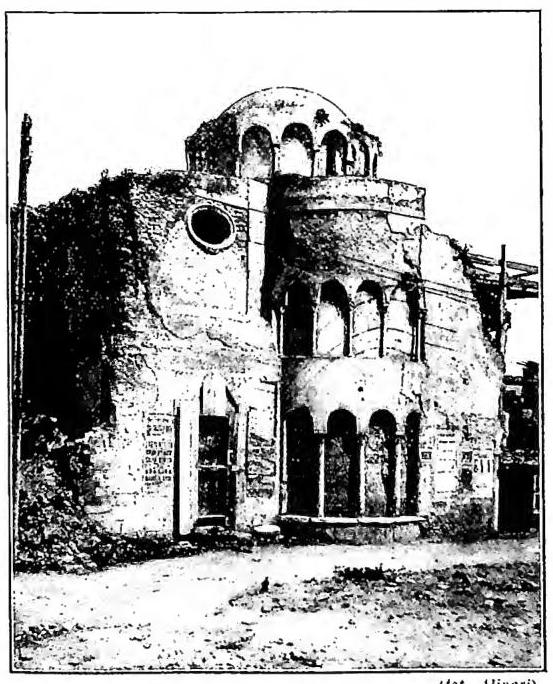
La cattedrale di M. è tornata ad imporsi come uno dei maggiori e più importanti monumenti di Sicilia. È costruzione dell'alto medioevo ed ebbe la sua forma organica attuale nel 1092. Sotto gli Aragonesi fu ulteriormente arricchita con musici (abside e pavimento) e la decorazione marmorea della facciata di gusto trecentesco. Ripetutamente offesa dai terremoti del 1638 e 1783, fu quasi rusa al suolo nel 1908, e quando ancora una volta era risorta dalle sue rovine, ebbe a subire i gravissimi danni arrecati dai bombardamenti nel 1943, che incenerirono i musici absidali del sec. XIV. Degni di nota le sculture della facciata, del Quattrocento e Cinquecento, e l'ornatissimo portale ispirato a forme gotiche d'Oltralpe. Altro monumento normanno (seconda metà del sec. XII) è l'Annunziata dei Catalani, la cui decorazione richiama caratteristiche proprie di chiese pugliesi e toscane coeve. Sono invece del periodo svevo le chiese di S. Maria l'Alemanna (perché passata all'Ordine teutonico con l'annesso ospedale), di S. Francesco e di S. Maria della Scala (Badiazza), quest'ultima fuori M. La prima, per quanto mutila, scomposta e rifatta in seguito, resta l'unica chiesa di Sicilia del Duecento, dagli elementi completamente gotici; l'altra di S. Francesco, nonostante i non pochi rifacimenti, presenta le sue inconfondibili caratteristiche all'interno, nettamente gotico-provenzali; all'esterno in molti particolari accusa la filiazione dal normanno Duomo cittadino. I ruderi di S. Maria della Scala invece accennano uno stile di transizione dal bizantino al romanico. Fuori M. si trovano: la chiesa del Salvatore di Rometta, monumento capitale per lo studio dell'arte prenormanna, eretto tra il sec. IX e il X. In esso la critica odierna vede l'estrema evoluzione dell'arte romana della decadenza, anziché un monumento bizantino. Di non minore interesse le vecchie chiese basiliane di S. Maria di Mili, S. Pietro d'Italia, SS. Pietro e Paolo d'Agrò, tutte di epoca normanna, e l'ultima, opera diGirardo Franco (1172). Il loro orientamento stilistico, per le sue origini, si ricollega all'arte bizantina, ma secondo forme già invalse nella Calabria. - Vedi tavv. LVI-LVII.
Patmo (Studi e testi, 68). Città del Vaticano 1938, passim. Per la vita delle accademie: M. Maylender, Storia delle accad. d'Italia, 5 voll., Bologna 1926-30, V. indice. Per l'arte: S. Bottari, Il duomo di M., Messina 1929; id., La genesi dell'archit. siciliana del periodo normanno, in Arch. stor. sicil., 28 (1932), p. 316 sgg.; id., Chiese basiliane della Sicilia e della Calabria, Messina 1939. Cf. pure: C. Autore, La chiesa bizantina del S. Salvatore in Rometta, in Arch. stor. messinese, nuova serie, 1 (1934), p. 54 sgg.; E. Calandra, Breve storia dell'arch. in Sicilia, Bari 1938, pp. 27, 30-44, 49-54. Mario Scaduto