
MISSION, PREROGATIVES, POWERS OF THE APOSTLES. — The election and immediate mission by Jesus constitutes the primary and fundamental requirement for the qualification of an apostle. This is clearly demonstrated by many texts of Holy Scripture: thus in Mk. 3:13-14 it is said that Jesus “went up into a mountain, and called to him whom he would... and he made that twelve, to be with him, and to be sent to preach”; in Jn. 17:18, the Lord, addressing the Father, says: “As thou hast sent me into the world, so have I also sent them into the world”; and again in Jn. 20:21, where Jesus says to the apostles: “As the Father hath sent me, I also send you.”
It is debated, however, whether beyond this immediate mission other conditions are required for apostleship; and in particular whether it is necessary that an apostle “have seen the Lord.” This requirement seems to be implied by the text of Mk. 3:13-14 already cited: “he made that twelve, to be with him”; it moreover appears to be presupposed by St. Peter, when, in the matter of choosing a successor for Judas, he suggested that he be chosen from among those “who have been in our company all the time that the Lord Jesus came in and went out among us, beginning from the baptism of John, until the day wherein he was taken up from us, one of these must be made witness with us of his resurrection” (Acts 1:21-22); this requirement is precisely what St. Paul seems to allude to when he writes: “Am I not an apostle? Have I not seen Christ Jesus our Lord?” (1 Cor. 9:1).
Despite this debate, however, many authors hold that election and immediate mission constitute not only the fundamental but also the sole requirement for apostleship. They therefore claim this requirement for Matthias (Acts 1:25-26), for Paul (Acts 9:15; 22:15), and for Barnabas (Acts 13:2-4).
The mission of the apostles is directed to a twofold office: one extraordinary, which was to cease with the apostles themselves, and which consists in continuing Jesus’ work of laying, according to the divine plan, the foundations of the Church upon the one cornerstone, Christ Jesus; the other ordinary, which was to be transmitted to the successors of the apostles, and which consists in being the hierarchical authority in the already founded Church.
The mission of the founders of the Church is illustrated, among other texts of Holy Scripture, by the following: Mt. 16:18: “Thou art Peter, and upon this rock I will build my church”; Eph. 2:20: “You are... built upon the foundation of the... apostles and prophets, Jesus Christ himself being the chief corner stone”; Rev. 21:14, where the apostle John, describing the “new Jerusalem,” says: “The wall of the city had twelve foundations, and in them the twelve names of the twelve apostles of the Lamb.”
The function of hierarchical authority in the Church, on the other hand, is indicated in the words addressed by Jesus to the apostles: “Whatsoever you shall bind upon earth, shall be bound also in heaven; and whatsoever you shall loose on earth, shall be loosed also in heaven” (Mt. 18:18); this function is further indicated in the words that Jesus spoke to Peter, and, in union and under the dependence of Peter, to all the apostles, namely, to feed his lambs and his sheep (Jn. 21:15-17).
Connected with the office of founders of the Church are the prerogatives of the apostles, that is, those extraordinary gifts with which the Lord personally wished to enrich the apostles so that they might be capable of fulfilling the great mission entrusted to them. In the common opinion of theologians, these prerogatives are: confirmation in grace, by which, after the descent of the Holy Spirit, the apostles could in practice no longer commit any grave sin, nor any fully deliberate venial sin; personal infallibility, by which, in their preaching and teaching, each apostle was immune from error both regarding doctrine to be believed and regarding the norms of moral life to be followed; universal jurisdiction with fullness of power, by which each apostle, without prejudice to the primacy of Peter, could everywhere found churches, create bishops, and organize with full authority the religious life. Whether the charism of biblical inspiration is to be considered a prerogative of the apostles is uncertain: some affirm it, e.g., U. Ubaldi, P. Schanz, J. M. Lagrange; most deny it, such as I. B. Franzelin, F. Leitner, A. Dorsch, H. Hurter, C. Pesch, G. M. Perrella.
The powers of the apostles are related to the ordinary office of hierarchical authority in the Church, that is, those faculties which they received as shepherds of the faithful and which they transmitted to the bishops whom they ordained. They pertain to the power: to teach (Mt. 28:18, 20); to govern (Mt. 18:17-18); to sanctify, especially through the administration of the sacraments (Mt. 28:19; Lk. 22:19; Jn. 20:21-23).
How the apostles fulfilled the mission to which they were destined, using their prerogatives and exercising the powers given them by the Lord, is shown both by the Acts, the Epistles, and the history of the early Church.
For the apostles and the deposit of Revelation, V. DOGMA, EVOLUTION OF
Francesco Carpino
THE APOSTLES IN POPULAR LITERATURE. — In the tradition of the common people there still circulates a series of brief legends, in prose and in an unfixed form, which have grown up around the figures of the apostles, presented, as a rule, as an indistinct group accompanying the Divine Master. Some pertain particularly to the apostle Peter and even to the mother of St. Peter. In this kind of fragmentary popular gospel, transmitted orally, the various characters are at times completely distorted, and the episodes take on an almost fairy-tale character. Even elements of rough and naive comedy are introduced. The figure of one or another apostle also appears in brief lyric-narrative songs, which develop legendary motifs around the Holy Family.
Paolo Toschi
THE APOSTLES IN ICONOGRAPHY. — Their representation is one of the favorite themes already of Paleo-Christian art, not only as insignificant accessories of the deeds of Jesus, but also as actors and principal figures. In this case they appear either individually or in groups. We refer elsewhere to the depiction of individual apostles.
The apostles are represented collegially often from the beginning of the 4th century onward. Jesus is always among them, sometimes in symbol (cross, lamb), ordinarily in reality, either on a throne or on the sacred mountain, in the act of instructing them or sending them to evangelize the world (traditio legis, traditio clavium), or in the solemn gesture of the Maiestas. For this reason they are found indifferently all seated in a circle (catacomb art), or standing in a line (fronts of sarcophagi) and they are accustomed to hold a scroll in their hands. More rare are extraordinary arrangements due to the nature of the field, e.g., the apostles arranged in a circle around the bust of Jesus (on the background of a glass), or the symbolic depiction by means of twelve lambs, doves, and even twelve stars, sometimes joined with the actual representation of the persons. A notable singularity is provided by the paintings of the Hypogeum of the Aureli (Rome), both because of the age notably prior to the 4th century and because the apostles are represented there without Jesus, both as a group and as individuals.
The apostles, like the other biblical figures, are all presented in tunic and pallium, almost always beardless, without any distinctive physiognomic elements, except for Peter and Paul, the two leaders, who from the 4th century onward—and not long after Andrew—are depicted with disheveled hair. When it was desired to distinguish them, their names were simply written next to each figure. It then appears that in the group of twelve, Paul is often placed in the position of Matthias; however, sometimes they also include the two evangelists Mark and Luke, who replace Thaddeus and one James. This list, already found on a sarcophagus in Arles and later in the Mausoleum of Theodoric in Ravenna, became stereotyped in medieval Greek art, while in the West the other list was used, namely that of the *Communicantes* in the Canon of the Mass.
As the Middle Ages progressed, the ancient themes already mentioned were joined by those of the Ascension, Pentecost, the Last Supper, the *Dormitio Virginis*, and later the Last Judgment and the separation of the apostles or division of the world, and these remained the familiar themes in Renaissance art as well. Entirely singular and widely used beyond the Alps is the representation of the twelve articles of the Creed by means of the twelve apostles, often paired with the twelve prophets. The preferred settings for the Apostolic College are arched or concave spaces, such as apses and domes; in particular, the great portals of Romanesque and Gothic churches.
During the Middle Ages, the personal characteristics of each of the twelve were also slowly formed (under the influence of the apocryphal Acts), so that by the 10th century in the East and the 14th in the West, each is now recognizable in the series. The main difference lies in the youthful figure that the West gives to the apostle John, while the East sees in him the Great Old Man of the Apocalypse.
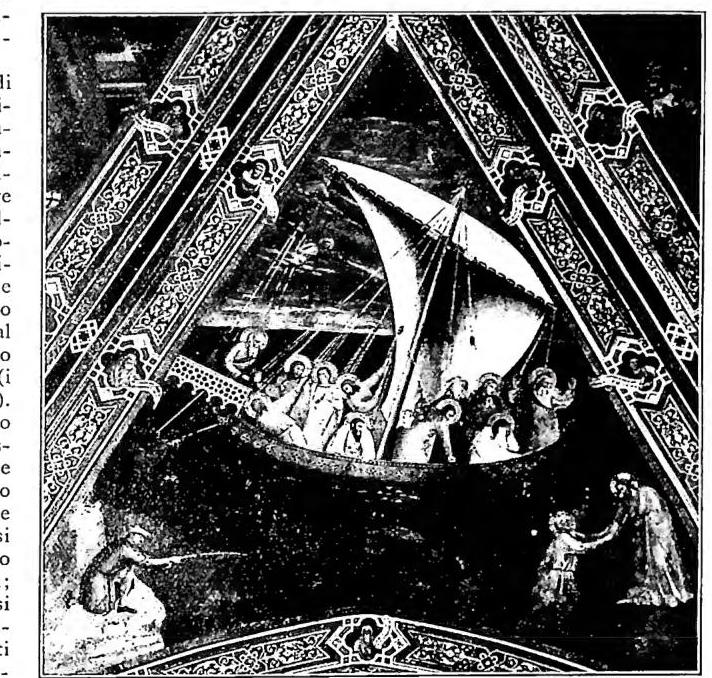
**Apostoli** – The boat of St. Peter saved from the storm. Fresco by Andrea Bonaiuti (14th century).
Kraus, *Real-Encykl. der christlichen Altertümer*, I, Freiburg in Br. 1882, pp. 64-68; J. Ficker, *Die Darstellung der Apostel in der altchristlichen Kunst*, Leipzig 1887; T. E. Weis-Liebersdorf, *Christus- und Apostelbilder*, Freiburg in Br. 1922; G. de Jerphanion, *Quels sont les douze apôtres dans l'iconographie chrétienne*, in *Recherches de science religieuse*, 10 (1920), pp. 358-67; K. Künstle, *Ikonographie der Heiligen*, Freiburg in Br. 1926, pp. 93-102; L. Bréhier, *L'art chrétien. Son développement iconographique*, 2nd ed., Paris 1928, passim; H. Hermann, *Jünger u. Apostel* (*Der Bilderkreis*, 12), Freiburg in Br., n.d.; Antonio Ferrua
**LETTER OF THE APOSTLES** – An apocryphal work whose title and extent are uncertain. The name *Epistola Apostolorum*—probably attested by the Latin translation—applies only to the first twelve chapters. They recount dialogues of the risen Jesus with his disciples.
As for its extent, the Ethiopic text is longer than the Coptic, and in the Latin translation chapter 17 follows chapter 13. In the text published by C. Schmidt there is certainly a lacuna between chapters 14 and 15 (cf. H. Lietzmann, in *Zeitschrift für neutestamentliche Wissenschaft*, 20 [1921], p. 175). The long Ethiopic text exists only in 18th-century manuscripts and is preceded by an *Apocalypse of Jesus* and the first two books of the *Testamentum Domini*, a Syriac compilation by L. Guerrier dating to around AD 400 (cod. Vindob. 16, once thought to be 5th century [cf. *Sitzungsberichte d. Wiener Akademie*, CLIX, 7], according to E. Hauler [*Wiener Studien*, 30 (1908), pp. 308 ff.] is from the 6th century), and are transmitted together with the *Apocalypse of Thomas*.
The first part (the *Epistle*) contains in chapter 2 an interesting list of the names of the apostles (cf. K. Lake, in *Harvard Theological Review*, 14 [1925], p. 95), in chapter 4 a quotation from the apocryphal *Gospel of Thomas* (or *Ps.-Matthew*, cf. C. Schmidt, pp. 226 ff.), mentions in chapter 7 Cerinthus and Simon Magus, though without clear references to their heresies; chapters 9 and following contain an apocryphal account of Christ’s resurrection (cf. A. Harnack, in *Theologische Studien für Bernhard Weiss*, Göttingen 1897, pp. 5 ff.; A. Baumstark, *Hippolytos und die ausserkanonische Evangelienquelle des äthiopischen Galiläa-Testaments*, in *Zeitschrift für neutestamentliche Wissenschaft*, 15 [1914], pp. 332-35). Chapter 11 probably contains a quotation from the *Gospel of the Hebrews*.
In the second part, chapter 13 recounts the descent of Christ from heaven in the form of an angel. During his stay on earth, the archangels serve in his place at the altar of the Father. The theme of Christ’s assimilation to angels is of Gnostic origin (cf. Jos. Barbel, *Christos Angelos*, Bonn 1941, pp. 236 ff.), but it was introduced into Church theology by Origen. It was Christ who, according to chapter 14, appeared to Mary in the form of Gabriel. Chapter 15 recounts