
### MITHRA and MITHRAISM
**I. MITHRA.** — Mithra is an Indo-Iranian deity invoked as the protector of contracts, according to the meaning of his name. In Vedic hymns, he is associated with Varuna, the sky god, and in the Avesta, he appears as a companion of Ahura Mazda, of whom he is the eye. Mithra is a god of light who grants fertility to the world and aids his followers in their struggle against the principle of evil.
After the conquest of Babylonia, astronomical and astrological theories, along with speculations about the planets and the zodiac, penetrated Mithraism, and Mithra, originally a god of light, became a solar deity and was identified with Samaš.
Mithra entered Rome in 67 BC with the prisoners from Cilicia, captured by Pompey (Plutarch, *Life of Pompey*, 24). His worship spread further under the Flavians and even more under the Antonines and the Severans. With Aurelian, the cult of the Sun became official in the Empire and merged with that of Mithra. Frequent inscriptions from this period include expressions such as *Sol invictus Mithras*, *deus invictus Mithras et Sol socius*; the emperor Diocletian, in the dedicatory inscription of Carnuntum, even refers to him as *fautor imperii sui* (CIL, III, 4413), and even *Mithras invictus Deus sol omnipotens* (Notizie degli Scavi, 1909, p. 84). In the Mithraeum beneath the Barberini garden, there are three scenes of Mithra with Helios, while in the Mithraeum under S. Prisca, he is depicted at a banquet. Traces of his cult are found especially in maritime cities, along trade routes, major rivers, and places where Roman garrisons were stationed, as the most active propagators of his cult were slaves and soldiers, often of Eastern origin.
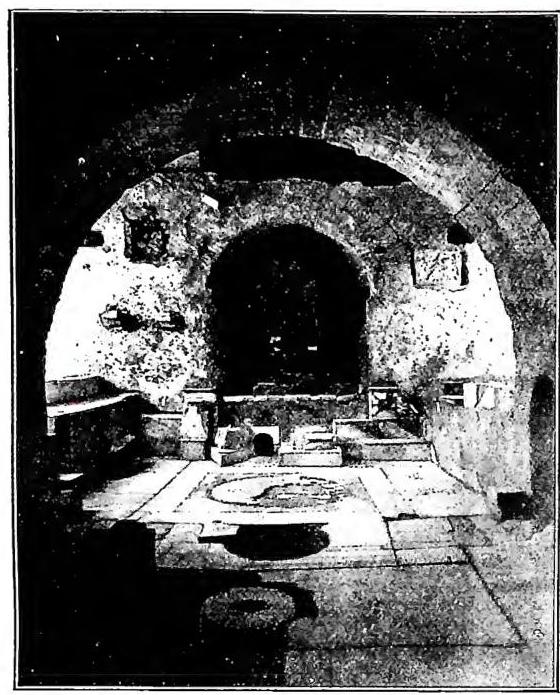
Mithraea in Rome were located beneath the Capitoline Hill, near S. Clemente, under the Baths of Antoninus, beneath the Palazzo dei Musei (formerly Pantanella), near S. Maria in Cosmedin, under S. Prisca, and under the Barberini garden at the Quattro Fontane, among other places. In Italy, the most notable Mithraeum is the one discovered at S. Maria di Capua Vetere, featuring a fresco of Mithra’s sacrifice (A. Minto, *Scoperta di una cripta mitriaca a S. Maria di Capua Vetere*, in *Notizie degli Scavi*, 1924, pp. 523 ff.). Mithraea are also found in the Danubian provinces, Germany, and Gaul; less frequently in Spain, Britain, and Pannonia. Greece shows no traces of the cult except in Patras, though it spread to Dacia, Moesia, Cilicia, Cappadocia, Pontus, Armenia, and as far as Dura Europos in Mesopotamia.
**II. DOCTRINE.** — Mithraic reliefs depict the story of Mithra, which can be reconstructed in its main lines as follows. Mithra is born from a rock, clothed in the leaves of a tree. A flood follows, then drought, but Mithra saves humanity by causing water to gush from a stone. He is ordered to hunt a bull, which first eludes him but is later captured and dragged by its legs into a cave (*transitus*), where Mithra slays it with a knife (*tauroctony*). From the bull’s blood, wheat sprouts; from its seed, plants and animals emerge, a process hindered in vain by the scorpion’s bite. This is followed by a pact between Mithra and the Sun; the two sit together at a banquet, then ascend together in the solar chariot to the heavens.
**IV. THE MYSTERY.** — Mithraic initiation was secret and preceded by an oath not to reveal the ritual’s secrets. The frescoes in the sanctuary of Capua (A. Minto, in *Not. Scavi*, 1924, p. 523) depict the initiate with blindfolded eyes and wrists bound by cords, which are cut by the mystagogue acting as a "liberator" (Pseudo-Augustine, *Quaest. Vet. et Novi Test.*: PL 34, 2214).
Once admitted as a member of the Mithraic community, the initiate could ascend the seven degrees of the hierarchy: Raven (*corax*), Bridegroom (*nymphus*), Soldier (*miles*), Lion (*leo*), Persian (*perses*), Sun-runner (*heliodromus*), and Father (*pater*). The various Mithraic degrees, listed in hierarchical order by St. Jerome in his letter to Laeta (*Ep. 107, 2* in CSEL, 55, 292), are depicted in the Mithraeum discovered beneath the basilica of S. Prisca in Rome, where initiates wearing these grades are shown under the protection of a planet (A. Ferrara, *Il mitreo sotto la chiesa di S. Prisca*, in *Bull. della commiss. archeol. comunale*, 68 [1940], pp. 59–96). Some of these grades belong to the category of servers (*ὑπερηχοῦντες*), while others are participants (*μετέχοντες*). Preparatory grades are also mentioned in the graffiti of Dura Europos. The head of the Mithraic sanctuary is called *pater patrum*.
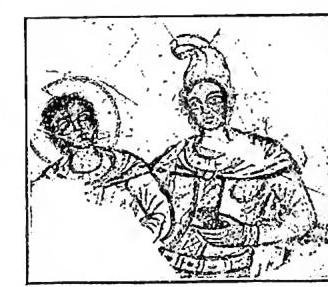
**V. CULT.** — Mithraea are underground structures designed to resemble a cave (*spelaeum*, *antrum*), symbolizing the heavens. They feature a central space flanked by two platforms where initiates are seated. At the sanctuary’s rear is the scene of the *tauroctony* and the altar. The various depictions of the god serve as examples for the faithful. Ritual meals (*agape*) included meat and wine, accompanied by sacred formulas. On either side of the *tauroctonous* Mithra stand two torchbearers, one holding his torch aloft, the other inverted. Together with Mithra, they symbolize the sun at dawn, noon, and dusk in the daily cycle, and at spring, summer, and autumn in the annual cycle. The sacred hymns sung during these solar phases have been lost. The birth of the god (*Natalis Invicti*) was celebrated on December 25. Excavations at Dieburg, Neuheim, and Dura Europos have yielded depictions of the solar Mithra hunting on horseback.
**VI. MITHRAISM AND CHRISTIANITY.** — Christian apologists attacked Mithraism as their principal enemy, viewing its ritual as a diabolical imitation of Christianity (Tertullian, *De praescr. haer.*, 40), not only because of its lustrations (which recalled Baptism), its doctrines, its belief in the resurrection of the dead, and the final judgment presided over by Mithra as savior, but especially because of its ritual banquet. After the official recognition of Christianity in the 4th century, the struggle between the two religions was definitively decided in favor of Christianity. With Theodosius’ victory over Eugenius in 394, the cult was suppressed in Rome, though it persisted longer in the provinces, particularly in the East. — *See* pl. LXXVII.
**
Fr. Cumont, *Textes et monuments relatifs aux mystères de Mithra*, 2 vols., Brussels 1896–1900; id., *Les mystères de Mithra*, 2nd ed., 1913;
J. Hertel, *Die Sonne und Mithra im Avesta, Auf Grund der awestischen Feuerlehre dargestellt*, Leipzig 1927;
J. Leipoldt, *Die Religion des Mithra*, Leipzig 1930;
Fr. Saxl, *Mithras. Typengeschichtliche Untersuchungen*, Berlin 1931;
J. Bidez – Fr. Cumont, *Les mages hellénisés*, 2 vols., Paris 1938;
M. J. Vermaseren, *De Mithrasdienst in Rome*, Nijmegen 1951.
---
### II. CLASSIFICATION OF MYTHS
The vast corpus of myths can, with regard to their content, be divided into three broad categories: naturalistic myths, historical myths, and etiologic myths.
1. Naturalistic myths: these are the broadest and most complex because they not only seek to account for the various phenomena of nature—astronomical, meteorological, agricultural—but also to explain the origin of the gods (theogony), of men (anthropogony), and of the world (cosmogony). Examples will be given in the individual chapters. The modern German mythological school, founded in Berlin in 1906 (Gesellschaft für vergleichende Mythenforschung), places mythology at the center of all mythological development, maintaining that from the initial observation of the sky, and especially of the phenomena of the sun and moon, all the various mythical complexes arose. This theory, which has merit in grouping and studying this category of myths in depth and in allowing the historical-cultural school of Graebner and Schmidt to make appropriate applications to cultural cycles by reconstructing solarism among the great hunting peoples (totemists) and lunarism among agriculturalists (matriarchal), has the defect, however, of ignoring history in that it claims that a myth should be studied without reference to the cultural or natural environment in which it arose; of failing to take into account that in primitive groupings agricultural myths are more important than astral ones; and of limiting the natural process of personifying perception, which is proper to human thought, solely to the world of the stars.
2. Historical myths. The tradition of the various human groups in natural religions: a) ties its own origins as a group and the fundamental institutions that regulate its life to a mythical figure; e.g., Romulus in Rome, Osiris in Egypt, etc.; b) considers the migrations of ethnic groups narrated by myth as adventures of divine personages; thus the myth of the Thessalian nymph Cyrene, abducted by Apollo and transported to Libya, signifies the colonization of Cyrene by the Minyan population of Thessaly, at the behest of the Delphic oracle of Apollo; c) depicts historical relations or overlappings of peoples or cults as alliances of gods; thus the alliance of Apollo and Dionysus at Delphi, etc. The philologist Ch. O. Muller (d. 1840) is to be credited with the scientific study of myth in relation to history. He observed that ancient myths have come down to us through various elaborations: of poets who sang them, of scholars who catalogued them, of historians who pruned them, of philosophers who allegorized them. It is therefore necessary to strip them of all this varied superfluity in order to find at the root of the myth either a historical fact or a cultural datum, whence the need to study cults to explain the origin of so many myths.
3. Etiological or explanatory myths (from the Greek ἀλτήκαισα). In truth every myth is etiological insofar as it explains something, but with this epithet are meant especially those myths directed to explaining the cause of a rite, the reason for a representation or a name. The modern school of functional ethnology sponsored by B. Malinowski tends to deny the etiological point of view because for the primitive the myth is not merely a narration but a lived reality insofar as it functions in relation to his present activity. But this active value of the myth confirms the legitimacy of the etiological point of view because if it did not have this active value and the production of the myth were not a service of the religious-social life of the group, it would sink to the level of a fable.
The same may be said of the approach given by the mythologist K. Kerényi to the study of mythology based on the examination of mythologoumena, i.e., myths considered in their totality and development; thus, for example, Prometheus would be the mythologoumenon of the masculine origins of life. According to this approach, myths have a primordial nucleus, a monad, expressing what is “generally human.” This monad, however, does not reveal itself in such an immediate primordial form that unites the fundamental data of mythologies always relating to the origins of both the cosmos and man, and in which the roots of the myth are immersed, but reveals itself only historically, at a later time, when it becomes the history of the “particularly human” within a given civilization, operating within it according to the time and place proper to that civilization. At the center of the myth (and of the cult) stands as actor man, who is thus also the involuntary and spontaneous creator (the myth has no explanatory aims, nor allegorical developments) of the divine world that is the object of mythology. What constitutes the weak point of the system is that it has placed the foundation of mythology in the “generally human,” in the divine figures, daughters of intuition, anterior to any determination, which can only be reached when they descend into the “particularly human,” i.e., into the realizations of a given civilization, upon which, however, it is indispensable to work with the elements of the historical method and of specific ethnological comparison.
Etiological myths are subdivided into: a) cultural myths properly so called, which are explanatory of rites. These are the most important and are created to justify the celebration of a rite whose origin is lost in the mists of the past; e.g., the myth of the burial of Osiris, considered as the prototype of the Egyptian funerary rite; these myths are also called demiurgic insofar as they refer back to a divine operator the first institution of the customs or teachings that the rite reproduces and the myth narrates; b) iconic myths arising to explain the reason for a representation: thus the statue of Vulcan, one-eyed, placed in the Vulcanal, gave rise to the legend of Horatius Cocles (= one-eyed); c) etymological myths that seek to explain the reason for a name; e.g., the name Lateran derived in the Middle Ages from *latet rana*, i.e., a frog vomited by Nero and secretly raised there. There are then very numerous particular etiological myths suggested by the most varied naturalistic, animal, and vegetable motifs with which the mythology of both primitive and cultured peoples is rich.
III. NATURALISTIC INTERPRETATION
The attempt to interpret myths arises when their content is no longer in conformity with the philosophical-religious mentality and moral consciousness of the group. In general, these interpretive attempts draw their directives from the philosophical and scientific ideas current at the time and apply them to mythical narration with the complacent aid of etymology. Already Theagenes of Rhegium, who lived in the second half of the 6th century B.C., gave a physical interpretation of Homer in accordance with the conclusions of the philosophers of Ionia and saw in the struggle of opposing warriors the contrast between hot and cold, fire and water: Apollo, Hephaestus, against Poseidon and the Scamander. The Stoics fully accepted this physical interpretation, and for them in the Theogony of Hesiod Chaos is the moist element, Gaia is the earthy sediment that settles at the bottom of the water, Night, daughter of Chaos, is the thick vapor rising from the moisture, Ouranos, son of Gaia, is the thin air that comes from the exhalations of the earth, Cronus who mutilates Uranus is Time that limits and arrests the fertility of nature, Zeus who chains Cronus is the first principle that directs and regulates the course of time, and so on. This Stoic interpretation of myth is well summarized by Varro (St. Augustine, De Civ. Dei, VII, 14), who demonstrates, with the support of often arbitrary etymologies, that the various deities are the personfication from phenomena of nature or the elements of the universe. Thus Janus (ab eundo) is the cosmos that continuously turns upon itself; Jupiter is the soul of the world and sums up universal life, residing in the aether, which is the purest and highest part of the cosmos; Neptune is that part of the world-soul which penetrates the waters; another section of the cosmos is the earth, also called Ceres or Ops because it is improved by cultivation, or Proserpina because from it the seeds sprout forth, or Vesta because it is clothed in grasses; Saturn presides over the seed and, it is said, devours his children, meaning thereby that the seed returns to the earth from which it came; Juno is the air and therefore dwells in the region immediately below the aether; Diana is the moon, whose rays are symbolized by the arrows which the goddess shoots, while her virginity signifies the barrenness of the paths over which she presides, which produce no vegetation, and so on. This Stoic exegesis, pantheistic at bottom, had the merit of being a very reasonable and felicitous interpretation of popular deities and ended by rendering them acceptable even to cultivated minds: along this line the interpretation of mythology remained until the end of paganism.
IV. HISTORICAL INTERPRETATION
The historical interpretation of myth also takes the epithet of Euhemeristic from Euhemerus of Messene (end of the 4th century B.C.). For him the gods are nothing but clever and cunning men, deified after death because of their brilliant deeds: Jupiter himself was one of these who, after traversing the earth five times and giving men the laws of agriculture and civil life, died in Crete where his tomb may still be seen. This interpretation, which in a way found confirmation in the cult of heroes (men deified after death) and fits well into the anthropomorphic conception of the gods so marked among the Greeks, pleased historians, e.g., Polybius, and was appreciated by the Fathers of the Church who saw in it a good arsenal of arguments for combating paganism, both because it reduced the stature of the gods to human dimensions and because by splitting into as many historical figures the various aspects of a single divinity it excluded root and branch every form of syncretism which, by bringing together and unifying divine figures, regarded them as different manifestations of a single deity (a typical example is Neoplatonism) and thereby elevated and thus strengthened the philosophical-theological speculation of expiring paganism.The Middle Ages, an age of speculative and not critical thought, and of the philosophical-theological systematization of Christian thought, did not concern itself with mythographic exegesis, also because its religious adversary was no longer paganism but Judaism and Islam, monotheistic religions which had to be combated with quite different weapons. Humanism and the Renaissance, by rehabilitating ancient literature and culture, and the Protestant Reformation, by spurring a more thorough examination of the Bible, on the one hand provoked the scholarly study of mythology and on the other, renewing the thesis of Christian apologists, interpreted pagan myths and beliefs as a plagiarism of Holy Scripture. Thus, through the erudition of the 17th century and the rationalism of the 18th (English deism, French encyclopedism, German Enlightenment), we arrive at the 19th century which inaugurates with F. Max Müller the philological and comparative exegesis of mythology, especially of the great Indo-European family; and with E. B. Tylor the examination of the myths of primitive peoples studied as the immediate expression of their vision of reality, experienced and then imaginatively enriched through the association of ideas, by virtue of analogy.
V. MYTH AND CULT
Myth is a necessary element of religion not only because, given that man is a rational being, a certain conception of the universe must be implicit in every religion, but also because the function of myth is indispensable as the unifying symbol of the social group, both in thought and in action. This value of myth as a symbol of social life explains why, as the conditions of society change, the myth ends by becoming too narrow and insufficient for the group which makes use of it; and then it is replaced by a mental creation broader, more comprehensive, more moral, which ends by attaining the value of a metaphysical system. The old myth remains as something outmoded and comprehensible only on condition that it be degraded to the rank of a fairy tale or allegorized as a receptacle of a lofty religious and moral teaching.Myth and cult are thus the two inseparable elements of the religious fact. Cult presents itself as the expression of that mystical emotion which is specific to religion; myth is the rational commentary on the acts of cult, which explains their development and directives, unifies their manifestations, and, in the absence of a written tradition, is the sum total of all the experiences through which the group has not only given itself a reason for its own existence and of the universe but has also provided for its ordinary existence by establishing the norms by virtue of which it can live its life, whether this be the narrow existence of a wandering clan or the politically evolved life of a city or a nation.