
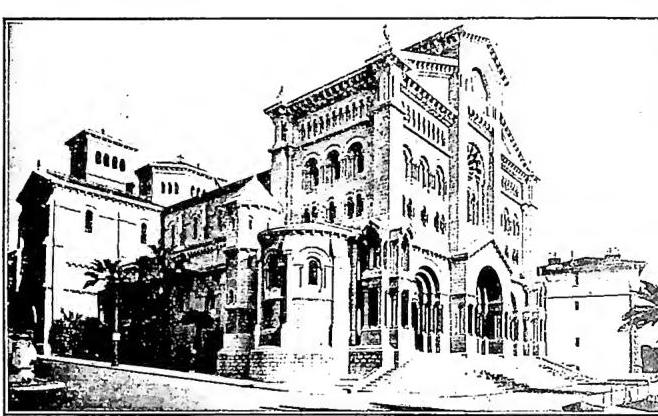
MUNICH (MÜNCHEN) and FREISING, ARCHDIOCESE OF. – In Bavaria, covering an area of 11,972 sq km; it has 2,057,220 inhabitants, of whom 1,744,574 are Catholic. It has 551 parishes served by 1,327 diocesan priests and 779 religious priests, two seminaries, 43 male religious communities and 511 female religious communities (Ann. Pont., 1951, p. 273).
The diocese was erected following the Bavarian Concordat of 1817 with the bull *Dei ac Domini nostri* of Pius VII in 1818. It was assigned the territory of the suppressed dioceses of F. (founded by St Corbinian, organizer of the Church in Bavaria, 716) and Chiemsee, the provostship of Berchtesgaden and parts of the archdiocese of Salzburg located in Bavaria. It was assigned the suffragan dioceses of Augsburg, Regensburg and Passau. The cathedral is the church of Our Lady, built from 1468 to 1488 by Jörg von Pilling. The first archbishop was Baron Lothar Anselm von Gebsattel (1821–46). He founded the Tridentine seminary at F. and restored the monasteries of Scheyern, Reisach, Laufen, Tölz, Landshut, Altomünster and Frauenchiemsee. His successor, Karl August von Reisach (1846–55), firmly opposed state interference in ecclesiastical matters; created a cardinal by Pius IX in 1855, he later moved to the Roman Curia. His successor, Georg von Scherr (1856–77), was greatly hindered in his administration by the machinations of the Bavarian government and the difficulties arising from the Döllinger case and the rise of Old Catholicism (*Altkatholizismus*). During the period of the *Kulturkampf*, the archdiocese was governed by Antonio von Steichle (1878–89), a noted Church historian, who, with the collective memorandum of the Bavarian episcopate that he convened in F. in December 1887, succeeded in obtaining a certain improvement in Church–State relations. He was succeeded by Anton von Thoma (1889–97), formerly bishop of Passau, who continued this work, also managing to resolve the question of the Old Catholics (1890). Franz Josef von Stein governed the archdiocese from 1898 to 1909; Franz von Bettinger from 1909 to 1917, a cardinal from 1914. The latter is known for his pastoral and charitable work: he founded the Union of Catholic Press and the School Organization among parents. All these works were expanded by Archbishop Michael von Faulhaber (from 1917), a cardinal from 1921, an intrepid defender of the Catholic faith against National Socialism. For the pastoral formation of the clergy of his diocese, the directives he issued at the two diocesan synods of 1920 and 1930 were of great importance.
Already in the Middle Ages the region was populated by flourishing Benedictine monasteries, such as those of St Andrew on the Freising hill in the 8th century, of St Vitus on the mountain (Schönberg) in the 9th century, of Fital (1330) and the Cistercian monastery of Freisdorf in the 12th century.
In 1221, during the lifetime of St Francis, a Franciscan convent was founded on the Anger, later transferred to the city; the building was subsequently ceded to the Poor Clares. In 1281 the first Augustinian monastery was founded. In the 16th century the Jesuits arrived in the region; in the 17th century the Capuchins, Carmelites and Theatines. At the beginning of the 19th century the Hieronymites and Oratorians. Among the female orders, following the Poor Clares came the Servites, the Salesians, the Elisabethines and the English Ladies. After the secularization of 1803, which for a time saw the ruin of all these institutions, the old religious houses, to which many others were added, flourished anew.
The University of M. was founded through the efforts of King Ludwig I in 1826, when he transferred the University of Ludwig Maximilian, which until then had been located in Landshut. This transfer was not merely a relocation but signified a refounding of the university’s spirit, which was freed from the Enlightenment-inspired Montgelasian tendency to exclude any interference by religious authority in university teaching. Following the example of J. M. Sailer, an active circle for the Catholic renewal of studies and social life in Germany developed around the University of M. It is associated with the names of Görres, J. A. Möhler, F. von Baader, Phillips, Allioli, Ringseis, Döllinger, von Moy and Lassaux. After 1848 currents less favourable to Catholicism entered the university. In the debates surrounding Vatican Council I, the university sided with Döllinger; however, the Catholic theological faculty also boasts in the second half of the 19th century not a few illustrious names, including the professors G. von Hertling, Kl. Baeumker, H. Grauert, O. Bardenhewer, A. Knöpfler, W. Thalhofer, J. Bach, and others.
For art, V. BAVARIA, III. Sacred art; GERMANY,