
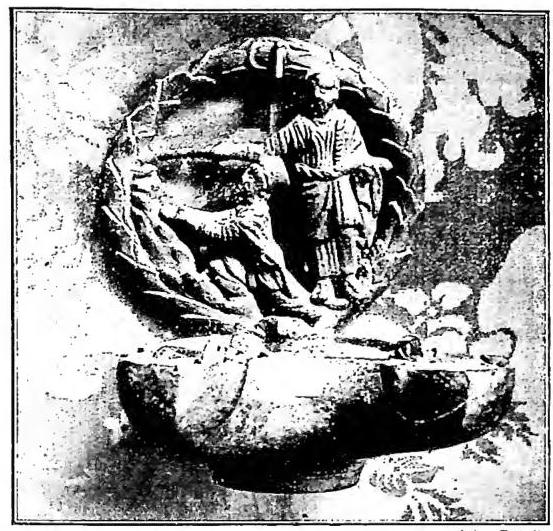
MOSES (Möseh, Mw[u]sə, Vulg. Moyses, ancient Latin Moses). — Founder of Israelite theocracy, legislator of Israel, who governed for more than forty years as a charismatic leader with a religious-nationalistic character, author of the Pentateuch (v.).
Moses’ youth is placed in the last decades of the sojourn of the Hebrews in Egypt, that is, depending on the sources (v. CRONOLOGIA, and DBS, II, col. 916), in the first half of the 15th century B.C., or between the end of the 14th and the beginning of the 13th century, when the “oppression” reached its acute phase, with the employment of the Israelites as slaves in immense constructions undertaken by the pharaohs (Ex. 1:8-14; cf. 5:10-23), accompanied by xenophobia, which provoked the fierce decree, reiterated several times, according to which the male Hebrew newborns were to be suppressed (ibid. 1:15-22). From this situation is determined the first event in the life of Moses, son of Amram, of the tribe of Levi. After hiding him for three months, his mother Jochebed placed him in a basket coated with grease among the reeds of the Nile, leaving his sister to keep watch; a royal princess, perhaps following a habit known to the child’s mother, came to bathe, saw the infant, had him picked up, and entrusted him for rearing to a woman called by the sister, that is, his mother herself. The woman reared him and after some years returned him to the princess, who gave him the name Moses (Egypt. mətsu “son, boy,” cf. Thutmose, Ahmose, etc.; in Ex. 2:10 connected with Heb. māšāh “to draw out,” an allusion to his being drawn from the waters). The exposure of the newborn in a basket on a river is also found in an Akkadian legend of Sargon (ca. 2600 B.C.), which, however, differs so much from the biblical account in the rest that the coincidence must be considered entirely accidental (H. Gressmann, Altorient. Texte, Berlin-Leipzig 1926, p. 234).
At court Moses remained perhaps forty years (Ex. 2:23; 7:7; cf. Acts 7:23): a period rich in experiences and decisive for the cultural and spiritual formation of the thoughtful young man. There is no difficulty in admitting that from the Egyptian environment Moses carried away a great idea of all that activity, which had its most wonderful flowering under almost all the rulers of the 18th and 19th dynasties (v. EGITTO), among whom must be sought the pharaohs of the “oppression” and of the Exodus: that is, all the complex work directed toward establishing a strong state cohesion, laws and civil institutions, cultural initiatives in the broad sense, including religion. Part of the Egyptian reminiscences that Egyptologists detect in Mosaic institutions can be traced back to what Moses saw during this period of his life.
Above all, the young Jew had to perceive the contrast between the condition of his people—enslaved and defenseless—and the Egyptian people, advancing in growing organizational progress; he felt that something had to be attempted. The Bible records his visits to his fellow countrymen, employed as slaves in the grandiose constructions (of Ramses II?; cf. H. Gressmann, op. cit., pp. 106, 107). M. killed an Egyptian overseer who was maltreating the Hebrew workers (Ex. 2, 11-12): “an act” in itself futile, but indicative of the impulses at work in the young man’s soul. The deed forced M. to flee from Egypt.
The second phase of the formation of the future legislator’s personality begins. From Egypt he made his way, as others had done before him for similar reasons (Sinuhe: cf. H. Gressmann, op. cit., p. 55 ff.), to the desert region beyond the eastern borders of the Delta, where there were various populations more or less akin to the Semites. He came to the south-eastern zone of the Sinai peninsula, where the Midianites were. With a Midianite priestly chieftain of the Kenite clan (Judg. 1, 16; 4, 11), named Jethro and Hobab (or Reuel: Ex. 2, 18; Num. 10, 29), he found shelter; indeed, he obtained in marriage the latter’s daughter Zipporah, by whom he had two sons, Gershom and Eliezer.
One day, while tending the flock of Jethro near Mount Horeb (q.v.), the great theophany occurred (Ex. 3, 1-22), which transformed the homeless fugitive into a leader. From a bush that burned yet was not consumed, a voice presented as that of “the God of your father, the God of Abraham, Isaac, and Jacob” commissioned him to go and free Israel from Egypt. When asked for His particular name, God revealed Himself as “I am” (ehiyeh) and shortly thereafter as “He is” (ehiyeh). The mission was specified as leading Israel to settle in the land of Canaan (Ex. 3, 17), assigned to him as his own. To Moses’ reluctance, on account of his sense of unfitness for such high office and a speech impediment, God responded by granting him miraculous powers and assigning him as collaborator his brother Aaron (q.v.), an eloquent speaker; indeed, He commanded him to go to Egypt at once. Moses, having taken leave of Jethro, set out with his wife and sons. During the journey an event occurred, recounted in terms too concise and obscure (ibid. 4, 24-26), commonly understood as a severe illness of Moses, which abated when his son Gershom was circumcised. At that time Moses was eighty years old (ibid. 7, 7).
In Egypt, once recognized by his fellow countrymen, Moses began negotiations with the Pharaoh. To Pharaoh’s refusal to let the Hebrews depart, he responded with the wonder of the rod and the ten miraculous plagues of Egypt (q.v.) (ibid. 7, 14–12, 36). At the tenth plague, Pharaoh not only permitted but ordered their immediate departure.

degli Israeliti. Comincia la vicenda nerrata in Ex. 12-20: sgombero dall'Egitto, traversata del Mar Rosso, poi il viaggio nella steppa, che avrà come primo punto d'arrivo il Sinai (v.), compiuto in due mesi, lungo una linea in gran parte identificata, nella direzione della costa sul Mar Rosso.
Durante questo periodo avvennero alcuni fatti importanti e incidenti vari, tra cui, fin dal giorno dell'uscita dall'Egitto, Pasqua (v.), poi la cerimonia dopo il passaggio con l'esecuzione del «cantico» di M. (ibid. 15), la raccolta della manna, un CAMITI (v.). Proprio a proposito di questo ultimo fatto si trova l'importante notizia: «E Jahweh disse a M.: Scrivi questo per ricordo e mettilo nelle orecchie a Giosuè: che io spegnerò del tutto il ricordo di Amalec di sotto il cielo» (ibid. 17, 14).
In vista del Sinai (ibid. 19) fu posto l'accampamento. È chiaro il piano di M.: sostare in una località a lui ben nota per organizzarsi per il rimanente del viaggio. Vi si verificò l'intervento di Dio, rimasto tra i più prodigiosi della storia sacra: al terzo giorno M. salì sul Sinai, ove tra fenomeni terrificanti Dio proferì una serie di prescrizioni, il primo nucleo della «Legge». Essi comprendeva il Decalogo (v. : ibid. 20), la prima prescrizione dell'altare (ibid. 20, 22-26) e il «Codice dell'alleanza» (ibid. 21-23), base della stipulazione del «Patto» (ibid. 24, 1-11), a cui seguì la consegna del codice scritto sulle tavole di pietra (ibid. 24, 12-18), accresciuto in seguito con molte altre leggi, riguardanti specialmente il culto (ibid. 25-31).
Durante una lunga assenza del capo avvenne una prima apostasia del popolo, l'erezione del vitello d'oro come simbolo di Jahweh e l'adozione di culti pagani, alla cui vista M. spezzò le tavole, che di lì a poco, a istanza di lui stesso, Dio rifece (ibid. 32). Di quell'epoca e degli anni successivi sono altre leggi religiose e sociali sparse nel Levitico e nel libro dei Numeri.
Eseguite le prime prescrizioni per il culto, tra cui la costruzione del Santuario e dell'Arca, M. diede ordine di partenza, questa volta puntando direttamente sul Canaan: era trascorso ca. un anno dall'arrivo al Sinai (cf. ibid. 19, 1 e Num. 10, 11). Il nuovo periodo è narrato in Num. 10 sgg., in forma di episodi e appunti, per lo più in ordine cronologico.
Dopo un censimento (Num. 1-4) e secondo le direttive di marcia date da M. (ibid. 11), gli Israeliti in varie tappe, in cui avvennero vari episodi – passaggio miracoloso delle quaglie (ibid. 12, 31 sgg.), alcune sedizioni contro Mosè punite da Dio, ecc. – attraversarono il deserto di Pharan, che nella parte settentrionale prendeva il nome di Sin, e andarono ad accamparsi a Cades, un centinaio di km, a sud-ovest del Mar Morto, ove erano delle sorgenti d'acqua. Da Cades (ibid. 32, 8) M. fece fare un'esplorazio
Moses’ death (ibid. 31:30-32:43), and a series of blessings for the individual tribes (ibid. 33). Then he ascended Mount Nebo, from which he beheld, across the Jordan valley, the plateau of Canaan, and in that posture he died. He was 120 years old.
In dying, Moses left an inheritance that extended into all future ages by reason of its religious significance; and it comprises two closely bound parts: one consigned to writing, the other infused into lived history.
Moses’ role as the author of writings that have come down attached to his name is the subject of the historical-critical problem concerning the Pentateuch (v.).
The existence of alphabetic writing several centuries before the age in which, however the details are fixed, Moses must be placed, is no longer a problem.
The notice recalled of the order given by God to Moses after the war with the Amalekites directly attests the established practice in Israel at that time of committing accounts of events to writing; and it is noteworthy that alongside the command, “Write this as a memorial in a book (as it is written) ‘And recite it in the ears of Joshua’” (Ex. 17:14), within the small nomadic group traditions were taking shape, yet alongside them an official nucleus of written documents was forming, since they are said to be “for testimony.” Numerous narrative passages in the present Pentateuch bear the aspect of documents of this kind, such as the lists of stages in the desert, accounts of victories (Ex. 13-18; Num. 31, 33, etc.), various events in relation to other peoples (Balaam, Num. 22-24; Edomites, Num. 20, etc.), internal events of the Israelite community (Num. 11, 12, 14, 16, 20, 21, etc.), the account of the census (Num. 1-2), of the first division (Num. 32), etc.
As regards the laws, the question is further subdivided, inasmuch as they are generally referred to the Mosaic age, or specifically to the person of Moses. Explicit testimonies scattered throughout the “Law” oblige us to hold that many prescriptions were already written at that time: the detail of the stone tablets for the first laws of Sinai attests this, above all for the Decalogue (v.).
That personal legislative activity can be traced back to Moses cannot be denied. Later tradition could not have invented this particular feature and fixed it specifically in Moses rather than, for example, in Abraham. After him, no one would have had the authority to impose a body of laws such as that which was practiced in Israel. That the Pentateuch (q.v.) reflects more the characteristics of a sedentary, agricultural people (e.g., Ex. 21-22) than those of a nomadic people is not problematic: the bedouinism of the forty years in the desert was provisional, always awaiting stable settlement. Mosaic Israel was not simply nomadic: agriculture is already mentioned with regard to the Patriarchs (Gen. 26:12; 27:7, etc.); in Egypt, besides sheep and goats, the Hebrews also had cattle (Gen. 45:10; Ex. 19:9, 24) and worked the land (Deut. 11:10). That the prescriptions remained far removed from practice shows that this was truly a programmatic, one might even say ideal, code, which did not result primarily from the codification of existing practice but proposed a higher state of civilization: another sign of its origin at the hands of an exceptional personality.
Mosaic legislative activity included cultural aspects (sacrifices, sacred furnishings, etc.). If the Mosaic origin of worship is admitted, both its legitimate transmission and the degenerations that the prophets later combated are explained. Thus, to Moses is traced the founding of the Ark, the assignment of the priesthood to the Levites (q.v.), with particular designation for the Aaronites, and all the essentials of the festivals and ceremonies.
As for the written recording of traditions prior to Moses himself, there is no doubt that Moses must have concerned himself with them to some extent, given their non-purely historiographical but religious character. With the general affirmation of Yahwism (covenant, law), Israel always linked its unique religious text, which begins with the account of the six days and continues by narrating how, within the general history of pagan humanity, it was inserted by divine will (call of Abraham), the first source of its moral and religious obligations, its own history.

It must be concluded that in pre-Mosaic and Mosaic history, in the Law—even the ceremonial law—there is a part directly Mosaic. But if one examines the evidence, the totality of proofs adduced from the Mosaic books themselves, from other books of the Old Testament, and from those of the New Testament in favor of the Mosaic authenticity of the Pentateuch (q.v.), it is difficult to see how this cautious assignment of some or many narrative and legislative passages to Moses suffices to demonstrate in him the “author of the Pentateuch.” Further study is needed to determine what this overall work consisted of, containing these passages recognized as Mosaic, which, possibly modified, updated, and expanded, has come down to us as “the Pentateuch” of which Moses is said to be the author.
As regards the documents, which are to be interpreted and not distorted, the literary-historical problem of Moses can only be framed in this way. Strictly speaking, several answers are possible: a dossier of minute documents, more than anything juxtaposed, already differentiated in that they were written by various collaborators ("followers") of the leader, or due to different circumstances and periods, possibly repeated (the doublets), later increased in number; or several writings of the kind proposing "books," already distinct, possibly more or less corresponding to the "documents" (EJP D) of criticism; or a single work, later expanded and glossed, but above all differentiated into "redactions" (north and south; or the sanctuaries, etc.), which left individual traces in the final work, compiled with the aim of restoring unity to the variety. The current state of studies does not allow for a choice, while showing that fruitful efforts have been devoted to reconstructing the history of the book through the centuries.
Of Moses' work, of its importance for Israel and through Israel for the entire history illuminated by the lights of the Hebrew-Christian religion, tradition is full.
Moses was the great promoter of monotheism: one might almost say that he codified and dogmatized II. With him, any possibility of hesitation between the "God of the Fathers" and other gods was removed. Monotheism, as a religious fact proper to Israel, through Moses, found historical justification: the distinction of monotheism (= Religion) from paganism, which occurred with the vocation of Abraham, was clarified as a theocratic program, an external historical factor in which lies the generative principle of Israelite religious civilization and of future Christian civilization. Moses is the necessary precursor of Christ.
Attempts to remove his figure from the Egyptian context (as one might explain the name M., and more generally Egyptian names like Hur, Ophni, Phineas, Phutiel, etc.) and all the reminiscences (cf. Ex. 20:2; Lev. 19:3; 25:42; 26:45; Num. 15:41; Deut. 5:6, 15, etc.) and Synoptic contexts in which biblical tradition places him are also recognized by non-Catholic critics as contrary to historical evidence (C. P. Tiele-N. Sonderblom [q.V. bibliography], p. 329; E. Sellin [q.V. bibliography]; etc.). The mention of his flaws shows that the authors of these documents did not work from imagination; they lacked any creative spirit and, moreover, in that episode, which holds nothing heroic for the people—indeed, it is woven with episodes of cowardice, lack of courage and discipline, as well as faith—the generation that should have been celebrated instead appears as a mass of coarse people, incapable of accepting even the slightest organization, perpetually divided and in revolt, so much so that it would have to disappear before the enterprise could succeed.
The foresight and practicality Moses demonstrates even in his grand vision (Ex. 3:2–4:17), when he asks God for a guarantee, a “name” as a seal of authenticity, proves that Moses was no wandering agitator. His psychological disposition was oriented in a direction quite different from the eventual outcome: he did not know that there was a sacred place in Sinai (ibid., 3:5), nor was he inclined to the idea of going to free Israel (ibid., 3:11; 4:1–13). The denial of Moses’ importance can only be made in contempt of the entire tradition of Israel. If he had not been an exceptional personality, how could he have been regarded as the founder of the religious and national existence of his people?
The rationalist attempts tend to exclude the importance of his “God,” whom they identify with a number of deities, or a volcanic deity of Sinai, or of Arabia (who speaks to the Hebrews in Egypt and assigns them Canaan), under Egyptian influences (the “monotheistic” attempt of Amenophis IV was ephemeral and directed toward an entirely different end); Diomedes in M. would have been one of many gods, like those that every people had. But “if... the term monotheist means one who teaches the existence of a single God, creator of all things, source of justice, who is equal, while powerful in Egypt, in the desert, and in Palestine, who has no sex nor mythology, who has human form (= names beluina), but cannot be seen by human eye and cannot be represented in any form: then it must be said that the founder of Yahwism, M., was certainly a monotheist” (W. F. Albright, From the stone age to christianity: monotheism and historical process, Baltimore 1940, p. 271). Constantly the Israelite religious consciousness recognized in the Yahweh preached by M. its own God. The God of the Fathers (Ex. 3:6) is at the same time the God of the children of Israel (ibid. 3:7), who revealed himself with a new name when he established with Israel itself a new relationship. This is a religion that does not come from man, but from God, of whom M. was only the “prophet,” the spokesman (Ex. 3:10; 4:12; Num. 11:24 sq.; 12:2; Deut. 18:15.18; 34:10; Hos. 12:4; Ps. 103:7, etc.). Yahweh, revealing himself as identical with the God of the Fathers, in the end only placed the demand for fidelity to the one traditional God. Only thus is the remote origin of monotheism explained, in the exact conception of a personal and moral God, supreme instance in decisions of juridical order, point of reference for all public and private life of those who regulated their existence according to the Mosaic code.
Archeologia. — Dura Europos (v.) si trova una serie di affreschi, datati alla metà del III sec., tra cui: M., figurato in dimensioni maggiori degli altri, conduce gli Israeliti fuori della città (Ex. 11, 3): un’iscrizione in aramaico riassume la scena; M. con la virga Dei tocca le acque del Mar Rosso e gli Egiziani sono sommersi; M. in mezzo al popolo d’Israele e ai rappresentanti delle dodici tribù; M. con la virga Dei tocca la fonte dell’acqua salata, che si trasforma miracolosamente in acqua dolce: i pesci guizzanti simboleggiano il miracolo; M. e il roveto ardente.
Tale ciclo biblico dimostra che, per facilitare il proselettismo, gli Ebrei della diaspora rappresentarono nelle loro sinagoghe episodi del Vecchio Testamento. Ora le numerose scene della vita di M. ivi rinvenute fanno pensare che l’iconografia di M. nell’arte cristiana sia potuta derivare da tali rappresentazioni. Nell’arte cimiteriale cristiana antica le scene relative a M. sono negli affreschi: fonte (v.); manna (v.), M. che si scioglie i sandali si trova in affreschi cimiteriali romani del sec. IV, come nel coemeterium maius della Via Nomentana (Wilpert, Pitture, pp. 388-89, tav. 168; id., Die Katakomben Gemälde und ihre alten Kopien, Friburgo in Br. 1891, tav. 26, 1), nel cosiddetto cimitero dei SS. Marco e Marcelliano (id., Pitture, p. 389, tav. 215; 216, 2), nel cimitero di S. Lorenzo (id., ibid., p. 389, tav. 205), in Domitilla (id., ibid., tav. 230, 1); ma l’esempio più notevole è quello nella cosiddetta cripta delle pecorelle in Callisto (id., ibid., tav. 275, 2), in cui al disopra del profeta appare fra le nubi la mano di Dio per esprimere l’intimazione (Ex. 3, 5). Nella scultura funeraria ricorre sia in sarcofagi romani che in quelli della Gallia (Wilpert, Sarcofagi, pp. 241-44; tav. 86, 3; 205, 4; 206, 1 e 2). Il simbolismo della scena fu espresso da S. Gregorio Nisseno nella commemorazione funebre di S. Melezio vescovo di Antiochia: «egli ha sciolto la calzatura dell’anima per camminare col piede senza macchia della mente sulla terra santa dove si contempla Iddio» (PG 46, 861).
Nella scultura cimiteriale si hanno le Rosso (v.), fonte (v.), di M. che riceve la legge sul Monte Sinai. Questa scena appare oltre trenta volte nella scultura cimiteriale romana e della Gallia (Wilpert, Sarcofagi, p. 237); di recente ne furono trovati altri due esempi, l’uno presso la Confessione di S. Pietro in Vaticano e l’altro in un sarcofago a doppio ordine in catacumbas. Si ha pure la presa delle quaglie (Ex. 16, 13) che ricorre in un sarcofago di Arles, ora nel Museo archeologico di Aix in Provenza, in uno di Pisa e sul coperchio di uno di Avignone (Wilpert,
Sarcofagi, p. 244 e tavv. 97, 2-4; 157, 2 e 209, 2). Alcune
lastre sepolcrali rappresentano il miracolo della fonte; nel
cimitero detto dei SS. Marco e Marcelliano sull'Appia,
l'epitaffio di Aurelio Teodulo (sec. IV) raffigura a destra
il defunto davanti al tribunale di Cristo e a sinistra in una
nicchia il profeta M., come insegna l'iscrizione «ΜΟΥΣΚΗΣ
ΠΡΟΦΗΤΑ», che stringe il libro della legge datagli dal Si-
gnore sul Sinai (Wilpert, Mosakken, p. 1020, fig. 499; id.,
Sarcofagi, p. 241 e tav. 205, 2).
In non-cemetery art, the episodes from the life of MOSES are more numerous. The richest collection was represented in the mosaics of the central nave in S. Maria Maggiore (Wilpert, Mosakken, plates 16-22). Some representations relating to the life of MOSES were destroyed at the time of Sixtus V, when the chapel of the Sacrament was erected, but they were published by Garrucci through the copies preserved (R. Garrucci, Storia dell'arte cristiana, Prato 1873-81, plate 218, 2-3). Other episodes were depicted at Nola, according to the testimony of St. Paulinus (Carm. 27, vv. 630-35); in a basilica in Spain, perhaps Saragossa, as attested by the Dittochaeum of Prudentius; and especially in S. Vitale in Ravenna; in the panels of the wooden door of S. Sabina in Rome (5th century); in the ivory reliquary of Brescia. Likewise in many miniatures; noteworthy among these are those of the Ashburnham Pentateuch (7th century), in the Bibl. naz. of Paris (Nouvelle acquisition lat. 2334, cf. Enc. Catt., VII, cols. 1039-40) and the Syriac ms. 341. In the Vatican Library in the miniatures of the codex of Cosmas Indicopleustes and in cod. Vat. Reg. 1 of the 10th century. In mosaic cycles, such as in the Palatine Chapel of Palermo; in the arch of the Roman basilica of SS. Nereus and Achilleus (795-816; G. B. De Rossi, Musacii, plates 22, 1; 26, 27). In the church of the Convent of S. Catherine on Mount Sinai the apse mosaic represents the Transfiguration. To the right of Jesus is Elijah, to the left is MOSES in the guise of an old man, bearded, distinguished by his name (ΜΟΥΣΚΗΣ). The patriarch is also represented on either side of a window of the apse in the act of loosening his sandals and receiving the law from the hand of God. The mosaics have been attributed to the end of the reign of Justinian (S. Vailhé, La mosaïque de la transfiguration au Sinai est-elle de Justinien?, in Revue de l'Orient chrétien, 2 [1907], pp. 96-98).