
NAPLES. ARCHDIOCESE OF — Christ of St Gregory the Armenian after restoration. Wooden sculpture (early 15th cent.).
known by the name of the Catacomb of St Severus. In one of the arcosolia is the figure of a high magistrate, the deceased, at the centre, between four saints, the first two, to right and left, Peter and Paul. In another arcosolium opposite, Sts Protasius and Gervasius. The Milanese influence is evident; with the Neapolitan bishop Severus, St Ambrose had occasion to exchange a letter, and relics of Gervasius and Protasius were in the altar of the basilica erected by St Paulinus at Fondi. The frescoes of this cubicle belong to the 5th century.
2. Baptistery
The baptistery of St John at the Fountain belongs to the last years of the 4th century rather than the first of the 5th; it is situated near the Cathedral and precisely to the right of one facing the apse of the basilica of St Restituta. Of square plan, it is surmounted by a dome which is connected to the perimeter walls by the transformation of the upper part of the corners into small vaults or hooded niches, so that the square terminates in an octagon. Of the mosaic decoration of the dome only some parts remain. At the centre of the dome, within a circle circumscribed by a band decorated with baskets and cups full of flowers and fruit, flanked by confronted birds, and in the field of a starry blue sky, the monogram cross with the apocalyptic letters, crowned by the hand of God. In the band surrounding the starry sky, in correspondence with the head of the cross, the phoenix between two palms. From this central circle eight trapezoids radiate, divided by bands adorned with full festoons of flowers, fruit, birds. Of these eight trapezoidal zones, five are preserved, entirely or in small part; one of them is subdivided into two vertically, another into two, but horizontally. The axis of the Baptistery was from east to west, and the original entrance was to east or west; now one enters from the south. In the north-east zone, two scenes: the Samaritan Woman at the Well and the Miracle at Cana; immediately after, on the east wall, the lower part of an Apostle in the Multiplication of the Loaves, in the east-south corner, the scene of the Dominus legem dat. Christ on the globe with St Peter cruciform to his left; St Paul is destroyed. On the present door, the zone is divided into two, horizontally: St Peter saved from the waves, above, and the Miraculous Draught of Fishes, below. In the last surviving zone, to south-west, the head of one of the myrrh-bearing women at the sepulchre of Jesus and the angel seated on the stone. In the four small vaults, of the symbols of the Evangelists two remain, to south-east the winged man; to south-west the winged lion. In the four compartments, which result placed between the vaults with the Evangelists, eight apostles, two on each side, who offer crowns. On the frontal arch of the vaults alternate scenes, of the Shepherd between two sheep and of the Shepherd between two stags which drink.3. Basilicas
The first is mentioned in the Liber Pontificalis Romanus. It was built and endowed by the emperor Constantine. Neither the Liber Pontificalis nor Bede indicate to whom it was dedicated, nor do the attributions given by Ado and by the monk John, author of the Chronicle of St Vincent at the Volturno (12th cent.), that it was dedicated to the Saviour, deserve credence. By the middle, however, of the 9th century, this basilica was called that of St Restituta, from the martyr, very probably African, much venerated on the Island of Ischia (at Lacco Ameno), and thence, perhaps, transported to Naples. The Constantinian basilica had five naves and no transept. Its lower end, to the south, was cut away when in 1294 the present Angevin cathedral was begun; subsequently it underwent the transformation of the whole upper part above the capitals, the raising of the pavement and the occlusion of the two outer naves. Of the ancient structure only the plan, part of the apse and the colonnade remain. In the left nave, the chapel of St Mary of the Beginning, with a mosaic of the Madonna, St Januarius and St Restituta, of 1313.The second cathedral of Naples was the basilica built by Bishop Stephen I (499–501). It stood near the Episcopal Palace and was dedicated to the Saviour; but from the name of its founder it was habitually called the Stefania. It was completely destroyed in 1294 with the rise of the Angevin Cathedral. Bishop John II the Mediocre (c. 557) rebuilt its apse, destroyed by fire, and had represented in mosaic the Transfiguration, which was renewed after another fire, in the second half of the 8th century, when it received the bodies of the martyrs Eutyches and Acutius transported from Pozzuoli; and, shortly before the middle of the 9th century, the bodies of the bishops of Naples transported from suburban cemeteries.
Of the other basilicas built before the year 1000, mention must be made, in chronological order: the Severian, erected by Bishop Severus (c. 363–409), of which the arched apse is preserved with pulvins superimposed on the capitals, decorated with a Greek-Latin monogram; the Soterean, erected by Bishop Soter (living in 465), in honour of the Apostles; the Pomponian, erected by Bishop Pomponius, in the third and fourth decades of the 5th century, in honour of the Virgin and called St Mary Major; the basilica in honour of St Lawrence, work of Bishop John the Mediocre; the Vincentian made by Bishop Vincent (c. 557–80) in honour of St John the Baptist (St John Major); of it remain two of the four columns which supported the drum of the dome, which have capitals decorated with the monogram of Bishop Vincent; the original apse, of importance at least equal to that of the Severian, remains still concealed by later walls and arches.
The basilica of St Januarius, annexed to the diaconia of the same name, is the work of Bishop Agnellus (c. 674–95), and the basilica of St Paul was erected by the Duke of the city, Antimus (801–818). The Severian, the Soterean, the Pomponian, the Vincentian and St Paul were throughout the Middle Ages called catholica; the Severian, the Pomponian and the Vincentian are among the most ancient parishes and, still today, seats of collegiate churches.
4. Marble Calendar
It was discovered in 1742 in the basilica of St John Major. It consists of two large marble slabs, about 6 m long and 0.88 m high, on each of which, in twelve columns, two for each month, are engraved the names of the saints and the feasts of the various days of the year (v. above, col. 247). It was executed shortly after the middle of the 9th century to serve as a screen or cancellus of an altar. It is not a liturgical monument in the sense of a calendar for the divine offices, but intended for private devotion. Much less is it a historical monument, as has been claimed, or an act of ecclesiastical policy, almost to signify attachment to Rome. The attempt of the Patriarch of Constantinople, between 718 and 747, to secure the submission of the Bishop of Naples, Sergius, by naming him archbishop, remained without effect. The Greek character of the Church of Naples, grafted onto an ethnic, cultural, political and social base, unfolds in the literary, monastic, hagiographical and liturgical spheres.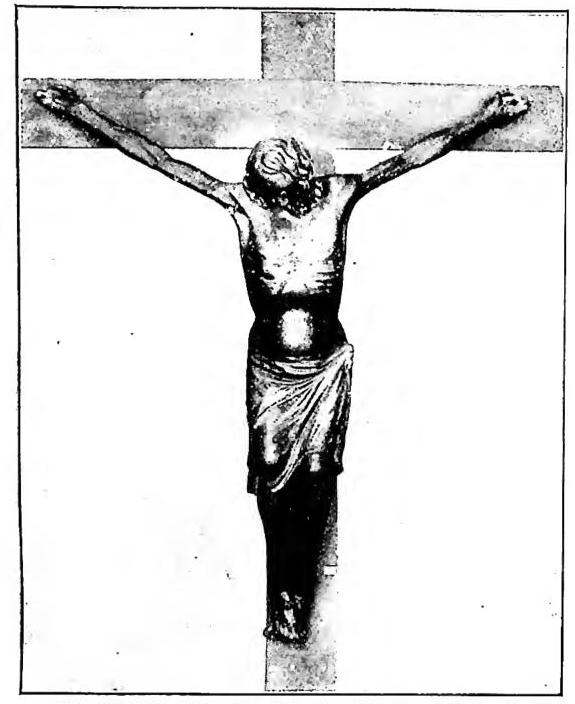
known by the name of the Catacomb of St Severus. In one of the
Of early Christian relief sculpture, almost nothing remains: the seven or eight fragments in the National Museum, part of sarcophagi, are either of Roman origin or uncertain. Far more survives from medieval sculpture, such as plutei and altar frontals. Among the plutei are those from S. Giovanni Maggiore and the so-called chapel of S. Aspreno at the Borsa, and, from a later period, those in S. Restituta with the Stories of Joseph on one, and on the other the Stories of S. Gennaro, Samson, and four Greek martyrs. For later churches, see below the section on Art.
5. Epigraphy
The epigraphic harvest before the 7th century is sparse. Apart from a few bare Greek and Latin names from the catacomb of S. Gennaro, no inscription survives that is earlier than the 4th century; of these, very few are datable, the earliest being from 377. Notable among them are the inscriptions of Bishop Maximus (d. c. 361), Bishop Gaudiosus of Abitinae, Abbot Habetdeus (d. 468), the noblewoman Candida clarissima femina (d. 585), and Abbot S. Agnellus (d. between 593 and 600). A painted dedicatory inscription names the saint depicted in the lunette of an arcosolium in the catacomb of S. Gennaro, between two deceased women, Sancto martyri Ianuario, from the 5th century. Also from the 5th–6th century is the Greek sepulchral inscription of Paula, daughter of the subdeacon Paul. From the 7th century comes the metrical inscription of the deacon Theophilactus; from the 8th, the Greek inscription of Duke Theodorus (d. 729–30), restorer of the diaconia of SS. Giovanni e Paolo in 721–22, and that of Duke Buono (d. 783).6. Ancient Clergy and Chapter
Characteristic offices in the ancient clergy include those of the Notarius, the Primicerius scholae cantorum, the cimiliarcha, the canonarch, the paramanarius, and the vestrarius. There are the presbyteri cardinales or simply cardinales, the diaconi cardinales, the primicerius, the archdeacon, and the archpriest of the cathedral clergy, attested even before the cathedral Chapter is explicitly mentioned, respectively in the years 1000, 1065, and 1065. The Chapter is first explicitly named in 1167; there is no doubt it existed earlier. In the 12th and 13th centuries, and until 1308, it often elected the archbishop. Of the 30 members who now compose it, 7 priests and 7 deacons hold a cardinalitial title, mentioned in the papal bulls of appointment. These titles correspond to the ancient churches over which they presided; the earliest of which there is surviving evidence, from the year 1337, refers to the canon cimiliarcha and is that of the martyrs Eutyches and Acutius.X. Art
Few works survive from the Romanesque period: in architecture, the bell tower of the church of S. Maria Maggiore (11th century) is unique; in painting, some 13th-century icons, including those in S. Domenico and S. Pietro Martire; in sculpture, however, the region of Campania was rich in a highly productive tradition, yielding splendid wooden works: crucifixes, Depositions, Madonnas, magnificent examples of which are preserved in the Duomo, S. Maria a Piazza, S. Aniello a Canonopoli, S. Giorgio Maggiore, and the Gerolamini.The Angevin period ushered in an intense artistic activity. Gothic forms from beyond the Alps were decisively adopted by architects of the Angevin court: magnificent churches in pure French style arose, such as S. Eligio, S. Lorenzo Maggiore, the Duomo, S. Chiara, and the city was adorned with sumptuous civil buildings like Castel Nuovo and S. Elmo. The transalpine canons, however, gradually gave way to more serene interpretations of local taste. Such are the Incoronata, S. Pietro a Maiella, S. Domenico, and S. Maria Donnaregina.
In sculpture, too, the initial contribution came at the beginning of the kingdom from French artists; yet even more fruitful was the arrival in Naples of the Sienese Tino di Camaino, summoned by King Robert to carve the tomb of Maria of Hungary in Donnaregina and remaining in the city until 1337. His works include the tombs of Charles of Calabria, Maria of Valois in S. Chiara, Philip of Taranto and John of Durazzo in S. Domenico, as well as a large and much-debated series of fragmentary sculptures. To further enrich the cultural landscape of those years, Tuscan elements arrived soon after, followed by the Florentines Pacio
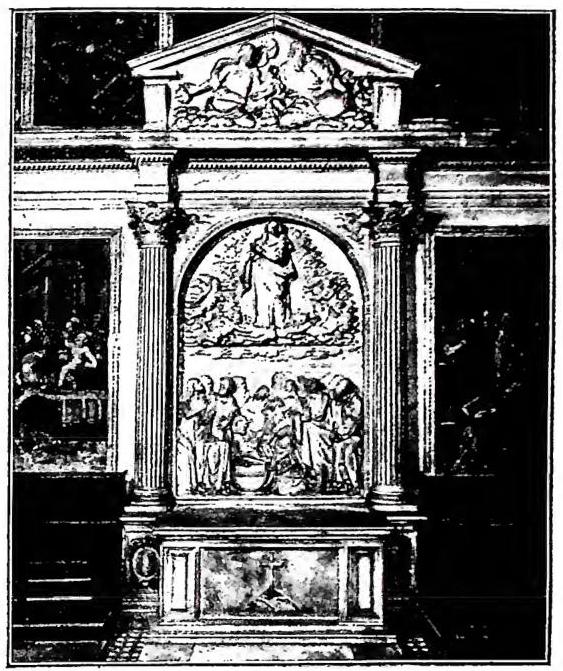
NAPOLI, ARCIDIOCESI di — Assumption of the Virgin. Marble bas-relief by A. Caccavello (c. 1570) — Naples.
NAPOLI, ARCIDIOCESI di — Jupiter strikes the giants. Capodimonte porcelain (18th century).
e Giovanni Bertini, authors of the great cenotaph of King Robert in S. Chiara, also defaced in the great disaster that befell the church during the Second World War. The painting of the Trecento in Naples is an important chapter in the history of art: first among all came the Roman Pietro Cavallini, who left frescoes in Donnaregina, then Simone Martini and finally Giotto, who worked, as sources attest, in S. Chiara, in S. Barbara and in Castelnuovo with frescoes now all lost; the local currents finally continued in the wake of these masters the validity of a particularly happy period for the figurative arts. The forms that had taken hold in the Gothic age persisted throughout the first half of the 15th century, gradually assimilating other cultural elements from Catalonia, Burgundy, and Flanders. Nevertheless, Renaissance voices were not lacking, such as that of Donatello, who together with Michelozzo sculpted the tomb of Cardinal Brancaccio for S. Angelo a Nilo.
It was only with the Aragonese Kingdom that the humanistic conception of the Renaissance became firmly established. To celebrate this period, one may recall the triumphal arch built in Castelnuovo for Alfonso of Aragon and the presence in Naples of artists such as Franco Cesar, Lorenzo—certainly one of the sculptors of the arch—Giuliano da Maiano, author of the Porta Capuana, Rossellino, and Benedetto da Majano, to whom we owe the Piccolomini Chapel in Monteoliveto, and others. In the field of painting, where the influence of foreign culture was especially lively, Colantonio emerged, notable for his role in mediating between Flemish art and the southern formation of Antonello da Messina.
In the 16th century, for the most part, the forms of the 15th century were repeated by local artists. Among the architects to be remembered are the Calabrian Mormando, Maglione, d'Angelo, together with the Lombard Domenico Fontana, author of the façade of the Royal Palace, the Florentine Dosio, the Aquilan father Valeriani, who built in Gesù Nuovo, and the Spaniard Pirro Luigi Scriva, who erected the new parts of the fortress of Castel S. Elmo for Don Pedro of Toledo. In sculpture, there was a veritable school that produced throughout the century, until the arrival of the Tuscans Michele, Angelo Naccarino, and Pietro Bernini, a series of highly notable artists. The leading sculptor was Giovanni da Nola; together with Gerolamo Santacroce, he drew inspiration from the Tuscan works of the church of Monteoliveto and adorned, like the d'Auriana and Annibale Caccavello, Neapolitan churches and palaces with fine sculptures. Neapolitan painting of the 16th century partook of many influences; at the beginning of the century foreign artists such as lo Zingaro, Rosso, Cesare da Sesto, and Giorgio Vasari came to paint in the city. A facile Mannerism thus took root in the local environment, evolving from the first and original Andrea da Salerno to the more elaborate interpretations of Curia, Imparato, and Santafede.
Caravaggio’s brief stay in Naples, between 1606 and 1607, suddenly elevated these mediocre standards.
The 17th century was the golden age of Neapolitan painting. The novelty of Caravaggism, absorbed by three great painters—Battistello, Ribera, and Mattia Preti—gave rise to a school that for three centuries maintained uninterrupted prestige throughout the peninsula. From Battistello’s immediate Caravaggism, which in 1607 itself assumed the master’s attitudes in *The Liberation of St. Peter from Prison* at the Pio Monte della Misericordia, to Ribera’s more restrained following of Mannerist residues, and finally to Preti’s personal vision, a new vitality infused Neapolitan painting and continued through all the artists of the century: Luca Giordano, Massimo Stanzione, Francesco Fracanzano, Andrea Vaccaro, Bernardo Cavallino, Salvatore Rosa, Micco Spadaro, Aniello Falcone, down to the 18th-century Solimena, who carried the Caravaggesque stylistic memory into the new century. A notable figure of the 17th century was also Cosimo Fanzago, architect, sculptor, and elegant decorator of church interiors with polychrome marble inlays.
In the 18th century, the influence of Solimena, who had followers in painting such as Sebastiano Conca, De Mura, and Bonito, was also felt in architecture and sculpture. Ferdinando Sanfelice, Domenico Antonio Vaccaro, the Palermitan Medrano, and the Florentine Ferdinando Fuga adorned the city with sumptuous buildings commissioned by the Bourbon kings, culminating in Luigi Vanvitelli, the leading exponent of 18th-century architecture, whose name is linked to the grand Reggia di Caserta. In sculpture, one recalls Queirolo, Celebrato, and Sammartino, the latter renowned as the initiator of the minor sculpture of the presepe, a characteristic and original expression of Neapolitan art.
The 19th century began in architecture with the refined Neoclassicism of Nicolini, author of the fine façade of the Teatro di S. Carlo and the Villa Floridiana. In the second half of the century, the sculptor Vincenzo Gemito emerged as a strong personality, while painting, first with the Posillipo school to which Giacinto Gigante belonged, followed by Carelli and Smargiassi, then with Domenico Morelli, the Palizzi brothers, Gioacchino Toma, and Saverio Altamura, continued the great tradition of the preceding centuries. — See plates CVII–CIX.