
ATOMIC NUCLEUS. — The study undertaken to discover the intimate constitution of chemical atoms led to the conclusion that every atom in fact consists of a nucleus and a peripheral region in which there are electrons connected with the nucleus. The atomic model proposed by Rutherford at the beginning of our century was modified by N. Bohr and A. Sommerfeld on the basis of the principles of Planck and Pauli. Bohr’s model of the quantized atom succeeded in interpreting almost exactly the emission of visible, ultraviolet, and infrared radiation by the hydrogen atom; and Sommerfeld’s theory made possible the classification of atoms in Stoner’s table, which, on the basis of the distribution of electrons revolving around the nucleus, in turn explained the recurrence of the physical and chemical properties of atoms.
The physical and chemical properties of the elements depend exclusively on the said distribution of the satellite electrons. And this distribution, in turn, depends on the electric charge of the nucleus, which determines the number of these electrons and the radii of their orbits. Since the electron has a negative electric charge which, in the present state of our experimental knowledge, must be regarded as indivisible, it has been taken as the unit charge.
Atomic nuclei have positive electric charges equal, apart from the sign, to an integer number Z of elementary charges, so that a neutral atom will be completed by an equal number Z of electrons revolving around the nucleus. This number Z, called the atomic number, thus has a threefold
meaning: 1) it measures the positive charge of the nucleus in elementary units; 2) it represents the number of negative electrons revolving around the nucleus; 3) it defines the position of the element to which the atom belongs according to a classification based on the increasing number of satellite electrons, a classification which, apart from a few exceptions, coincides with that based on the increasing value of atomic mass. The elementary charge, accurately measured, is 1.6 × 10⁻¹⁰ coulomb.
The simplest atoms are those of hydrogen (H);
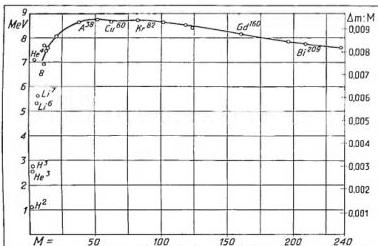
NUCLEUS ATOMICUS - Mass defect and binding energy of nuclei.
Although the proton and electron had been known individually since the beginning of our century, it was only later, in 1932, that two other isolated particles were discovered: one called the positive electron or positron, which has all the characteristics of charge and mass of the negative electron, apart from the sign; the other, the neutron, an electrically neutral particle having a mass slightly greater than that of the proton, namely 1.675.10⁻²¹.
It should be recalled that chemistry refers atomic masses to a special unit of mass = 1/16 of the mass of an atom of oxygen (O). One unit of mass is equal to 1.6603.10⁻²¹ grams. Its reciprocal, namely 6.02.10²¹, is called Avogadro’s number and represents the number of units of mass required to form the mass of one gram. To each of these elementary particles, considered as small spheres, a diameter of approximately 3.10⁻¹⁰ cm may be assigned. The number of “heavy” particles (protons alone or protons + neutrons) is called the mass number. Each n. may be indicated by the symbol of the element to which it belongs, together with two numbers, M above and Z below.
E.g.: ₁H¹, ₄Be⁰, ₆O¹⁶, ₂₅U²³⁸ respectively indicate n. (or atoms) of hydrogen, beryllium, oxygen, and uranium having atomic numbers 1, 4, 8, 92 and mass numbers 1, 9, 16, 238. As a consequence of the threefold meaning of the atomic number, atoms (or n.) of equal atomic number Z belong to the same element; the atomic numbers given above, 1, 4, 8, 92, can belong only to atoms of H, Be, O, U respectively, so that, when they are omitted, no ambiguity results; nevertheless, these same atoms (or n.) may have mass numbers different from those indicated, so that atoms such as ₁H², ₁H³, ₄Be¹⁰, ₆O¹⁷, ₆O¹⁸, ₂₅U²³⁶ may exist, belonging to elements chemically identical with the preceding ones, and called their isotopes, since in Stoner’s classification or in that of Mendelejeff they must occupy “the same place.” A single chemical symbol is used for all the isotopes of an element; hydrogen with mass number 2 is an exception, being also called heavy hydrogen or deuterium, for which the symbol D may also be used. The n. of D are called deuterons.
In addition to natural n., beginning in 1916 artificial n. began to be obtained by modifying the former through “bombardment”; that is, the aim of the ancient alchemists—to transform one element into another element—was achieved; however, the n. thus obtained either correspond to some already known natural n. and in that case possess all its characteristics, including any radioactivity, or else are all radioactive, that is, unstable. The artificial n. manufactured today number many hundreds and continue constantly to increase. The bombardment of n. was first achieved by Rutherford, by placing near the substance to be bombarded a substance possessing α radioactivity. The α particles emitted in large numbers have a certain probability of striking the n., a probability that diminishes as Z increases, since the repulsive force exerted on the α particle by the n. increases (Coulomb’s law) with increasing Z. The n. struck absorbs the α particle and generally emits a proton or a deuteron or another particle, and is transformed into another n.
The energy of particles is customarily measured in MeV (mega-electron-volts); one MeV is the energy acquired by an electron when it is accelerated through a potential difference of one million volts. The α particles emitted by radioactive substances have energies ranging from 4.23 MeV (emitted by Th²³²) to 8.76 MeV (emitted by Po²³³; for the symbols V. CHIMICA).
N. of protons, deuterons, and α particles with energies much greater than those of natural α particles can be obtained by means of “accelerator machines” called linear and multiple accelerators (studied and perfected by Cockrott and Walton, Van de Graaf, Alvarez), cyclotrons (Lawrence), synchrocyclotrons (Mc Millan and Weksler), and bevatons or cosmotrons; the first make it possible to accelerate protons, deuterons, and α particles to energies of tens of MeV; cyclotrons to 100 and synchrocyclotrons to hundreds of MeV; and, finally, bevatons to thousands of MeV (1000 MeV = 1 Bev); e.g., Fermi’s synchrocyclotron in Chicago can give α particles up to 480 MeV; in this machine, the most powerful of its kind, the electromagnet alone has an iron mass weighing 1700 tons; the bevatrON under construction at Berkeley has a ring magnet 90 metres in diameter. Protons, deuterons, and α particles accelerated to these extremely high energies not only succeed in reaching n. of the greatest charge, but can produce particular reactions analogous to those that give rise to the mesotrons of cosmic rays. The possibilities of nuclear reactions are, finally, particularly great when bombardment is carried out with neutrons. The first experiments in this direction were undertaken in 1932 by Fermi in Rome and by Joliot in Paris. Fermi’s neutron source consists of a small glass tube containing a little beryllium powder and an α-radioactive substance (radium, emanation, polonium, etc.). From the collision of the α particles with the n. of beryllium, the reaction eBe⁰ + eα² = e2Li⁰ + neutron is obtained. Neutrons have extremely high penetrating power and therefore readily emerge from the glass tube. In Fermi’s neutron source, approximately one neutron is produced for every 30,000 α particles. Since one gram of radium emits 37 billion α particles per second, approximately one million neutrons per second are obtained from them.
The atomic piles devised and first constructed by Fermi represent neutron sources enormously more intense than Ra + Be preparations. One of the more modest atomic piles, the French one called ZOE, can provide a flux of approximately 10¹¹ neutrons per second, equal to that obtainable from a Ra + Be source containing one hundredweight of Ra. The artificial radioactive n. obtained through bombardments of various kinds have disintegration characteristics similar to those of natural n. But in addition to these phenomena there is another one of particular importance, discovered in 1939 by Hahn. Uranium α 1²³⁵, struck by a neutron, breaks into two nearly equal parts and a certain number of neutrons (from 0 to 6, on average 2.4).
The phenomenon was called fission (English fission); besides U²³⁵, it is exhibited by certain other heavy elements, above all by Pu²³⁶, for neutrons of every energy. U²³⁶, by contrast, splits only if the neutron striking it has an energy above 2 MeV. The atomic pile is a device in which a controlled succession of fissions occurs and continues “in a chain,” owing to the neutrons generated in the fissions, which in turn can produce further fissions; this chain reaction
cannot occur with U²³⁸ because the neutrons released in the fission have energies below 2 MeV. The nuclear reaction of the atomic bomb is also of the same nature; whereas in the pile the number of successive fissions is controlled, in the bomb the successive generations of neutrons are made to increase as rapidly as possible, so as to obtain a reaction of an explosive character.
The masses of the nuclei were accurately measured by means of an instrument devised in Cambridge by Aston and called a mass spectrograph. The results of the measurements showed that each individual nucleus has a mass slightly lower than that which should be expected from the number of protons and neutrons composing II. Each nucleus thus exhibits a “mass defect” Δ m, as though its elementary components, when “packed” together, underwent a reduction in their mass. This reduction has been regarded as the equivalent of the energy required to bring the nucleons (= protons + neutrons) close together and pack or bind them (in German this energy is called packungenergie; in English, binding energy) and is always increasing with atomic mass, except for certain irregularities found among the first elements. On the basis of Einstein’s relation: E = c²Δ m; if E is measured in MeV and Δ m in mass units, the constant c² assumes the value 931 MeV/mass unit (which still has the dimension of the square of a velocity). If one calculates the mass defect of the individual nucleons constituting the nucleus, that is, the value of Δ M/M, it is found to vary with the mass number M, as indicated in the figure.
Every nuclear transformation entails a variation in the mass defect; this produces an evolution of energy (an exothermic reaction) if it transforms one nucleus into another with a greater mass defect, which occurs when one passes from nuclei with M very large or very small to nuclei with intermediate M. Conversely, if one starts from nuclei with intermediate M and proceeds toward nuclei with either greater or smaller M, there is always a decrease in the mass defect; in this case the reaction is always endothermic, that is, accompanied by the absorption rather than the evolution of energy. The graph in the figure makes it possible to determine whether a given nuclear reaction is exothermic or not, and what energy is evolved or absorbed in II.
#### NUDISMO: V. NATURISMO.