
CHIMISTRY. —
I. DEFINITIONS AND DIVISIONS
The word c. may derive from the Egyptian or Coptic terms “km.t” or “Kèmi,” meaning “black earth” or “Egypt”: c. would thus be the science of Egypt, that is, of the region where it was first cultivated. The Arabs added the Arabic article “al,” hence the name alchemy, by which this science was designated until the early modern age, when it came once again to be called simply c.C. is the science that studies the specific properties and substantial transformations of all material bodies as such; nuclear transformations, which belong to physics because they are studied by its methods, are excluded.
It is divided into two branches. The specific properties and transformations of substances, without reference to particular substances or particular reactions, are studied in general in physical c. or theoretical c.; in addition to the methods proper to c., it makes use of the methods
of study belonging to mathematics and physics. The properties and transformational processes concerning individual substances or each group of substances are studied in systematic descriptive general c.; for didactic and practical reasons, this is divided into inorganic or mineral c. and organic c., or the c. of carbon compounds. And when the various substances or particular groups of them are studied with more restricted aims or in particular natural or artificial associations, c. gives rise to its numerous branches of application: astro-c., geo-c., bio-c.; industrial, agricultural, analytical, pharmaceutical, bromatological, metallurgical, photographic c., c. of dyes, textiles, etc.
II. LAWS OF CHEMICAL COMBINATIONS; ATOMIC-MOLECULAR HYPOTHESIS
Nature has provided human beings with a great variety of substances. Some of these can also be found in a pure state, such as diamond, quartz, and other crystalline substances; almost all other bodies, however, are more or less homogeneous mixtures or more or less organized associations of various chemical species. First prehistoric human beings, then peoples of greater culture, and, with greater commitment in the Middle Ages, the alchemists, and in the modern age, chemists, made numerous attempts to modify bodies, especially through the action of heat. Changes of state (evaporation, condensation, melting) and other predominantly physical transformations (mixtures, dissolutions, crystallizations, drying) were thus obtained; at times chemical species were separated in a state of relative purity (sodium chloride by evaporation of seawater, sulfur by sublimation of crude ore, pure water by distillation of natural water, alcohol by distillation of wine). At other times technical operations based on chemical reactions were carried out, such as the preparation of cast iron by heating iron ores with coal, of copper by the analogous operation performed on copper ores, of lime by prolonged heating of limestone (prehistoric times), and of glass by melting siliceous sand with plant ashes and lime (the ancient Chinese and Egyptian civilizations).Chemical transformations received a correct interpretation when people began to consider their quantitative aspect, that is, to take account of the weight ratios according to which bodies combine and, when gaseous substances participate in or are formed, also of changes in volume and of the ratios between gas volumes.
It was thus observed that some substances subjected to physical and chemical means either underwent no further transformation or yielded products always of greater weight (combinations, syntheses), but never products of less weight than the starting material (decompositions, analyses); that is, certain substances revealed a possible capacity to enter into combination, but not to yield simpler products. Chemical elements were thereby discovered: those simple substances, that is, not capable of further decomposition or simplification, by the combination of which all other pure substances are formed, and from these all bodies.
Combinations between elements do not occur in just any manner, but obey laws, some of which, the stoichiometric laws, were discovered at the dawn of chemical science:
Principle of the conservation of masses or weights (Lavoisier, 1743–94). The sum of the masses (or weights) of the substances resulting from a chemical reaction is equal to the sum of the masses (or weights) of the substances that have reacted. This principle is also called the conservation of matter; but improperly so, since the scientist detects in matter only its physical and chemical properties, not its essence or complete definition, which belongs to philosophy. It is also expressed in the following materialistic-sounding forms: “nothing is created and nothing is destroyed, but everything is transformed”; or “the quantity of matter contained in the universe is constant,” though with less precision; in fact, the concepts of creation and destruction are not objects of positive experience; nor are there sufficient elements for establishing a law referring to the entire universe, since only an extremely small fraction of it is known.
Principle of definite proportions (L. G. Proust, French chemist, 1755–1826). Pure bodies have a constant composition.
Law of multiple proportions (G. Dalton, English chemist, 1766–1844). In a series of pure substances that have two elements in common, the quantities of one of them combined with the same quantity of the other stand to one another in simple ratios.
Law concerning combinations between gaseous substances (G. Gay-Lussac, French chemist, 1778–1850). Gases or vapors combine with one another in simple volume ratios when measured under equal conditions of temperature and pressure.
It was subsequently found that these laws are not observed exactly in every case, for different reasons specific to each law. The principle of the conservation of masses is limited by the possible transformation of a fraction of mass into energy (nuclear reactions, radioactive transformations); the laws of definite and multiple proportions are limited by the possible existence of chemical combinations (e.g., natural iron sulfides of the pyrrhotite and pyrite types) in which, within certain limits, two elements are combined in non-simple ratios; the law of gaseous combinations is limited by the properties of real gases, which deviate from those of perfect gases.
Knowledge and application of these laws opened the way to the atomic hypothesis formulated by G. Dalton in 1804: 1) there exist as many different kinds of atoms as there are elements constituting matter; 2) all atoms of the same element have the same weight. This hypothesis was not yet sufficient for calculating the relative weights of atoms from the weight ratios according to which the elements combine with one another. To achieve this required Avogadro’s (1776–1856) insight, who in various writings from 1811 to 1838 proposed the celebrated hypothesis bearing his name: “equal volumes of gas under the same conditions of temperature and pressure contain an equal number of molecules.” His writings, however, remained almost unknown and therefore fruitless for the advancement of science until they were studied and given their due value by Cannizzaro (1826–1910), who succeeded in drawing the attention of scientists to them at the Karlsruhe congress in 1860. His work may be summarized in the following “Cannizzaro rule,” which makes it possible to determine the atomic weight of an element when the molecular weight of the combinations in which it participates can be determined: “by the atomic weight of an element is meant the smallest quantity of it contained in the molecular weight of its combinations.”
Once the elemental percentage composition and molecular weight had been determined, and the atomic weights were known, the number of atoms of each kind making up the molecule became known; that is, the chemical formulas were established, which summarize all this knowledge in an extremely simple and complete manner. A more thorough study of the properties of substances, and in particular the observation that certain atomic groupings passed unchanged from one substance to another in reactions (the theory of radicals), led to the establishment of structural formulas, which summarize, with equal simplicity, though less certainty, not only the composition but also certain chemical properties of the substances represented.
III. PERIODIC CLASSIFICATION OF THE ELEMENTS
Just as in the eighteenth century for the descriptive natural sciences, so in the first half of the last century there were the first attempts to classify the chemical elements; but it was only the Russian chemist Mendelejeff who succeeded in 1869 in proposing a classification which, with few modifications, definitively entered science. Although constructed according to empirical criteria, it was later seen, at the beginning of our century, that this classification had a rational basis, because the properties of the elements, and therefore their position in the classification, were a direct consequence of the electronic structure of the atoms of which the elements are composed.Assuming the knowledge of MATERA (v.), a brief explanation of Mendelejeff’s table will be given here.
It should be noted that the classification is based above all on knowledge of the atomic weight of the elements and then of their physical and chemical properties and those of the compounds derived from them: among all these properties, the characteristic valences of each element are especially important.
Valence means the number of hydrogen atoms with which an atom of the element combines, or for which it substitutes itself, in its various combinations: the same element may display different valence according to the combinations in which it participates. As an example, let us consider three of the simplest combinations of nitrogen. In ammonia, where one atom of nitrogen combines with three of hydrogen, nitrogen functions as trivalent; in nitric oxide, where it combines with one atom of oxygen and consequently substitutes for two atoms of hydrogen, it functions as bivalent; in nitric acid, where it substitutes for 5 atoms of hydrogen (from three molecules of water), nitrogen functions as pentavalent:
N underset{H}{overset{H}{C}} N = O HO - N underset{O}{overset{O}{C}}
To highlight the periodic variations accompanying the increase in atomic weight, account will be taken of the maximum valence that the element displays in its combinations with oxygen and, for metalloids alone, the maximum valence with respect to hydrogen (metals either do not form combinations with hydrogen or form combinations that are difficult to prepare and unstable).
With this understood, let the symbols of the chemical elements be arranged on a horizontal line in increasing order of atomic weight, beginning with H, He, Li, etc. (v. table below). Up to fluorine, all the elements have properties clearly different from one another; but when neon is reached, it is found always to be zerovalent: that is, it combines neither with hydrogen nor with oxygen nor with any other element, precisely like helium; it will therefore be written in the column below helium. Then come sodium, magnesium, etc., whose properties are undoubtedly similar respectively to those of lithium, beryllium, etc.; and so one proceeds up to scandium in the third row. From titanium onward the analogies are no longer so marked (Mn, for example, is a metal that does not combine with hydrogen, whereas chlorine is a gas that forms a stable combination with hydrogen, hydrochloric acid), but formal analogies remain, particularly the maximum valence with respect to oxygen: this is taken into account by placing it in the corresponding column but shifted toward the left. After manganese there is no zerovalent element, but the metals Fe, Ni, and Co, which cannot be written either below Ar or below K; they are therefore written consecutively on the same row.
Because of the undoubted analogies between Zn and Mg, As and P, Se and S, Br and Cl—analogies that become increasingly pronounced from left to right—copper too is placed in the same column as Li, Na, and K, although the analogies between it and these elements are barely perceptible: this is taken into account by writing it shifted toward the right. With these qualifications, one continues up to lanthanum. From cerium to lutetium, periodicity undergoes a major interruption: indeed, there is no room in the table for the rare-earth metals, whose properties are very similar to one another, and they are written separately. Periodicity begins again with hafnium and then continues without any other noteworthy peculiarities up to uranium.
Because of its valence analogy with the alkali metals Li, Na, etc., hydrogen may be removed from the first row and placed above lithium or above fluorine. The table is thus constructed; it should only be noted that, in order to preserve evident analogies, Ni and Co, K and Ar, I and Te had to be interchanged, making an exception to the progression of atomic weights in favor of the properties.
All the elements have thus been classified:
into 6 periods, of which the first two, from He to F and from Ne to Cl, are short, each containing 8 elements; and the next three, long, containing 18 elements each, plus the 14 rare-earth elements for the fifth; the sixth is interrupted with uranium and contains only 6 terms;
and into 9 groups, from the 1st to the 8th, plus the group of zerovalent elements; group 8 contains 3 elements in each long period; the remaining groups, from the 1st to the 7th, are divided, only in the long periods, into two subgroups each.
At present it is preferred to present the periodic system of the elements as in the table at cols. 1541–1542, in which: a) the numbering of the periods is changed, with H and He forming part of the new 1st period, while the old 1st period, which begins with Li and no longer with Ne, is designated as the 2nd period; a similar shift in numbering affects the subsequent periods. This is justified by the convenience of making the periodic classification correspond to the electronic structure of atoms; b) the group of noble gases is placed to the right of the table, at the end of each period rather than at the beginning of the following one; c) the maximum valence of the individual elements with respect to oxygen is highlighted by indicating the formula of the characteristic oxides; d) the division into subgroups is given greater prominence; e) the rare earths, which in the table are indicated simply by the expression «rare earths», are listed separately; f) the following are highlighted for the individual elements: the atomic number, the symbol, the atomic weight, and the number—by no means always certain—of isotopes (v. MATERA) so far found in nature.
Element 43 is poorly known: it subsequently assumed the names Masurium (Ma) and Technetium (Tc); element 61 subsequently assumed the names Illinium (Il), Florentium (Fl), and Promethium (Pm). Lutetium (71) is also called Cassiopeium (Cp). Radon (86) is also called Emanation (Em) or Niton (Nt). Element 87, poorly known,
| PERIODS | GROUPS | 0 | 1 | 2 | 3 | 4 | 5 | 6 | 7 | 8 |
|---|---|---|---|---|---|---|---|---|---|---|
| 1 | H | (He) | Li | Be | B | C | N | O | F | |
| 2 | (Ne) | Na | Mg | Al | Si | P | S | Cl | ||
| 3 | (Ar) | K | Ca | (Sc) | Ti | V | Cr | Mn | Fe Co Ni | |
| Cu | Zn | (Ga) | (Ge) | As | Se | Br | ||||
| 4 | (Kr) | Rb | Sr | Y | Zr | Nb | Mo | (Ma) | Ru Rh Pd | |
| Ag | Cd | In | Sn | Sb | Te | I | ||||
| 5 | (X) | Cs | Ba | (La) (TERRE RARE) | (Hf) | Ta | W | (Re) | Os Ir Pt | |
| Au | Hg | Tl | Pb | Bi | (Po) | - | ||||
| 6 | (Ra) | (Ac) | Th | (Pa) | U | - |
(progr. Enc. Catt.)
| GROUP SUBGROUP | A 1 B | A 2 B | A 3 B | A 4 B | A 5 B | A 6 B | A 7 B | 8 | 0 |
|---|---|---|---|---|---|---|---|---|---|
| OXIDE TYPE | R_{2}O | R O | R_{2}O_{3} | R O_{2} | R_{2}O_{5} | R O_{3} | R_{2}O_{7} | ||
| PERIOD 1 | 1 H HYDROGEN 1.008 2 | 2 He HELIUM 4.003 2 | |||||||
| 2 | 3 Li LITHIUM 6.940 2 | 4 Be BERYLLIUM 9.02 | 5 B BORON 10.92 2 | 6 C CARBON 12.010 2 | 7 N NITROGEN 14.008 2 | 8 O OXYGEN 16.003 3 | 9 F FLUORINE 19.00 1 | 10 Ne NEON 20.183 3 | |
| 3 | 11 Na SODIUM 22.997 1 | 12 Mg MAGNESIUM 34.32 3 | 13 Al ALUMINIUM 26.97 1 | 14 Si SILICON 28.06 3 | 15 P PHOSPHORUS 30.98 1 | 16 S SULFUR 32.066 4 | 17 Cl CHLORINE 35.457 2 | 18 A ARGON 39.544 3 | |
| 4 | 19 K POTASSIUM 39.096 3 | 20 Ca CALCIUM 40.08 5 | 21 Sc SCANDIUM 45.10 1 | 22 Ti TITANIUM 47.90 5 | 23 V VANADIUM 50.95 1 | 24 Cr CHROMIUM 52.01 4 | 25 Mn MANGANESE 54.93 1 | 26 Fe IRON 55.85 4 | 27 Co COSARIUM 58.94 1 |
| 29 Cu COPPER 63.54 2 | 30 Zn ZINC 65.38 5 | 31 Ga GALLIUM 69.72 2 | 32 Ge GERMANIUM 72.60 5 | 33 As ARSENIC 74.91 1 | 34 Se SELENIUM 78.96 6 | 35 Br BROMINE 79.916 2 | 36 Kr KRYPTON 83.7 6 | ||
| 5 | 37 Rb RUBIDIUM 85.48 2 | 38 Sr STRONTIUM 87.63 4 | 39 Y YTTRIUM 88.92 1 | 40 Zr ZIRCONIUM 91.22 5 | 41 Nb NIOBIUM 92.91 1 | 42 Mb MOLYBDENUM 95.95 7 | 43 99 | 44 Ru RUTHENIUM 101.7 7 | 45 Rh RHODIUM 102.91 1 |
| 47 Ag SILVER 107.800 2 | 48 Cd CADMIUM 112.41 8 | 49 In INDIUM 114.76 2 | 50 Sn TIN 118.70 10 | 51 Sb ANTIMONY 121.76 2 | 52 Te TELLURIUM 127.61 8 | 53 J IODINE 126.92 1 | 54 X XENON 131.3 9 | ||
| 6 | 55 Cs CAESIUM 140.13 1 | 56 Ba BARIUM 137.36 7 | 57-71 RARE EARTHS | 72 Hf HAFNIUM 178.6 7 | 73 Ta TANTALUM 180.88 1 | 74 W TUNGSTEN 183.92 5 | 75 Re RHENIUM 186.31 2 | 76 Os OSMIUM 190.2 7 | 77 Ir IRIDIUM 193.12 1 |
| 79 Au GOLD 197.2 1 | 80 Hg MERCURY 200.61 | 81 Tl THALLIUM 204.39 4 | 82 Pb PIONIUM 207.21 5 | 83 Bi BISMUTH 209.09 3 | 84 Po POLONIUM 210.0 3 | 85 | 86 Rn RADON 222 3 | ||
| 7 | 87 | 88 Ra RADIUM 226.05 4 | 89 Ac ACTINIUM 227 2 | 90 Th THORIUM 232.02 6 | 91 Pa PROTACTINIUM 231 2 | 92 U URANIUM 238.07 3 | |||
| MAXIMUM VALENCE RESPECTIVELY | 1'H 1'O | 1 2 | 2 3 | 3 4 | 4 5 | 3 6 | 2 7 | 1 8 | 0 0 |
| RARE EARTHS | 57 La LANTHANUM 138.92 1 | 58 Ce CERIUM 140.33 4 | 59 Pr PRASEODYMIUM 140.92 1 | 60 Nd NEODYMIUM 144.27 7 | 61 62 Sm SAMARIUM 150.43 7 | 63 Eu EUROPIUM 152.0 2 | 64 Gd GADOLINIUM 156.9 7 | 65 Tb TERBIUM 157.61 1 | 66 Dy DYSPROSIUM 162.46 6 |
| TRANSURANIC ELEMENTS | 93 Np NEPTUNIUM 239 3 | 94 Pu PLUTONIUM 239 2 | 95 Am AMERICIUM 241 | 96 Cm CURIUM 242 |
|---|
(progr. Enc. Cutt.)
designated by the name “Actinium k” (Ack), there is still (1949) insufficient information for classifying the transuranic elements. The names Americium (95) and Curium (96) are perhaps not definitive.
The classification of the elements is truly natural and has been of great benefit to chemists and physicists. It has made it possible not only to predict the existence of certain elements that had not yet been discovered in Mendelejeff’s time, but also to establish their properties with a precision that has aroused wonder; it has shown that the atomic number has an importance greater than that of atomic weight and that, consequently, the properties of the elements are a function not of weight but of atomic number.
Written in other ways, the table makes it possible to identify analogies not only by groups, as has been seen, but also by periods and zones. Finally, its rationality emerged from the fact that the regularities and irregularities of the system are closely connected with the electronic constitution of atoms. The classification is therefore useful to the scholar also from the didactic and mnemonic standpoint.
IV. ENERGY ASPECTS OF CHEMICAL TRANSFORMATIONS
As knowledge increased, the chemist was no longer content to know what and how many were the elementary constituents of matter, the chemical elements, and the stoichiometric laws governing combinations, summarized in knowledge of atomic weights, valences, and chemical formulas; rather, with regard to chemical reactions, he sought to determine the conditions under which they take place, why they proceed in one direction rather than another, and what laws govern the development and absorption of the energy accompanying them.Fundamental for science was the discovery of the law of the conservation of energy and of the equivalence among the various forms of energy, made by J. R. Mayer (1842), confirmed by the experiments of J. P. Joule (1843), and generalized by H. von Helmholtz (1847). It states that an isolated system preserves its total energy unchanged, independently of the transformations undergone by the individual fractions of energy: mechanical, thermal, electrical, radiant, chemical, and potential.
Observation had then shown that reactions accompanied by the development of heat occur more frequently, that is, transformations of systems rich in internal energy into others that are poorer in II. Explosive substances are examples of systems that readily transform with a great development of thermal and mechanical energy (which, in the form of chemical energy, had previously been contained in the explosive substance), yielding more stable systems, in this case consisting of the gases formed in the explosion. Water, limestone, and silicates, which together constitute almost the whole of the solid and liquid surface of the earth, are instead examples of substances poor in internal energy and therefore highly stable: their decomposition into elementary components requires a great expenditure of energy.
The elements that combine to give very stable substances possess a great mutual affinity. This is a term that comes to us from alchemy, already used by s. Alberto Magno to designate the union between similar substances in accordance with the axiom of the ancients: «similia similibus». The term was retained because, even at the beginnings of chemical science, it was believed that related or similar elements joined together to form combinations in preference to dissimilar elements. It was later seen that this could be true for certain categories of substances, whereas for others the opposite was true, since combinations between elements with opposite characteristics, such as sodium and chlorine, calcium and oxygen, were very stable. But the word affinity remained to denote the tendency of elements to enter into combination and, in general, of chemical substances to react with one another.
It was M. Berthelot, with his celebrated law of the maximum development of heat (1867), who provided a criterion for measuring affinity: «Chemical transformations that proceed spontaneously, that is, without the contribution of energy supplied from outside, tend to produce the system of substances whose formation is accompanied by the greatest development of heat».
The rule indicated by Berthelot was valid in many cases; it was not, however, generally applicable and therefore could not constitute a natural law. The difficulty was resolved by J. van't Hoff, who replaced heat, as a measure of affinity, with the maximum work that can be obtained from the reaction when it is conducted under the ideal condition of reversibility. One of the most practical, but possible only in a few cases, ways of carrying out reversible processes, so as to obtain the maximum work and hence the measure of affinity, consists in transforming the chemical energy of the reaction into electrical energy, as occurs in electric cells.
It is important to note that the affinity of a chemical process depends not only on the nature of the reaction, but also on the concentrations of the substances that react and are formed, and on the temperature, so that the direction in which a reaction proceeds also depends on these circumstances. The study of the relations among the concentration of substances, their specific heat, temperatures, energy exchanges, and affinity is perhaps the finest chapter of physical chemistry, entirely founded on a fruitful application of the second principle of thermodynamics. Further progress in this field was made by Nernst in 1906 through the formulation of his theorem, or the third principle of thermodynamics, which specifies the relations between thermal intensity and maximum work at low temperatures, near absolute zero.
V. CHEMICAL REACTIONS IN THE LIVING ORGANISM AND THE 2nd PRINCIPLE OF THERMODYNAMICS
The question of vital energy that stirred chemists and biologists in the eighteenth and nineteenth centuries is well known: they asked whether the production of organic substances required a force different from those at work in ordinary physical and chemical processes. It was resolved experimentally with the synthesis of urea carried out by Wohler in 1826, starting from an inorganic substance, ammonium cyanate, a synthesis followed by that of very numerous other organic substances. Today it is held that even the most complex chemical reactions essential to life follow the same laws as every other chemical reaction; what eludes science, however, biochemistry (v.) by which reactions are brought about, ordered, and utilized for the growth and preservation of the individual or the species.But if the question has been resolved in its qualitative aspect, as stated above, through the synthesis of innumerable organic substances (approximately 1 million to date, 1940–49), other aspects of the question have not yet been defined. A subject also raised in recent times is the following: does life thermodynamics (v.) or not?
Attention focused on a higher plant which, with two products of low energy content, water and carbon dioxide, and with small quantities of other substances, constructs an extremely differentiated organism made up of substances with a high energy content, such as cellulose, starch, sugars, fats, proteins, lignin, etc. At the end of the growth process, the energy attained and consumed—theoretically noble energy, wholly transformable into work—is found in three forms: of that accumulated in the plant in the form of the chemical energy of organic substances, part is noble energy transformable into work, and part is degraded energy, no longer transformable into work but only into heat. The remainder has been dispersed into the environment in the form of heat during the growth process: overall, there has been a degradation of energy. A plant, while obeying the first principle of thermodynamics (or the conservation of energy), would contravene the second principle if it were capable of constructing its tissues from carbon dioxide and water by using, at least in part, the heat, at uniform temperature, of the environment in which it lives: this does not occur, as has been seen from the example given, in higher plants, nor has it been demonstrated even for the lower forms of life.
Science cannot explain life, a complex phenomenon, one aspect of which lies beyond its competence: it can only affirm that the individual elementary physical and chemical processes, from the combination of which the aspect of life accessible to it results, obey the laws of physical chemistry.
VI. CONSTITUTION OF MOLECULES
Having resolved stoichiometric and energetic questions, present-day theoretical c. is concerned with the structure of molecules and the relations between molecular constitution and the physical and chemical properties of substances.Numerous quantitative relationships are known, especially those derived from the application of the second law of thermodynamics. They link some of the following quantities: 1) the temperature at which the chemical process takes place, 2) the maximum work that it can provide, 3) the equilibrium constant of the reaction, 4) the variation of this constant as the temperature changes, 5) the latent heat of fusion and 6) the cryoscopic constant, 7) the latent heat of evaporation and 8) the ebullioscopic constant, 9) the specific heat of the substances participating in the physical or chemical process, etc.
Such reactions, essentially physical in nature, do not constitute sufficient material for the construction of a deductive, rational science, but they cover a modest sector of c., which still retains certain characteristics of a descriptive and empirical science.
It must be acknowledged, however, that the results obtained through experimentation by physical and chemical means on substances and chemical processes today represent an imposing body of knowledge, both from the speculative and the practical point of view.
By exposing crystals to X-rays of known wavelength and examining the diffraction patterns formed by those rays as they emerge from the crystal, it has been possible to measure the exact distances between the atoms in the molecule and the minimum distances to which the atoms of adjoining molecules can approach one another (v. figures).
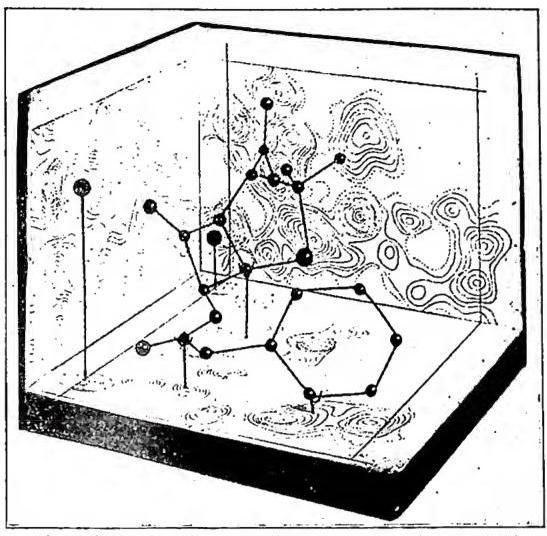
(from E. Chain, Chemical properties and structure of the penicillina, in Endosour, 7 [1913], p. 156) CHIMICA - Model of a benzylpenicillin molecule.
From measuring the dielectric and magnetic constants (v. ELETTROLOGIA) of substances, and measuring the variations they undergo under the action of electric and magnetic fields respectively, it has been possible to calculate the electric and magnetic moments of molecules and to draw useful conclusions concerning their shape, the distribution of electric charges, and the form of magnetic fields.
The results of these and numerous other investigations have, in many cases, made it possible to provide satisfactory answers to certain questions concerning the structure of molecules and the properties of substances.
When molecules (or ions) join together to form crystals, they solve a “minimum problem”: compatibly with the shape of the molecules and with the intermolecular forces, they assume the arrangement corresponding to the minimum internal energy and often, though not always, also to the minimum volume.
In joining together to form molecules, atoms must satisfy a greater number of conditions, not all of them clearly defined; among these are valence, the direction of the valences, affinity, and stability. These are merely different aspects under which the properties of atoms manifest themselves.
Valence has already been discussed in connection with the periodic classification of the elements. The three hydrogen atoms in the ammonia molecule, previously cited as an example, do not assume an arbitrary position around the nitrogen atom, nor do they assume a position of maximum symmetry, that is, the positions of the three vertices of an equilateral triangle whose center is occupied by the nitrogen atom. Instead, they occupy the vertices of the base of a triangular pyramid, the fourth vertex of which is occupied by the nitrogen atom, so that the hydrogen atoms are not arranged around the nitrogen atom but all lie on one side of II. water (v.) the two hydrogen atoms do not lie on a straight line with the oxygen atom; rather, the former form with the latter an angle of 104°-31°. In methane, on the other hand, the four hydrogen atoms surround the carbon atom in positions corresponding to maximum symmetry, namely, at the vertices of a regular tetrahedron, at whose center the carbon atom is located.
Affinity, which has already been discussed, considered as the greater or lesser tendency of identical or different atoms to join together to form a true chemical bond, varies first of all with the nature of the atoms, but also depends on other circumstances: in particular, on the type of bond, as will be said below, and on the nature and arrangement of the other atoms in the same molecule. It is measured by the energy required to separate the two atoms to infinity, that is, to break the bond, while leaving the other conditions unchanged. Certain typical metalloids (H, N, O₂) in the elemental state form highly stable diatomic molecules and therefore constitute examples of very energetic bonds between two identical atoms. Carbon is the only element whose atoms possess a marked ability to join in chains, even very long ones, or in rings or systems of rings, including very complex ones; silicon and sulfur also possess this ability, though less markedly. Oxygen has the capacity to combine with all the elements, naturally excluding the zero-valent elements of the helium series, which form no stable combinations with any element.
The stability of chemical compounds depends particularly on temperature and heat of formation, as well as on other circumstances. Every substance has a limiting temperature of stability, above which it decomposes into other, more stable and often simpler substances. The influence of heat of formation on the stability of substances has already been mentioned: substances formed from the elements with a strong development of heat are stable at ordinary temperatures, whereas those formed with the absorption of heat are unstable. The thermal character varies with the temperature at which the reaction takes place.
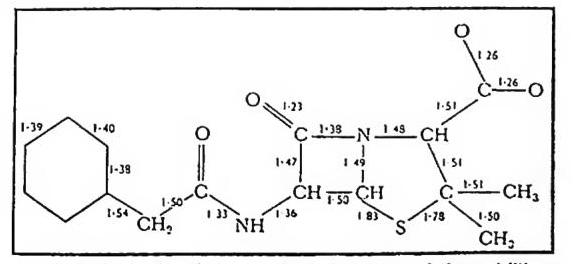
(from E. Chain, Chemical properties and structure of the penicillina, in Endosour, 7 [1913], p. 157)
CHIMICA — Interatomic distances (in Ångströms) in benzylpenicillin molecules.
between the two, the first positive and the second negative, an electrostatic attraction is established: this is the case of sodium chloride Na Cl. Covalence, or a homopolar bond, exists when the two atoms contribute one electron each, so that the two atoms remain bound to each other by a pair of electrons which, in a certain sense, belongs simultaneously to both atoms. The resulting attraction cannot be expressed by means of classical physics models, but is explained only through the mathematical methods proper to quantum wave mechanics.
The forces that establish an attraction between molecules in crystals or liquids, and also in the gaseous state when the molecules approach one another beyond a certain limit, are not essentially different from those established between atoms of the same molecule; but since the electric charges in the molecule have for the most part already been neutralized and the electrons already engaged in intramolecular bonds, the attractive forces that can develop are weaker than those between atoms of the same molecule, and equilibrium with the repulsive forces is established at a greater distance. When intermolecular attractions reach the same order of magnitude as intramolecular ones or exceed them, condensation, polymerization, or other chemical reactions may occur.