
GOLDSMITHING
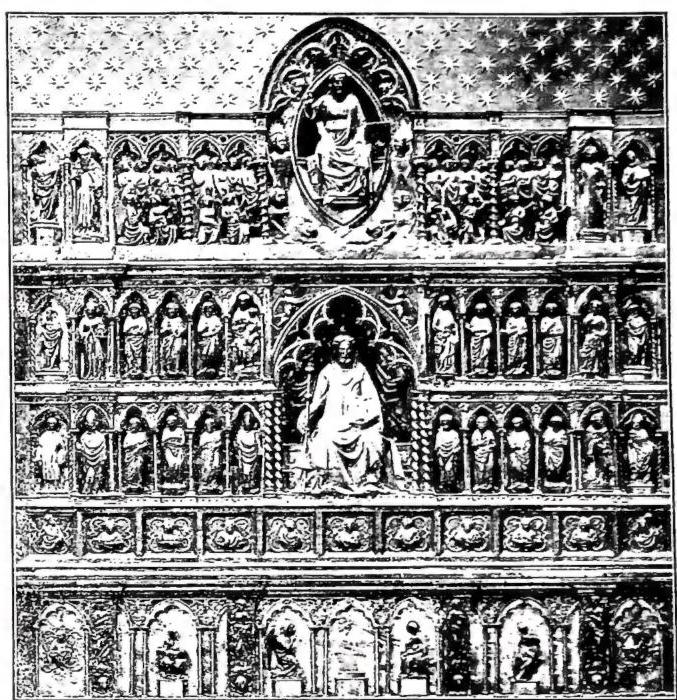
Silver frontal of St. James. Tuscan artists of the 14th and 15th centuries – Pistoia, Cathedral.
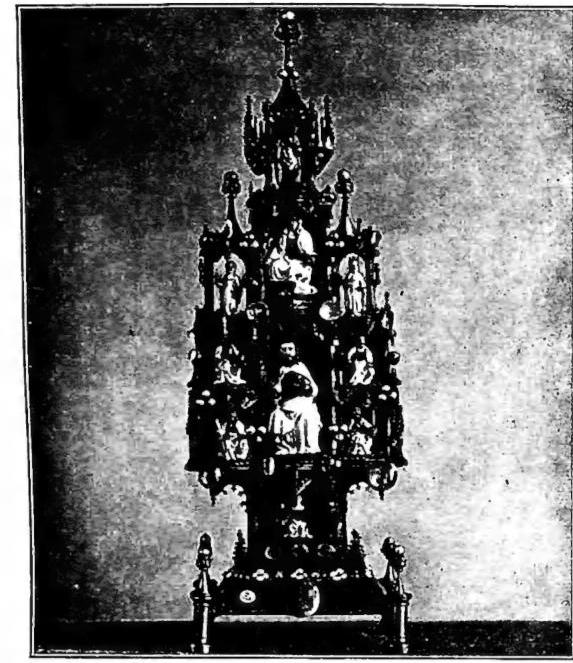
Architectural lines with plastic and chromatic decoration in translucent enamels (urn of St Taurin at Evreux). Linked to French art is that of Flanders, which left very notable works between the 14th and 15th centuries in the Golden Horse of the parish church of Althoing in Bavaria, and in the Calvary of Matthias Corvinus of the cathedral of Esztergom. In Germany few types were repeated that derive from Romanesque models even if their lines took on the intonation proper to architecture.
English goldsmithing of the 15th century shows a decisive orientation toward French models. Very rich was also the production of goldsmithing in the Iberian region, which had very active workshops in Barcelona and Saragossa where themes and models derived from France and Tuscany were elaborated. Typical are the reliquary busts of the cathedral of Saragossa, the tabernacle of the parish church of El Salvador de Burriana in Los Cuevas de Canart, the crosses adorned with enamels of the churches of Cuencabuen, Linares and Parrears on the island of Majorca, the chalices of the cathedrals of Tortosa and Toledo.
It was in this period, moreover, that the guilds of goldsmiths began to form, which established statutes relating to the alloy of silver and gold, the obligation to hallmark works and the rules for verification. Not all silverware, however, bears such a hallmark and the signatures of the authors and the consuls who were to verify them; this practice became general almost only in the 18th century. In Tuscany goldsmithing, already in the Gothic period, had vividly participated in pictorial and plastic problems and had remained so closely tied to the other arts that it necessarily had to follow the progress made in the first half of the 15th century. Above all, the effects deriving from the Florence-Siena and Siena-Florence contacts found in goldsmithing an explanation as direct as in no other decorative art. At the end of the 14th century the relations between Siena and Florence were these: Siena held the field for a most refined decorative sensibility that drove it predominantly toward pictorial forms: in a century it had pushed the small translucent decorative enamels of Guccio di Mannaia to the painted enamels of the reliquary of Ugolino di Vieri; Florence, instead, absorbed and imitated all the decorative achievements of Siena but, for its part, was inclined to transfer, where possible, into the very ductile material, researches more properly sculptural. The Sienese work led to the reliquary of Ugolino da Vieri; the Florentine to the frontal of Pistoia. But Siena could not free itself from Florentine imitation and in the first half of the 15th century the frontal of the baptistery of St John is a work of sculpture in which notable artists such as Verrocchio, Pollaiuolo, Michelozzo and the most expert goldsmiths participated; in Florence the most skilled sculptors, GHIBERTI, LORENZO (v.), Antonio Pollaiuolo (v.), were active. These were the greatest, but, as Benvenuto Cellini says, there have been countless of this art of gold. All of us Florentines, Cellini also was a goldsmith and sculptor, whose truly excellent technical virtuosity and acute sensitivity in sensing the voice of the material are well known. He worked among renowned goldsmiths whom he praised and criticized, such as Luca Agnolo, Amerigo Amerighi, excellent in enamel work, Piero di Nino, expert in filigree, Luciano da Jesi. Rare works are associated with names: the salt cellar of gilded silver in the Museum of Vienna to Benvenuto Cellini, the Farnese casket in the National Museum of Naples to Antonio Manno and Giovanni di Castel Bolognese, the gilded silver cross in the Vatican Basilica to Antonio Gentile, the pax of Pius IV in the cathedral of Milan to Cardasso, the pax in the Treasury of the cathedral of Palermo to Sansovino, the Evangeliary of the cathedral of Padua to the goldsmith Alvise, the cover of the Grimani breviary in the Marciana Library to Alessandro Vittoria, to Pietro Lierni the cross of Domaso, to Girolamo delle Croci, to the Rocchi brothers, to Giulio Danti, to Bartolomeo Spano many other works, to Lodi (church of the Incoronata), to Perugia (Cathedral), to Reggio Emilia (Cathedral); but all the goldsmiths of the Renaissance, although working in workshops where different survivals of previous centuries remained, ended up using the same techniques and drawing on the same decorative repertoire. And this not only in Italy but almost everywhere throughout Europe. The technique of minute, fragile, most elegant relief is common to all goldsmiths. The relief determines small planes, very mobile surfaces multiplied by facets with continuous possibilities of creating effects of calm and pleasing light, aristocratic decorations and, made in filigree, composes fragile and graceful objects; the pearl, united with pale gold, had very delicate applications in Venetian jewels. It is impossible to recall all the artists who in the 17th and 18th centuries worked for the Church and for palaces. Reference may be made to the Filiberti family, of whom many works remain in Parma; to Giovanni Giardina, to Giuseppe Galardi, to Antonio Gigli; to Carlo Guarnieri; to Filippo Tofani, to Angelo Spinazzi, to Giuseppe D'Angelo, to Pietro and Filippo Juvara. To interrupt this admirable production, which even in Lisbon for the furnishings of the chapel of St John supplied by Roman goldsmiths, and in Spain for the silverware of Sicily sent by the viceroys, aroused enthusiasm, the neoclassical fashion intervened: it solidified volumes, stopped and stiffened the undulating decorative lines, tired the hands, numbed the imagination. Decorative motifs drawn from Egypt penetrated: lotus and palmette leaves on the bases, on the shafts shaped like columns sometimes fluted with Ionic or Corinthian capitals; the use of cameos in jewels was appreciated, as were engraved gems in Hellenistic imitation, but, in general, the golden age of goldsmithing seemed now to have ended, above all because at the end of the 19th century the use of mechanical production invaded, which could give imitations of the antique according to types adapted to the functions of the Church and to the needs of civil life. The execution of the unique piece was considered an exception and the work of isolated artists who continued to maintain in Milan as in Florence as in Venice and in Palermo nobility of technique and felicity of invention. – See plates XV-XVII.