
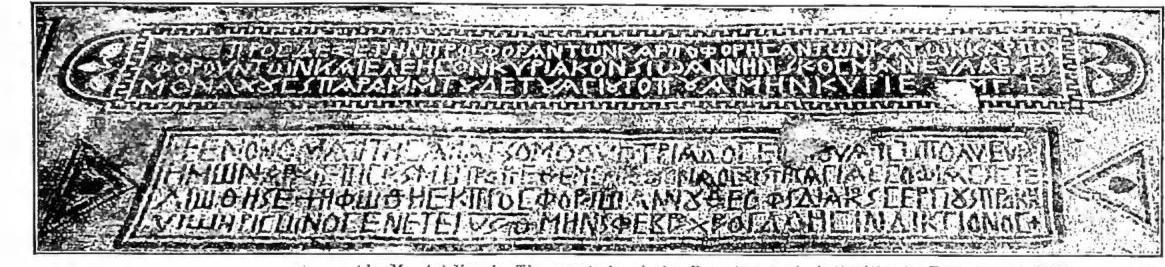
PALESTINE — Inscription commemorating the competition of the deacon JOHANNI for the erection of the church of St. Sophia (Feb. 604) — Halid al-Kifaji.
suitable places where a monastery with cells and cloisters could easily be built. Among the best preserved from the Byzantine period are Sijāgāh (completely excavated), Sijar el-Ganem near Bethlehem (with fine water installations), and Hān el-Aḥmar (5th cent.), which have a walled complex with several cells. Of the double installation by the Jordan of St. Gerasimus almost nothing remains, since the cells were made of very weak materials. At first a cave served as a church, but in the 5th cent. many churches were built (Mār Sābā, Kossiba, Wādi Fārah, etc.), usually single-naved with pillars, though rock-cut chapels were not entirely abandoned.
Christian cemeteries in P. are often rock-cut chamber tombs with arcosolia. The chambers are rarely painted and the repertory is limited: crosses, birds, palmettes (Gethsemane, Bejt Gibrīn, 'Ajn Kārim), perhaps a figure of an angel (Qolōnjijah). The cross is always placed on the pediment and is added if the tomb is reused ('Ajn Hannieh, Jerusalem, etc.). This type of tomb is sometimes built of masonry, e.g., the complex near the Gate of St. Stephen in Jerusalem. The catacomb or gallery system, though with few examples, is also known, e.g., the so-called ‘Tombs of the Prophets’ on the Mount of Olives with a semicircular plan. Many grave stelae are scattered everywhere, showing that open-air cemeteries were also widely used. They bear the cross, the name of the deceased, and a brief phrase. To find formulas of distinctly Christian flavor one must ordinarily go down to the 6th cent. The date is reckoned by local hours: Eleutheropolis (Bejt Gibrīn, Gaza), Scythopolis (Bejsān), Bosra, Pompeiopolis, etc. In churches and monasteries there are polyandria, i.e., very deep common graves, fitted with a ring at the mouth where three stones were placed, one of them pierced (pellai-kon) so that it could be easily removed. Sometimes the graves are covered with mosaics (Sijāgāh, the church of Antimus at Jericho, 'Amwās, Bejsān, etc.).
Pottery continues without notable differences from the Roman period, with jars, cups, plates, etc., well fired. The vessels are coated with black slip and decorated with white lines, or only with cinnabar stripes in geometrized floral patterns, rarely with any figure. Rouletting and many molded rims are used as relief decoration. Sigillata ware, less precise than in earlier times, bears the cross in various forms ('Ajn Bejt Sūriq, 6th cent.), Sijar el-Ganem (plain of Jericho), an indeterminate human figure (Sijāgāh), perhaps an imperial personage (Bejt Alfah, Synagogue), and may represent Jesus Christ (Jericho). Among the plates, one for polycandela found at Gallico is notable; it bears the inscription: ‘S. THEODOSIUS: Josephina, humble monk,’ and one found at 'Ajn Kārim (Visitation) which has the letters IC XC YC OY beside the cross and the names of JOHANNI and PAUL. The earthenware lamps generally have an elongated ovoid body, well fired but with very restrained decoration: the cross in many forms, palmettes, and a few inscriptions, among which the two most common are: AYXNAPIKA KAAE and QOC XY FENH IIACIN. There is also a ‘heart-shaped’ type, less well fired, with fine decoration including scenes and animals, but it seems to have developed after the 6th cent. Stamps for bread, bricks, etc., often bear the cross with the A and Ω, sometimes only outlined with dots (Sijāgāh) or planted on Calvary in a pyramidal arrangement of three (Tulul er-Rūsum near Gaza). Some small earthen flasks, evidently used for holy oils, have two small handles at the mouth and walls adorned with simple representations dominated by the cross and the three crosses on Calvary (Sion, Ophel) or doves, small vessels, and palms ('Ajnabus near Nābulus). Certain sun-dried clay disks, bearing impressions of scenes of the Nativity, the Annunciation, the cross, and the legendary concealment of St. JOHANNI in the mountain (a disk preserved in Bobbio and coming from 'Ajn Kārim), are known as eulogiae.
Many metal objects survive, such as the ampullae (v.) preserved in Bobbio and Monza, which came from P. via the consul Leontius (late 6th cent.) and were sent to St. Gregory the Great. They are believed to reproduce some compositions existing in P. at that time and some representations of the Holy Sepulchre with elements perhaps copied from life. Many chains come from church excavations, with rings interspersed with crosses for polycandela and censers. The latter have a rounded, segmented bowl (Jericho) or plain (Muḥmās), or paired (Bejsān), or hexagonal (Nestorian hermitage near Jericho). Few candlesticks are known, round and unadorned ('Ajn Bejt Sūriq, 6th cent.). Metal lamps often have the cross as a handle. Medallions found in tombs sometimes depict the Lord and the Virgin (lead seals at Bejsān, monastery) or figures of saints including St. George and another on the cross blessing, perhaps a stylite. It is noteworthy that the latter were found together (at el-Gīs, ancient Gisala) with others bearing the mystical eye to ward off the evil eye and the common inscription: EIC OEOC O NIKN TAKA KAA. Rings are often plain; one is notable for its symbols: serpent, eagle, and lion (Ashkelon), others bear the word YIYA followed by a name, and one with crude figures of the Saviour and the Virgin (Gezer). Metal weights likewise ordinarily bear the cross with surrounding ornaments or beneath a loggia, sometimes (lead) on Calvary.
Glass continues the repertory of the Roman period: many weights and chalices are of glass, including the fine example found at Gerasa, which shows sheep at the symbolic plant and doves. Glass lamps have a simple bowl and a tapering foot for insertion in polycandela, ending in a small roundel. Window glass is yellowish and thick, or folded and curved with a large radius. It is set in plaster, which is supported by fragments of brick laid one upon another like a small column.
3. From the 7th to the 12th cent
From inscriptions it may be inferred that Christians continued to build or at least repair churches until the 8th cent. Notable examples are those at Sbejṭah (711 and 725–35) and 'Awgā el-Hāfir (767–68) in P. and at Quwejsmeh (717–18) and Mā'n (719–20) in Transjordan. Under Yazīd II (722–23) the iconoclastic movement began, which spared neither sacred images nor human figures in mosaic pavements. It is hard to say whether churches that show undamaged mosaics were abandoned before this date. As buildings, the reconstruction of the Holy Sepulchre in the 11th cent. after the fierce destruction by al-Hākim (1000) is notable, as is the erection of the church of the Holy Cross near Jerusalem, still extant, while nothing remains of the once-famous church of the Amalfitans. Graffiti found in the Arab palace at Meferg, near Jericho (8th cent.) and elsewhere attest that Christians participated in the creation of Arab art works.From the 12th to the 13th century. – In these centuries there was an almost incredible building movement: churches and castles sprang up everywhere, mostly of rather large proportions, built with hewn or rough stones in the parts not visible. The walls are 2 m thick so as to support the weight of the massive vaults. The plans are mostly of basilican style, except when there was an adaptation of ancient structures, as at the Holy Sepulchre and the Ascension. The workers cut the stones diagonally, so that today the diagonal tool marks left by their instruments serve as a characteristic of this period. The walls were literally covered with paintings and mosaics, which unfortunately have come down to us in a very fragmentary state. Among the paintings, fragments from Abū Gōs (Saints, Bosom of Abraham) stand out, as well as the stele from Bethphage, the work of a very skilled and somewhat independent artist (Raising of Lazarus, Disciples Taking the Asses, Palm Procession), from Bethlehem (in a chapel and on the columns of the Basilica), very rough and primitive (Deesis and saints), from Sebaste (Invention of the Head of St John, defaced by workers when it was found in 1931), and from Dej Mükelik (Christ with Saints and Crucifixion). Among the mosaics, a fragment of the Ascension on Calvary and parts of three scenes from the life of Christ (Entry into Jerusalem, Transfiguration and Ascension, Nativity in the Grotto), saints, angels and representations of councils in the Basilica of Bethlehem stand out. Among the sculptures that escaped vandalism, a “kiss” or “embrace” from the hospital of St John (now in the Museum of the Flagellation), the artistic capitals of Nazareth with scenes from the life of Christ and the Apostles, which were buried before being placed on the façade of the Basilica, the fine capitals with figures of monstrous animals from the Ascension and the cloister of Bethlehem, the beautiful frames of the Holy Sepulchre and above all the sumptuous portal of the same Holy Sepulchre, which bears scenes from the last week of Our Lord’s life (Last Supper, Raising of Lazarus, Palm Procession). The altars are built of masonry (St Helena at the Holy Sepulchre) and also feature painted panels (St Stephen). There is a series of bells, one with the inscription Vox Domini, others with a single letter and one with handles in the form of winged dolphins. They were accompanied by about a hundred organ pipes.
Pottery has no special characteristics and continued to be made by the Arabs, from whom it takes its name, by hand (rough vessels painted with minium) and on the wheel. Beautiful glazed ware has been found, but mostly with geometric designs (Emmaus el-Qubejbeh) and rarely with floral designs, coats of arms and small human figures (Aftit). The lamps are always elongated in shape, but often bear Arabic inscriptions without the formal Muslim characteristics. – See plates XLIII–XLV.