
PATTI LATERANENSIS. — These are the agreements concluded between the Holy See and the Italian State on 11 February 1929, which resolved the Roman Question (q.v.).
The resolution of the dispute, which for about eighty years had divided Church and State in Italy and troubled and saddened consciences, followed a period of preparation that, considering only the post-war years, dated back to the Cerretti-Orlando talks (May 1919) and found its foundation in the negotiations initiated by the Mussolini cabinet after it came to power.
To the desire for an agreement, generously expressed by the new Pope Pius XI (q.v.) at the very moment of his ascension to the papal throne, with the blessing from the external loggia of St Peter’s, and confirmed in the encyclical *Ubi arcano*, the Italian government responded, in turn, with the drafting of a Bill for the reform of ecclesiastical legislation (March–December 1925); this Bill, prepared by a commission presided over by the Italian Undersecretary of Justice and including, though not officially mandated, some ecclesiastics, was intended to address the complex issue of ecclesiastical property in implementation of Article 18 of the Law of Guarantees (q.v.; see the commission’s report and draft bills in A. Giannini, *Concordati postbellici*, II, Milan 1936, pp. 455–92).
However, with a chirograph dated 18 February 1926, addressed to the Cardinal Secretary of State (AAS 18 [1926], pp. 84 sq.), Pius XI declared that in such matters no rights or powers of legislation could be recognized in others except through appropriate negotiations and legitimate agreements with the Holy See. Following this declaration, the Italian government shelved the Bill, and shortly thereafter (14 May 1926), the Minister of Justice Rocco announced to the Chamber of Deputies that studies on the matter would be resumed on a broader basis.
These negotiations were to take place between the representative of the Holy See, the lawyer Prof. Francesco Pacelli (q.v.), and that of the Italian government, the State Councillor Domenico Barone, who was pressed to conclude the agreements. The talks, begun privately on 6 August 1926, became official on 4 October of the same year. On 24 October, the Holy See presented its detailed proposals, which also included a draft convention regulating the legal status of the Church in Italy, i.e., the future Concordat. Pacelli and Barone signed a draft of the Treaty on 24 November and prepared two drafts of the Concordat in February 1927.
The continuation of the discussions was hindered by various events, including the controversies surrounding the establishment of Fascist youth organizations, which culminated in the Holy See’s forced dissolution of the Boy Scouts (cf. chirograph of 27 January 1927, AAS 19 [1927], pp. 41 ff.). It was only in November 1928, after countless sessions and the preparation of the documents in their final form, that plenipotentiaries were appointed, namely the Cardinal Secretary of State and the Italian Prime Minister. On 7 February 1929, the Cardinal Secretary of State announced to the diplomatic corps accredited to the Holy See the imminent signing of the agreements, which took place in the Lateran Palace on the 11th of the same month. Ratification was exchanged on 7 June, and on that day Law No. 810 of 27 May 1929 entered into force, making the agreements executable in Italy.
The Lateran Pacts (q.v.; see the text in AAS, 21 [1929], pp. 209 ff.) consisted of: I. a Treaty of 27 articles with four annexes (1, plan of the territory of the State of the Vatican City [q.v.]; 2, list of properties with extraterritorial privileges and exempt from expropriation and taxes; 3, list of properties exempt from expropriation and taxes; 4, financial convention); II. a Concordat of 45 articles governing the conditions of the Catholic religion and Church in Italy.
The Treaty, in Article 1, reaffirms “the principle enshrined in Article 1 of the Statute of the Kingdom of 4 March 1848, by which the Catholic, Apostolic, and Roman religion is the sole religion of the State.”
Article 2 recognizes, on Italy’s part, “the sovereignty of the Holy See in the international sphere as an attribute inherent in its nature.”
Article 3 recognizes “the full ownership, exclusive and absolute sovereign power and jurisdiction of the Holy See over the Vatican, as it is currently constituted, with all its appurtenances and endowments, thereby creating the Vatican City”; while Article 4 establishes that within the City “no interference by the Italian government may be exercised and that no authority other than that of the Holy See shall exist.”
Under Article 8, “Italy, considering the person of the Supreme Pontiff sacred and inviolable, declares punishable any attempt against him and any incitement to commit such an attempt with the same penalties established for attempts and incitement against the person of the King” (now the President of the Republic, Articles 276–77 of the Penal Code). Furthermore, “public insults and injuries committed in Italian territory against the person of the Supreme Pontiff through speeches, acts, and writings shall be punished as insults and injuries against the person of the King” (now the President of the Republic, Article 278 of the Penal Code).
The delicate legal situation of organs, persons, and things pertaining to the supreme governance of the Church is outlined in Articles 9, 10, and 11 of the Treaty. These establish (Article 9) that “all persons having stable residence in the Vatican City shall be subject to the sovereignty of the Holy See”; that (Article 10) “the dignitaries of the Church and the persons belonging to the Papal Court, to be listed in an agreement between the High Contracting Parties, even if not citizens of the Vatican, shall always and in every case be exempt from military service, jury duty, and any personal service in relation to Italy (while equal treatment is provided for other officials of the Holy See in official roles)”; and that (Article 11) “the central institutions of the Catholic Church shall be exempt from any interference by the Italian State (save for provisions of Italian laws concerning the acquisition of corporate bodies), as well as from conversion in respect of immovable property.”
Under Article 12, “Italy recognizes the Holy See’s right of active and passive legation according to the general rules of international law”; while Article 19 stipulates that “the diplomats and envoys of the Holy See, the diplomats and envoys of foreign governments accredited to the Holy See, and the Church dignitaries coming from abroad and bound for the Vatican City... may... pass through Italian territory to reach it” (cf. LEGAZIONE, diritto di; CORPO DIPLOMATICO; CORRIERI DIPLOMATICI; AGENTE DIPLOMATICO).
Articles 13–16 recognize the ownership, immunity, and exemption from expropriation and taxes of certain properties belonging to the Holy See. In turn, the latter, in accordance with Article 18, shall “keep accessible to scholars and visitors... the treasures of art and science existing in the Vatican City and in the Lateran Palace.”
While this is implicit in both the preamble and the content of the Treaty, the final paragraph of Article 26 (cf. also Article 45, paragraph 2 of the Concordat) expressly abrogates Law No. 214 of 13 May 1871 (the Law of Guarantees [q.v.]) and “any other provision contrary to the... Treaty.”
The Concordat, which accompanies the Treaty, regulates “the conditions of the Catholic religion and Church in Italy.”
While referring, for the examination of these conditions, to another entry (ITALIA, IV), it should be observed here that they are based on the following fundamental principles: 1) assurance by Italy of the "free exercise of spiritual power," the "free and public exercise of worship, as well as... jurisdiction in ecclesiastical matters in accordance with the norms of the... Concordat" (art. 1); 2) establishment of forms of particular favor for ecclesiastical persons and entities (arts. 3-4, 6-8, 29 h para. 1, 30 para. 3); 3) recognition, within Italian law, of norms and relationships of the Church's legal system, especially regarding marriage (v. MATRIMONIO, IV, II) and education. All these norms, taken together, contribute to orienting the Italian legal system—if not in a strictly confessional sense—toward considering the position of the Catholic religion and Church as invested with particular prestige.
Some observations are necessary regarding the nature of these documents and their legal value. First, they constitute a solution based on a bilateral agreement, in conformity with what had always been requested by the Holy See; in this regard, they stand in opposition to the unilateral discipline established by the Law of Guarantees. It should also be noted, however, that this solution was achieved without the intervention of any other subject of international law; this contrasts with proposals, repeatedly advanced, that envisaged the participation of other states in the conclusion of the agreement, with the aim of ensuring greater stability for II.
The protocols, Treaty, and Concordat must be considered acts having relevance in the international legal order. As regards the first, there is no doubt that it is a genuine international treaty, stipulated between the Italian State and the Holy See, as the supreme organ of the Catholic Church, which already possessed international personality prior to the stipulation. With regard specifically to the Concordat, the most authoritative doctrine unhesitatingly affirms its international character (v. CONCORDATI). It should be further observed that it too was stipulated by the Holy See as the supreme organ of the Catholic Church (in the same capacity assumed in the Treaty) and not, as some have argued, as the representative of a hypothetical Italian national church.
A matter of great importance is that concerning
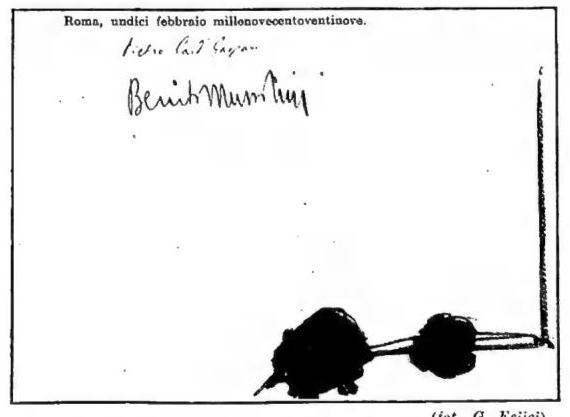
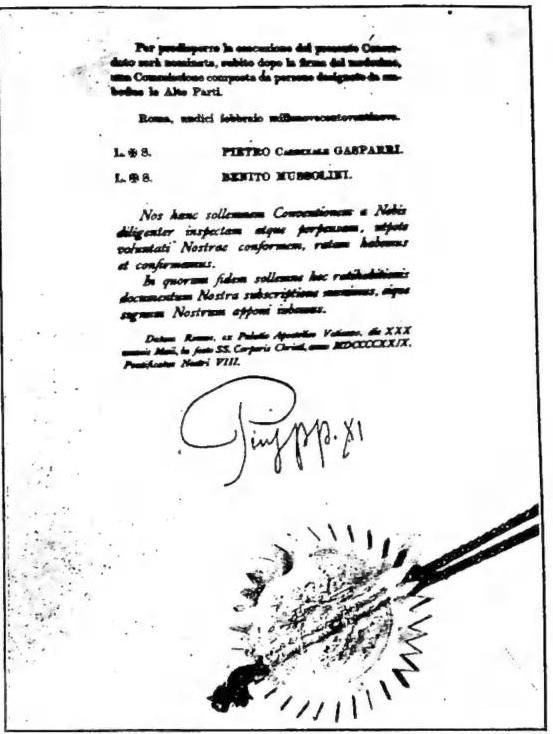
LATERAN PACTS - The signatures of Cardinal P. Gasparri and B. Mussolini and the seals affixed to the Lateran Pacts (11 Feb. 1929).
32. - ENCYCLOPEDIA CATHOLICA. - IX.
To publish the subsequent issue of the present Cimento, given with insistence, we have given the signature of the same, with the cancellation composed by persons delegated in a free manner by Ab. Parf.
Rome, eleven February one thousand [recently sent].
L. 8. PETRO CAMERATA GASPARRI.
L. 9. BERTO XUBOULETI.
No concording solicitations are made to Nello diligently in the inexistence of every pertinence, with respect to voluntary matters. Our conference, we believe, is not in a position to confirm.
Insofar as they solicit documented requests, our request is not in a position to confirm.