
PIENZA, DIOCESE OF - Episcopal Palace (15th century) - Pienza.
It comprises 108 churches and oratories, served by 44 secular priests and 10 regular clergy; 72 religious sisters. The patron saint of the diocese is St Andrew the Apostle, feast day 30 November.
I. ORIGIN AND DEVELOPMENT OF THE DIOCESE
Pienza, a small town in Tuscany, in the province of Siena, 52 km from that city and about 8 km from the Cassia road, stands on a hill (491 m) and is one of the most characteristic towns of the region, a true jewel of the early Renaissance. «Born of a thought, a dream of beauty» (Pascoli) of Pius II (L. S. Colonini [q.v.]), who was born there on 18 October 1405, when it was still the modest village of Corsignano; it arose as if by magic in little more than three years, from 1459 to 1462, after 22 February 1459, when Pius II, returning for the first time to Corsignano, conceived the bold plan of transforming his birthplace into a city. Once entrusted with the task, Rossellino set to work at once, assisted by the ablest Sienese of the day.The Pope passed through again on his return from Mantua to Rome in September 1460. By August 1462 the works were almost completed, and the Pontiff returned to inaugurate the realization of his dream. With the bull Pro excellenti of 13 August 1462 he renamed old Corsignano Pienza and raised it to the status of a bishopric. On the 29th of the same month the cathedral was consecrated, and on 7 October Pienza had its first bishop in the noble Sienese Giovanni Cinughi.
Alongside Pienza, Pius II raised Montalcino to the status of a city and diocese, making them both principal sees. Moreover, they were placed under the direct jurisdiction of the Holy See; they were formed from parishes detached from the dioceses of Arezzo, Chiusi and Grosseto. They remained united or separate from time to time, until Clement VIII finally separated them on 23 October 1594. On 17 June 1772 Clement XIV united Pienza and Chiusi aequae principaliter; this union still endures, with both dioceses remaining under the direct jurisdiction of the Holy See. The diocese of Pienza was for a long time in the hands of the Piccolomini (q.v.).
II. RELIGIOUS MONUMENTS
Parish church of SS. Vito and Modesto. About 1 km from the centre (to the west). The church of ancient Corsignano: a Romanesque construction of the 11th–12th centuries, in rough tuff blocks, restored in 1925. Pius II and Pius III were baptized there. S. Francesco, a Romanesque-Gothic church, predating the foundation of Pienza, restored in 1905. The cathedral (dedicated to the Assumption), built on the site of the ancient church of S. Maria, of which traces were found in 1932. It is a blend of classical and Albertian forms on the façade, Gothic and Renaissance elements inside, with a radiating apse and three naves of equal height, supported by four-column piers. This is how Pius II wanted it, imitating churches he had seen in Austria. The church is so luminous that the Pope himself called it ‘domus vitae’. Perhaps uniquely in history, on 16 September 1462 the Pope, in order to prevent any alteration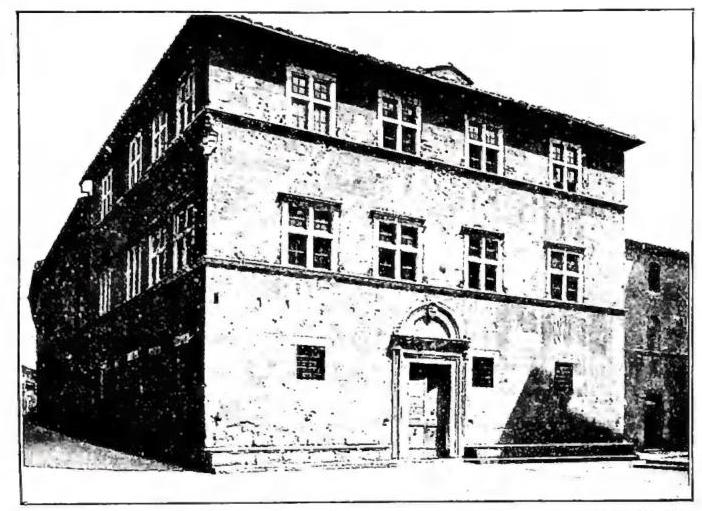
Pienza, diocese of - Episcopal Palace (15th century) - Pienza.