
PORTO-ROYAL. – A Cistercian monastery founded in 1204, raised to the status of an abbey in 1212, famous in the 17th century as the center of Jansenism (v. GIANSENIO and GIANSENISMO).
Located in the Chevreuse valley, two hours’ walk from Versailles (hence called P.-R. des champs), in 1626 it was moved to Paris in the suburb of St-Jacques (P.-R. de Paris) due to unhealthy air. The abbey would have become the French center of Catholic spirituality within the Counter-Reformation had not Saint-Cyran turned it into a source of religious unrest and disorder. For this reason, on 29 October 1709, the nuns were removed by royal decree, and on 29 January 1710 the abbey was demolished. On its ruins
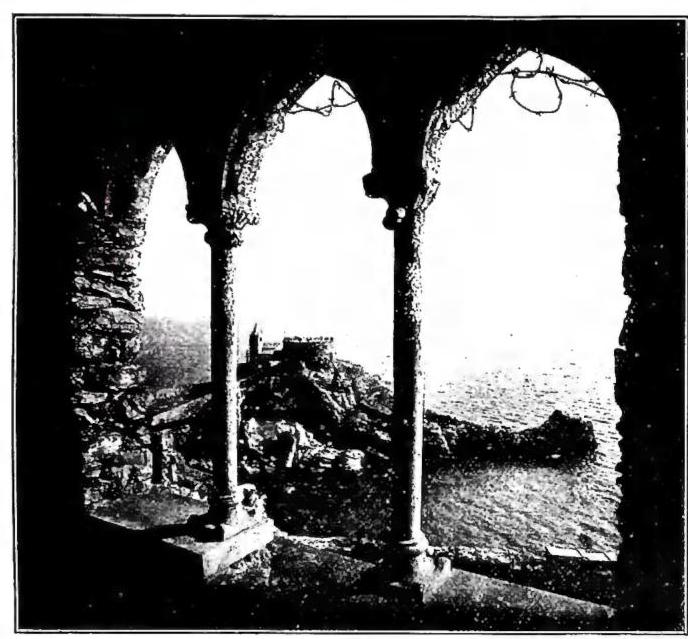
Porto Venere, Sanctuary of – View from a Gothic triforium (14th century).
the dispersed Jansenists gathered in melancholy pilgrimage; famous among these was the one held on the centenary of its destruction, commemorated by Eustachio Degola (v.), the surviving Genoese Jansenist. Subsequently, P.-R. became a myth to which Mme de Sévigné, Racine, Voltaire, Sainte-Beuve, Renan, and Gazier lent their historical-literary cult, viewing it variously as a spiritual Lyceum, a mystical Thebaid, or a school of humanism. Influences from the Oratorian spirituality of Bérulle and that of St. Francis de Sales might have enabled it to achieve such aims had not Du Vergier de Hauranne steered this moral revival toward heresy and schism. The original sin of P.-R. was the *Augustinus* of Jansenius, whose doctrine, though softened by the sensibility of the Port-Royalists, retained the pessimistic vision of the world and life. To this was added an “angelic pride” and a “spiritual wrath” that, intolerant of the authority of the Church’s magisterium, led souls to live within the Church despite the Church, with equivocations and ambiguities that remained typical of Jansenist developments and were almost identically repeated in all its epigones, along with the mystique of disobedience. P.-R., the spiritual family of the Arnaulds (v.), especially of Mère Angélique, its reformer, consisted of Les Vierges, Les Messieurs, and Les Petites Écoles; these were centers of education and cultural institutions run by nuns and solitaries. The nuns managed boarding schools where they received girls destined for the cloister or the world, while the solitaries ran the proper schools where they instructed boys. From these boarding schools and schools emerged nuns and women of Parisian high society, as well as distinguished men such as Pierre Nicole, Blaise Pascal, and Racine.
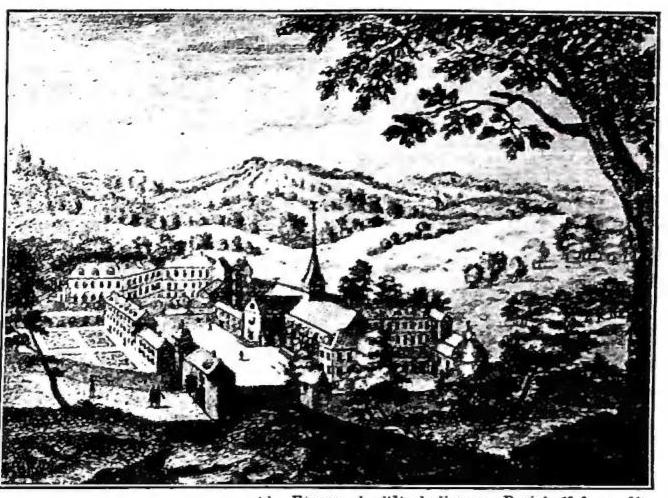
Les Messieurs, laymen or ecclesiastics known as solitaries, were spiritual sons of Saint-Cyran, to whom the entire reforming idea is owed. They served as confessors, directors, and teachers in the Petites Écoles: an association, therefore, of pious individuals, grouped in small numbers, who worked simultaneously in their respective states toward the salvation of souls. In their endeavor to imitate the Christians of the early Church, they devoted four hours a day to spiritual and manual labor and to personal and common prayer that echoed through the valley of P.-R. des champs. Their directors included Singlin, Mangeuleine, and Le Maître de Saci, nephew of Angélique Arnauld, an illustrious orator and lawyer, counselor of state, who had abandoned his profession to found this family of hermits, known as “fathers of the desert,” in the new Thebaid of P.-R. Some of them also undertook humble offices, such as De la Petitière, the best soldier in France, who, as penance after a duel, took up the trade of shoemaker, and De la Rivière, a scholar of Hebrew, Greek, and Spanish, who became a forester.
The solitaries numbered 10 in 1647 and 25 in 1652, gradually increasing. Les Vierges, the spiritual daughters of Angélique Arnauld, often came from families of lawyers and magistrates. They were inclined to see miracles everywhere, to find in Scripture texts that precisely justified the circumstances of their conventual and worldly lives, and to regard every idea of their own minds as divine inspiration, every act of their apostolate as a sacred mission, and every contradiction as persecution. They could not tolerate being accused of Jansenism, nor could they endure condemnations of Jansenius, Saint-Cyran, or Arnauld. When the Pope or a high ecclesiastical superior demanded submission, rather than obeying inwardly, they would chorus: “Blessed are those who suffer persecution for righteousness’ sake.” Among them, Jacqueline, Pascal’s sister and “la directrice,” as well as the sisters of Angélique Arnauld, were notable.
Within the walls of P.-R., theology, mysticism, asceticism, and the Jansenist diplomatic corps strangely mingled, and the pages of Jansenius’s *Augustinus* served as a textbook, alongside *Lettres chrétiennes et spirituelles* of Saint-Cyran and the treatise *De la fréquente Communion* by Antoine Arnauld. These works were later supplanted, in the saddest hour of the abbey, by Quesnel’s *Réflexions*, which united all the preceding motifs of heresy into its fundamental and undisputed code. To these documents must be added the *Lettres* of Angélique, Madeleine, and Agnès Arnauld to grasp the intimate chronicle of Jansenist rigorism, which had P.-R. as its experimental center, not excluding *Le chabolet secret du St.-Sacrement*.
In the austere awareness of a distant Father God, a severe Christ as judge and mediator, and a Mary exalted by a “terrible” dignity, in a vocabulary where the terms “inaccessible,” “incomprehensible,” “incommunicable,” and “ineffable” are frequent, in a complicated and rigid sacramental life, P.-R. shut itself within its ancient walls in a cold piety, a Stoic pride, for a perfection without holiness, following a logic—the *Logique de P.-R.* of Antoine Arnauld—that was always tempted and never resolved.
Portsmouth, Diocese of. – A city in England. The diocese (a suffragan of Westminster) was founded in 1882 by division from the Diocese of Southwark. It comprises the counties of Hampshire and Berkshire, the Isle of Wight, and the Channel Islands. Its patrons are the Immaculate Conception and St. Edmund of Canterbury. It has approximately 124 parishes, served by 13 diocesan priests and 254 religious.
It contains the abbeys of Douai (Woolhampton), Quarr (ancient, refounded in 1908), Farnborough (1884), of Benedictine monks, and Ryde (of nuns, 1882); in all, there are 64 religious communities (43 in 1910). It has 148 public churches, 33 private and institutional chapels. The population (1931 census) is 1,399,969, with about 60,000 Catholics. There are 36 elementary schools and 38 others, 6 hospitals, and 6 orphanages. In 1949 there were 376 converts, 256 infant baptisms, and 350 marriages.
The diocese is roughly coterminous with the ancient Diocese of Winchester, suppressed by Elizabeth in 1559; since 1940 its bishop has been Msgr. John Henry King; his predecessors were John Vertue (1882–1900), John Baptist Cahill (1900–1910), and William Timothy Cotter (1910–1940). The dio
The see of Winchester dates from 635, among whose bishops were St Swithun (852–62), St Elphage (984–1006), William of Wykeham (1367–1404), Waynflete (1447–86), Richard Fox (1500–1509), Thomas Wolsey (1529–30), Stephen Gardiner (1531–55) and the last, John White (1556–60). In the cathedral, dedicated to St Swithun, the marriage of the English queen Mary to Philip II of Spain was solemnised in 1554. It is also a magnificent example of Romanesque and Gothic architecture of the twelfth to fifteenth centuries. Notable too are the churches (once abbeys at Romsey and Dorchester, the latter a cathedral church from 634 to 1085, when it was transferred to Lincoln), and the ruins of the abbeys of Abingdon, Beaulieu, Netley and Reading. From the ruins of the last, Pugin built a Catholic church in 1837. William of Wykeham founded the collegiate school at Winchester in 1378 and the pious king Henry VI that at Eton in 1441.
In the apostasy of the sixteenth century Hampshire remained largely faithful. Under Henry VIII the Venerable Thomas Dingley and the Blessed John Rudge were martyred in 1539; the Blessed Margaret Pole, mother of Cardinal Pole, in 1541; and under Elizabeth I the Blesseds John Slade and John Body (1583), Thomas Hemerford and John Mundyn (1584), Swithun Wells, Lawrence Humphreys, Roger Dicconson (a native of Lincolnshire) and Ralph Milnes (1591), and the Venerables John Adams (1586), Thomas Pilchard (1587), Robert Nutter (1600), Nicholas Tichborne (1601) and Thomas Tichborne (1602). The Blesseds Robert Anderton and William Marsden, from Lancashire, were captured and martyred on the Isle of Wight in 1586. The Blessed Anne Lynne lived for some years in Hampshire. The pupils of Winchester School were forced by military violence to attend Anglican worship in 1559; at that time the prisons were filled. In 1645 the Catholic garrison at Basing House, which had resisted the Puritans, was burned. In the eighteenth century Richard Challoner, Vicar Apostolic of the London District, visited Berkshire and Hampshire in 1741 and 1749. The priest John Milner carried out a mission in Winchester between 1779 and 1803. From 1903 many religious, both men and women, found refuge there from masonic persecution in France, among them the English Benedictine monks who came from Douai to Woolhampton in 1903.
During the Second World War (1939–45) the Channel Islands were occupied by the Germans; several Catholic churches were destroyed and others damaged. In 1946 many hitherto unknown letters of Robert Parsons and others were found at Milton. In the same year the body of the pious Richard Challoner was transferred from the Barrett family’s Catholic tomb at Milton to Westminster Cathedral.