
REGIO, ISAAC SAMUEL. - Hebraist, b. at Gorizia in 1784, d. there in 1855. From 1810 professor of history and geography at the local Lyceum, and from 1846 honorary rabbi in succession to his father Abraham, R. is an authentic representative of the Enlightenment.
He wrote in Hebrew: *On the Divine Origin of the Law* (Vienna 1818). He published a Pentateuch with Italian translation and a rationalistic commentary (ibid. 1821). His principal work is *The Torah and Philosophy* (in Hebrew, ibid. 1827), in which he treats of the utility of uniting religion with philosophy. Many of his ideas were developed in epistolary form and collected in a correspondence. He edited works by Elia Delmedigo and Leone da Modena. He was editor of various journals. He produced a poetic version of the Book of Isaiah (1831).
The city of R. C., situated on the southern slopes of the Aspromonte, overlooking the Strait of Messina, repeatedly destroyed by earthquakes, the last of which occurred in 1908, has always been rebuilt, larger than before. Apart from its fabulous origins and the events under the Enotrians and Ausonians, R. was certainly a Chalcidian colony from the mid-8th century B.C. and developed into one of the most important republics of Magna Graecia. After the Second Punic War, it passed under Roman rule, which established there the colony of *Rhegium Julii*. Its strategic position made it a bridge between East and West; its Latin inscriptions, writes P. Orsi, are equal in number to the Greek ones. At the fall of the Empire it passed to the Goths and shortly afterward to the Byzantines, who held it with varying fortunes until 1060, despite frequent raids by Saracens who sacked and destroyed it several times in the 9th and 10th centuries. The first Normans established their county seats at S. Marco and Mileto, while the Swabians did not appreciate its strategic importance, so that R. declined until the 16th century, when its revival began.
Local and regional historians attribute its first evangelization to St. Paul, who, however, stayed there only one day, according to Acts 28:13. The acts of the martyrs, St. Stephen of Nicea, the first bishop of R., who is said to have suffered martyrdom together with Suara, alleged bishop of Locri, and the holy virgins Perpetua, Felicity, and Agnes, are not earlier than the 10th century. Nevertheless, R. did not delay in embracing the Christian faith, so much so that it is mentioned by St. Jerome.
No authentic names of bishops are known before the 6th century. The Marco “episcopus Calabriae” who took part in the Council of Nicaea in 325 was not bishop of R., because Calabria at that time was the Salentine peninsula; and it is anachronistic to speak of that Hilary who in 439 held a synod against the bishop of Umbriatico. Lanzoni also rejects the existence of that Sisinnio, mentioned for 532 in the late and fabulous *Life of St. Placidus of Leon Ostiense*. In the *Registrum* of St. Gregory the Great, we finally have a Lucius, prior to 590, a Boniface, who had much to say to his clergy from 592 to 602, and finally a Paulinus, bishop of Taurianum, who temporarily administered the see. Some successors of the 8th–9th centuries appear in the ecumenical councils of those times, and Bishop John was the papal legate of Agatho at the Council of Constantinople in 680. At the Second Council of Nicaea in 787, Bishop Constantine is still mentioned, signing in Greek as a simple bishop. At that time the iconoclast emperors had already withdrawn from Rome all the bishoprics of Calabria to subject them to the patriarchate of Constantinople. Through their agency the ecclesiastical province of Calabria was created, with R. as the metropolitan see of all other dioceses in the region.
Indeed, in the early *Notitiae graecae episcopatuum* of the time of Leo the Armenian (813–20), the metropolitan see of R., called the Eparchy of Calabria, comprises all the Calabrian dioceses, namely Bivona, Taurianum, Locri, Rossano, Squillace, Tropea, Amantea, Crotone, Cosenza, Nicotera, Bisignano, Nicastro, and Cassano. But in the time of Leo VI the Philosopher (886–902) the new metropolitan see of S. Severina was created, with five minor suffragans. Another change occurred under the Normans: Mileto succeeded Taurianum and Bivona and became immediately subject; Amantea was incorporated into Tropea; Nicotera was included within the territory of Mileto only to be reconstituted in 1392; Rossano gained autonomy, and Cosenza, suffragan of R. in Greek documents and of Salerno in Latin ones, ended by becoming a metropolitan see with Martirano, recently founded, as its suffragan. R. instead had two small Greek dioceses, Oppido and Bova, founded at that time and previously included within its own territory, aggregated to it; later the diocese of Catanzaro was founded, to the detriment of Squillace, and likewise made subject to R. The metropolitan rights over all these dioceses were confirmed by Alexander III with a bull of 1165 (Ughelli, IX, p. 235; PL 200, 400). In 1818, Nicotera was united in perpetuity with Tropea, Bisignano with S. Marco and declared immediately subject to the Holy See; finally, Catanzaro was made an archdiocese in 1927.
In the territory of R. many Greek monasteries flourished, most notable among them those of S. Nicola Calimizzi, S. Maria Trapezomata, S. Anicetus, S. Salvatore di Castaneto, S. Anthony de Archi, S. Maria de Terreti, etc., which persisted until the 16th century. The Calabro-Greek monasticism had worthy representatives in Sts. Cyprian, Cosmas, Vitalis, and Arsenius of R., St. Thomas of Terreti, and above all St. Elias of R., called “the Cave-dweller,” whose fame reached even the East.
R. was one of the first dioceses of Calabria to be Latinized by the Normans; yet in the city and its territory Greek elements long survived in considerable numbers even in the 16th and 17th centuries, as is evident from pastoral visitations of the time, especially those of Annibale d’Afflitto around 1600. The Franciscans arrived there as early as 1221; followed by the Dominicans, who in the 16th century opened a school there, the Carmelites, the Augustinians, the Minims, and the Jesuits, who had a flourishing college there. The Capuchin movement was initiated in Calabria, contemporaneously with Matteo da Bascio, by the two Observant friars of Reggio, Frs. Ludovico Cumi and Bernardino Molizzi, called “il Giorgio.” Ecclesiastics of great renown were: Matteo Saraceni, Franciscan and archbishop of Rossano in the 15th century, inquisitor of the Kingdom of Naples; Giuseppe Morisani, a most learned historian and archaeologist; Fr. Cesare De Cara (v. infra); Antonio De Lorenzo, ecclesiastical and civil historian.
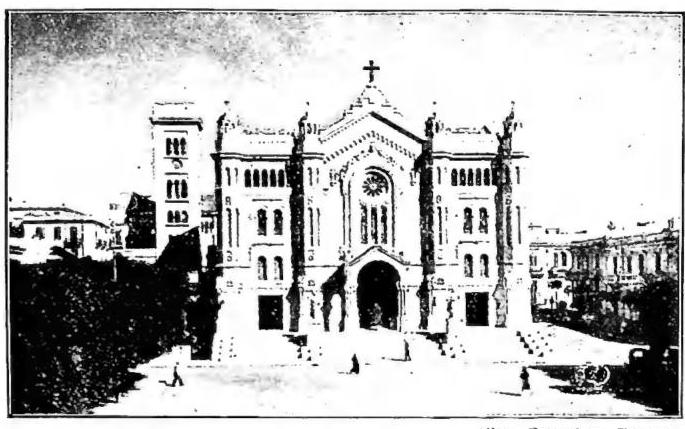
Ancient monuments of R. have been destroyed by earthquakes: only the Castle and the Sanctuary of Consolation have partially survived. Modern structures include the magnificent Cathedral with its original pulpit and statues by Francesco Ierace of Polistena; the church of the Victory, in neoclassical style by Piacentini, to whom is also due the building of the National Museum of Magna Graecia; and finally the grand Regional Seminary, which accommodates almost all the clergy of Calabria after the fire that destroyed that of Catanzaro.
R. has a long and glorious line of saintly, zealous and learned prelates. Among them we may recall St CYRIL, a Basilian, whose reputation for holiness drew St LEO from Ravenna, who was later made bishop of Catania. In the 11th century a Greek document describes Archbishop NICHOLAS of R. as “metropolitan of Calabria and Sicily,” perhaps because the ecclesiastical hierarchy in the nearby island had been almost annihilated by the Saracens and he had been entrusted by Constantinople with the task of overseeing the Churches across the strait.
In the 16th century the archbishop of R. was GASPARE RICCIULLI DEL FOSSO of Rogliano, a Minim, who attended the Council of Trent and died with a reputation for holiness. His successor, ANNIBALE D’AFFLITTO of Palermo, likewise enjoyed a reputation for sanctity and reformed both clergy and people. The Benedictine RANGER was the first cardinal to be placed in charge of the archdiocese from 1091 to 1121; LANDO or LANDONE, counsellor to Frederick II and employed by the popes on delicate missions; the Franciscan Fra GENTILE; TOMASSO RUFFO, son of Peter, count of Catanzaro, much beloved by Innocent IV; PIETRO FILOMARINI, a Neapolitan; PIETRO ISVAES, a Spaniard, cardinal of St CYRIACUS; AGAPIUS TRIVULZIO, likewise a cardinal; GIR. CENTEGLIE; GIOVANNI ANDREA MORREALE; and GENNARO PORTANOVA, the last archbishop of Reggio to be raised to the purple (d. 1908); LANZA (v.). — See pl. XXXII.