
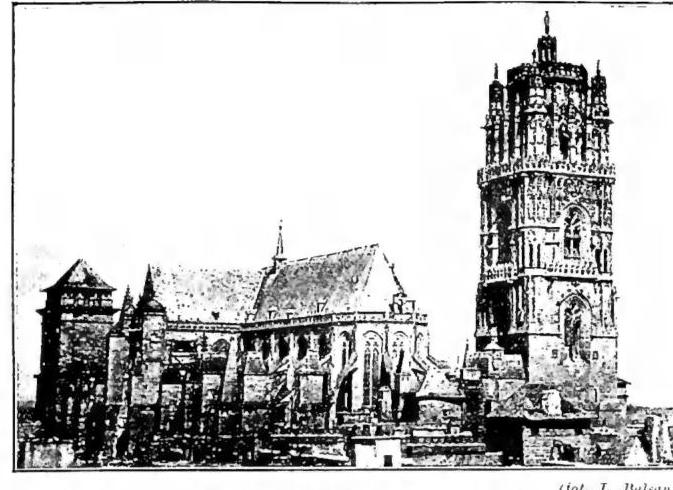
RODEZ. DIOCESE OF — Apse of the Cathedral (14th–15th c.) — Rodez.
Those of Albigensian stock had already been subdued in 121 BC. On its steep-sided hill, dominating a loop formed by the Aveyron, the city occupied an area perfectly suited to an oppidum. Once sparsely populated, it became overcrowded in the 18th century, while today the department, enjoying secure economic growth, faces an alarming depopulation.
RODEZ
Diocese. The boundaries of the diocese follow those of the Roman province. With only minor modifications by Quercy (and the detachment of the canton of St-Antonin, transferred to Tarn-et-Garonne in 1808), the boundaries remain the same as those of the department. However, civil authority long contested the capital from ecclesiastical authority. The Count of R., successor to the county squeezed between royal domains and their jurisdictional capitals, Millau for the Haute Marche and Villefranche, first seat of the seneschal and later a presidial seat for the Basse Marche, held only the center of the ancient Rouergue. After 1607 Rodez was merely an episcopal city, and the bishop assumed the title of count.
From earliest times ecclesiastical authority occupied a very strong position in Rouergue. Though the diocese’s excessive size justified its division under John XXII, who in 1317 detached the southern part of the Tarn to create the diocese of Vabres, Rodez, even thus diminished, remained a very extensive jurisdiction with 475 parishes and 66 annexes in 1771. The Concordat of 1801 merged the two dioceses into that of Cahors, but in 1817 the see of Rodez was restored. Pope Pius IX, by decree of 21 May 1875, restored the ancient title of Vabres, suppressed in 1801, in favor of the bishops of Rodez.
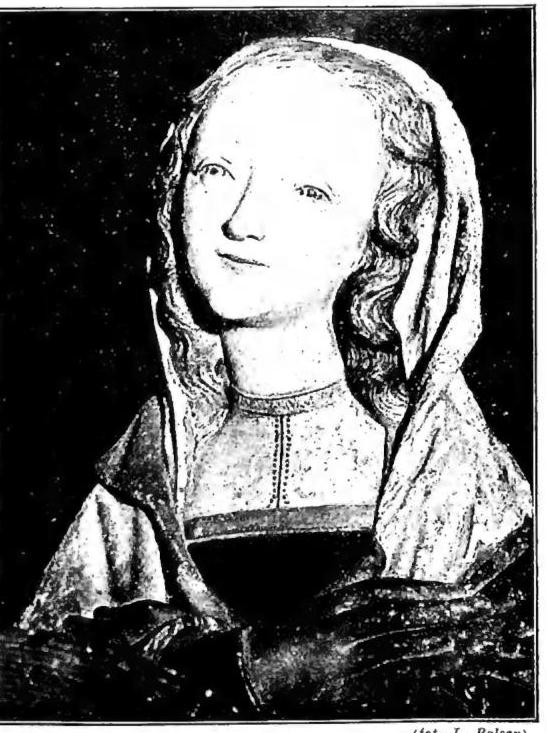
The interior of the cathedral features a choir commissioned by Bishop F. d’Estaing; the Chapel of the Pietà by Canon G. Roux; the tribune and the Chapel of the Agnus Dei by Philandrier; and on the high altar a Madonna of the 14th century. The church of St Amantius is a Romanesque building, rebuilt in the 18th century, whose plan and ancient materials it retains; a classical façade and a spire-topped bell tower (the work of the Capuchin P. Cassagnes) were added. Inside is a series of gilded and polychrome altarpieces in wood from the 17th–18th centuries. The church of the Sacred Heart, erected in 1808, sought to imitate the abbey church of Conques. The former capital of Roux, a religious revival center, is the chapel of the former Jesuit College, founded by Cardinal d’Armagnac in 1562 (L. Salter, Un témoignage de 1620 sur le Collège des Jésuites de R., in Bulletin de littérature ecclésiastique, 39 [1938], pp. 204–27).
RODEZ, DIOCESE OF — Interior of the ancient church (11th c.) of Conques (Aveyron).
A cardinal from 1338, he corresponded with Petrarch. The bishops of the 14th and 15th centuries continued the work on the cathedral, perfectly respecting the continuity of the original plan. Blessed Francis d’Estaing (1501–20), belonging to one of the great families of Rouergue, carried out in his diocese work that left lasting marks: reform of the Chapter, the clergy, and the monasteries; revision of the calendar; and the institution of the feast of the Guardian Angels. He had A. Salvath build the famous bell tower completed in 1526, a marvel of strength and soaring elegance, where the fluted piers with their garlands of egg-and-dart and classical modillions harmoniously support, at 87 m height, the statue of the Virgin accompanied by four censing angels. Throughout Rouergue there remain works of art that attest to his piety and artistic taste, ranging from the sometimes tender, sometimes exaggerated sentimentalism of the late 15th century to the first accents of the new art known in Italy (C. Belmont, Le bienheureux François d’Estaing évêque de R., 1460–1529, Rodez 1924).
His successor, George d’Armagnac, of the comital family, was bishop of Rodez from 1529 to 1562 and of Vabres from 1536 to 1577; then ambassador of Francis I to Venice and later cardinal in 1544. He further encouraged humanism and completed the cathedral; its western façade’s Gothic piers bear his coat of arms. A curious small Renaissance-style building with pediments and corbels, an early work by a pioneer, the canon-architect G. Philandrier, commentator on Vitruvius. Unfortunately, Calvinism spread at that time in the southern part of the department. The subsequent bishops were three Corneillan: James (1562–82), Francis, and Bernard (1614–15); then H. de Préfixe, former tutor to Louis XIV; L. Abelly; G. Le Voyer de Paulmy (1666–82), who founded hospitals and seminaries; then G. M. Champion de Cicé (1776–81) and Cardinal G. C. E. Bourret (1871–96), a personal friend of Leo XIII. As elsewhere, the bishops had to take the lead of the civitas during the turbulent period of the great invasions and give their
Essentially religious in character, Rouergue abounded in abbeys, most of them Cistercian, reorganized by Cardinal Bourret, such as Bonnecombe, Bonneval, Nonenque. Even before the Revolution the ancient Benedictine abbeys of Nant, Vabres, Conques, and the female abbey of the monastery of St Saturninus near Rodez had disappeared or been secularized. They were replaced by a flourishing number of more recent convents and by several mother houses of new religious institutes, such as the Sisters of the Holy Family of Villefranche (St Emily de Rodat, 1816), Dominican Sisters of Notre-Dame du Rosaire de Montéis (1849), Ursulines of Malet (1866), Sisters of St Joseph of Clairvaux (1824), of St Dominic of Gramont (1843), etc.
There are numerous shrines, especially dedicated to the Blessed Virgin, such as Notre-Dame of Ceginac, the most renowned, and others like those of Fontcourrie near Marcillac, Fraysse near Bournazel, Treize-Pierre near Villefranche, Lez near Mur-de-Barrez, Grandvabre and Gironde, Peyrusse and Romette, Estables and Lenne, Orient and La Salvage, Bergounhoux and St-Chély, “Notre-Dame-des-Buis” at St-Geniez, “de-la-Négrette” at Espalon, Notre-Dame de l’Espinasse at Millau, of Mercy at St-Affrique, Notre-Dame of Pity at Rodez and at Réquista. The pilgrimage to St Tarcisius at Rodelle is still much frequented, while that to St Foy at Conques has become purely artistic. Rodez was the birthplace of Cardinals and Archbishops of Paris D. A. Affre, who fell on the barricades in 1848, and G. Verdier; and of the historian Amant-Alexis Montell (1769–1850), author of Histoire des Français des divers états aux cinq derniers siècles (1828–1889).
In the Baptistery Chapel is preserved a Christian sarcophagus from the church of the Madeleine; on the front is the Lord teaching between eight Apostles; on the sides, on one, Christ teaching between two Apostles, and on the other a building surmounted by the signum Christi between two saints, one of whom makes the gesture of acclamation (E. Le Blant, Sarcophages chrétiens de la Gaule, Paris 1886, pl. 22). The Maurice Fenaille Museum has gathered numerous relics of the notable artistic riches of ancient Rouergue,
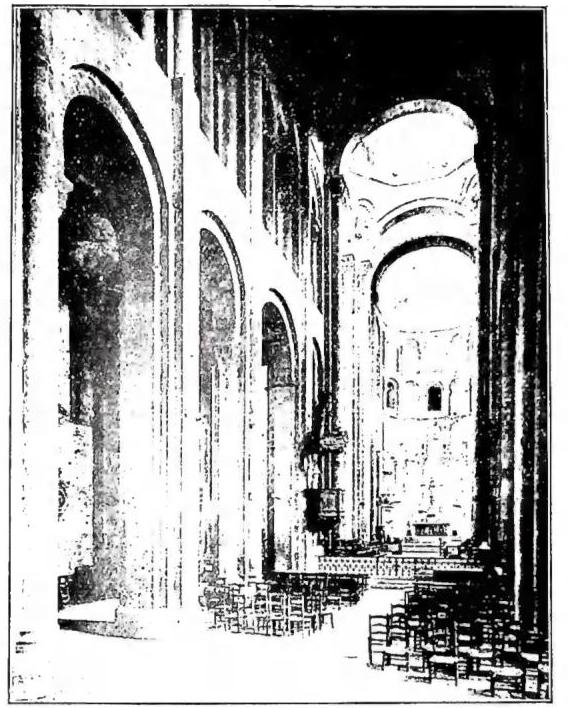
Rodez, diocese of - Interior of the ancient church (11th c.) of Conques (Aveyron).
RODI
### I. GEOGRAPHY
Rodi is the largest, after Lesbos (1440 sq. km.), and the southernmost of the major Sporades, situated a short distance from the coast of Caria (Asia Minor).
Almost entirely mountainous, its relief, which culminates in Mount Attiario (1215 m.), is arranged like a long cluster gently sloping with a certain regularity toward the western and eastern coasts, the latter of which opens into a series of more or less wide bays, both carved into terraces. There are no true plains. The climate, of Mediterranean type, resembles that of eastern Sicily, with a long dry period (from April to October) and a rainy one (average 1000 mm., but with notable variations); winters are very mild and winds are frequent (and not rarely violent).
The population (61,791 inhabitants; 43 per sq. km.) is overwhelmingly Greek, with a few Muslims and Jews; hence the prevailing confession is Greek Orthodox. The island's economy is typically agricultural; however, the rural element, still attached to outdated farming systems and technical methods, barely exceeds half of the total population. Livestock farming is modest in scale, with a prevalence of free-range animals (goats and sheep) of lesser demands. The soil yields cereals, potatoes, legumes, and especially olives and grapes; fruit trees are also fairly widespread. Beekeeping (honey and wax) has ancient traditions; silkworm breeding has almost disappeared; fishing is by no means negligible. There are no true industries, while a decent level of craftsmanship persists (rugs in Rhodes, ceramics in Lindos).
Of the inhabited centers, the largest is Rhodes (51,000 inhabitants), which still retains a rather medieval fortress-like appearance rather than a modern urban one, though its commerce has developed significantly during the Italian occupation.