
Romanesque Art
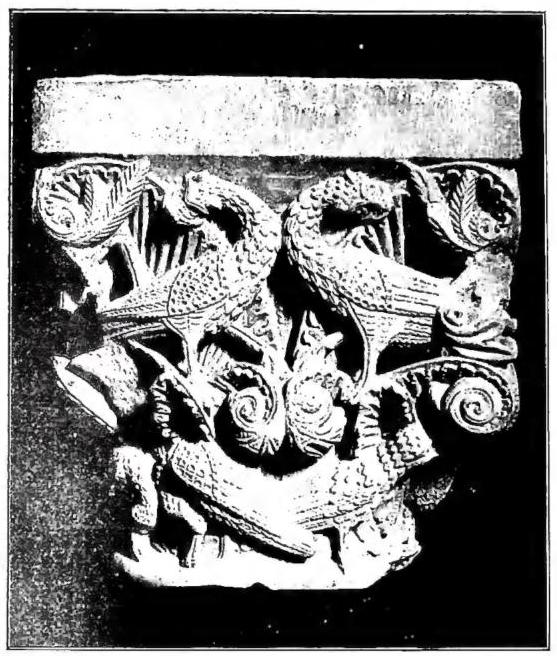
ROMANESQUE ART - Capital from the cloister of the ancient cathedral of Lérida, discovered in 1925.
Compared to France, this is especially true with regard to the plastic culture, which then reflected the very lively Ottonian figurative taste.
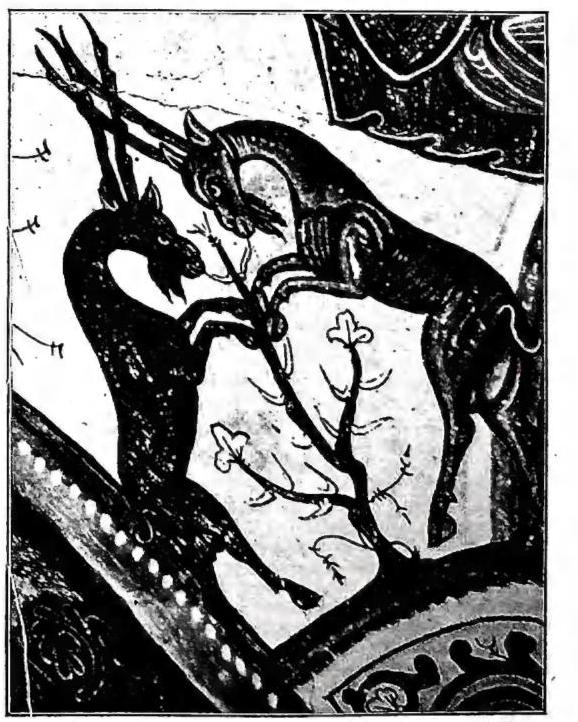
Even in painting, what was done in the European regions north of the Alps and in Spain seems more than anything else the logical prelude to the development of Gothic forms. The paintings that covered entire spaces and which, due to a series of events, have come down to us only in small part were, especially in the 11th century, painted in flat, uniform tones with a very limited number of colors distributed within well-defined fields by precise outlines. In such paintings, very often the foundation—both iconographic and otherwise—was the miniature, whether of Eastern origin or derived from the major centers of Carolingian or Ottonian production. In Spain, the paintings of Tahull, now in the Barcelona Museum; in France, those of the abbey church of St-Savin (Vienne); in Germany, whatever remains of ancient paintings in the churches of the Rhineland, all testify to the same tendency to reduce every expression within a narrative rhythm, within an ascent that would soon, in the second half of the 12th century, announce the new spirits of Gothic taste.
The Italian figurative civilization, while maintaining in the centuries of the early Middle Ages its own logical mode of evolution and its individual tone, had come to be shaped mainly according to the contributions that various contemporary cultures—whether of Byzantine, barbarian, or Carolingian imprint—had brought to it, with which it had come into contact. However, by the 11th century, this figurative civilization, while not renouncing any new element that could represent an enrichment, also assumed a new independence with respect to what was being done in other regions of Europe. At that time in Italy (v. ITALY, VI. Art, 3), while architectural forms, slowly depressed for centuries, were reunited in the almost sudden and widespread revival of building activity, painting and sculpture, which had also become very active, assumed decidedly new intonations and increasingly adhered, in the direct modes of expression, to the character and temperament of the Italians.
In architecture at that time in Italy, two distinct currents can be identified. The regions of the Po Valley (Piedmont, Lombardy, part of Veneto, Emilia) as well as, in many respects, the regions to the east of the Apennines, participated—albeit with different accents and spirits—in the same architectural orientations that were characteristic of Central European regions; whereas the regions facing the Tyrrhenian Sea, especially Campania, much of Lazio and Tuscany, reworked, with a new mentality and a new clarifying spirit, certain forms that sprang from the depths of classical tradition, often humbled but never extinguished in the immediately preceding centuries. Thus, while in the northern regions and those of the Adriatic side there is a constant use or aspiration to raise complex buildings with pillars supporting ribbed vaults, loggias, and galleries that emphasize, in a complex interplay of light and shadow, the new values of architectural space then being defined precisely in the heart of Europe, on the Tyrrhenian side there prevails, with a love for the clear harmonies of columns, arches, and entablatures leading toward high, luminous apses, that of broad smooth walls where painters, inlayers, and mosaicists spread their beautiful chromatic fantasies. But alongside these two tendencies, sometimes fused with them, sometimes pure with independent forms and accents—especially in the major centers of the coasts, in the maritime cities, etc.—there also emerges, with extraordinary richness of motifs, the art of the East in its various gradations. Thus in Sicily, Apulia, Campania, Pisa, and above all in Venice, in that marvel which is the basilica of St. Mark.
No less lively and dynamic is the profile of sculptural activity. In it, one first witnesses, as it were, a deepened clarification and distinction of the decorative schemes of the early Middle Ages; then, also due to the progressive elimination of old symbolism, one arrives at a concrete vision of reality whereby the human figure, as a new expression of beauty, is fully liberated from the marble.
Wiligelmus (v.) at the beginning of the 12th century, Antelami (v.) and the Master of the Months of the Ferrara cathedral testify to the intense vitality of Romanesque sculpture in Italy. In it, the classical and oriental elements, both Eastern and Northern, are present; yet it is true that those same elements, which sometimes seem dominant, in the very act of being adopted by the Italians to narrate with vivacity and clarity, change in tone and become adherent to the mentality of those who express themselves with complete spontaneity. It then becomes evident how the shaping of the various pictorial currents of the Romanesque age in Italy had the same value and importance that the *dolce stil novo* had in the literary field, from which Dante’s new language was to spring.
Pietro Cavallini, Duccio di Buoninsegna, and Cenni di Pepi, known as Cimabue, are the three formidable figures who conclude the great cycle of Romanesque painting in Italy. They conclude an era but also announce a new one. And their gigantic figures dominate the great cycle of art as the true patriarchs of that modern painting which recognizes Giotto as its first master. — See plates LXXIX–LXXXII.