
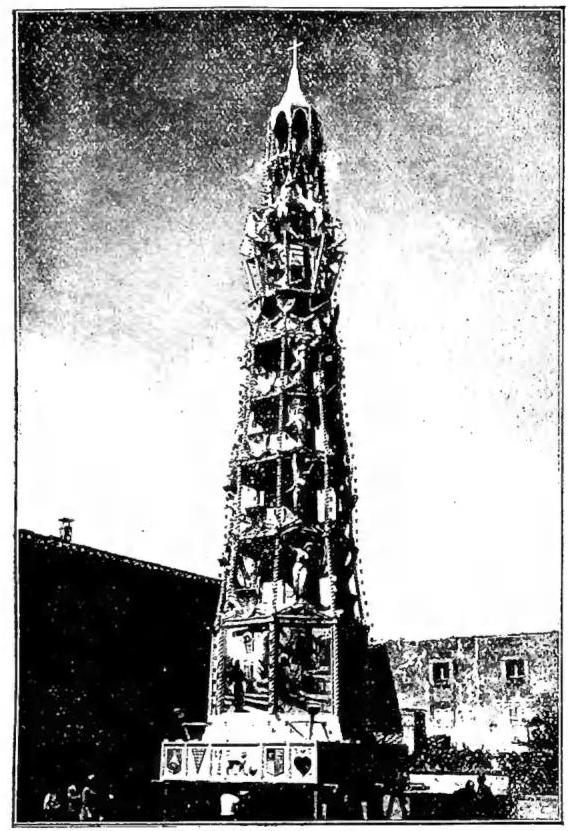
GOLDEN ROSE. – It is a symbolic gift that the popes use to send, as a sign of particular esteem and benevolence, only to queens, although in the past they were accustomed to honor with this distinction sovereigns, princes, and eminent personalities as well.
GOLDEN ROSE – Machine of St. ROSE of 1952 – Viterbo.
The cult of St. Rose has been enhanced by iconography, which, although not very rich, includes successful representations (e.g., the paintings by Benozzo Gozzoli on the walls of the church of St. Rose in Viterbo) that illustrate the most salient events of the saint’s life according to the traditional veneration of her life. Altars dedicated to her stand in Rome at the church of St. Catherine, formerly called St. Rose’s, and at that of Aracoeli (as well as an oratory common to the two holy virgins Rose of Viterbo and Rosalia of Palermo), and also at Vitorchiano, Bolsena, Tivoli, Fabriano, Salerno, and Foggia.
GOLDEN ROSE. – On the Protestant side, it originated from a historical novel, apparently invented by the Lutheran theologian Johann Valentin Andreae (1586-1654).
In 1614 an anonymous work appeared: *Professione di fede della Confraternita della R.* In 1615: *La Rivelazione della Confraternita del S. mo Ordine di R.* Finally in 1616: *Die Chy-

Rose, St. – Machine of St. R. of 1932 – Viterbo.
sophia of the Golden Rose*, a work that enjoyed great success and was translated into various languages.
The Golden Rose consists of a golden rose, sometimes simple, without stem or leaves, and at other times a flowering branch with leaves and thorns, until it assumed, in the time of Sixtus IV (1471-84), its current form: a cluster of entirely golden roses adorned with precious stones, the central flower, larger than the others, containing within a small cup balsam and musk.
It is not possible to establish its first origin with certainty. It is known only that in 1049 Leo IX, in exchange for the exemption from the jurisdiction of the local ordinary granted to the monastery of St. Cross of Tulle in Alsace, imposed on the nuns the annual sending of a golden rose to the Pope; but in the relevant document Leo IX himself speaks of the golden rose as a not new practice. The earliest historically attested record of the granting of a golden rose by the Pope dates back to 1096, when Urban II, passing through Angers during the preaching of the First Crusade, presented it to Count Fulk of Anjou. During the Avignon period, the custom then spread of offering the golden rose to various illustrious persons of both sexes, to churches, and to cities. Suffice it to mention, besides various emperors, the kings of France Louis VII, Charles VI and VII, the king of Naples and Aragon Alfonso, who received it in 1451 from Nicholas V for the victory over the Turks, John of Austria, one of the victors of Lepanto, to whom it was given by Gregory XIII in 1576, Queen Casimir of Poland in 1684 for the victory at Vienna. Among the principal churches benefiting from the golden rose are to be remembered the Roman basilicas of St. Peter (5 times), St. John Lateran (4 times), St. Mary Major (2 times), and the churches of St. Mary sopra Minerva and St. Anthony of the Portuguese, as well as, outside Rome, the sanctuary of Loreto, St. Mary of the Flower in Florence, St. Dominic in Perugia, and the basilica of Our Lady of Lourdes. Among the cities, instead, are to be listed Venice, which received it several times, Bologna, Siena, Savona, and Lucca.
The last male recipient of the golden rose was the Doge of Venice Francesco Loredan, who received it from Clement XIII in 1759; since then, except for some churches, it has been reserved exclusively for queens, among whom were

Rosalba, St. – Supposed autograph inscription of St. R., drawing transmitted to the Bollandists by Prince of Belmonte Giuseppe Emanuele Ventimiglia – Palermo, Serra Quisquina.
It was received by the former Queen of Sardinia Maria Theresa (1825), the queens Isabella (1868) and Maria Christina of Spain (1886), the empresses Eugénie of France (1856) and Elisabeth of Brazil (1888), the queens Amelia of Portugal (1892) and Marie Henriette of Belgium (1893).
The ceremony of the blessing of the golden rose formerly took place in St. Cross in Jerusalem; but when the emperor was in Rome to be crowned there, it was destined for him and the blessing ceremony took place in St. Mary in Cosmedin. At present the golden rose is blessed by the Pope on Laetare Sunday (the fourth Sunday of Lent), before Mass in the Hall of the Sacred Vestments in the presence of many cardinals, and then carried by the Pope himself to the Sistine Chapel, where he entrusts it to one of the deacon cardinals and places it on the altar. When the person for whom the golden rose is intended is in Rome, the Pope himself delivers it to her at the exit from the Sistine Chapel; otherwise an official bearer is appointed, chosen from among the supernumerary Gentlemen of the Sword and Cape.
The tradition of offering the golden rose, interrupted in the time of Pius X and Benedict XV, was resumed by Pius XI, who conferred it in 1923 on Queen Victoria Eugenie of Spain, in 1925 on Elisabeth, Queen of the Belgians, and in 1937 on Elena, Queen of Italy (d. 28 Nov. 1952).