
ROSSO, MARE — The Exodus from Egypt and the crossing of the Red Sea. Fresco of the 3rd century, Dura Europos, synagogue.
the altarpiece of Villamagna. From 1522 dates the great Dei altarpiece, formerly in S. Spirito and now in the Pitti, which reveals a greater study of formal and compositional balance, certainly owing to the influence of analogous compositions by Andrea del Sarto. In S. Lorenzo is the Marriage of the Virgin, dated 1523, likewise carefully composed according to traditional models but extraordinarily acute in its details; from the same year comes the extraordinary Moses and the Daughters of Jethro: an exceptionally daring composition resolved through truly anticipatory formal boldness. In 1523 R. moved to Rome where, led astray by the overwhelming examples of Raphael and Michelangelo, he frescoed in S. Maria della Pace the Creation of Eve and the Original Sin, perhaps his weakest works. Having fled because of the sack of 1527, he went to Perugia and Arezzo: from this period date the Deposition (1528) in S. Lorenzo of Borgo S. Sepolcro and the Transfiguration for the cathedral of Città di Castello (1528–30). In 1530 he moved to France. The works executed there have not survived, except for the Deposition in the Louvre (1537–40), since the Gallery of Francis I in the château of Fontainebleau, painted with collaborators between 1534 and ’37, has been seriously disfigured by alterations and repainting. R.’s work in France had a major influence on the formation of the Fontainebleau school.
Of the greatest importance is his graphic production, which has survived in numerous examples (Paris, London, Florence, etc.).
R.’s personality, long unrecognized, has only recently been reassessed as one of the highest and most original expressions of early Tuscan Mannerism.
Carla Guglielmi]
RED SEA (Gr. ἡ ἔρυθρα θάλασσα; Heb. jām sūph). - A vast expanse of sea extending from the entrance of Bāb el-Mandeb, between southwestern Asia to the east and the coasts of northeastern Africa to the west, up to Cape Mohammed in the north, where it bifurcates into two branches: the Gulf of Suez (Sinus Arabicus) to the west, and the Gulf of el-'Aqabah (Sinus Aelanticus) to the east. The Hebrew appellation jām sūph, "sea of reeds" or "sea of rushes" (Ex. 10, 19; 13, 18; 15, 4), is of uncertain origin; however, its identification is not in doubt, as its extremity is indicated (Ex. 23, 31; I Reg. 9, 26; Ier. 49, 21) in the Elanitic Gulf or Gulf of el-'Aqabah.
The general opinion, supported by biblical texts, is that the miraculous passage of the Hebrews through the Red Sea (Ex. 15, 4-22) occurred in the Gulf of Suez, which at that time, through natural channels, was connected to the basin of the Bitter Lakes. Reed beds still exist there today, and it is not unlikely that they were abundant at the time of the Exodus, thus justifying the Hebrew appellation.
The precise location of the crossing has been variously determined: near Serapeum, between Lake Timsāh and the Bitter Lakes; at Šaluf, between the Bitter Lakes and Suez; or at the ford that once connected Clysma (= Suez) to el-Šatt. The most probable opinion, presented by Bourdon and based on geography, archaeology, and the study of papyri, places the crossing between Gebel Geneffef and Gebel Hasan along the path leading to the ford situated in the southern part of the Little Bitter Lake.
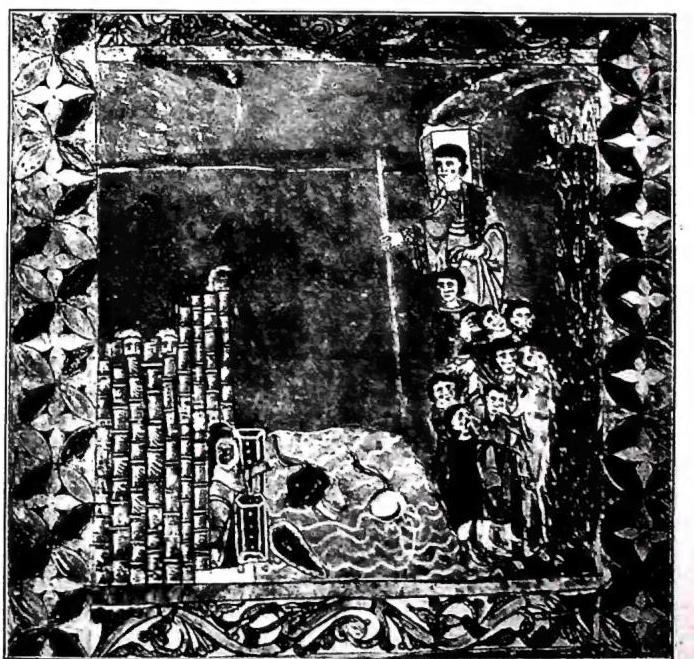
(fot. Sananini) RED SEA - Miniature from an Exultet of the 12th century - Rome, Biblioteca Casanatense, cod. 724 B. I 13.
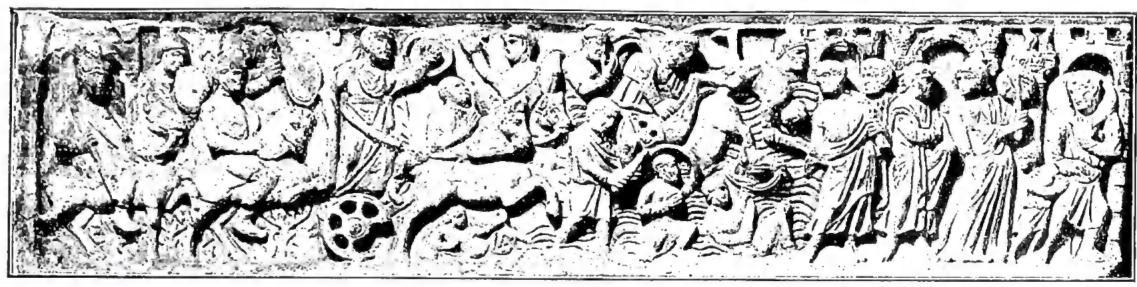
This is seen on a sarcophagus lid discovered in San Lorenzo al Verano, belonging to a certain Gorgonio (late 4th century). Among other representations of the crossing on sarcophagi, seven are Roman and thirteen Gallic. The most famous sarcophagi include the Lateranense no. III, those in the museums of Split, Arles, Bellegarde, Avignon, and the church of Saint-Trophime in Arles, used as an altar frontal.
Other reproductions of the scene appear on a panel of the door of Santa Sabina and in one of the mosaics of the basilica of Santa Maria Maggiore (5th century), where the Hebrew people, with Moses, witness the drowning of the Egyptians.
Finally, the crossing of the Red Sea is frequently depicted in miniatures, such as, for example, in the codex of the homilies of St. Gregory Nazianzen (late 9th century) and in a Psalter of the 10th century (H. Omont, Les miniatures des manuscrits grecs de la Bibliothèque nationale, Paris 1902, pls. 42 and 9); in Octateuchs of the 11th and 12th centuries, such as the Vatican Greek codices nos. 746 and 747 (Wilpert, Mosaiken, p. 455), etc.
In this scene, G. Wilpert believed there was a symbol of the invocation: "libera l'anima del tuo servo come liberasti Mosè dalle mani del Faraone" ("free the soul of your servant as you freed Moses from the hands of Pharaoh"); E. Becker instead sees an allusion to the Battle of the Milvian Bridge with the defeat of Maxentius; F. J. Dölger a symbol of Baptism, according to St. Paul (1 Cor. 10:2).