
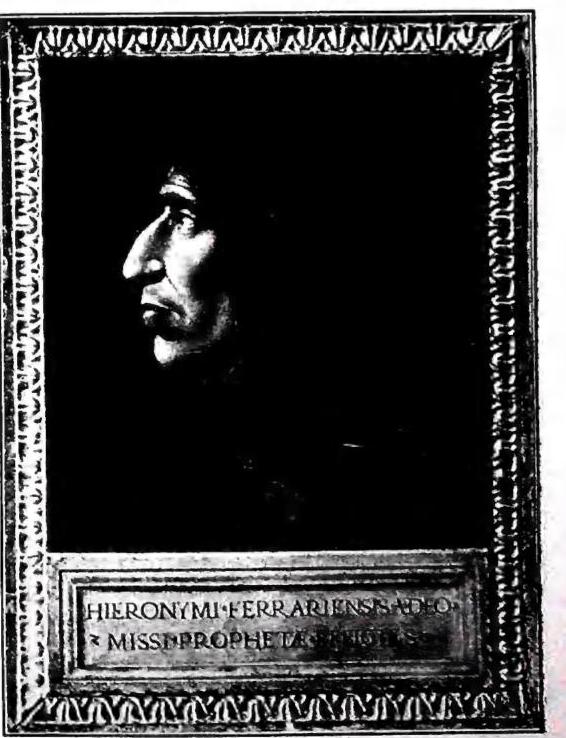
SAVONAROLA, GIROLAMO. — Born in Ferrara on 21 Sept. 1452, son of Niccolò di Michele Savonarola and Elena Bonacossi, possibly a descendant of the Bonacolsi, lords of Mantua. The Savonarola family originated in Padua, from which branch had transplanted to Ferrara in 1440, when Michele, a physician of great renown in his time, was summoned there by Niccolò III. It was this Michele who took charge of G.’s education; and there is no doubt that the aged scientist, formed in the 14th century and thus a man of the Middle Ages, a man of exemplary piety and strict morals, exercised a great influence upon the formation and life of his grandson. As to S.’s studies, it is known that after completing his humanistic education up to the age of 17—perhaps at the school of Battista Guarino—he devoted himself to the liberal arts. From Platonist he soon became Aristotelian, but “Aristotelian in the Thomist sense,” as has been said. The long study and great love that led him to seek out the volumes of the Aquinate were part of the legacy left him by his grandfather, as was his devotion to Holy Scripture, which he soon knew by heart, it is said.
Having taken his degree in the liberal arts and begun medical studies, he soon abandoned them. In the adolescent S. one finds in full and perfect form the sentiments and thoughts that would make him “a man of discord in the whole world.” The humanistic paganism that was contaminating life, art, and even religion was unbearable to him, as was the corruption spreading through every class of men; and he saw its primary cause in the bad shepherds of the Church. This idea both prostrated and exalted him indubitably; in his early writings, in prose and verse, one already sees the future reformer fully armed: the canzone De ruina mundi (1472) might be said to have issued from the pen of the S. of twenty-five years later. And since he could not endure the great wickedness of the Italian people (as he would write to his father), he continually recited a short prayer to God, saying: “Notam fac mihi viam in qua ambulem quia ad te levavi animam meam.” The path was that which he took on 24 Apr. 1475, when, leaving his father’s house without farewell, he went to don the habit of the Guzman at S. Domenico in Bologna. On entering the cloister he had not wished to be ordained priest, but to attend to the humblest tasks of the convent; yet he accommodated himself to the will of his superiors, who would not leave his intellect idle. He pursued theological studies, first at Bologna and then at Ferrara, having returned to his native city in ’79. He was still there in ’82, when at the Chapter of Reggio he was entrusted with the office of lector at S. Marco in Florence. Here he quickly won the hearts of his brethren and disciples, both by his marvelous expositions of Scripture and by the perfection of his life. Those who were his companions bore witness to his more-than-human virtues and the great fruit he bore by word and example. The Bl. Sebastiano Maggi declared that he had confessed him countless times without finding in him even a venial sin. Less success attended, in ’82 and ’83 at Le Murate, in ’84 at S. Lorenzo, his first attempts at preaching; though the unhappy character of these beginnings was magnified by ancient apologists in order to make his later triumphs appear more miraculous.
Meanwhile his fervent anxieties grew, an echo of which is found in the canzone Oratio pro Ecclesia. It was a sudden revelation of the scourge and renewal impending over the Church, received in the convent of S. Giorgio (1484), which showed him once more the path and gave rise to his prophetic preaching, begun at S. Gimignano during the Lenten seasons of 1485 and ’86. In ’87 he preached at Florence in S. Verdiana, but had to interrupt his Lenten course when he was elected Master of Studies at the Studium generale of S. Domenico in Bologna. After completing the year of his magisterium, he was sent to Ferrara, and thence to preach “in many places of Lombardy.”
Famous remained his Advent preaching of 1489 at Brescia, where he prophesied the sack that the city would suffer in 1512. He preached the Lent of 1490 at Genoa; then he was sent back to Florence, having been requested by Lorenzo de’ Medici himself, to please Giovanni Pico, enamored of S.’s soul and intellect since the Chapter of Reggio, and more during his first Florentine sojourn.
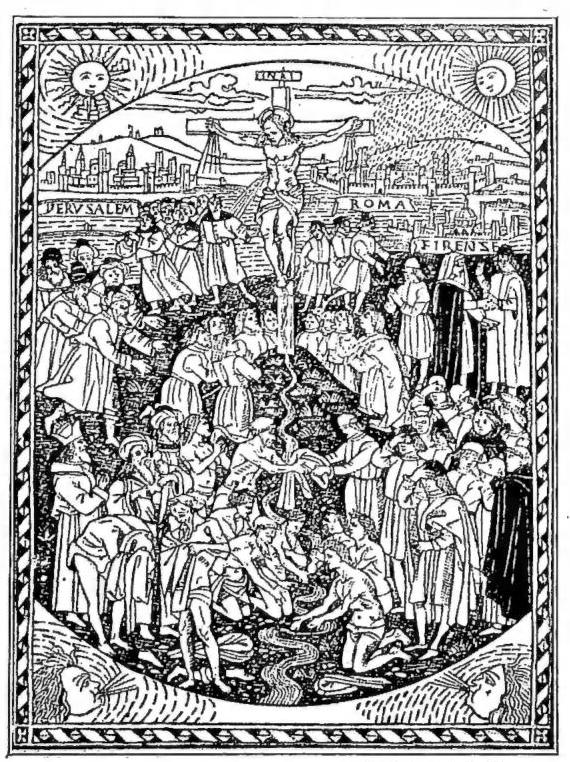
Returning to his fated city, S. was soon after elected prior of S. Marco. While attending to the duties of his new office and to preaching, he published several ascetical works, such as treatises On Widowhood, On Humility, On the Love of Jesus Christ, and works of philosophical popularization. But his preferred field of battle was the pulpit. A cycle of lectures begun for the friars in the garden immediately after his return to Florence drew such a crowd of laymen that he had to continue it in the church, where he began to expound the Apocalypse. In the Lenten courses of 1491 and ’92 his voice rose still higher, prophesying the scourging and renewal of the Church not only on natural grounds but also with the opening of some visions. He foretold the imminent invasion of foreign armies that would take the strongholds and the fortresses—a prophecy fulfilled by the easy expedition of Charles VIII; and at the same time he foretold his own excommunication, imprisonment, and martyrdom. These prophecies, and his manner of preaching “in the apostolic way,” so different from the humanistic style, earned him contradictions from the great and the learned, but immense favor among the people. He thundered against the vices of the laity and the clergy, even against Lorenzo himself, who at last realized the mistake he had made in recalling that indomitable friar and sought to remedy it, first with threats, then with blandishments; but in vain: it was now too late, his own life was ebbing, and S.’s following was growing. When what he had obscurely foretold in his sermon of 17 May 1492 came to pass, three weeks later S. was summoned by Lorenzo to his deathbed. That Lorenzo refused him sacramental absolution was asserted by a weeping legend, but was demonstrably false.
In the Lent of 1493 he preached at Bologna, where tradition says he dared sternly to reprove from the pulpit the Bentivoglio, wife of the city’s lord; in the Lent of ’94, at Florence, where, Lorenzo being dead, the greatest obstacle to the great work he envisaged was removed: to make of S. Marco a model of religious life in which the fervor of the early Church might flourish again, so that a great fire of faith and charity might blaze in Florence, “the heart of Italy,” and thus spread to the whole of Christendom. To gain independence from the Lombard Congregation was the first step on this path, and to this end he directed his efforts