
SLAVERY
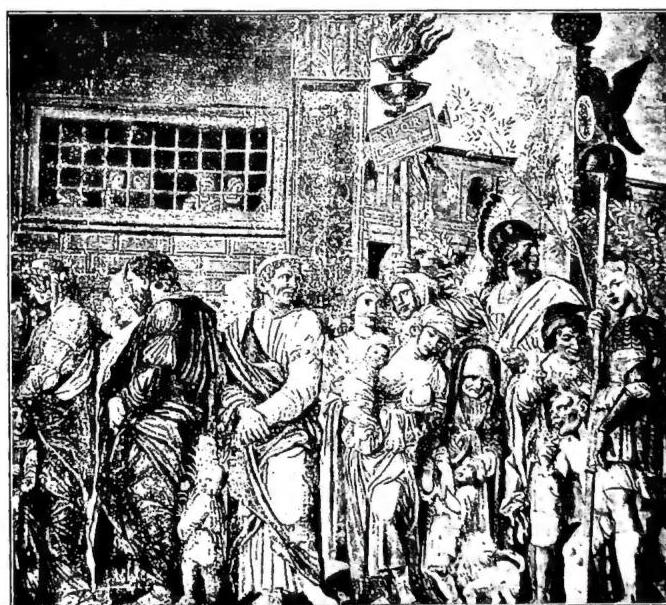
Slavery – Slaves working bread. Relief from the 1st century B.C. Detail of the frieze on the tomb of M. Virgilio Eurisace – Rome.
In the city (familia urbana) the number of slaves was considerable and they provided not only for the needs of the household but also for cultural tasks, such as copying books, concerts, and lectures.
Even in Rome a slave could be manumitted, thus passing into the status of a freedman; this could occur through particular legal transactions, such as a will, in iure cessio (manumissio vindicta), and the registration of the slave, with the master’s permission, in the census lists (manumissio censu). Alongside these forms of manumission, known as civil, which in historical times made the freed slave a Roman citizen, there were other less formal types (manumissiones inter amicos, per mensam, etc.), whose efficacy over time was guaranteed by the praetor.
With the advent of Christianity, a new form of manumission was introduced, with the same effects as the civil forms: manumissio in ecclesia.
The condition of slaves, which was initially harsher in Rome than in Greece, worsened under the Empire, precisely when the wretched conditions of agriculture, due to vast latifundia and the abundance of free labor no longer occupied in wars, gradually diminished slave numbers due to the lack of new imports, while free labor under the colonate system increased.
Claudius declared free any slave whose master wished to dispose of due to old age or illness; Hadrian and Antoninus Pius removed from masters the right to kill slaves; Constantine considered the killing of a slave equivalent to that of a free man.
---
II. SLAVERY IN THE BIBLE
Among the ancient Hebrews, as among other peoples, war captives particularly fed the slave market (1 Sam. 30:3; Amos 1:9; Ezek. 27:13; 1 Macc. 3:41). Moreover, all the children of a slave were considered the property of the master (Ezek. 21:4). An Israelite could not be sold as a slave to foreigners; indeed, he should never have been reduced to such a condition (Lev. 25:42–46). In practice, however, for financial reasons or insolvency toward creditors, Israelites were often subjected to slavery (2 Kings 4:1; Neh. 5:5, 8). A thief who could not restore the stolen goods became the property of the victim (Ezek. 22:3). The poor sometimes found themselves in such straits that they had to sell their families and themselves (ibid., 21:7 ff.).Jewish legislation in many cases restricted the master’s rights, forbidding him from selling his slaves. Indeed, he was obliged to grant freedom to his fellow-countryman slaves after six years of service, providing them with the bare essentials for living (Lev. 25:39–54; Ex. 21:2; Deut. 15:12–18). A slave was permitted to renounce his freedom; in such a case, he remained the property of the master (Ezek. 21:5–6). Freedom could also be regained through flight (Deut. 23:16 ff.) or as a result of mistreatment by the master (Ezek. 21:26–27).
The law insists on prescribing humane treatment, especially adducing religious motives. Slavery among the Hebrews was far more tolerable than among pagans. The prophets and therapists openly declared themselves opposed to II. Yet in practice the condition of these wretched people was by no means enviable. The very humane law that required the liberation of a Hebrew slave after six years of service was never observed. In the Bible, only once is a general manumission of slaves described, but it was immediately followed by the rather ungenerous demand to reclaim property rights as soon as the danger of the capture of Jerusalem seemed averted (Jer. 34:8–22).
Angelo Penna
---
III. CHRISTIANITY AND SLAVERY
Against slavery, Christianity did not organize revolutions, but rather worked indirectly, patiently, and consistently to create the conditions and environment in which slavery would be almost naturally and logically eliminated from society. It taught and put into practice the principles of equality, brotherhood, and love among all men within its own institutions. It exhorted slaves to be patient, resigned, and obedient, but at the same time commanded masters to treat them as brothers, as themselves, because before God there is neither slave nor free (Gal. 3:28; Eph. 6:5–9; Col. 3:22–24). The letter of St. Paul to Philemon on behalf of Onesimus, his fugitive slave, who was received, converted, and sent back to his master, is moving: “receive him no longer as a slave, but as a beloved brother” (v. 16).Within the Church, slaves enjoyed all the privileges and faculties of other free faithful; they participated without any discrimination in liturgical assemblies, and once freed, they could become clerics and even bishops. Their physical and moral person was protected, as any act by masters that might harm them in any way was forbidden; even their intimate feelings were respected, and their unions, by virtue of the sacrament of Matrimony, were not considered mere contubernium but true coniugium, a sacred and indissoluble marriage. Pope Callistus I bore the marks of a fugitive slave; many female slaves contributed to the propagation of the Gospel, several were deaconesses; the number of slave and freed slave martyrs for the faith (St. Felicity, St. Blandina, St. Theodulus, St. Agricola and Vitalis, SS. Protus and Hyacinth) and for chastity (St. Potamena,

Slavery – Slaves working bread. Relief from the 1st century B.C. Detail of the frieze on the tomb of M. Virgilio
SLAVERY – Bronze collar of a slave with the inscription: “Servus Dei fugitivus.” The name “Servus Dei” indicates a Christian slave – Vatican Library, Sacred Museum.
Alongside this work of moral redemption, the Church also sought to restore to those wretched souls the longed-for good of freedom. It not only endeavored to emancipate those who had become slaves by right of war or for other reasons, even alienating and selling sacred vessels and furnishings for this purpose, but also induced masters to do so voluntarily. No less intense was the Church’s activity in combating the proximate causes of slavery: it condemned immoderate luxury and the ambition to possess many slaves, sanctified family affections to prevent the exposure of children, and above all ennobled labor by removing its humiliating stigma of degradation and presenting it as a means of elevation and sanctification. The Church also gave strong impetus to the manumission of slaves.
The Church’s long-suffering and patient activity was accelerated and legalized by Christian emperors. It was forbidden to brand slaves on the forehead, and the punishment of crucifixion—formerly reserved for them—was abolished. According to the decree of the Council of Elvira (305), which imposed temporary excommunication on masters who in any way caused the death of slaves, it was established that a master who directly caused the death of a slave should be punished (Codex Theodosianus, ed. Th. Mommsen, Berlin 1905, IX, 12, 1). It was forbidden that in the division of an inheritance the families of slaves be dispersed (ibid., II, 25, 1), and slaves were granted the right to defend their claim to free status in court (ibid., IV, 8, 5). It was also established that a slave sold as a child, upon reaching adulthood, could reclaim his freedom (ibid., IV, 8, 6). To the various forms of manumission was added that practiced in church in the presence of the bishop; full civil rights were granted to those freed in this manner, and if the master was an ecclesiastic, a simple declaration sufficed without any formalities (ibid., IV, 7, 1). Slaves sold by their parents out of economic necessity regained their freedom without any compensation to the master, for whom the service already rendered was deemed sufficient recompense (ibid., III, 3, 1). Masters who prostituted their female slaves were punished (ibid., XV, 8, 1), and these women could appeal to the bishop, who had the authority to declare them free (ibid., XV, 8, 2). Finally, the right of asylum already granted to churches was extended to their buildings and attached lands (ibid., IX, 45, 4). Special privileges were granted to Christian slaves owned by pagan or Jewish masters; it was forbidden for these masters to purchase Christian slaves under penalty of death (ibid., XVI, 9, 4–5), and if a master had his slave circumcised, the slave became free and the master was punished with death (ibid., XVI, 9, 2). The same provisions applied to heretical masters who forced their Catholic slaves to act against the faith (ibid., XVI, 5, 40; XVI, 6, 4; XVI, 9, 4).
Under Justinian, the liberal movement in legislation reached its zenith, and slavery steadily declined. In the 4th–6th centuries, it was common to see masters freeing their slaves either upon embracing a more perfect Christian life, at the moment of Baptism, or more often at the point of death, *pro remedio animae*, as it was called.
Naturally, in this work of redeeming slaves, there was a difference between city and countryside; social exigencies and economic necessities did not permit the complete and total abolition of slavery, for servile labor was still deemed too indispensable to be abruptly eliminated. Nevertheless, even for rural slaves, progress was gradually achieved. The law that forbade the sale of slaves apart from the land on which they worked, creating a form of *stabilitas loci*, marked the transition from true slavery to the *colonato* and serfdom; it was not yet complete abolition, but it was undoubtedly a great step forward, especially when one considers the initial state of affairs.
As regards the Middle Ages, it has been believed that the absence of a condemnation of slavery corresponded to a favorable evaluation of it, whereas ecclesiastical sources from East and West offer varied judgments and solutions with a constant and lively concern for the issue. The Church admitted slavery but counseled manumission whenever possible, and while establishing a relationship of “proportional equality” (Imbert) between slave and free, it protected the slave from the cruelty of the master and the master from the slave’s anarchic violence. The Church’s doctrine, developed in the early centuries, drew on Jewish tradition, the New Testament, and to a certain extent Stoic philosophy, jurisprudence, and pagan literature. The equality of all men—before God and in the essential conditions of human personality, in the end (salvation of the soul) and in the means (participation in grace)—without distinction of race, wealth, doctrine, or social condition, is expressed in the Pauline formula *οὐκ ἔνι Ἰουδαῖος οὐδὲ Ἕλλην* (“There is neither Jew nor Greek”), exclusive to sacred texts. The fundamental norm is acceptance of one’s state.
The explanation of slavery found in its origin does not lead to its passive acceptance: “Poverty and wealth, freedom and servitude entered life together with vice, and from vice they arose... But look to the original equality, not to the subsequent division” (St. Gregory Nazianzen). The maintenance of slavery, due solely to temporal exigencies, would end with the triumph of truth: “The natural order willed that rational man not rule over man, but slavery is ordained by that law which commands the natural order be preserved; therefore slaves... if they cannot be free, should make their servitude almost free until iniquity passes away and every principality ceases and God is all in all” (St. Augustine). Indeed, it is the very nature of slavery that makes it worthy of condemnation: “Slaves steal out of poverty, flee out of fear... lie out of fear, are gluttonous for lack of goods; masters flee the Lord and display even graver faults. The lesser culpability of certain slaves compared to that of certain masters shows that while both dishonor the entire Christian people, the latter particularly discredit the class to which they belong” (Salvian). In opposition to the Jewish concept of manual labor as punishment and the pagan view that excluded it for citizens as *artes sordidae*, the Christian view exalted labor as the fulfillment of a sacred duty determined by three causes: the expiation of sin, the remedy for passions, and the testimony of love for God. The Apostolic Constitutions bear witness to this, directing exhortations to work and condemnations of idleness to both rich and slaves. This critical process reached a terminological conclusion: the title of “master” in the proper sense belongs exclusively to God, and its abuse by man is condemned (St. Cyril of Jerusalem). This is proven by its opposite: “If you need the inferior, you are not truly a lord” (St. Augustine). Thus, while the destruction of slavery was already implicit in the premises of Christianity, the Church’s work gave it enduring value and defense.
Absolute equality was, however, limited by the sacraments of Matrimony and Holy Orders. The Church did not intend to oppose the laws in force; therefore, it did not establish canons contrary to the law and customs of the early centuries of the Christian era, but it sought to make the union of man and woman, whether free or slave, indissoluble. Thus, it was

*Schiavitù* – Bronze collar of a slave with the inscription: *Servus Dei fugitivus*. The name *Servus Dei* indicates a Christian slave. Vatican Library, Sacred Museum.
The validity of the master’s consent, from which his obligation to respect it derived, remained in force. When Callistus’ premature authorization—which permitted the marriage of both slave and free women—failed to take effect, various solutions were proposed by the Apostolic Constitutions and the *Sanctions et Decreta* of Nicaea, excluding marriage between slaves before manumission and the payment of a dowry. Thus, for the admission of a slave to the clergy—something some councils and St. Leo proposed under the condition of the master’s assent—this became a source of abuse among those who sought only to evade their obligations through this means. Yet already in 452, Valentinian III, while permitting this practice, safeguarded the threatened interests of masters, and Zeno in 484 forbade any ecclesiastical office to slaves, establishing that freedom must precede the *honores clericorum*, except for anchorites as long as they remained such.
The Church adhered to Valentinian’s solution, granting servants the possibility of access to sacred Orders, subject to certain guarantees for masters. The Apostolic Constitutions protected slaves by excluding offerings from masters who mistreated them—effectively banning them from the assembly of the faithful—and the Council of Elvira, already mentioned, while anathematizing the "week of the euthanasians," which incited slaves to class hatred and refusal of obedience.
Manumission, though recommended *pro remedio animae*, remained an act of charity rather than a legal obligation. This explains how churches could possess slaves as part of their ecclesiastical patrimony, assigned as serfs of the glebe, though it remained common for wealthy Christians to redeem slaves or prisoners—a practice undertaken countless times, even at great sacrifice and sometimes by selling sacred vessels, as seen in the cases of St. Ambrose, St. Augustine, and St. Hilary of Poitiers. This, however, led to a marked increase in freedmen who possessed only their freedom without the means to earn their bread; hence the advice to masters to teach them a trade.
The barbarian invasions did not alter the condition of Roman slaves. The general conditions of medieval society continued the movement already begun in late antiquity, and the upheaval of classes did not fundamentally change the ancient status, equalizing in cities the condition of serfs with that of semi-free persons and extending in rural areas the form of colonate that included former serfs of the glebe... These semi-free cultivators would become one of the most powerful elements in the origins of communal liberties (Roberti).
Yet among the barbarian populations settled in Italy, the slave, though considered equal to a thing or an animal under the *Lex Salica* and the *Edictus* of Rothari, possessed a family, limited legal capacity, could engage in legal transactions, and bring suit in his own cause. And just as the inhuman master incurred the severest ecclesiastical penalty, excommunication, so the *Edictus* of Liutprand, influenced by the Church, denied the primitive right to kill a slave.
In predominantly Roman and Christian contexts were the means of escaping slavery. With the near-disappearance of enslavement through war, birth remained the primary cause, confirmed by Gratian’s *Decretum* (C. 32, q. 4, c. 15) and by Romanic and Lombard sources; so too did crime, extended beyond Roman law, and insolvency in certain obligations. Freedom could be obtained by law when a conspiracy or grave crime of the master was uncovered—thus reviving Roman provisions in the *Edictus* of Theodoric (cc. 17–19) and perhaps the *Lex Wisigothorum* (VII, 6, 1)—or against the master’s oppression, as seen in the *Edicta* of Liutprand (c. 140) and Ratchis (c. 7); or in defense of religion by excluding Christian slaves from Jews. The thirty-year prescription of Roman law was revived by the Lombards but not admitted by the Franks (*Capitularia Italica Karoli Magni*, c. 8 [a. 801]). Freedom could also be obtained through manumission, in Roman or Germanic forms, solemn or private, gratuitous or onerous. In solemn forms, intermediaries served as witnesses to prevent future disputes and formally released the slave from all bonds. Manumission by *giarethinx* or "in the fourth hand" delivered the slave from the master to three free men, and from the last of these he was led to a crossroads, equipped with arms, and set free.
Manumission *ante regem*, among the Lombards and Franks—possibly derived from a Roman precedent, as Tamassia explained—entailed the slave’s appearance before the king, paying a symbolic coin. Manumission *in ecclesia circa altare* involved the slave carrying a candle around the altar, in the presence of clergy and people.
Freedom could also be granted by a declaration of will *inter amicos* or by testament. Redemption at a price required the slave’s peculium or funds from private individuals or religious associations, offered for pious causes.
Yet, as Schupfer noted, a point had been reached where the slave’s legal personality could no longer be denied: “He gradually withdraws his body and land from the master’s hands, answering only with a portion of his labor and produce, and slavery itself ends by transforming into serfdom.” Thus, with the disappearance of ancient slavery, other forms of dependence arose.
With the feudal division of serfs into various categories—from serfs of the glebe through *aldi* or freedmen and original Roman coloni up to semi-free coloni—more favored were the serfs of churches, who often surrendered themselves voluntarily, and the *servi massarii* of great estates; alongside the humblest domestic servants in households were the *famuli*, *vassi*, *ministeriales*, and *pueri* of lords, kings, or churches, who could rise to become *milites* and nobles. This fragmentation fostered a tendency to equate serfs, semi-free persons, and degraded freemen (Roberti). As the latter were conflated with the others, it became easier for serfs to contest the master’s rights and consider themselves nearly all free, until the abolition of slavery was affirmed in statutes, at which point the various indistinct groups of serfs formed the *minores* of cities and countryside.
Characteristic of the 12th and especially the 13th centuries were provisions favoring serfs, which, by diminishing the power of great lay and ecclesiastical lords, strengthened the authority of the Commune and simultaneously brought about a profound social evolution that preceded and surpassed those more celebrated in England and France. Between 1205 and 1289, Pistoia, Assisi, Piacenza, Padua, Vercelli, Bologna, and Florence issued solemn declarations of freedom, established free boroughs, and asserted the rights of human personality.
In cities, middle and lower artisans still faced certain political limitations, and the corporate organization—at its peak in this period—excluded the lowest classes; hence their restlessness and attempts to assert their rights within the Commune, culminating in violent episodes such as the Ciompi revolt, while in the "popolo" communes, antimagnate statutes excluded nobles from residence in cities, as in Viterbo, or saw their houses demolished by popular fury.
Without entirely abolishing domestic servitude and serfdom, the Communes dealt them a very severe blow almost everywhere. These institutions lingered on in the countryside with the dependence of peasants on their lords. A special form of domestic servitude persisted during the age of the signorie, and the slave trade enjoyed periods of prosperity. Despite the fierce condemnations of the popes Innocent IV, John XXII, and Martin V, who deplored the trade originating from the Middle East, the Black Sea region, the African coasts, and the naval victories over pirates, the Venetians and Genoese obtained slaves for European markets, traces of which remain in wills and dowry contracts. It was a point of pride for noble families to have black boys as pages and Circassian or Saracen slave-girls to attend to brides and daughters, though their condition was almost always good.
c la figlia, to celebrate the priestly jubilee of Leo XIII, decreed the abolition of slavery.
A lingering consequence of the slave trade, even after its abolition, is the inferior legal status of blacks and mulattos compared to whites in some states today.
VI. THE WORK OF THE CHURCH
It must be honestly acknowledged and praised that missionaries and popes acted decisively against the slave trade and slavery.In the early period, when the importation of blacks into Europe was at issue, the following points must be noted: in many places the African population was already almost entirely composed of slaves, reduced to this condition either as punishment for crimes (adultery, theft, murder) for which local laws prescribed death, commuted to slavery. Secondly, it was difficult for missionaries to ascertain the exact origin of the human merchandise, since traffickers were very careful to conduct their trade in places where they were not subject to oversight. Given these circumstances and the ideas of the time, missionaries were led to conclude that the sale and purchase of blacks by Europeans was not entirely an injustice for those who merely changed masters.
As for the slavery of the Indians in America, the documentation provided by Bartolomé de las Casas, the opponent of slavery, is sufficient. The missionaries (Dominicans and Franciscans, and later all others) who accompanied the explorers to the New World soon found themselves forced to fight against exploiters, and not a few suffered greatly and even died at the hands of Europeans. When, subsequently, blacks were imported mainly from Africa, only the missionaries took pity on them, mitigated their sufferings, sought to induce the colonists to act with human and Christian compassion, and strove by every means to secure their redemption, denouncing the countless crimes in writings that are still extant. Among them, St. CLEVE (v.) stood out. If the initial cruelty and later slavery eventually disappeared, this was due above all to the work of the missionaries. The slow disappearance of slavery is to be attributed to the colonists and European governments, which had an interest in maintaining II.
Regarding the activity of the popes, it is recalled that Pius II, on 7 October 1462, at the beginning of the slave trade in Europe, denounced slavery as a *magnum scelus* and ordered bishops to punish those who practiced it with ecclesiastical censures (O. Raynaldi, *Annales*, X [a. 1482], Lucca 1752, pp. 341–42). Paul III (Bullarium Taurinense, XIV, Turin 1868, pp. 712–13), on 29 May 1537, gave the Archbishop of Toledo the mandate to protect the Indians of America and extended the reserved excommunication to those who would reduce them to slavery or deprive them of their goods. In the same year, with a bull addressed to the entire Christian world, he issued an absolute condemnation of slavery, even going so far as to invalidate retroactively every such contract, so that all slaves had the right to free themselves from their condition. Urban VIII, on 22 April 1639 (ibid., pp. 712–714), renewed these provisions in even stronger terms. Slavery was gradually diminishing, but too slowly, and Benedict XIV, in 1741, wrote to the Bishop of Brazil and the King of Portugal, lamenting that the provisions of his predecessors had not been fully implemented (Bullarium Benedicti XIV, I, const. 38, Rome 1845, p. 123). Pius VII at the Congress of Vienna made his authority felt so that the slave trade might be prohibited, and indeed secured its proscription. Gregory XVI, on 3 December 1837, issued an encyclical urging bishops to use every means to eradicate slavery, now illegal, and to mitigate the sufferings of slaves (Acta Gregorii XVI, II, Rome 1901, pp. 387 ff.). Pius IX lent his voice in the same spirit when, in 1851, he beatified St. CLEVE (v.). Leo XIII, having seen the last remnants of slavery abolished in some parts of Brazil, warmly commended this in a letter to the bishops of that nation on 5 May 1888, while summarizing the documentation of what the Church had always done in favor of slaves (Acta Leonis XIII, VIII, Rome 1889, pp. 169–92). Finally, Pius X, with the letter *Lacrimabili statu Indorum* of 7 June 1912, reserved to the Ordinary the absolution of anyone who reduced a human being to a state of slavery (AAS, 4 [1912], pp. 521–25). Moralists dispute whether this provision is still in force.
Among the episcopate and Catholic laity, Lavigerie (v.) and the merits of the Claverian Society, founded on 29 April 1894 by M. T. Ledóchowska, are well known. In Italy, Giuseppe Toniolo (v.) founded an anti-slavery society.
Despite the Berlin Convention of 1885, Brussels of 1890, St-Germain of 1919, and Geneva of 1926, a League of Nations commission of experts recently acknowledged the existence of slavery in some nations: Tibet, Arabia, Abyssinia. In the latter country, the Badoglio Decree of 12 April 1936, during the Italian occupation, was not entirely ineffective in abolishing slavery. The subject of slavery and the slave trade has been taken up again at the international level with the Universal Declaration of Human Rights (v.) at the UN (1948).
VII. SLAVERY AND CHRISTIAN MORALS
Slavery, understood and practiced as the complete subjection of one man to another, or as the denial of juridical personality (so that a man is treated as a thing), or as the deprivation of the essential capacity for self-determination connected with personal autonomy, is contrary to natural law.It is not, however, demonstrated that a state of servitude in which the fundamental rights of the human person are recognized is opposed to natural law, even if it involves a permanent bond between servant and master, though a wider availability of one’s labor, as established by the law of all civilized nations, is clearly more consonant with personal autonomy and dignity.
Yet this bond does not touch the person as such, but only his labor. To demonstrate its opposition to natural law, it would therefore be necessary to prove the unnatural character of perpetual obligation.
Therefore, for an ethical evaluation of slavery in the various forms in which it has been and still is, albeit illegally, practiced among certain peoples, it is necessary to take into account all the notes and circumstances that accompany it: one must distinguish between law and fact; and within the realm of law itself, it is necessary to consider all the norms and understand the very contradictions that are not infrequently encountered between one and another.
Thus, while the slave is not considered a juridical person, on the other hand in some forms of slavery the right is recognized not only to marry but also the fundamental right of redemption. If, moreover, one considers certain advantages that derive to the slave from his condition, such as, for example, the right to be supported by the master for life and the related economic security, it will not be difficult to understand how, even in a Christian climate, the institution of slavery could remain for so many centuries.