
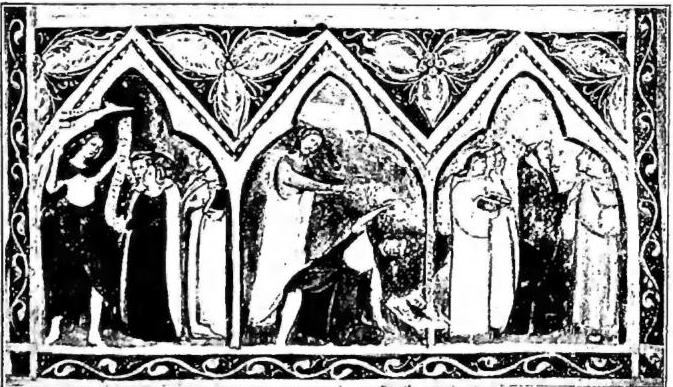
SCORPION. — An animal of the arachnid order, of olive-brown color; the flat body is equipped with two large chelicerae and a long, segmented abdomen ending in a venomous sting. The European species is small, and its sting causes only temporary disturbances; the stings of the much larger tropical species, however, can be fatal.
The Greeks and Romans made the scorpion a symbol of wickedness because of its insidious and deadly abdominal sting, and they considered it a prophylactic animal against the evil eye, on account of its malice (cf. Steier, *Spinnenleere*, in Pauly-Wissowa, III A, 2 [1929], cols. 1786-1809). In ancient and medieval Christian literature, the scorpion is a symbol: 1) of heresy (cf. Tertullian, *Scorpiacae*, I: PL 2, 121) and of the "hereditary" evil "because with its curved sting it pours venom into the body of the Church" (St. Jerome, *Contra Vigilantium*: PL 23, 363; cf. also *Comm. in Ezechielem*, I, 1: ibid., 25, 33; *Comm. in Joel*: ibid., col. 948; St. Augustine, *Serm.*, 126, 8: ibid., 38, 623; St. Bernard, *Epist.*, 196: ibid., 182, 363; medieval Latin bestiaries of a mystical and dogmatic character); 2) of falsehood and hypocrisy: "scorpions are those," says St. Gregory the Great, "who appear to be plastered with flattery on the face, but carry behind their backs the means to pour out their venom" (*Hom. in Ezechielem*, I, 9: PL 76, 879; cf. also the moralizing bestiaries). The *Physiologus* does not mention II.
Toward the end of the Middle Ages in Italy and France, the scorpion became a symbol of Jewish perfidy. In France, this is attested by the famous fifteenth-century Passion plays (cf. the Passions of Arras, by Arnoul Gréban, Jean
of Nottingham, Peter of Sutton, Richard of Conington abandoned the doctrine of Scotus, at the same time there were not a few others who proved ready to subscribe to the declaration with which in the fourteenth century Antonius Andreas concluded his *Expositio in Metaphysicam* (among the *Opera omnia* of Scotus, Vivès ed., VI, p. 600): "I wish all who read this text to know that both in my judgments and in my annotations I have followed the doctrine of the most subtle and excellent Doctor, whose fame and memory are blessed, as he who with his sacred and profound doctrine filled the whole world and made it resound, namely, Master J. Duns Scotus. My foot has followed in his footsteps." The reason, then, for the election of Scotus as head of that school, already begun by Alexander of Hales (q.v.) and founded by St. Bonaventure (q.v.), is his profound doctrine and subtle intellect, by virtue of which he was, as Mariano of Florence writes (*Compendium Chronicarum*, in *Archivum Franciscanum historicum*, 2 [1909], p. 631), "a wonder of his age." Francis of Mayrone, John of Bassolis, Hugh of Novocastro, James of Ascoli, Landulf Caracciolo, Francis of the March, Gerard Odone, Peter of Aquila, Peter Thomas, Nicholas Bonet, and numerous other doctors of the fourteenth century, attracted by the acuteness and solidity of Scotus's doctrine, spontaneously began to comment upon, illustrate, and defend the Master's doctrine, to extol the man and the Franciscan, even placing the most laudatory inscriptions on his tomb, such as: "Fountain of the Church," "Doctor of Justice," "Ark of Wisdom," "Leader of the Clergy," "Light of the Cloister," "Trumpet of Truth" (Wadding, *Annales Minorum*, ad an. 1308 n. 35, VI, Quaracchi 1931, p. 133). Although this enthusiasm of the first disciples somewhat waned at the time of the general decline of Scholasticism, there were still in this century valiant Scotists (e.g., Peter Tartaret, Bartholomew Bellati, Nicholas d'Orbells, Anthony Sirrect, Francis Vidal y Noya, John Foxal, William Vorilong) who continued the tradition of the first disciples of the Subtle Doctor.
The reason for this uninterrupted flourishing of admirers and followers is to be found, as Mariano of Florence attests (*op. cit.*, p. 631), in the fact that Scotus "wrote certain most subtle works above all other theologians," or, as the chronicler Nicholas Glassberger reports (*Chronica*, in *Analecta franciscana*, II, Quaracchi 1887, pp. 113-114), in the fact that he was "a most illustrious star of the Church and the Order." Even the great reformers of the religious life of the Seraphic Order exalted and followed the Subtle Doctor; John of Capistrano called him "Doctor of the Friars Minor," and Angelo of Chivasso "prince of theologians." Above all, St. Bernardino of Siena, who in his missionary travels relied on Scotus's volumes as well, adorned his sermons with long extracts from Scotist doctrine (cf. D. Scaramuzzi, *La dottrina di G. D. Scoto nella predicazione di s. Bernardino da Siena*, Firenze 1930). From this period dates the liturgical monument erected in honor of the Doctor Marian: in the fourth lesson of the second nocturn of the Office of the Immaculate Conception, approved by Sixtus IV, it is affirmed that Duns Scotus was predestined by Divine Providence to remove the difficulties accumulated by the University of Paris against the Marian privilege: "But the Lord Jesus Christ, to protect the dignity of His beloved Mother, immediately sent Scotus, an eminent doctor of the Order of Friars Minor, to that city" (cf. C. Balic, *J. Duns Scoti theologiae marianae elementa*, Sebenico 1933, pp. xxvii-cxx).
II. DEVELOPMENT
Scotism in the sixteenth to eighteenth centuries enjoyed its golden age. Alongside the general causes that favored the establishment of Scholasticism in general, of which Scotism is an integral part (the invention of printing, the post-Tridentine reform, the insistence of Pius V and Sixtus V on Scholasticism), there were particular causes, among which must be noted the edition of Scotus's *Opera omnia* by Wadding in 1639; the struggles for the Immaculate Conception, which were carried to their extremes and in which Duns Scotus was considered by all as the principal representative of the common doctrine; the prescriptions of the Franciscan Order, which, while at first had not given Scotus any preference, and in 1500 had placed him on a par with other Doctors, after 1593 strictly ordered that in the schools "the teachers should endeavor to explain only Scotus's text, and not other authors" (cf. Duns Scotus). Moreover, the development of Scotism was greatly aided by the fact that in the schools and various universities, alongside the *Libri Sententiarum* and the *Summa Theologiae* of St. Thomas, the *Opus Oxoniense* began to be explained, according to the ordinance of 1520 by the Minister General Licheto (Wadding, *Censura in Opera Scoti*, Vivès ed., VIII, p. 2). Scotism thus had its chair at Padua, Perugia, Bologna, Florence, Rome, Turin, Vienna, Louvain, Paris, but above all in the various universities of Spain.Among the numerous authors who explained Scotus's *Opus Oxoniense* and whose commentaries were printed, we may recall Clement Bascetti, Laurence Brancati of Lauria, Alfonso Briceno, Francis Casimir, Maurice Centini, Bartholomew Cimarelli, John of Cartagena, Francis of Herrera, Jerome Galli, Anthony Higuery, Philip Fabri, Melchior Flavi, John Fonio, Armand Hermann, Hyacinth Hernandez de la Torre, John of the Incarnation, Charles Lanteri, Maturin Lebreton, Joseph Leali, Francis Licheto, James Malafossa, Paul of Mercatello, John Ovando, Mark Odonez, Bonaventure Passeri, Francis of the Pitigiani of Arezzo (*Aretinus*), John Francis Perez Lopez, Peter of Posen, James Pierio, James Podborski, John Poncius, Andrew Rochemarin, Gregory Ruiz, Paul Scriptor, Gaspar Sghemma, Matthew Sosa, John Vigario, Peter Vriese.
Of the golden age of Scotism, the following are notable: Claudius Frassen, John Gabriel Boyvin, Bartholomew Mastrius, Bonaventure Belluti, Maurice O'Fihely of Porto, Francis
Macedo, Matteo; Ferchio, Sebastiano; Dupasquier, Carlo; del Moral, Girolamo; da Montefortino, Girolamo; Krisper, Crescenzio; Smising, Teodoro. Despite the Order’s prescription to explain only Scotus’s literal doctrine, even in this period one finds that independence and freedom of spirit which is one of the characteristic traits of Franciscan doctors. Alongside the Capuchins, who generally prefer St. Bonaventure, and alongside great theologians like Alfonso de Castro and Ludovicus Carvajal, who were not admirers of the division into “Thomists, Scotists, Nominalists,” even among the most ardent disciples of the Subtle Doctor one finds the principle affirmed that to be a good Scotist it is not necessary blindly to follow the great master. Thus Johannes Poncius writes: “Proposui semel argumenta aliqua contra nonnullas rationes Doctoris Subtilis, et dixi non esse necesse ut sectatores ipsius singulas eius rationes tueantur” (Philosophiae ad mentem Scoti cursus. Appendix apologetica, Rome 1645, p. 2). These authors recalled the admonition of the master himself: “In processu generationis humanae semper crevit notitia veritatis” (Ox., IV, d. 1, q. 3, n. 8, ed. Vivès, XVI, p. 136).
The Scotists also played a very important and effective part in the various activities and controversies of the age. At the Council of Trent there were present about one hundred Franciscan theologians, among whom not a few shared the judgment expressed by the celebrated Andreas Vega: “Tanta est mihi pietas in Doctorem Subtilem, tamque piam habeo opinionem de illius felicissimae ingenio et catholica et omnino singulari et praecellenti doctrina ut neque illas argumentis adduci possim...” (cf. Wadding, Annales Minorum, VI, p. 152). The Scotists carried on a great activity against the “Reformers,” so that in England, under Edward VI, among the works of the scholastics those of Scotus were cited in particular and were burned by the heretics with the cry of “Fumus Scoti ac Scotistarum” (Wadding, op. cit., p. 148; P. de Martigné, La scolastique et les traditions franciscaines, Paris 1888, p. 314). Even in the controversy “de auxiliis,” between Jesuits and Dominicans, some, like Mastrius and Krisper, framed a mediating theory. But without doubt the greatest effort of the Scotists of this period was concentrated on the defense of the Immaculate Conception, and among the most ardent defenders of the privilege one must still recall Petrus Alva y Astorga.
III. DECLINE AND RENASCENCE
In the second half of the 18th century and in the 19th, Scotism, like scholasticism in general, moved toward decline. But while a few decades after 1854, the year in which the Scotist school celebrated its greatest triumph with the proclamation of the dogma of the Immaculate Conception, scholasticism began effectively to renew itself, Scotism showed no signs of revival. In this period the Minorite Order, which in its golden age of the Scotist school numbered about 150,000 religious, had not yet recovered from the scourge of wars and revolutions; and on the other hand it became almost fashionable to present Scotus as the precursor of all those evils and errors against which the Church had to struggle. But the nearer one approached the fiftieth anniversary of the proclamation of the dogma of the Immaculate Conception and the more the historicist movement inaugurated in the second half of the 19th century spread, the more the figure of the Subtle Doctor began to appear in his true historical reality (v. Duns Scotus). The historical-critical method, indeed, not only effectively contributed to making known the life, the works, and the history of the Scotist school, but above all brought out the relationship between Thomism and Scotism. Among the protagonists of this Scotist renaissance the disciples of St. Thomas do not occupy the last place, for example, Gilson and Grabmann.IV. SCOTISM AND THOMISM
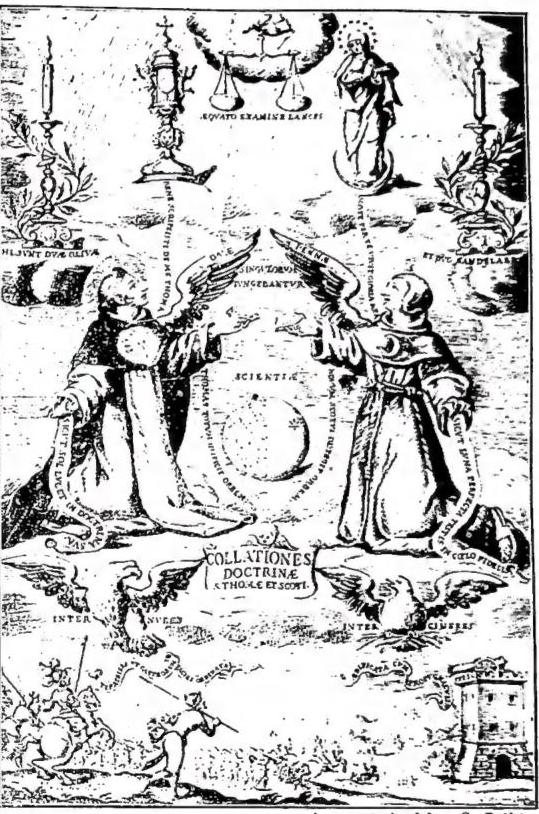
Duns Scotus did not attempt merely the synthesis of the two primitive Franciscan schools, that of Oxford with its mathematical-scientific tendency and that of Paris rich in the material collected in the Summa of Alexander of Hales and in the works of St. Bonaventure, but also the synthesis of the Aristotelian-Thomistic current with the Augustinian-Franciscan. By placing being as such as the object of metaphysics and eminence as the object of theology, affirming the univocity of being, and by means of the formal distinction, the so-called voluntarism, he attempted to understand and illustrate revealed truths. His disciples, however, often exaggerated these principles, so that they were accused of having introduced into the doctrine of Scotus a realism which is not in the texts: “quod in ipsa re” (Johannes de Rada, Controversiae theologiae inter s. Thomam et Scotum, Venice 1598, p. 110), and that it was their disciples who dug an abyss between the two doctrines: “sed eius discipuli ne videantur cum Scoto sentire D. Thomam in aliam adducunt sententiam” (ibid., p. 16); that even in the case of conflicting positions sometimes both are probable and perhaps equally verisimilar (Macedo, Collationes doctrinae s. Thomae et Scoti cum differentiis inter utrumque, I, collat. 6, different. 4, sect. 4, Padua 1671, p. 141), so that if one understands well the position of each one must say: “bene dicit s. Thomas et Scotus” (Sarnano, Conciliatio s. Thomae et Scoti, Rome 1911, p. 10).These controversies and various attempts at reconciliation could not, however, always lead to a happy result; not only because they were based on a false principle, namely the systematic opposition of Scotus to Thomas, but also because the disputants did not always take care to know the fundamental positions of their masters, as is evident from the considerations on the scope in relation to the dogmas.
V. SCOTISM AND DOGMAS
Scotism did not ask the dogmas for its metaphysics, nor can its philosophical theses be considered a corollary deduced from revealed truths. Yet it would be a grave error not to bear in mind that Scotist philosophy arose from the effort to understand the mysteries of faith, to form an intellectus fidei. As a counterproof of having attained more or less this intellectus fidei, Duns Scotus appeals to the magisterium of the Church: “Si aliqua proponere temptat, sed... prius tenetur consulere Ecclesiam, et sic errorem vitare” (Rep. Paris, III, d. 25, q. unica, n. 6; ed. Vivès, XXIII, p. 462). It would not be very useful to reproduce the list of doctrinal points in which the peculiarities of Scotist doctrine are reflected, as Fulgentius Stella did in the 17th century in his work entitled: Celebriores Thomistarum et Scotistarum theologica controversiae (Milan 1651). What is important is to see clearly the point of view of Scotism, that is, to see exactly in what manner the Scotists by means of the univocity of being, the formal distinction, the so-called voluntarism, attempted to understand and illustrate revealed truths: only thus can one avoid the misunderstandings that have unfortunately filled the history of Catholic theology.First of all, it is necessary to bear in mind that the entity is not in Scotism a “habens esse,” but rather entitas essentiae. And this entity, which as such is “ens in quantum ens,” the primary object of the intellect, is conceived as an essence absolutely indeterminate, as a “quid” of which nothing further is considered. This entity must not be posited as a genus since it is common; on the contrary, it is too common to be a genus: “Ens autem non est sic limitatum, sed indifferens, quia ex hoc habetur quod praedicetur in quid de ente limitato sicut limitato, et ideo non est genus” (D. Scotus, Collatio 24, ed. Balic, De Collationibus, I. D. Scoti..., in Bogoslovni Vestnik, 9 [1929], p. 214). It is therefore not conceived in the manner of the genera of the Porphyrian tree, from which created and uncreated essence might be derived as further specific determinations. The single concept that in this way is one whose unity suffices to generate contradiction when affirmed and denied of the same thing (Ox., I, d. 3, q. 2, n. 5, ed. Vivès, IX, p. 18) and that “every inquiry about God presupposes” (Ox., I, d. 3, q. 3, n. 6-9, ed. Vivès, IX, pp. 102-109), refers only to the transcendental-logical aspect, not to the metaphysical aspect. It eludes pantheism—an accusation that Gilson rightly characterizes with the words: “une aussi complète absurdité ne vaut pas la peine de la réfuter” (Les seize premières Theorematiques, in Archives d'histoire, oct. I, d. 11, p. 36). This connoisseur of Scotist and Thomist doctrine, after reporting how the Thomists accused D. Scotus of pantheism, while the Scotists, for their part, accused Thomas of agnosticism, concludes by noting that all were wasting their time, since the word “ens” does not mean the same thing in the two doctrines. If it meant, in St. Thomas as in Scotus, the common and transcendental essence and its modalities, the analogy of being would imply a certain agnosticism regarding the divine attributes; if it meant, in Scotus as in St. Thomas, the essence whose supreme perfection is its act of being, the univocity of being would imply a certain pantheism. Now, precisely history shows that this was not the case. There is no agnosticism in the one, nor pantheism in the other, if the word “ens” is taken in the sense that each of them attributes to it (E. Gilson, D. Scot à la lumière des recherches historico-critiques, in Scholastica ratione historico-critica instauranda, Rome 1951, pp. 509-10).
The same misunderstandings occur regarding the questions of the divine nature, the hypostatic union, and the human soul. Scotus, after demonstrating that in the Holy Trinity the unity of essence is compatible with the other persons, notes that it does not seem intelligible how the essence is not multiplied and how there can be more supposits (persons) unless a certain distinction is admitted between the reason of essence and the reason of supposit (Ord. I, d. 2, n. 388; ed. Vaticana 1950, II, p. 349). Indeed, the reason, for example, why the first person of the Holy Trinity is Father is different both from the reason why it is God and from the reason why the second and third persons are Son and Holy Spirit, and these reasons are not something of our intellect but rather something in the divine essence itself: they are the formal reasons, which objectively express a diversity in divinity and in paternity, in filiation and in spiration. And yet they cannot be something really distinct, for this is incompatible with the infinite simplicity of the divine essence. There is therefore a formal distinction, or rather, a formal non-identity of the different realities of the same thing “prior to any act of created or uncreated intelligence” (ibid.).
When asked whether “such a distinction can be called real,” D. Scotus replies that it is neither “real actual” nor “real potential” (ibid.). All accusations against the formal distinction therefore generally stem from misunderstanding: there are those who, contrary to Scotus’s explicit thought, understand it as “real actual”; others consider the principle “tot esse, quot entitates” an intolerable error, wondering how Scotus and the Scotists do not come to the nature of being, nor understand how “ex duobus existentibus in actu non potest fieri unum per se ens,” as Cajetan said. On the other hand, there are Thomists who, considering the problem objectively, marvel that Cajetan himself does not see that Scotus’s entitas formalis rightly does not have actual existence (E. Gilson, Jean Duns Scot, Paris 1952, p. 470; cf. D. Cornelisse, Tractatus de Deo Uno et Trino, Quaracchi 1913, pp. 197-206).
Since, therefore, in Scotus existence is but a mode of essence, as many real essences as there are, so many “esse” there are as well; and since in Christ there are two natures, one created and one uncreated, there must also be two “esse”: one created and one uncreated. Christ, however, is not two entities, since each “esse” is the “esse” of one and the same Christ. If it is objected that “esse” constitutes the entity, the Scotists reply that in concrete beings entities are counted according to the number of subjects. In our case there is only one subject, Christ, and consequently, the fact that there are two “esse” in no way implies that there are two entities: “Etsi in Christo sunt duae voluntates, non tamen duo volentes, quia concretum non numeratur absque numeratione suppositi, sicut patet de habente duas scientias, qui non dicitur duo scientes. Ita in Christo, si sint plura esse, quorum utrumque erit esse simpliciter suppositi, non sequitur suppositum esse duo entia” (Ox., III, d. 6, q. 1, n. 8; ed. Vivès, XIV, p. 311). Scotus, therefore, although he posits in Christ two “esse” and two filiations, strenuously defends, and logically according to his principles, the perfect unity of Christ, insisting that the Word is formally man “Verbo formaliter” (ibid., d. 7, q. 1, n. 3; ed. Vivès, XIV, p. 333); that the operations of Christ are the operations of the Word: “Omnes operationes Christi sunt operationes Verbi per communicationem idiomatum” (Rep. Paris., III, d. 12, n. 2; ed. Vivès, XXIII, p. 326); and that instead of the traditional formula of the “assumptus homo,” the safer and less equivocal expression “natura assumpta” is preferable: “proprie homo non fuit assumptus sed natura humana” (ibid., d. 6, q. 3, n. 3; ed. Vivès, XXII, p. 291). “Cum dicitur,” writes Girolamo Galli commenting on Scotus’s text, “Verbum assumpsit hominem — quamvis homo a parte praedicati magis abstrahat et pro natura supponere videatur, attamen, cum Nestorius pro homine intelligeret naturam suppositatam, et per assumptionem, unionem non hypostaticam, sed moralem, vitanda est illa locutio” (Opus de ineffabili incarnat. mysterio, Milan 1645, p. 143). “Christus est una persona — adds another Scotist — , unum subiectum, unum ‘ego,’ unus filius, cui competunt divina humana” (P. Minges, Compendium theol. dogm. specialis, II, Ratisbon 1921, p. 262).
Certainly, the Subtle Doctor, also called the Doctor of the Incarnate Word, would be greatly astonished to see how today, by some, the history of the “assumptus homo” has been presented under his name, enriched not only with the propositions “perfect man though assumed, Jesus is therefore someone,” “Jesus Christ is a man designated directly as the assumed man, and not the Word,” but with various other expressions drawn from modern psychology rather than from Scholastic thought. But here the case is such that, just as St. Thomas is not always a Thomist, so neither is Scotus always a Scotist!
While certain Scotists go beyond the intention of the Subtle Doctor regarding the so-called “human psychology of Christ,” there are also Thomists who, although far from admitting the single *esse* in Christ, complain of Scotist infiltrations (cf. H. Diepen, *La psychologie humaine du Christ selon St Thomas*, in *Rev. thomiste*, 58 [1950], pp. 524 ff.), or even fear that “one day or another St. Thomas may be suspected of having been a Scotist *avant la lettre*” (cf. C. V. Héris, O. P., *A propos de la psychologie humaine du Christ*, ibid., 59 [1951], p. 468). But whatever may be the case regarding this thorny and intricate Christological question (cf. P. Parente, *L'io di Christo*, Brescia 1951; P. Galtier, *La conscience humaine du Christ*, in *Gregorianum*, 32 [1951], pp. 525-69), in the history of dogma there are no lack of examples of how Thomist thinkers may arrive at Scotist conclusions if, for a moment, they forget their own principles.
Passing over in silence the Scotist critique of the argument from motion used to demonstrate the existence of God—a critique which some theologians, following the declarations of Cajetan and Bañez, call “the triumph of Scotist subtleties” (cf. M. Chossat, *Dieu*, in *DTHC*, IV, col. 933)—one cannot fail to recall the problem of the immortality of the soul. It is well known that Cajetan (v. DE VIO), shortly before his death, candidly confessed that no philosopher had given an apodictic demonstration of the soul’s immortality, so much so that it was said that this prince of Thomists “declined toward the path of Herveus and Scotus” (cf. Thomas de Vio, card. Cajetanus, *Scripta philosophica; Commentaria in De Anima Aristotelis*, I, Rome 1938, p. LI, n. 2). Duns Scotus, although he holds that a moral demonstration of immortality can be given philosophically, repeats that there is no strictly metaphysical, apodictic, and necessary demonstration: *“Non video aliquam rationem demonstrativam necessariam ad propositum”* (Rep. Paris., IV, d. 43, q. 2, n. 15; ed. Vivès, XXIV, p. 496); *“Non est demonstratio nec ratio simpliciter necessaria, sed tantum probabilis”* (ibid., n. 24, p. 499). If the intellective soul, Gilson observes, is not a spiritual form possessing an *actus essendi*, but a real essence which derives its existence from its cause and not from the act of being, then an analysis of this soul reveals no intrinsic principle of perpetuity or incorruptibility. In this metaphysics of essence, the “form of the whole” integrates the being as *esse* does in the metaphysics of the act of being. Where the latter disappears, the Thomistic proof of the soul’s immortality disappears with it (E. Gilson, *Jean D. Scot*, pp. 487-97). Certainly, immortality could be proven if one could demonstrate that the soul was created in itself and for itself, not as part of a composite—but Aristotle never attempted this, nor is it evident how he could do so starting from his principles: *“valde dubium est,”* says Scotus, *“quid ipse senserit de inceptione animae intellectivae”* (Ox., IV, d. 43, q. 2, n. 19; ed. Vivès, XIX, p. 47).
It is this realization—that is, that starting from certain principles posited by pagan philosophers we cannot apodictically prove this or that truth of the faith—one often finds in the holy Fathers. This is an evident and necessary demonstration with respect to philosophers who know nothing of Revelation and are not so disposed to the knowledge of religious truths even when accessible to the light of reason. But what pagan philosophers could not do, Christian philosophers can do, and this even by means of natural reason alone. From this perspective, one must judge Scotus’ own concept of theology as a science. If theology, because of its contingent object and its lack of intrinsic evidence, cannot be called a science according to the four conditions laid down by Aristotle in the *Posterior Analytics* (I. I, cap. 2), this does not mean that sacred doctrine must be denied a scientific character (cf. A. M. Vellico, *De charactere scientifico theologiae apud Doctorem Subtilem*, in *Antoniarum*, 16 [1941], pp. 3-30).
In particular, to evaluate and properly appreciate the so-called “voluntarism” of Scotus, it is necessary to keep in view its point of departure. Duns Scotus, writing after 1277—that is, after the ecclesiastical condemnation of certain philosophical theses which presented the concept of the Greco-Arabic world, according to which God does all that He does *ad extra* necessarily—sought to safeguard contingency and freedom without, however, placing the will of God at the origin of ideas. Thus the Subtle Doctor insists that God’s knowledge, insofar as He is the cause of the existence of things, is not necessary but free, and declares that *“if it is a question of the existence of concrete things, with all their attributes, God knows it from the decrees of His will, and not from necessary ideas, for otherwise things would not be contingent, and indeed no contingency would be possible in the world”* (P. Minges, *I. D. Scoti de critica philosophica et theologica*, II, Quaracchi 1930, p. 101).
As for the so-called “moral voluntarism,” although it is often asserted that Scotus subjects part of the Decalogue, and consequently part of the natural moral law, to the free and arbitrary will of God, it must be noted that Scotus did not intend to include in this law anything in which God has at times dispensed, precisely because the natural moral law depends solely on the intellect of God and not on His will. *“The discussion between Scotists and Thomists,”* Gilson rightly observes (*Jean D. Scot*, pp. 613-14), *“can only refer to what is actually included in the natural law; as for the very notion they have of this law, it is no less intellectual”* (cf. D. Scotus, *Decretum de voluntarismo*, in *De Anima Aristotelis*, I, Rome 1938, p. LI, n. 2). In short: the so-called “Scotist voluntarism,” whether considered in the moral or psychological sphere, has no connection with modern voluntarism, which establishes that the will, and not the intellect, is the rule of truth and certainty. In Scotus, what is at stake is a certain primacy of dignity of the will with respect to the intellect: Scotus emphasizes love, the charity whose excellence is spoken of in theology in general, while the Thomists give greater emphasis to the intellect, that is, to knowledge; but it is clear that neither love excludes knowledge nor knowledge excludes love.
From this brief overview of the principal positions of Scotus in relation to certain dogmas, it is clear that he was persuaded that the thought of none of his predecessors could simply represent human intelligence in all its fullness and fertility, nor could anyone formulate a system that would be the definitive and absolute expression of Christianity in every detail. Thus, exercising the freedom granted to others, he sought by a serene search for truth to elucidate and understand these same dogmas, accepted by all, by his own path. The Scotists in the centuries that followed multiplied works and volumes in which they attempted to highlight these more or less original aspects of their doctrine, without always succeeding in demonstrating the correctness of their positions. And there is no reason to be surprised, if one considers the condition of human nature, namely, that what appears clear to one seems obscure to another. *“Prossus enim morum et geniorum ignarus sim,”* declared a Scotist in the 17th century, *“si illa quae mihi arrident, credam aliis semper placitura, immo non gravissime aliquando displiceant. Eo nempe occurrit humana caecitas ut quae uni sunt clara, alteri sunt plane obscura”* (G. van Sichen, *Cursus integer philosophicus*, Antwerp 1666, “ad lectorem”).
However, among so many controversial issues, one deserves to be remembered which in past centuries was known as the "Scotist opinion," and which today is a dogma of the faith: the Immaculate Conception. "Among all the religious orders," wrote Tommaso Strozzi, S.J., "that in the fourteenth century contended for the glory of the Conception of Our Lady, the Franciscan Order stood out, for under the banner raised by Scotus it undertook above all others the defense of this mystery, for which in the following centuries it endured so many struggles, published so many volumes, engaged in such continuous battles, and achieved such notable victories that by this single endeavor it has become more illustrious in the Christian world than for all its other merits which render it worthy of esteem..." (*Controversy on the Conception of the Virgin Mary*, part 1, ch. 30, Palermo 1700, pp. 566-67).
VI. ASSESSMENT
Duns Scotus, contemplating with his powerful and subtle intellect the mystery of being and Christian dogmas, discovered aspects unknown or unconsidered by his predecessors. With one of the boldest efforts of human reason engaged in the pursuit of truth, he gave an impetus to theological studies that has continued from the fourteenth century to our own day. The Scotist school has a history of many centuries, rich in a literature that in past times rivaled that of Thomism; and, together with Thomism, in the seventeenth century it was expounded in almost all the universities of Europe, not only by the sons of St. Francis, but also by theologians and philosophers of other religious orders, so much so that the Cistercian Caramuel could speak of the Scotists "qui non sunt Franciscani" and affirm that Scotist doctrine was "communissima" (*C. Lobkowitz, Theologia moralis fundamentalis*, lib. II, nn. 568, 570, Lyon 1657, pp. 149, 150)."The criticism," wrote Mausbach, "directed by the Scotists against Thomism was of value for the whole of theology, because it kept at bay the danger of rigidity and fossilization, which easily leads to 'iurare in verba magistri'; it pointed out, moreover, the weakest points of the Thomist doctrinal system, while at the same time bringing to light the strength and grandeur of the entire construction" (*Thomismus und Skotismus*, in Wetzler und Welte's *Kirchenlexikon*, 2nd ed., XI, Freiburg im Br. 1899, col. 1709). Something similar could be said of the criticism made by the Thomists against Scotism. The controversies and noble rivalry of the Catholic schools are beneficial not only for the progress of science but also to prevent the uncertain from being taken for the probable, opinion for faith, or falsehood for truth. "For as fire leaps forth from the collision of stones, so from the clash of minds in subtle disputations truth is elicited and flashes forth" (*Cornelius a Lapide, Commentarium in Sapientiam*, chaps. 6, 22; *Opera omnia*, IV, Naples 1855, p. 710). However, to avoid useless and vain controversies, it is necessary first, before attempting to defend or refute a proposition, to understand it in its text and context. And the historical-critical method of today has shown that from this point of view there were deficiencies in past centuries. Today it can be said that instead of opposing D. Scotus to St. Thomas, one should place him alongside him, remembering that in neither one nor the other do we find those presumptuous men who, in the words of the Common Doctor, think: "that what seems true to them is safe, and what does not seem true to them is false" (*St. Thomas Aquinas, Summa contra gentiles*, I, 5).