
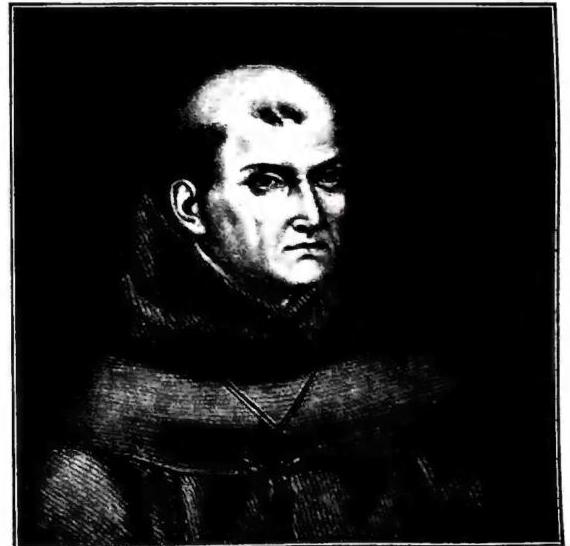
SERRA, JUNÍ-PERO. – Franciscan friar, born Miguel, at Petra (Majorca) on 24 Nov. 1731, died at Monterey (California) on 28 Aug. 1784.
On 14 Sept. 1730 he took the Franciscan habit. He earned a degree in theology at Palma, where for a time he taught philosophy and theology at the University of Majorca. On 19 Jan. 1750 he arrived in Mexico City and at the College of San Fernando prepared for missionary work among the Indians. From 1750 to 1758 he was a missionary among the Indians of Sierra Gorda north of Querétaro. He translated the catechism into the language of the Pame Indians. Recalled to Mexico, he worked there fruitfully (1758–67) as a popular missionary. When in 1767 the Jesuits were expelled from Spanish dominions, the Franciscans took over the missions of Lower California, and Serra asked to go. Named superior, he landed with fifteen companions at Loreto, the center of the Jesuit mission in Lower California. In those years the Spaniards began to concern themselves with the possession of Upper California, until then completely neglected. With the expedition sent in 1769 to occupy the land definitively, Serra sailed with four Franciscans, later joined by others. The task was to bring the Indians of the region, of very low culture, to the faith. Continuing the method followed by the Franciscans in Sierra Gorda, Serra founded a series of missions: San Diego (16 July 1769), San Carlos (3 June 1770), San Antonio (14 July 1771), San Gabriel (8 Sept. 1771), San Luis Obispo (1 Sept. 1772), San Francisco de Asís (8 Oct. 1776), San Juan Capistrano (1 Nov. 1776), Santa Clara (12 Jan. 1777), San Buenaventura (31 March 1782). From these missions sprang the principal cities of California, such as Los Angeles, San Francisco, San Diego, Monterey, Santa Barbara, and others. Serra was the father of the Indians, and for this reason California celebrates him as a national hero, and his statue stands, representing the State of California, in the Hall of Congress in Washington (1 March 1931). The cause of beatification, introduced in the diocesan curia of Fresno, is already under study at the Sacred Congregation of Rites.