
SILLOGISM. — From the Greek οὐν-λόγος, λογισμός, it indicates a connection of ideas, discourse. The term, already used by Plato (Theaet., 189 d; Phil., 41 c), in reasoning (v.), conclusion, inference (a meaning also suggested, figuratively, by συλλέγειν, to gather; cf. the Latin colligere, to infer).
With Aristotle, to whom the systematic theory of the syllogism is owed, the term assumes a technical meaning: “a syllogism is a discourse in which, certain things having been posited, something other than them follows of necessity, by the fact that those things have been posited” (Anal. pr., I, 1, 24 b 19; cf. Top., I, 1, 106 a 25). This definition reveals the essential concept of the Aristotelian syllogism as an instrument of demonstration or apodictic proof. Whereas Platonic διαίρεσις, or division (Soph., 253 d), insofar as it is a dialectical method, does not present formal necessity and is therefore only an “impotent syllogism” (ἀσθενὴς συλλογισμός; Anal. pr., I, 31, 46 a 33), the syllogism, in its perfect form, “needs nothing other than the premises in order to show the necessary consequence” (ibid., 1, 24 b 22). The Aristotelian definition extends to every form of formal reasoning; not, therefore, properly speaking, induction (v.), although Aristotle sometimes uses the expression “syllogismus ex inductione” (Anal. pr., II, 23, 68 b 15). Indeed, Aristotle technically contrasts syllogism and induction (Anal. pr., loc. cit.; Top., I, 72, 104 a 13).
The logical structure of the syllogism as the typical form of deductive reasoning consists in comparing two terms (concepts, noemata) with a third, in which their mutual inclusion or exclusion is shown: the syllogism thus resolves into a mediated judgment (and therefore into a synthesis of judgments), in which the agreement or non-agreement between subject and predicate is derived from a pre-established relation of both to another common term. The syllogism therefore comprises three terms: subject and predicate, or “extremes” (ἄκρα; the predicate, the major extreme: ὄρος πρόσος, τὸ μεῖξον; the subject, the minor extreme: ὄρος ἔσχατος, τὸ ἔλαττον), and the middle term (ὄρος μέσος, τὸ μέσον; cf. Anal. pr., I, 4). The terms are distributed among three propositions: two premises (προτάσεις, τὰ κείμενα, τὰ προτεινόμενα), the major (ἔξιμα), in which the predicate is referred to the middle term, and the minor (πρόληψις), in which the middle term is referred to the subject; and the conclusion (ἐνταρά, τὸ συμπέρασμα), which expresses the relation of agreement or exclusion between predicate and subject: “When three terms stand in such a relation to one another that the last is contained in the whole of the middle and the middle is contained or not contained in the whole of the first, there is necessarily a perfect syllogism connecting the extremes” (Anal. pr., I, 4, 25 b 32 ff.), e.g., mammals have pulmonary respiration, man is a mammal, therefore man has pulmonary respiration. The foundation of the logical force of the syllogism therefore consists in the particular relation of predication or subordination that it establishes among the terms and that is expressed in the law: if a predicate belongs to a subject, the predicate of that predicate also belongs to it, or “everything that is said of the predicate must also be said of the subject” (Cat., 5, 3 b 4-5). This formula is merely an application of the principle of identity and non-contradiction and consequently clarifies the universal formal necessity of the syllogism. Kant expressed it in analogous terms: “The first and universal law of every affirmative reasoning is... nota notae est nota rei ipsius; of every negative reasoning: ... repugnans notae repugnat rei ipsi” (Die falsche Spitzfindigkeit d. vier syllogistischen Figuren, § 2). Aristotle also indicated the principle in another way, in terms of extension: “what is said universally (καθόλου, κατὰ παντός) of a class must also be said individually of the single subjects contained in the class: if every man is mortal, and Socrates is a man, Socrates is also mortal” (the principle “dictum de omni”; cf. Anal. post., I, 4, 72 a 28, and Anal. pr., I, 1, 24 b 27). The formula of “identity” (“two things equal to a third are equal to each other”), although not absent in Aristotle (Top., VII, 1, 152 a 31; cf. Sum. Theol., 1°, q. 28, a. 3 ad 1), nevertheless does not express his most precise way of understanding the relation among the terms of the syllogism; nor is it perhaps in itself the best formula, since the relation among the terms in the propositions of the syllogism is not necessarily one of identity. From the nature of the syllogism Aristotle already deduced its fundamental law: “it is clear that every demonstration must be through three terms and no more” (Anal. pr., I, 25, 41 b 35); this rule, together with the other requiring the middle term to be taken universally in at least one of the premises (the middle term, particular twice, may resolve into two terms: cf. ibid., chap. 24, 41 b 7; and Anal. post., I, 11, 77 a 8-9: “if there is no universal term, there will be no middle term”), was later elaborated in the well-known eight traditional rules.
Aristotelian theory proceeds further (Anal. pr., I, 4 ff.) to determine the figures (πῆλματα) and moods (τόσοι) of the syllogism. The “figure” depends on the different position of the middle term in the premises; the “mood” on the arrangement of the premises according to their quantity and quality (universality and particularity, affirmation and negation). Aristotle distinguishes three figures: in the first, the middle term is subject in the major premise and predicate in the minor; in the second, predicate in both; in the third, subject in both. The laws of inference for the individual figures are determined, and the method of reducing the syllogisms of the second and third figures to the type of the first is then presented. Aristotle regarded the first as the only perfect and independent form of syllogism (wrongly, it seems: cf. W. D. Ross, op. cit., in bibl., pp. 49-50). To Aristotle’s three figures
a fourth was subsequently added (attributed to Galen [v.]), in which the middle term is predicate in the major premise and subject in the minor, and which is therefore rather a transposition of the first. Taking into account the laws of the individual figures, the arrangement of the middle term and of the premises according to quantity and quality permits 19 different modes of valid syllogism, expressed in medieval scholasticism (for the first time, it seems, in the Somnulæ logicales of P. Hispanus) by the mnemonic verses Barbara Celarent Darii Ferio, etc.; in which the vowels of the individual terms indicate the propositions of the syllogism in one of the four figures (for example, Barbara is a syllogism with three universal affirmative propositions in the first figure). In the Aristotelian treatment there follows an extensive exposition of modal syllogisms, in which the modality (necessity or contingency) of the subject-predicate relation is also expressed (cf. Anal. pr., I, chaps. 9-22). From the point of view of matter or content, Aristotle distinguishes the demonstrative syllogism (σ. ἀποδεικτικώς, φιλοσόφημα), which proceeds from universal and necessary premises (Anal. post., I, 4, 72 a 7, and 6, 75 b 5) and is therefore founded on “essence” (Met., VII, 9; XII, 4, 1078 b 24), and which is extensively developed in the Posterior Analytics; the dialectical or inquisitive syllogism (σ. διαλεκτικώς, ἐπιχειρήμα), which, proceeding from probable premises, “attempts” the search for truth; the contentious or sophistical syllogism (σ. ἀριστικώς, σόφισμα), which “seems to demonstrate” but in fact does not demonstrate (v. SOFISMA); and the rhetorical syllogism (σ. ἐγπορικώς, ἐνθυμήμα; the latter term subsequently being used, beginning with Boethius, with another meaning), which proceeds from analogies and examples (cf. Top., VIII, 11, 162 a 15 and I, 1, 100 a 27 ff.; Anal. pr. II, 27, 70 a 10; and Rhet., I, 1, 1355 a 6 ff.). The derivative forms of the syllogism that represent a simple variation of it (polysyllogism and sorites) are not explicitly considered by Aristotle (the sorites—but not the term—is mentioned in Anal. pr., I, 23, 41 a 18, and already developed in Alexander of Aphrodisias [V. I]); nor are the analogous forms of deductive reasoning treated (the so-called “disjunctive” syllogism, hypothetical syllogism, and dilemma).
Such, in general outline, is the Aristotelian theory of the syllogism, which thereafter remained substantially unchanged through the innumerable commentaries and subsequent developments. Aristotle displayed in it a particular acuteness of intellect and himself emphasizes with satisfaction his discovery: “before us there was nothing to expound concerning the manner of syllogizing, and we personally had to undertake long and laborious investigations” (De soph. elend., 34, 18 a 1 ff.). Hegel, while observing that Aristotelian syllogistic refers solely to the forms of finite and abstract thought, does not hesitate to describe Aristotle as, in a certain sense, “the naturalist of the spiritual forms of thought,” and his logic as “a work that does the greatest honor to the depth and vigor of abstraction of its discoverer” (Lezioni sulla storia della filos., Italian translation by G. Codignola and G. Sanna, II, Florence 1932, p. 374). Having fixed the forms of thought “which branch out like a web of infinite mobility” in concrete thought “was a masterpiece of empiricism: and this awareness has absolute value” (ibid., p. 383). Leibniz’s assessment was similar: “je tiens que l'invention de la forme des syllogismes est une des plus belles de l'esprit humain et même des plus considerables” (Nouv. ess., IV, chap. 17, § 4).
Nevertheless, a fundamental accusation was brought against the syllogism from antiquity onward (Sextus Empiricus, Pyrrh. Hypot., II, 14, 1996): the universal major premise presupposes the particular conclusion and therefore, as a demonstrative process, the syllogism involves a vicious circle: in order to say that “every man is mortal,” one must already know that “Socrates is mortal” as well. The uselessness of the syllogism for science is then reiterated by Bacon (Nov. org., I, 13–14) and by Descartes, who asserts that in order to construct a syllogism one must have its matter in advance: hence nothing new is learned through the syllogism, and “vulgar” dialectic is entirely useless “rerum veritatem investigare cupientibus” (Reg. ad direct. ingenii, 10, near the end). The criticism is developed at length by Locke, for whom the syllogism, “if it serves to demonstrate the connection between the proofs,” “nevertheless gives no assistance to our reason … in finding proofs and making new discoveries”: the syllogism shows the connection between two extremes, once a middle term has been posited, “but no syllogism shows, or can show, that connection which the middle term has with one or the other of the extremes” (Ess., IV, chap. 17 § 4, 6; V. Leibniz’s reply in Nouv. Ess., IV, chap. 17). The objection was taken up thoroughly by J. MELLO (v.): “reasoning from the general to the particular cannot as such prove anything; for from a general principle we cannot infer any particulars other than those which the principle itself assumes as known” (System of logic, II, chap. 3). There is therefore no inference in the syllogism, according to Mill. When the syllogism is constructed, the inference has already been completed; and consequently the syllogism serves only as a test of the correctness of our inductive processes: it is not a method of inquiry, but of interpretation and proof; and therein lies its irreplaceable usefulness.
The Millian difficulty arose in part from the empiricist presupposition that the universal (v. UNIVERSALISTI) is reduced to a mere collection or sum of individuals. Nevertheless, it does not seem that every basis should be denied to the objections against the syllogism. Particularly, the syllogism in purely extensional terms (every man mortal — Socrates a man — Socrates mortal) is substantially equivalent to a simple relation of subalternation between a general proposition and a particular proposition. Nor, generally speaking, does the syllogistic form constitute the natural mode of the inference of thought. The movement of thought takes place through the connection it discovers between a fact and a value, between the particular and the universal, or between the universal and the particular. And, at the moment of inquiry, this discovery is accomplished through the perceptive power of the mind, which does not unfold itself in an explicit syllogism, but rather involves it in the substance of its intuitive-discursive act. Aristotle himself observed that for the invention of the middle term—in which alone the true progressive moment of knowledge consists, and which precedes the formulation of the syllogism and is not accomplished through it—“sagacity” is required (ἀγγίνουα : Anal. post., I, 34, 89 b 10). For this reason, the syllogistic schema is of no effective assistance, nor does it in fact intervene in the living and creative effort of thought, which proceeds through analysis, comparisons, and direct comparisons of concepts and things, thus traversing the indefinite relations of the real (the κοινωνία τῶν λόγων of Plato: Soph., 253 d, 257 a). And yet the essential structure of the syllogism underlies the deductive process of thought, which finds in the syllogism and its schemas its clarification and logical necessity and therefore, as Aristotle rightly held, demonstration (v.).
In Hegelian idealism, since the real is rationality, the syllogism, as the only possible form of rational content, assumes an absolute value: “the syllogism is the essential ground of being of every truth,” and “everything is a syllogism” (Enc., § 181). In G. Gentile, the syllogism, as an expression of objectified and abstract thought, is determined by the law of identity: circularity in the demonstrative process is therefore inevitable. Thus, although “the nature of thought that has been thought, governed by the principle of identity, is fully expressed in the syllogism,” it nevertheless has value only as “a moment in the dialectic of the act of thinking” (Sistema di logica, I, Florence 1940, p. 258).
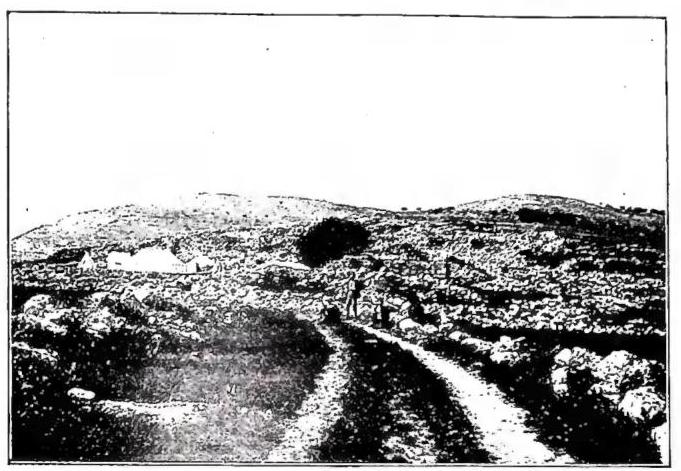
(photograph: Laboratorio Zincografico Terra Santa)
SILO - Panorama.
1925, pp. 127-78 (cf. Enc., §§ 181-70); W. Leibniz, Nouv. est., IV, cap. 17; trad. it., II, Bari 1926, pp. 244-69; G. Calogero, I fondamenti della logica aristotelica, Firenze 1927, pp. 209-47; J. De Tonquédec, La critique de la connaissance, 2e ed., Parigi 1929, pp. 375-435; J. M. Le Blond, Logique et méthode chez Aristote, ivi 1930, pp. 57-106; J. Fröbes, Logica, Roma 1940, pp. 187-265; W. D. Ross, Aristotele, trad. II. di A. Spinelli, Bari 1946, pp. 45-72; F. H. Bradley, The principles of logic, I, 2e ed., rist., Oxford 1950, p. 243 agg., e II; J. Locke, Essay on human knowledge, IV, cap. 17; trad. it., II, Bari 1931, pp. 374-401, V. LOGICA; RAGIONAMENTO. Ugo Viglino