
EPIGRAPHIC SYLLOGIES. - In the Roman world, the East preceded the West in the collection of inscriptions; in Greece, in fact, syllogies were compiled as early as the 3rd century B.C., and from these the Palatine Anthology, compiled by Cephalas in the 10th century, and the Planudean Anthology in the 14th century appear to have drawn. In the West, the first example is provided by a fragment of an ancient Roman syllogy, which a monk of Einsiedeln transcribed in the 9th century together with other Christian inscriptions; it was only in the 15th century that the numerous syllogies began to appear through which the great Corpus inscriptionum latinarum was gradually prepared.
After the Peace of Constantine, Christian epigraphy underwent such extensive development that in the early Middle Ages it gave rise in various regions of the West to numerous syllogies. The East, by contrast, can set against them only monumental inscriptions of the 5th–7th centuries, with additions from the 9th–10th centuries, taken from syllogies of Constantinople and nearby places and gathered in a special chapter of the Palatine Anthology, as well as funerary inscriptions of uncertain origin mixed in the chapter τῶν ἐπιτυμβῶν with pagan inscriptions (G. B. De Rossi, Inscr. christ., II, n. 29). This epigraphic activity, in which Rome always remained at the center, slowed during the final centuries of the Middle Ages, but from the 16th century onward resumed with a different character and ever-increasing vigor.
1. Christian syllogies prior to the 15th century
Some observations concerning this period should be made first. Various syllogies are found in many regions, but they are limited in scope; the larger ones, reserved for the greatest cities, are extremely rare, and these were produced with the special purpose of serving as illustrations or supplements to itineraries or descriptions of sacred buildings. The abundance of syllogies in the early Middle Ages is explained by the literary taste of the period, which was the sole reason for the small collections and not a secondary one for the larger. Poetry in Christian epigraphy did not remain, as it had in classical epigraphy, confined to tombs, but already in the 4th century, with Damasus, and even more with Ambrose and Prudentius, it extended to the decoration of churches. From the 5th century onward, parenetic, exegetical, and doctrinal poems adorned basilicas, baptisteries, and monasteries as well, especially through the work of Paulinus of Nola, Paulinus of Périgueux, Sidonius, and Ennodius, with a fervor that continued, following the example of Alcuin, throughout the Carolingian age. During that period, the epigraphic syllogies, providing material for exercises in monastic schools, were subjected there to numerous divisions and manipulations, partially incorporated into poetic anthologies, and reduced to the form in which they have come down to us.The verses that decorated a baptistery and a basilica and are reproduced in the Salmasian Anthology of cod. Paris. 10318 (De Rossi, op. cit., n. 20) can readily be traced back to a syllogy of 7th-century Latin Africa; from a similar anthology (id., op. cit., p. 460) derive two poems contained in cod. Sessor. 55, one of which was composed by St. Augustine for the tomb of a deacon who fell victim to the Donatists.
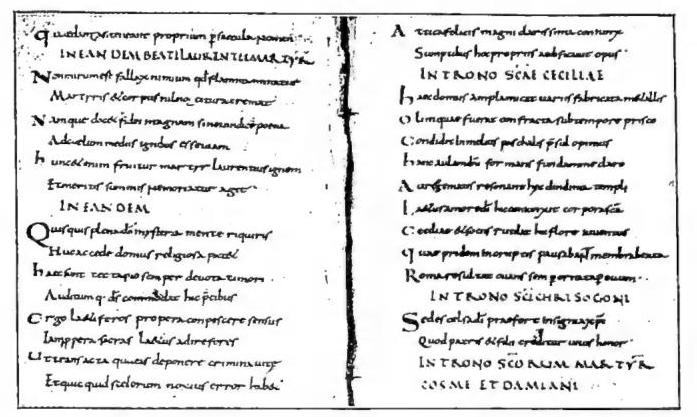
(Int. Enc. Cntt.)
SILLOGI EPIGRAFICHE - Corpus Laureshamense: S. Laureshamense I, with inscriptions from S. Lorenzo in Damaso, S. Cecilia, S. Crisogono and SS. Cosma e Damiano - Biblioteca Vaticana, cod. Pal. lat. 833, fols. 32v–33r (9th–10th centuries).
Spanish sylloge, or perhaps two sylloges, dating no later than the 7th and 8th centuries. From the anthology of 9th-century Christian poets in cod. Paris. 2832, De Rossi (op. cit., n. 25 app.) extracted three poems engraved in the basilica and monastery of S. Martino in Galicia, composed by its founder Martino di Bracara, which very probably derive from an epigraphic collection of the region; in several codices of Isidoro di Siviglia’s Etymologiae (id., op. cit., n. 22) are reproduced the couplets with which he adorned his Library.
Gaul presents, in the collection of inscriptions of the basilica and monastery of S. Martino di Tours, the only sylloge of this period to have reached us in its original state together with its descriptio; contained in many codices, from the Turon. of A.D. 820 to the Veron. of the 15th century, it is in several cases joined to the description. It is not certain, as De Rossi maintained (op. cit., n. 18), that it goes back to the 6th century. Two 7th-century epigraphs, intruded into the great Turon. sylloge of Rome (id., op. cit., n. 6), may suggest the existence of a second local sylloge. The anthology cited from cod. Paris. 2832 contains a substantial group of 6th-century inscriptions which, with the exception of some from Spain, belong to various cities of Gaul, namely Vienne, Lyon, Orléans and Arles; they appear to have been extracted from one or more original sylloges. Indeed, for Vienne another source (id., op. cit., n. 25) provides certain evidence of a special sylloge in verse and prose; for Lyon, De Rossi (op. cit., n. 24) is led to admit a fairly ancient sylloge on the basis of four poems in cod. Valent. 393; moreover, its epigraphic importance is confirmed by the eight epitaphs of 5th- and 6th-century bishops discovered during the reconnaissance of 1308 (id., op. cit., n. 33) in the church of S. Niceta. A sylloge of the 8th century in Aquitaine may be inferred from the four poems (id., op. cit., n. 260) inserted in cod. Paris. 4841. Traces of a collection for Trier (id., op. cit., n. 1) remain in the two Christian epigraphs transcribed in Scaligero’s vetus membrana.
In Italy during the early Middle Ages, the composition of sylloges is to be connected with the movement of pilgrimages, which became intense in the 7th century with the Anglo-Saxons, driven by the fervor of neophytes to visit the tomb of s. Pietro and those of so many other Roman martyrs, and continued uninterruptedly in the 7th century and thereafter, with a less ardent religious spirit but greater literary enthusiasm; this movement directly gave rise to the first sylloges of Rome and indirectly to those of the Italian cities situated near or along the route followed by the northern pilgrims.
In Rome, the wealth of sacred memorials soon made itineraries necessary to guide devout pilgrims through the numerous cemeteries and great basilicas. Four complete ones have been preserved, critically discussed by De Rossi (Roma sott., I, Roma 1864, p. 135 ff.): the Salisburgense 140, compiled under the pontificate of Onorio I (625–38); the Salisburgense 209, identical with the Wirceburgense 49, contemporary with or slightly later than Onorio; and the Malmesburriense, composed between 648 and 682.
For Rome, numerous 9th- and 10th-century sylloges remain, containing metrical inscriptions from cemeteries and basilicas, which De Rossi learnedly discussed, as well as no fewer groups of similar inscriptions that he extracted from poetic anthologies of the same centuries; from this mass of apographs of the Carolingian school it can be demonstrated that one must trace them back to only two original sylloges. For the extensive treatment, summarized here schematically, reference is made to A. Silvagni, Inscriptiones christianae Urbis Romae, nova series, I, Roma 1922, V. Conipectus auctorum; n. 1 with the corresponding synoptic table of the sylloge, and Dissert. della Pont. Accad. rom. di arch., 15 (1921), p. 181 ff.
The numerous Roman sylloges may be gathered into two distinct groups. a) Sylloges with inscriptions from cemeteries and cemetery basilicas, joined to titles of certain urban basilicas: Turonense (De Rossi, Inscr. chr., II, n. 6), Centulense (id., op. cit., n. 7), Einsiedlense II (id., op. cit., n. 2), Harleiana (id., op. cit., n. 9), Laureshamense IV (id., op. cit., nn. 3, 8), Vir-dunense I (id., op. cit., n. 12). The common characteristics of the sylloges in this group are as follows: no inscription is later than the pontificate of Onorio I; the total epigraphic material, amounting to approximately three hundred inscriptions, is repeated in the various sylloges for nearly two-thirds of its extent, and appears rather as a common body variously reworked; in almost all the sylloges the inscriptions are arranged in more or less extensive fragmentary topographical groups. The Turonense alone offers 37 cemetery inscriptions in regular topographical order, from the Via Salaria to the Ostiense, in complete correspondence with the Salisburgense 140 itinerary, as De Rossi pointed out; no sylloge contains cemetery inscriptions from the Via Flaminia, Cornelia, Aurelia or Portuense. In conclusion, since it cannot be critically maintained that various complete and partial sylloges, as De Rossi seems to suppose, were made in the same period for the same cemeteries, it is preferable to posit the compilation in the 7th century of a single great sylloge, contemporary with the ancient itineraries and following the suburban and urban order of one of them. This was joined to it as an illustration for learned pilgrims; soon detached from it, it eventually underwent the numerous reworkings of scribes and monastic schools. b) Sylloges with inscriptions of basilicas alone: Vaticana (id., op. cit., n. 5), Lauresh. I and II (id., op. cit., nn. 13, 11), Cantabrigense (Silvagni, op. cit., n. 1); Virdunense II (De Rossi, op. cit., n. 5), Wir-ceburgense (id., op. cit., n. 14), and sylloges in anthologies of codd. Paris. 8041 and 2773, 2832, 4841, 9347 (id., op. cit., nn. 21, 23, 25, 26), cod. Bruxell. 10615 (id., op. cit., n. 27 F), Lugdun. Q. 69 (id. op. cit., n. 26 B). The sylloges marked with an asterisk contain exclusively inscriptions from the Basilica Vaticana; in the remaining ones, these inscriptions are joined to a few others from different basilicas. The Vatican sylloge, devoid of inscriptions later than Onorio and furnished with a lemma showing that it was connected with another collection, must be joined to the great 7th-century sylloge, of which it very probably formed a specially distinguished part. The synoptic table of all the other sylloges brings to light a collection of 124 inscriptions from the basilica of S. Pietro and the adjoining buildings, eight of which are dated from 707 to 795; it therefore constitutes a second great sylloge of the 8th century, overlooked by De Rossi, which corresponds to a description of the Basilica itself from the 8th century (id., op. cit., p. 224), transcribed in an appendix to the Salisburgense 140 itinerary, and which very probably was originally attached to II.
The Basilica Vaticana had another sylloge in the 12th century, composed of epitaphs of popes inserted into the description of the Basilica in cod. Vat. 3627, which the priest Petrus Mallii presented to Alessandro III (1159–81). It was composed with a polemical purpose (id., op. cit., n. 19) in the contemporary dispute over precedence between the Basilica Vaticana and the Laterana.
The route taken by pilgrims descending from the Gran S. Bernardo through the Val d’Aosta emerged onto the Po plain; of several nearby cities, namely Milan,
Pavia, Vercelli, Piacenza, and Ivrea: the s. Lauresh. III reports inscriptions from some of these cities, which De Rossi judged to have been extracted in the eighth century from one or more s. Milan (id., op. cit. n. 16) certainly had a distinct and much more extensive s. than the ten poems in the codex, as the fragment of a Milanese itinerary transcribed after the Roman one in Salzburg 140 would suggest. A second collection of epigraphs of Milanese bishops of the sixth to eighth centuries (id., op. cit., n. 18) was discovered in the sixteenth century by Alciato and transcribed by him inaccurately in cod. Dresd. F 82; in his study De Rossi maintained that it had been compiled in the eleventh century in connection with the Vitae pontificum Mediolan. But a more detailed examination, with the aid of new information (A. Silvagni, Studio critico sopra le due s. medievali di iscrizioni cristiane milanesi, in Riv. di arch. crit., 15 [1938], pp. 107–22, 249–79), makes it possible to trace it to an earlier origin, probably the eighth century, and therefore to regard it as a fragment of the preceding s. Pavia, as the capital of the Lombard Kingdom, must likewise easily have possessed a special s., of which the present one would be a substantial fragment; the Greek inscription of S. Pietro in coelo aureo, reproduced in the s. Einsiedlense, should also be added. On the Via Flaminia at Spoleto, five poems by Bishop Achille were transcribed in the seventh century; they are found inserted in s. Lauresh. IV and in other codices of the Roman s. of the seventh century. To these must be added the titles of Bishop Spes and of a deceased person of 384, written in the ninth century on a pittacium (De Rossi, op. cit., p. 43) discovered in Aachen in 1878. From the sanctuary of S. Felice at Nola, celebrated by Bishop St. Paolino, come seven poems, including the votive poem of Damasus, inserted in cod. Paris. 1443 and partially in other codices. Ravenna, geographically distant from the movement of the pilgrims, did not offer a s. of its own to the activity of the Carolingian school; evidence of a s. or of isolated transcriptions consists in the poem of Droctulfo, inserted in three codices of the Roman s. of the seventh century, and in three inscriptions (id., op. cit., n. 1) of the membrana Scaligeri.
2. S. of the fifteenth century and of the later centuries. — In the preceding period Rome was at the center of Christian epigraphic activity, which extended over almost the whole of the West; in this period such activity is almost exclusively concentrated in Rome, where alone its development can be followed. It is well known that the first humanists devoted themselves to the search for ancient literary codices and, at the same time, to the transcription of epigraphs; from them arose that contempt for the crude Christian inscriptions which spread among all the epigraphists of that and the following century in the north, whereas in Rome during the sixteenth century it greatly diminished, until it disappeared with the flourishing of studies in Christian archaeology.
At the very beginning of the century, cod. Vat. Barb. 1952 presents a famous s. of classical inscriptions, with only twelve Christian ones, bearing the date 1409; a second recension, incorporated into a Descriptio urbis Romae eiusque excellentiae, is contained in codd. Vat. 10687 and Chis. I. VI. 204, both miscellanies; a third recension is found in cod. Vat. 3851, attributed to Nicola Signorili. De Rossi (op. cit., n. 37, p. 316 ff.), failing to take proper account of the date of cod. Barb., attributed the second recension to the year 1347 and identified its author as Cola di Rienzo; this conclusion was accepted by all scholars. A critical examination of the procedure followed (Silvagni, op. cit., n. 8; Archivum latinitatis medii aevi, Paris 1924), by undermining the dating of this recension, restores the full value of the date 1409 of the first recension. Its author, however, remains uncertain; he must certainly have been a humanist and was quite possibly Poggio Bracciolini, who from 1402 onward was transcribing inscriptions in Rome. Poggio Bracciolini is to be remembered here solely for a parvus quaternio of the Roman s. of Einsiedl. discovered by him in Switzerland around 1417; together with the preceding s., it supplied the only Christian inscriptions to all the great collections for more than a century (De Rossi, op. cit., n. 42). A small collection of epigraphs from S. Pietro can be extracted from the 4 ll. De Basilica Vaticana contained in cod. Vat. 3750 and in other codices (id., op. cit., n. 44), which Maffeo Vegio composed around 1450; as a good humanist, he was anything but an admirer of Christian inscriptions. Pietro Sabino was the first humanist expressly to protest against such—
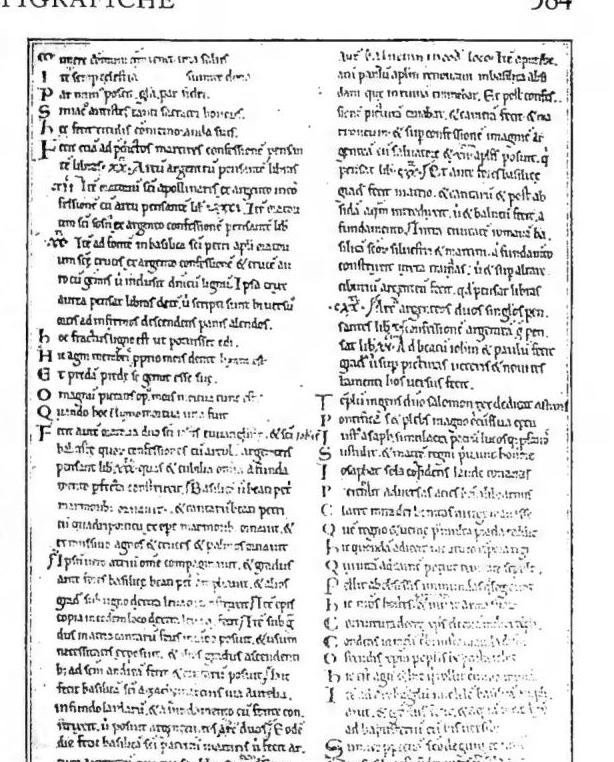
SILLOGI EPIGRAFICHE - S. e. di Cambridge: iscrizioni della basilica dei SS. Proto e Giacinto, dell'ontorio di S. Croce e della basilica dei SS. Giovanni e Paolo, intercalate nel testo di una copia del Liber Pontificalis - Cambridge, Biblioteca Universitaria, Kh. IV, 6 (alias 2021), f. 238v (sec. XII).
fatto disprezzo, e separando dalle classiche le iscrizioni cristiane, antiche medievali e recenti, da lui raccolte nelle chiese ed in altre parti di Roma, ne formò una ricca s. che nel 1494 offrì al re Carlo VIII (una copia ne fu riconosciuta dal De Rossi, op. cit., n. 66, nel cod. Marc. lat. X. 195). Di una simile s. di sole iscrizioni in prevalenza medievali di chiese romane danno notizia il Cancellieri ed altri, che formata nel 1498 da Giovanni Capocci andò poi perduta (Silvagni, op. cit., n. 27); bisogna scendere ai primi del sec. XVII per trovarne un altro esempio nella raccolta di Carlo de Serva del cod. Voll. G. 28 (id., op. cit., n. 62) e per ultimo al 1703 con quella di Epifanio Davanzati del cod. Vat. 10164 (id., op. cit., n. 95).
Con l'inoltrarsi del sec. XVI cadono in Roma le prevenzioni umanistiche e numerose iscrizioni classiche si trovano in certe s. mescolate ad iscrizioni cristiane antiche medievali e recenti, che esclusivamente appartenevano alle rispettive chiese; tale si presenta la s. dell'anonimo Spagnolo (id., op. cit., n. 57), raccolta, sotto il pontificato di Pio V, nel cod. Chis. I. V. 167. Questo ed i precedenti autori trascrivendo nelle chiese romane le iscrizioni cristiane avevano trascurato del tutto quelle numerose che nell'età medievale vi erano state trasportate dalle gallerie cimiteriali per lastricarne i pavimenti; a queste, non escludendo le altre delle chiese e le classiche, si rivolse l'attenzione di alcuni contemporanei epigrafisti. Aldo Manuzio (id., op. cit., n. 59), ne riportò un gran numero nel suo apparato epigrafico, specialmente nel cod. Vat. 5241 non posteriore al 1588; Filippo di Winghe (id., op. cit., n. 60) nella sua s. anteriore al 1592 contenuta nel cod. Bruxell. 7872-73 ne seguì l'esempio, così pure Giacomo Sirmond (id., op. cit., n. 62) alla fine del secolo nei suoi collectanea conservati nel cod. Paris. 9695. Il medesimo sistema tennero durante il sec. XVII Francesco
Suárez (id., op. cit., n. 84) la cui ricca collezione anteriore al 1667 è riunita nei codd. Vatt. 9140 e Barb. 3084, Francesco Tolomei (id., op. cit., n. 88) che lasciò 2 voll. di Iscrittiuni copiate dallì suoi originali in varii luoghi di Roma l'an. 1666, conservati nei codd. K. VIII. 1-2 della Biblioteca di Siena, come prima aveva tenuto G. B. Doni (id., op. cit., n. 74) che con la sua raccolta di iscrizioni cristiane e classiche, da cui fu estratta la s. del cod. Maruc. A. 293, si proponeva nel 1632 di formare un Corpus, disegno che neanche il mecenatismo del card. Barberini riuscì poi ad amare.
Nessuno degli autori citati riportò iscrizioni degli antichi cimiteri, da molti anni riscoperti; A. Bosio le fece per prima conoscere con la Roma sotterranea, uscita postuma nel 1632, a cui seguirono molto più tardi il Fabretti, il Boldetti e il Marangoni. I custodi antecedenti e successivi preposti dalla Chiesa agli scavi delle catacombe si preoccuparono solo di ricercare reliquie di martiri, mentre d'ordinario spogliavano le gallerie di tutte le lapidi che in gran numero venivano alla luce. Quelle dei cosiddetti « corpi santi » passavano alla Lipsanoteca del Sacristà pontificia o a quella del cardinal vicario, quelle dei comuni fedeli venivano disperse in Roma per lastricar chiese, per arricchire i musei esistenti, più spesso collezioni presso privati e case cardinalizie (riunite queste dal Marini nella Galleria Vaticana) e fuori di Roma per formare importanti collezioni lapidarie. Dalle due lipsanoteche, i cui manoscritti (Regesta Sacristi pontiff. e Acta custodiae card. Vicarii) forniscono due ampie raccolte di iscrizioni cimiteriali, e dalle varie collezioni lapidarie attinsero per le loro s. Venuti (id., op. cit., n. 102), Lupi (id., op. cit., n. 103), Seguler (id., op. cit., n. 118), Oderici (id., op. cit., n. 124) e Reggio (id., op. cit., n. 133) nel sec. XVIII, Amati (id., op. cit., n. 141), Sarti (id., op. cit., n. 144) e Settele (id., op. cit., n. 145) nel sec. XIX.
A metà del Settecento A. F. Gori (id., op. cit., n. 106) preparò solo un piano per la pubblicazione di un Corpus di iscrizioni cristiane; ma pochi anni più tardi Gaetano Marini con ben altra preparazione attese a raccogliere da ogni parte del mondo romano iscrizioni cristiane anteriori al sec. XII, che trascrisse, divise in vari capitoli, in quattro grandi volumi conservati nei codd. Vatt. 9071-74. Tutto il suo apparato epigrafico riordinò G. B. De Rossi mentre pubblicava il 1° vol. delle Inscriptiones per la continuazione delle quali lasciava una grandiosa raccolta di 19.000 schede manoscritte.
Bina.: G. B. De Rossi, Inscriptiones christianae urbis Romae, II, Roma 1888; A. Silvagni, Inscript. christ. urbis Romae, nova series, I, ivi 1922. Angelo Silvagni