
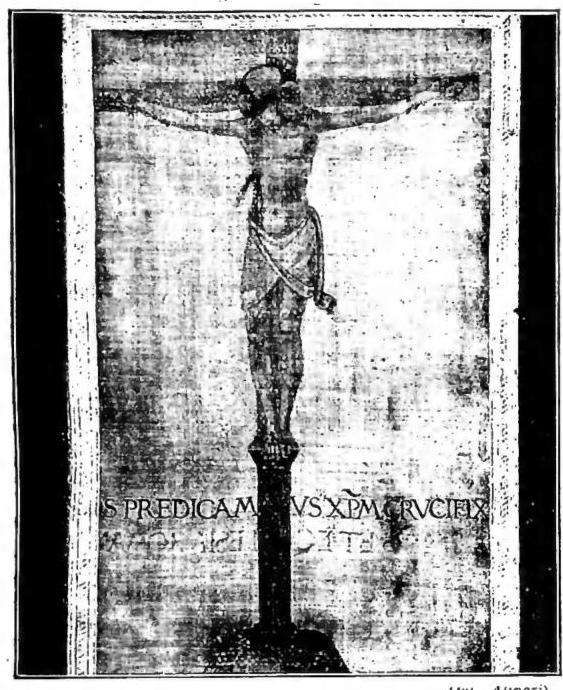

STANDARD — S. by Fra' Girolamo Savonarola (late 15th century). Florence, Museo di S. Marco.
The cloth is adorned with painted or embroidered sacred images (s'ascris imaginibus insignitum), sometimes only with modest ecclesiastical ornaments bordered and fringed; those of triangular military shape are excluded. As for the fabric (silk, linen, velvet), the color, and the ornament, there are no strict prescriptions: they are blessed (Rit. Rom., tit. IX, cap. 8, n. 3) and used in the Church as ornaments, especially in processions; they follow the processional Cross (Præferatur Crux, et ubi viget consuetudo, vexillum; Rit. Rom.).
They originated from the processional Cross, carried on a vertical staff to which an ornamental cloth was attached. They were not in use in the first millennium; they first appeared in a miniature from the Troparion of the Abbey of Prüm (late 10th century, Paris, Bibl. nat. 9448), as an altar ornament, and in a fresco of St. Clement in Rome (11th century) in a solemn procession of the translation of the holy relics. They are then frequently mentioned by liturgical writers, and medieval ecclesiastical inventories list many of them; each confraternity had its own s., often richly adorned with painting or embroidery. The s. is the symbol of the Lord’s triumph (Honorius, Gemma animae, I, 72; Durandus, Rationale, lib. VI, cap. 102); Christ descending into limbo or risen is represented holding the s. in His hand; likewise the Eagle of the Apostles. The s. is also the emblem of the triumphant Church and of the virtues of hope and fortitude.