
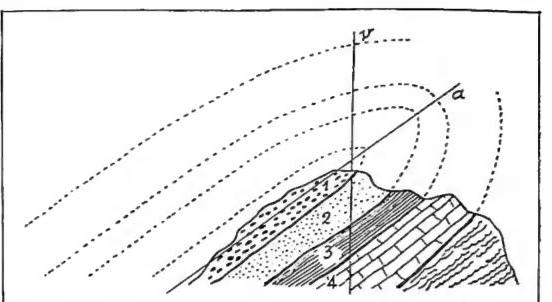
STRATIGRAPHY — Fig. 5. — Inverse succession of strata (from top to bottom, in the order 1, 2, 3, 4: inverted series), in a deeply eroded overturned fold. The dotted part completes the original overturned fold.
I. STRATIGRAPHIC ANOMALIES
If two or more strata deposited successively without interruption of sedimentation are regularly superimposed one above the other, they are said to be concordant (fig. 1). Sometimes, however, it has happened that, after the deposition of a group of strata, through a gradual or sudden retreat of the sea (regression), the sea floor emerged, that is, entered a continental phase, during which its surface was variously eroded. If, after a certain lapse of time, this region is again covered by the sea (ingression), the strata deposited there, even if they maintain parallelism with the older ones, are said to be discordant (stratigraphic unconformity; fig. 2), while the absence of marine deposition constitutes a “sedimentation gap.” Deposits that succeed one another regularly superimposed or that are included between an ingression and a regression belong to the same cycle of sedimentation.IV. STRATIGRAPHIC SCALE AND ITS DIVISIONS
By coordinating the results of paleontological studies and sedimentary cycles and taking into account all regions of the Earth and also other general paleogeographic events, it has been possible to construct a succession of terms called the stratigraphic scale. The earliest attempt at chronological classification seems to be due to Lehmann (1756), followed by that of A. G. Werner (1789), based on lithological characteristics. However, before Werner, G. Arduino had already established, as early as 1759, a geological classification divided into four orders which he called: primary, secondary, tertiary, and quaternary; these names are still preserved to indicate the four great eras: Paleozoic, Mesozoic, Cenozoic, and Neozoic, and which correspond fairly well, as regards northern Italy, to the actual stratigraphic succession of this region, as indicated by Arduino. At geological congresses, the nomenclature to be adopted for the divisions of the stratigraphic scale was established, the terms of which are group, system, series, stage, zone, and their chronological equivalents are era, period, epoch, age, hemera.It should be noted that the boundaries between eras are established on a paleontological basis (disappearance and appearance of large groups of organisms), but they may also coincide with stratigraphic unconformities (between Archean and Paleozoic, in some regions of North America) or with the beginning of great orogenetic cycles (between Mesozoic and Tertiary: beginning of Alpine orogenesis).
Geological periods may coincide, in certain localities, with great cycles of sedimentation, limited by partial retreats of the sea (Pliocene, in the Italian Peninsula). For the smaller divisions, although they may correspond to cycles of sedimentation, the criterion of separation is increasingly based on characteristic fossils (genera, species, varieties). The “zone” is truly the paleontological unit: it may correspond to a single stratum and may be represented by a single species of characteristic fossil. Some periods (Carboniferous, Permian, Triassic), since their marine and continental outcrops are known over wide areas, have a double division and nomenclature. Naturally, there exists in no region of the Earth a natural section that shows the entire stratigraphic series, from the Archean to the present; however, there are localities where the complete successions of an entire area or period are represented (Paleozoic, in southwestern England; Mesozoic and almost all of the Cenozoic in certain sectors of the Umbrian-Marchigian Apennines; the Devonian in the Meuse Valley, etc.). Finally, it should be recalled that geological periods derive their names either from the geographical locality, sometimes Latinized, where the terrains were first studied (e.g., Cambrian, from Cambria, the Latin name for Wales) or from the prevalent or characteristic type of rock (e.g., Carboniferous, in western Europe, for the presence of large quantities of fossil coal).