
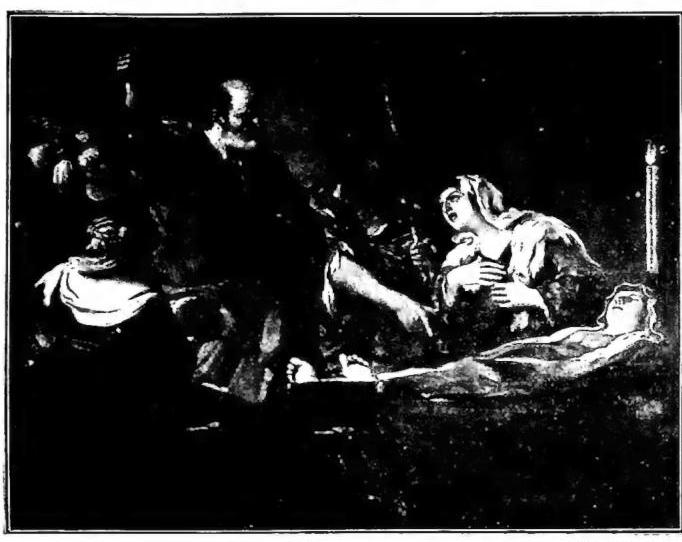
TABITHA — St. Peter Raises Tabitha, by Guercino (17th c.) — Florence, Pitti Gallery.
Tabitha kept the sacred vessels. In the “Most Holy Place” was the Ark of the Covenant (v.). In the “Holy Place”: 1) the table of the bread of the Presence (v.), rectangular (cubits 2 long × 1 wide × 1½ high), of acacia wood overlaid with gold, with a gold border to hold the feet of the bread-cakes and a gold rim around the edges of the table; in four gold rings the poles were inserted; on it were placed twelve loaves (corresponding to the twelve tribes); then ladles, dishes, cups and bowls, all of gold, for the libations; 2) the seven-branched lampstand (v.) on the south side; 3) the altar of incense (v. ALTAR) between the table and the lampstand. The incense was composed of storax (styrax officinalis), onycha (unguis odoratus), galbanum and frankincense (boswellia thurifera). In the forecourt, finally, stood the altar of burnt offerings and the bronze laver (“sea”) with a pedestal for the water used by the officiating priests for their ablutions (Ex. 30:17–21; 38:8). The symbolism of the Tabernacle is evident (cf. Heb. 8–9; Rev. 13:6; 15:5; 21:3). Each object had its own symbolic meaning.
In six months the individual parts were constructed separately, and on the first day of Nisan in the second year of the Exodus the Tabernacle was erected and consecrated by Moses; the glory-cloud of Yahweh enveloped it, taking possession of it (Ex. 40). The Tabernacle accompanied the Israelites through all their wanderings from the desert to the Promised Land: at Gilgal (Josh. 4:19; 5:10; 9:6; 10:6, 15, 43; 14:6); at Shiloh (ibid., 18:1; 19:31; Judg. 18:31; 21:19; 1 Sam. 1–4; 14:3; Ps. 78:60); at Nob (1 Sam. 21:1); at Gibeon (1 Chr. 16:39; 21:29; 2 Chr. 1:3); on Mount Zion (1 Kgs. 3:4). When the Temple was built, it was preserved as a relic in an upper chamber of the Temple. Jeremiah is said to have hidden it, together with the Ark, in a cave on Mount Nebo before the fall of Jerusalem (587 BC); after the exile it was never found again (2 Macc. 2:4–5).
The historicity of the Tabernacle has been denied by the school of Wellhausen (it would derive from the Priestly source P and reproduce the model of the Temple of Jerusalem). Yet its construction was required by cultic needs. Today earlier traditions than the Temple of Jerusalem are recognized (C. R. North, J. Engnell, etc.), and the existence of an amphictyonic league of the twelve tribes around a central sanctuary (M. Noth, A. Alt, M. Frank, J. Cross) or around a sacred tent (T. H. Robinson) is conceded.
T. is the transcription of Aramaic jebitā (Hebrew sebhiyyāh, Greek δοσκάς), “gazelle” (considered by Semites and in the Bible as a type of beauty; cf. Hebrew šebhî, “ornament”); it was widely used as a woman’s name, like other animal names (Rachel, Deborah, Jemima).
Archaeology. — On a fragment of a sarcophagus from Arles the scene of the raising of Tabitha is depicted, following the narrative in Acts 9:36–42: the Apostle approaches the bier where the dead Tabitha lies, takes her hand and she rises; in the foreground are two veiled widows, before the Apostle two other kneeling women. The same subject has been identified by G. Wilpert on a sarcophagus at St-Maximin; it is also reproduced on an ivory in the British Museum.