
TEXTRO
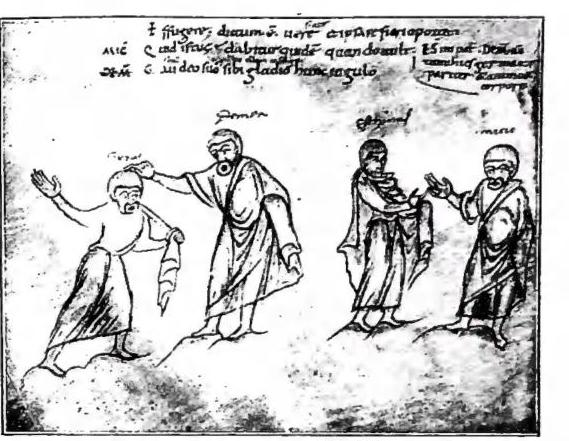
vv. 955-57 of Terence’s *Adelphoe* with the characters: Syrus, Demea, Eschinus, Micio. Illuminated manuscript from the Ambrosian Library, cod. H. 7 inf. (10th century) with miniatures derived from an imperial prototype, probably 3rd century. Milan.
---
Abstraction and typical representation of the environment; the street where the middle comedy and the new comedy with Menander will be placed, ensuring the transition from Greek to Latin comedy. But first, a word about the wall: a rapid composition that, in its brief and vivid form, summarized the lesser daily reality, attested by papyri; summarized literarily by Herodas and Theocritus; the foundation of Plato’s dialogues. The inevitable fragmentation of the wall marks the decline of comedy, just as pantomime does, where a mute actor dissipates a fanciful reality for amusement and escape.
---
IV. ROMAN THEATRE: CULTURAL SITUATION AND STAGE CUSTOMS. TRAGEDIES. THE COMEDY OF PLAUTUS AND TERENCE. ATTELLANA AND MIME. PANTOMIME. SENECA.
In a few years, the creative power of great Athenian theatre reached its peak and declined; but when we speak of Roman theatre, if referring by name to a circumscribed place—Rome, though the metropolis of the Mediterranean world—may suggest a comparison from city to city, it refers to a secular span from the 3rd century BCE to the 6th century CE, and to an immense territory stretching from Britannia to Africa and from Asia Minor to Noricum. In reality, this term serves as an encyclopedic allusion; and though the Mediterranean political entity, politically unified by Rome and continuing along the line of Hellenistic culture, accepted Athenian tradition as hegemonic, many contributions of diverse origin blended with II. Certainly, an infinite distance separates the poetic dignity of Athenian authors from the vulgar and common demands of Roman theatre, especially imperial theatre, in the capital and provinces: all the more striking when considering the commitment with which political authority provided for theatrical life, ensuring that the urban plebs never lacked spectacular entertainment, often spending vast sums on stage apparatus and constructing sumptuous theatres everywhere. During the Empire, indeed, theatre, along with Baths and Basilicas, embodied what was deemed worthy of expression in the architectural ritualism of the most solemn structures.
This development was gradual: the first stone theatre was that of Pompey, in the last century of the Republic. Yet the political direction of spectacles, the concern—not practical but hedonistic—to offer the urban plebeians, who also constituted the electoral mass, adequate amusement, was ever-present. Initially, religious concerns seemed to mingle with it: when Etruscan actors were imported for certain purification ceremonies during a pestilence. But it is certain that the ground of agreement was not this; moreover, the urban plebs of Rome were ethnically and culturally a hybrid mix, and there was no religious anti-history in Rome that proposed seeking elsewhere than the lowest tolerable level of choral concord.
When magistrates and candidates for public office organized spectacles to bring lustre to their name and magistracy, they gladly resorted to eloquence and solemnity, even at the expense of deeper human interest. Another ground of agreement was comic play, the grotesque violence of verbal or mimetic satire—not directed, as in Athens, against persons or institutions (which would have been harmful and dangerous given the interests of the ruling class that financed the spectacles), but against generic types and masks; and here it was easy enough to trace back, through Hellenistic models, to an original comic typology in which different ethnic layers could recognize themselves.
Eloquence, then, on one side, and grotesque incisiveness on the other: such were the most frequent characteristics of Roman theatricality. The scenographic and spectacular element could take precedence; and certain re-enactments of victories were derived from triumphal processions where, above all, the quantity of masses and the wealth of spoils counted to impress the plebs. This is the essence, beyond its literary extensions (attended even by illustrious politicians), of tragedy. Comedy, by contrast, made use of its very poverty: the actors’ stage was quickly erected in a corner of the square, often at the behest of a impresario commissioned by a political figure; and the gathering was haphazard, seated on benches or standing, amid the noise of traffic, with the restless and curious minds of idlers, easily distracted or dispersed—by, for example, the announcement of a tightrope walker’s performance. The prologues of comedies are pleasantly full of such allusions to this lamentable fickleness and are deeply concerned with any disturbance.
The houses depicted on stage, open onto the public street, with an alleyway imagined at the rear, and the easily proposed and accepted conventions (e.g., an actor entering the stage from the spectators’ right was assumed to come from nearby places and the forum; but one exiting to the left was assumed to go to distant places—the fields or the sea) all contributed to giving the audience the idea that they were stopping for a moment in the street to watch, as curious onlookers, scenes from everyday life. Even the time of the performance, around midday—the hour of the crowded market in Mediterranean cities—avoided the sense that theatre was a rare event suspending ordinary life.
A more precise discussion of tragedy and comedy in Republican Rome would involve examining the texts (only fragments of tragedies remain) and comparing them with Greek models. Urged by some authoritative and decorous recommendations, authors (Livius Andronicus, Quintus Ennius, Marcus Pacuvius, Lucius Accius; but add to the canon the political dilettantes, like Quintus Cicero) had, on one hand, to obey the solemnity of the political and national program and to solemnize events, introducing emotional allusions to Roman current affairs even when not required by the Greek model they followed (the *praetexta*, i.e., tragedy in Roman dress and on Roman historical themes, overcame this obstacle); on the other, they had to capture the public’s attention and thus reduce the plot to its most elementary and striking structure, setting aside the supreme spiritual intelligence of the Athenians—the search, through word and image, for divine truth.
Thus, a disparate organism, witness to the profound fracture between morality and custom, between politics and religion, between the certainties of history and the truths of the spirit that had accompanied the long Hellenistic crisis: a crisis to which the Romans could offer an external remedy—their universal political organization—and recommend it with eloquence at times verging on the sententious (hence the maxims, such as Accius’ famous *odierint dum metuant*; partly due to the fact that tragedies were often preserved as school texts). And one will see in Seneca the culmination of a literary dramaturgy that accompanied the tradition of theatrical theatre.
Far greater fortune awaited comedy at the hands of two great authors: Plautus and Terence; yet even in them, who so far surpass the external opportunities of custom and time with the power of poetic individuation, one can discern the conflict between the immediate demand for a mimetic realization and the higher mastery of intelligence. Plautus, the elder, is both actor and director; he knows he cannot renounce the farcical evidence that the public wants and on which, with success, his bread depends: he accepts the themes of Attic comedy, certainly not reworking them through textual comparison, as translators and imitators, like the tragic poets, did. His audience cares nothing for the precious play of reminiscences, meditations, and paraphrases: it is enough for them to seize upon the farcical motif, to rise a foot above the misunderstandings of the twins (Menaechmi), to mock the twisted anxiety of the poor wretch who discovers a treasure (Aulularia), and in the Mostellaria to pretend that his audience consists of strong spirits who do not believe in ghosts. From the constraints of mimetic play he frees himself now with a human pity rich in sympathy and fervor (as in the Rudens, for example, or in his most nobly austere comedy, the Captives, where the spirit of sacrifice of a slave is exalted—who, in saving his master from captivity, does not know he is redeeming his own father)—and always with the rich vein of his songs, the melodic abandon, the pure harmony of a lyrical image that overlays the mediocrity of trite things.
Terence the African is closer to Menander, calmly probing the hidden folds of character, avoiding clamorous scenes, expressing more deeply than his own words; and a vague melancholy is nobly suspended over the figures of his Heautontimorumenos, his Hecyra, his Andria. Plautus belongs to the Italic plebeian stock, and, paradoxically, to understand him in comparison with forms closer to our own time, he behaves like a poet in comic opera who welcomes the opposing indications of comic jest and eloquent sentiment. Terence, a freedman whose culture and genius render him worthy of acceptance in the aristocratic circles of Rome, obeys an international program of elegant refinement and literary comedy.
Thus we return, century after century, to the same situation: on one side, the grotesque comedy of the popular tradition; on the other, the demand for an international, Hellenizing culture that insists on refinement and elegance; and poetic genius is a gift that descends upon both, without the observance of cultural canons meriting it more or less than observance of the rules of plebeian play. In Rome, century after century, the tradition of Atellan farce continues (from Atella: a city of Campania; not without some duplication of meaning that alludes to the black mask: atella is also a diminutive of atra: grotesque comedy, with strongly characterized types; Bucco the glutton, the buffoon Macco, the ogre Manduco, the hunchback Dossenno, and the senile Pappo; and through the work of Pomponius and Novius the Atellan fabula assumes literary stability and reflexivity. At the same time (in the last century of the Republic) the work of Decimus Laberius, later of Publilius Syrus (here too one must consider the origins of the two authors: the former a Roman knight, the latter an Asiatic freedman) reduces mimetic tradition to literary form, the representation of a fragmented reality that composes itself into a unitary justification through formal invention and a minimum of logical coherence (the Atellan, like every grotesque comedy, evades reality and takes no interest in it).
With the imperial age, which in every way favors theatrical performances, without a corresponding authentic life (indeed: it corresponds to dissipation), the two truly important voices of theatrical culture are Seneca and the pantomime: one opposed to the other. Seneca, even if performed, does not aim to establish a dialogue with an audience: what concerns him, if he wishes to give theatrical resonance to his word, is the effect it produces on that gathered throng of friends, admirers, and acquaintances whom the literary author assembled in the acroamata, the listening halls arranged in libraries or baths or private palaces. The pantomime, imported to Rome from Magna Graecia (but under Augustus two Oriental actors, Pylades and Bathyllus, became famous), consisted in the representation of a myth entrusted to a single actor, who, without speaking and sometimes without the accompaniment of chorus or music, depicted the entire story. Predominance of literary word in the theater of the auditoria, and predominance of the actor’s art in the theater of the pantomime; and a fracture of that unity which Greek theater had proposed: a fracture all the more grave in that the public of popular theaters, those with an immediate effect on social custom, was in a state of total passivity. The play of transfigurations passed through the spectators and estranged them from themselves; thus the actor was at times the rain-laden cloud of gold in the tale of Danaë or the sun that exposes the adultery in the fable of Venus and Mars. But would one not say, to establish the usual and necessary parallel between the extreme tendencies of Roman theater, that even Seneca’s tragedy itself points to a fearful extremity: the pantomime signified the dispersal of the actor’s active and moral personality into an irredeemable multiplicity of disinterested attitudes, while the tragedy of Nero’s age proposes a tragedy of pitiless horrors that traverses and overwhelms every intent of human dignity, limiting and stifling every freedom. And if the dramatic composition of the Senecan corpus does indicate a cathartic process and a possibility of redemption, from Hercules Furens to Hercules Oetaeus, the tragic images remain as exemplars of an extreme tendency: inoperative, there and then, when they were written, or at least lacking resonance in the theatrical sphere; but after fifteen centuries they offered the tragedy of the sixteenth century the ne plus ultra of evil that, even in its inertia, awaits justification. The response proved positive, and from that point a great history began, because between that and this the Christian centuries were interposed.
THE SACRED DRAMA: MIMIC SURVIVALS AND LITURGICAL CULTURE IN THE MIDDLE AGES. CHRONOLOGY. THE LITURGICAL DRAMA. GEOGRAPHICAL DISTRIBUTION. REPRESENTATIVE FORMS OF PARENTAL LITERATURE. THE MYSTERIES. LAUDS AND SACRED REPRESENTATIONS IN ITALY.
That rupture of Greco-Roman theatre, which had as its extreme manifestations mime and literary dramaturgy, did not reconcile itself spontaneously: a new culture was needed, a renewed depth of thought, and the rediscovery within the new Christian civilization—propagating among the new peoples of Europe—the perfection of that perennial philosophy which the Athenians had naturally intuited in living (which does not mean philosophizing naturalistically), which their mystery circles had the mystery cults suggest to the tragedians, and which their philosophers had distilled into theoretical propositions. Theatrical buildings were either transformed into fortresses, or filled in, or became stone quarries; and the mimes, once gathered in urban theatrical companies, became wandering performers, persecuted when not tolerated, plying their trade in markets and fairs, mingling with jugglers. The great themes of tragic theatre remained in the custody of high culture, but almost entirely losing the memory of what the tragic performances had actually been (tragedy and comedy became terms of new meaning); and the long-standing themes, already placed within the framework of classical comedy, dissolved once more into the vulgar tradition, or were repeated amateurishly, or collected in anthologies of farces, or sometimes, unconsciously, reconnected to the remotest carnivalesque traditions. Thus, both the Church and the new military aristocracies emerging from the dissolution of Roman society and the proliferation of barbarism viewed theatrical forms with disfavour: for the former, they were profane and immoral diversions; for the latter, unworthy entertainments for a rigorous conception of the dignity of the free man, that is, the warrior who knows how to defend and attack.
And yet, while the mime dispersed, an intention of the highest significance—and with great future prospects, even for the purpose of a unitary reconstruction of society—allowed tragedy, transfigured, to survive: for Christian liturgy, while celebrating the Passion, Death, and Resurrection of the God-Man, also embraces His human and divine life. Certainly, Greek tragedy, like every dramatic intuition, conveys only a mediated actuality; the event is true only in the poetic transfiguration of acts and in the receptivity of the chorus; whereas at the heart of liturgy there is not merely the evocation but the actual presence (and this alone suffices to distinguish between liturgy and drama in this paragraph, which insists on the idea of a liturgical dramaturgy). Yet Christian liturgy, while placing the Sacrifice at the centre of the liturgical edifice, in no way excludes the possibility that the whole of human life—words and deeds—should be arranged around that point; and that the words marking the believer’s transition from the natural sphere of worship to the supernatural sphere of faith should correspond to the Eucharistic reality.
Such are the premises of an event that unfolds over a millennium, from the sixth century—when all signs of organized theatre vanish—to the tenth century, when theatre becomes the centre of an ideal and total transfiguration of civil society in the nations of the West. An event, we say; but we cannot claim that this was a coherent and continuous process of sacred integrations, nor that profane forms gathered themselves into more complex organisms. The chronological terms, in such vastness, already say little: and there persists among historians a tendency to backdate the beginning of the new age, the so-called Renaissance, whenever they document—or believe they do—the existence of those supposed autonomous forms. The historian can only record more or less if they attempt to contrast the two worlds of sacrality and profanity, which together contribute to forming a single reality: a more pronounced presence or a more proclaimed absence of one or the other sphere, merely for dialectical convenience of discourse, a plenitude of sacred offices, or an uneasy rise of the profane. And the Middle Ages are the age that continually re-proposes this integrative exigency: we are far from believing that the Renaissance, whether understood as a rediscovery of the ancient or as an immanentist investiture of a human absoluteness, can truly be considered as the *plenitudo temporum*, perfection—which is a clumsy polemical and political inference applied to history. On the contrary, to anticipate the conclusion, the compromise solution proposed by 16th-century Italian culture remained valid—or was believed to be so—only within the circle of academic philologism, which thought it could recover the sense and actuality of ancient tragedy but was contradicted both by the profound religious intuition of the musical language that replaced the literary language in tragedy and by the inevitable technical limits encountered by the wholly comic and profane solution of the Commedia dell’Arte. The other great theatres of the West continued a meditation that became moral and religious even when—and especially when—it attempted the test of absolute human freedom.
Scholarly criticism has long studied the dramatic elements of the liturgy, particularly the offices of the Roman Breviary, in order to observe them at the heart of a new evolution in dramatic language. Yet this is not a matter of distinguishing different substances within a conglomerate: the liturgy is a unitary poem, which has an upper, charismatic limit and a lower, theatrical limit; and the very same words can be received in their transcendent efficacy, operative of supernatural reality, and in their spectacular evidence. This better explains the history of medieval dramaturgy, for the entire history of medieval drama refers to the liturgy; it avoids the naturalistic prejudice of forms that supposedly germinate spontaneously from one another; and it better declares the attitude of the Church, which, having condemned the profanities of decadent pagan theatre, did not reject the collaboration that the sacred itinerary offered to the persuasiveness and evidence of the representative form that accompanied it, so long as it could do so without impeding the rite. When, however, the illustrative elements threatened to overshadow the rite itself in the flourishing of the Renaissance arts, the Church recalled the austerity of pure liturgy, freeing it from the efflorescences that threatened to suffocate or divert it toward profanity. The relationship established between the theatrical and the liturgical is not ultimately different from that between liturgy and the figurative arts: a musician or a fresco that formally seals a moment of sacred history establishes the same point of contact between history and sacrality, between witnessing an event—even an inert one—and participating in II. And the history of such theatre oscillates between iconoclastic rigorism, which would do away with every sensory aid, and secular crystallization that makes spectacle an end in itself, content with its own evidence.
The culminating moments of the rite, like those illustrated on the walls of the temple, can receive confirmation from fragments of mimetic illustration that extend the ritual allusion: most easily in the joyous and glorious destruction of the Nativity and the Resurrection, as in the Office of the Nativity and the Office of the Sepulchre. Where the sacred intention remains purest, the liturgical drama is scarcely more than a figurative variation proposed in sacred vestments, with minimal apparatus (the dialogue between the Holy Women and the Angel at the Sepulchre, who asks *Quem quaeritis?* and answers *Non est hic, surrexit*, etc.; or the dialogue of the Nativity, sometimes, as in the Paduan Ordinary, before a crib arranged just below the altar, representing the Virgin and the Child, between “two canons in copes who are called Midwives” and the “masters of the schools and the Cantor... who are called Shepherds”). Where the figurative intention grows, the variation assumes greater scope, descending from the altar to the forecourt, passing from clerics to laity. There is no limit to such extensions, whether one passes from the sparse lines of the *Quem quaeritis* of St. Gall (musical tropes from which it was once thought verbal tropes derived, later expanded with mimetic evidence—Léon Gautier’s thesis, valid if not granted exclusive status) to the twenty-five days of the Passion Play of Valenciennes, or from the 9th to the 16th century; yet a thread always binds the illustrative fragment—however extended, however prominent in its mimetic display, however intrusive in its assertion among the play of evidences—to the liturgical text, indeed to the liturgy itself, which is ready to subsume within itself the events of time and the history of humanity, with its cycles of the year and of the saints.
From the 9th to the 16th century, we said: not to establish a law of evolution tied to time, but only to fix the chronological frame. This means that, for a more precise historical understanding, we must place before that *terminus a quo* the iconoclastic heresy, which opposed such personified representations even more violently than statues and paintings; and after that *terminus ad quem*, the immanentist heresy, which would restrict within the human sphere every itinerary toward the divine implicit in the celebration of the Word. This observation on temporal distribution must be extended to the destructive and subjective: to speak of a St. Gall origin (Gautier), or Byzantine (La Piana), or Roman (Toschi) is to misconstrue a poetic intention that above all seeks to transcend place and time, even though such theses retain validity when Byzantine texts are studied as a conscious reaction to the proud and exclusive intellectualism of that culture (the most important text is indeed the *Christòs páscho*, once attributed to Gregory Nazianzen but likely dating to the 11th century: a cento of Greek tragedies; yet no one can believe that its Christocentrism is unrelated to the polemic against anti-ritualist monotheism, or that its form is elaborated by chance, out of pedantic erudition, without regard for that classical-Christian humanistic syncretism that sought in ancient texts a glimmer of natural revelation of supernatural truth); when the St. Gall tropes are traced back to Benedictine culture, likewise conciliatory, activist, and historicist; when “Roman” is understood as “Catholic,” rather than as a prevalence of national intentions. Once this is said, and the search for genetic process from chronological occasions to religious intentions is inverted, the distribution of forms of sacred drama across Europe—from Byzantine East to French West—can become something more than an erudite catalogue.
A process of local definition is also discernible even when sacred drama remains within the sphere of Latin linguistic expression. The liturgical pluralism that permits variations collected and preserved in the ritual books of the churches does not fail to work upon that fundamental concern to solicit the participation of the choir in the rite. Of the extent of these interferences, the example of the recently discovered Cassinese drama suffices: it contains the so-called *Officium quarti militis*, preserved first in a *rotulum* (roll), the part of a single actor transcribed—a projection of the chivalric legend into the drama of the Passion (De Bartholomaeis). When then the language becomes vernacular and is placed alongside the Latin—at first leaving the sung parts in Latin—this is a sign that the liturgist becomes a dramatist and recognizes in the vernacular community the maturity necessary for a more active and conscious participation. Note well: the direction remains Latin; and the stage directions are in Latin (just as in the Italian sphere the stage directions of dialect comedies are in literary Italian); yet even here the religious and ecclesiastical direction of popular life is more concerned—far more than political or feudal authority—to ensure a full process of individuation for the lay group that takes part in the rite and gladly reflects itself in its own garments and customs. This occurs over a vast territory and in the most diverse forms: from the Bohemian *Unguentarius* (where the quackmime is mingled with the *Officium Sepulcri* and the Latin chants of the Three Marys) to the Provençal *S. Agnese*, where the characters, even the saintly ones, intone words to well-known melodies of profane songs. The texts are numerous and highly significant, not only as imposing testimony of a custom or as linguistic documents: the entire range of poetic possibilities unfolds here, namely the active intervention of a word to illuminate and thus to shape an environment. There are French texts first of all, and Provençal and English, Iberian texts with an intensely poetic flowering up to the masterpieces of Gil Vicente, and German and Slavic texts from Bohemia, Croatia, and Poland.
A special mention must be made of what occurred in Italy to the sacred theatre. Under the direct influence of Franciscanism, indeed personally of St Francis of Assisi, to whom the origins of the Lauda and the foundation of the Nativity at Greccio are linked, the concern of popular dramaturgy was less one of illustration than of edification. Elsewhere the spectacular element could prevail: while in central Italy the history of the dramatic Lauda unfolded, throughout the entire territory, even in Italy, where the style of the French Mystères spread (the word doubling the sense of mysterion over the etymon ministerium), one witnessed cumbersome intrusions, interminable spectacles: immense historiographies that dissipated in an invasive illustration (and ultimately irrelevant from the liturgical point of view) the spiritual concentration, the proper sense of the mystery. But in Italy, indeed in Umbria, the story mattered less than the reflection that was recommended, and remote events less than the preeminent and concrete fact that mattered to the assembly: to become aware of its supernatural destiny by celebrating together the event of sacred history and the recommendation of the liturgy. At the root of this, clearly, was a comforting mentality: group life, understood as both a source of merciful succour and religious edification, which inserted itself into the broader civic life while maintaining a certain autonomy: not exactly conventual life, but life in a sodality, with its own rules and festivals, under the guidance of ecclesiastical assistants. And one prayed in Latin, but sang in the vernacular; and because of this preeminent concern—to build the spiritual life of the community by weaving it with prayers and works—both choral song and sacred representation, both lyric and dramatic Lauda, served the same purpose. Those who have studied the dramatic forms of the Umbrian disciplinati could well take pleasure in regarding them without forgetting the scheme proposed by Aristotle at the origins of dithyrambic drama: a process of spontaneous objectification that separates the character from the chorus in the fervour of mimetic suggestion. While remaining doubtful about the creative possibilities of original impulses, and knowing how, even in 13th-century Italy, intelligence and the aid of reflection prevailed over naive exaltations, it is certain that here simplicity and choral unity were the intended endpoint. Music played a large part; and the word supported it, often as an indication rather than a poetic definition, leaving it to musical tone, as more eloquent, to define the collective sentiment and the characters. It is also true that it was the ambitious desire of the confrères to move from the oratory to the piazza and to secure civic importance for their festivals: as is shown by the Orvieto collection in comparison with the Lauda-books of Urbino, for example, and of Perugia. But the foundations of the new dramaturgy, which developed and concretized the premises contained in liturgical drama, were laid; and the life of the new theatricality, which suddenly abandoned the continuation of the Mystères and Representations, through the influence that the forms of theatricality in Europe exerted on the new theatre, is connected to this fundamental intuition of the Umbrian Lauda.
---
VI. II. PROFANE THEATRE: CARNIVAL FESTIVITIES AND BANDED COURTS. MIMES AND JONGLEURS. TRIUMPHS, ECLOGUES AND ALLEGORIES. — Medieval sacred drama always involves a relationship between the human and the divine; and its range, when texts are examined, appears far more varied than is suggested by those who, starting from a highly partial historiographical scheme, presume to see the entire epoch rigidly dominated by an exclusivist theocracy, and art deduced according to logical schemas (without counting that even then there was good and bad rhetoric; and that the excellent method of philosophical research then helped more than later to distinguish). Even the most solemn moments of the rite, those that would seem necessarily to bend to the most rigid intransigence, opened up to the festivity of comic invention: thus in the Officium Nativitatis the scenes of the Obstetrices and the Shepherds; in the Officium Sepulcri the theme of the Unction; in the Officium Peregrini that of the Inn; and when later vernacular compositions proved abundant in such characterizations, one must not forget that the original blending was proposed by older texts: indeed, by very ancient traditions, if they are found even in apocryphal gospels, which the Church sometimes admitted into less solemn and less demanding manifestations of the rite: almost a pious contribution of legends. Moreover (as musical language so often demonstrates, freer from precise conceptual notions and quicker to echo popular emotion), precisely in the most solemn festivities, merriment allowed freer play to the imagination. The important thing, in judging that world, is always to keep that relationship in mind; and the distinction here adopted in two paragraphs should indicate rather an assiduous interference than a parallelism, and much less an antagonism. Moreover, the distinction is semantic and catalogic, not intrinsic and categorical; and in every authentic form of poetry, no matter what occasion prompted it—sometimes even satirical and mocking—the touchstone is always truth; and truth is indivisible.
Thus the rite opened itself to laughter; and the liturgical celebration of the Innocents gave rise to the election of the Episcopus puerorum, and the feast of Epiphany to the popular uproar against Herod, and, with a confusion too understandable of characters, against the Herodians, who became the she-devil Redodessa in so many merry and frightening rites. It was easy enough, given the syncretism of the prevailing conception in Catholic countries, for these pauses in the rite to accommodate one or another survival of very ancient customs: such as the memory of the Saturnalia in the winter solstice festivals. The important thing was to establish a relationship and to emphasize it in time. Thus it was with Carnival: on closer inspection, it received from the rite and from the liturgical order in which the seasons of the year were arranged a kind of investiture, an almost indirect justification: and thus it came to form part of a rigorously ordered discourse (Carnival does not disappear where a stricter moral judgment intervenes to forbid it; but where the ideal sense is lost, the rhythmic and spectacular order that the liturgy suggests for the year: it no longer makes sense if the sacred suggestion fails). The same may be said of a relationship that, outside the liturgy, was established between the hierarchy of the clergy and the hierarchy of the laity: even political life, in its most elevated and reflective forms, owed something to Byzantine influence (and the court of Constantinople remained exemplary for all Europe in that complex of ceremonies that liturgically expressed the sacred investiture of the emperor: caesaropapism, as we say; and that ceremonial passed to the West, from the court of Burgundy).
---
THEATRE
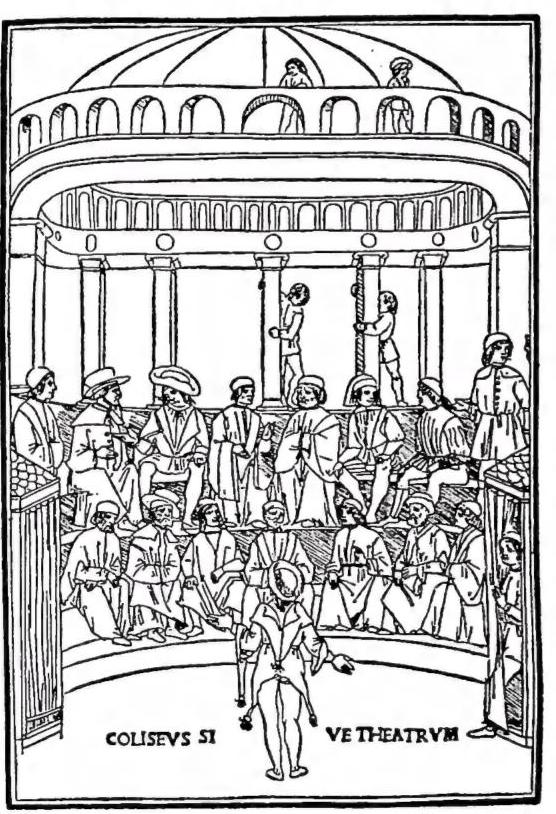
Theatre — Performance of a comedy by Plautus. Engraving adorning the Comedies XX of Plautus, printed in Venice by Lazzaro Soardo, 14 August 1511 — Vatican Library copy.
---
THEATRE — Title page of the Comedies of L. Ariosto, with a pen drawing by Giulio Martinelli of Urbino (1622), reproducing the mask-mouth with a classical scene in the background and a central figure holding a mask and a musical instrument — Vatican Library, cod. Urb. lat. 688, f. 1'.
At the court of Spain, and through Spanish etiquette at the court of the Habsburgs, this theatrical and spectacular manner of expression, modeled on the lofty language of liturgy and shaped by a dominant religious and unitary conception of life, was rigorously codified from the “acclamations” that greeted the monarch to the rules of precedence. The pluralism of Western society after the year 1000, and above all the prodigious adaptability of communal civilization in Italy—which preserved the most rigorous religious unity while multiplying human experiences in every direction—opposed this hierarchical regulation. Yet even in its most excellent and refined manifestations, the courts of the West reiterated that intention, especially in the “banned courts” that this or that political authority, including the communal republics, proclaimed on solemn occasions. Then the entire society set aside its usual occupations (though even war, when it was not a trial by ordeal and was not reduced to mere slaughter, recalled the tournament and the ritual of knighthood), and the festival arrived: power was contemplated and celebrated, poets and minstrels solemnized and enlivened it, and the festive pause presumed to renew the golden age. These solemnities were themselves spectacles; yet they provided a framework for chivalric and courtly games, convivial mimes (such as the extremely ancient Coena Cypriani, which presented a procession of biblical figures: a parade of more or less rich costumes, a pretext), and finally the jests of the minstrels, who for once paused in their wandering lives and were received into an illustrious society.
Upon entering the court, the minstrel ceased to be a fragmentary and occasional performer of buffoonish antics and comic or acrobatic tricks; he could now insert his role into a coherent discourse. One may be inclined, for the sake of emphasis in a historical survey, to isolate this figure and present it as emblematic of a process of validation. Yet the fact remains that every comic moment gains meaning, prominence, indeed justification and investiture—and the possibility of being effective and active within a circle—precisely because it is observed and understood within a broader order. Thus the ex lege buffoons and minstrels, who in theory were banished from society, were reconciled with it on such solemn occasions. Much of medieval satirical poetry, from the songs of the goliards to the beast epic, can be viewed in relation to this minstrel tradition; and the minstrel himself, depending on whether a separatist or a unitary and hierarchical mentality prevailed, could be seen either as a miles de curia, a courtier who aided the prince with wise counsel, sometimes concealed beneath the mask of natural wisdom or the guise of the feigned madman, or as a buffoon. Remaining evidence appears both in the traditions collected by novellists and historians (the most famous of these minstrels are credited with a repertoire, or even a comic legend: they became figures in a comic mythology after having been actors—such as the characters recounted in the Novellino, by Giovanni Boccaccio, and Franco Sacchetti) and in the texts of vernacular mimes. Among the more distinctive personalities of this kind are Rutebeuf, who touched on all the themes offered to his profession as a Parisian trouvère and ranged from mime to lament to sacred legend; Adam de la Halle of Arras, who concluded his cycle in Naples and defined himself within a theatrical organism that was more solidly structured and autonomous (Jeu de la Feuillée, Robin et Marion); and Cielo d’Alcamo, with his mime Rosa fresca, set against and opposed to the courtly poetry of Frederick II’s curia.
Yet the court needs to celebrate itself in its supreme functions; it cannot be satisfied merely to serve as a backdrop for the inventions of the technicians of spectacle, such as the minstrels. Because of the sacred character it assumes—repeatedly emphasized—the court, which encompasses all social life within that circle of thought and custom, also wishes to be remembered in its most authentic role: not as a technical instrument of political action, but as a ladder toward a transcendent transfiguration. Hence the Triumph. Let us keep in mind, as we reconstruct this form and participate in it ideally, the celebrated texts of literature and painting: first and most demanding, Petrarch’s Trionfi, which openly declare the ladder by which man ascends to the divine; and they constitute an ideal scenography arranged for many individual representations, and proposed even to the intelligence of antiquity. In the satirical Florentine mentality, the triumph soon became a carnival theme; but where princely curiosity was more firmly rooted or more disposed to self-glorification, as at the courts of Burgundy and Milan, the triumph remained the appropriate form of courtly celebration, blending allegorical representations—often in the guise of pastoral eclogues—that recalled great (or reputedly great) political and dynastic events, shrouded in the veil of resounding fables and arcana that classical literature loved. Politics and literature, the one inclined to pay homage and the other hastening to bestow it, each played a part in that ideal theater of the court. In the Italian Quattrocento, it celebrated its own deeds, without ultimately failing to suggest genuine possibilities for a more concrete dramaturgy.
VII. THE COURT TRIUMPH: SYNCRETISM OF THE EARLY CINQUECENTO IN ITALY. IN SEARCH OF AN ACTUALITY FOR THE ANCIENT COMEDY. THE REPERTOIRE OF THE NEW TRIUMPH. THE COURT OF FERRARA. FROM THE COURT TRIUMPH TO THE NATIONAL TRIUMPH.
The early sixteenth century in Italy (since at the turn of the century the culture of the Baroque age begins here, earlier than elsewhere in Europe) saw all tendencies converge in a tumult of overlapping forms, the most ancient mingling with the new and the less new, knotting together what had been and what was to come: laude were sung and performed, often expressing the confraternal spirit descended from the religious spirituality of the thirteenth century; grand spectacles were mounted in city squares or at shrines, filling the stage with characters and drawing crowds, often dispersing, in the vulgar taste of the Quattrocento, any concentration of moral life across space and gestures;
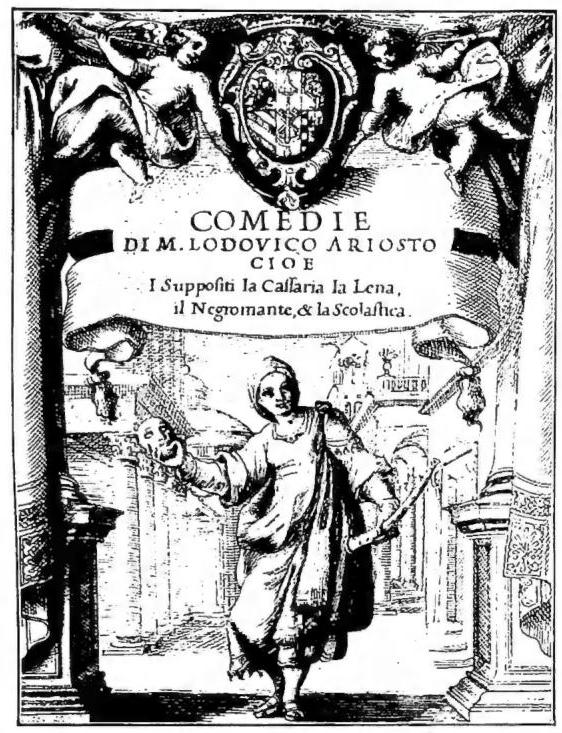
Theater – Frontispiece of the Comedies by L. Ariosto, with a pen-and-ink drawing by Giulio Martinelli of Urbino (1622), reproducing the stage setting with a classical scene in the background and a central figure holding a mask and a musical instrument – Vatican Library, cod. Urb. lat.
Jesters invade the markets and the noble halls, they are in taverns and in the palaces of princes, collecting the old jokes of the trade and the new façades of Latin anthologies; in universities and academies scholars recite classical compositions or works modeled on them; in solitary studies writers try their luck with words, and in the cells of monasteries monks annotate sacred texts and codices of classical wisdom, considered not adverse to Christianity, but rather as a journey of a single human quest that the truth of revelation does not submerge, but rather confirms and exalts. Political catastrophe heightens the tumult and spurs adventure; and the words that are spoken, all the words, in whatever form expressed, in paintings and in music, in books and in buildings, go beyond their occasion, received as they are by a flexible and strong intelligence, clear in assessing circumstances and at the same time bold in foreseeing consequences, entirely disposed to receive, not only in the secret of meditation, but in the open play of manifold attentions, and to judge freely, disposed to the human and therefore, with a sincerity so enthusiastic that it does not always save itself from the precipices of pride and facile improvisations, to the divine.
Already struggling to define the meaning of the terms "tragedy" and "comedy," which in antiquity were so important and so clearly complementary, but giving precedence to literary documentation over the notion of scenic realization, scholars had reduced both to narrative forms, distinguishing tragedy, which begins with the illusion of good fortune and ends in sorrow, from comedy, which begins badly but ends in the inevitable happy ending: definitions much more painful than what later emerged from a polemical perspective, to be sure; and the classifications of literary genres fulfill a task of systematic reflection, as well as of cataloging; but reading ancient texts, reconsidered with a spirit of contemporaneity and in the concreteness of a human relationship, revealed ever more clearly what their substance was. The poem of Dante was titled *Commedia*, with a title encompassing so much life lived and pregnant with so much future history, and tragedy the Latin *Ecerinis* of his contemporary Albertino Mussato. It is above all through this path of Latin imitations that work is done in the fourteenth and fifteenth centuries. Tragedians aim at Seneca, with laborious approximations, until Senecanism is assimilated in its substance of moral proposal. Comedians, with more ready success, aim at Terence. Already Terentian manuscripts reveal with what attention editors seek a relationship between the ancient and new theatrical customs: it is known that analogy is the basis of historical knowledge; and it is no wonder that a Latin text that had already inspired the dramatic inventions of the Saxon nun Hroswitha in the tenth century, through its sacred legends, is now invaded by the throng of jesters. Even the organizer of the new study of classical antiquity, Petrarch, composed Latin comedies, now lost; and following his example, comedies were written and, placing more faith than he in the validity of imitation and the dignity of realization, performed from the end of the fourteenth century onward: Pier Paolo Vergerio, Aeneas Silvius Piccolomini, Ugolino Pisani. Universities become the natural place where these inventions and performances are arranged; and since Italian universities are a center gathering all the life of the West, even these university comedies are imitated everywhere, especially in Germany through the Studium of Padua. Their custom continues well beyond the sixteenth century and flourishes again in the collegiate theaters of the Jesuits throughout the centuries of the Baroque age.
Amidst such urgency and dispersal of lives, theater, which is also reflection and gathering, must seek a place. The place of religious theater was the church, with its adjuncts: the churchyard and the schools of confraternities. The university could open itself to performances by amateur actors as long as the humanistic Latin of students could echo the intentions initiated by the ecclesiastical Latin of clerics. But who ensures a place for the new secular theater, and the transformation of actors from amateurs into professionals, is the court, with its adjuncts of the patrician hall and the academy. It is in the perspective of the court that the new texts must be read: of the court that wants to be the center of civic civilization, extending almost infinitely, adventurously, its correspondences beyond the city walls: toward the countryside, which is viewed with a new eye, not always lingering in the Arcadian idleness of a false and artificial earthly paradise; toward the countries of Europe, which participate with new responsibility in common life, in new languages that define new literatures; toward the new continents opened by the voyage of Christopher Columbus. To the court converge all forms and currents: the court confirms, if only in words, the religious inspiration of communal civilization, and makes good face, even when decorously bored, to the rediscoveries of antiquity. The most important novelty for the historian of theater is this: that a preeminent social group, that which gathers around the prince, accepts the challenge of testing the current correspondences of ancient representative forms and proposing new ones. The already known ancient texts, those that are discovered to enrich old catalogs (Plautus takes the place of Terence in the fortune of Latin comedy) and the new texts that authors compose on precise commission, form the repertoire. The transition is made from the Latin language to the vernacular: because, if in universities student-spectators understood the learned language of student-actors, in certain cases it was necessary to express oneself more concretely in the vernacular; and so ancient comedies are translated, adapting them to the sententiousness and allegorism of courtly representations, or interspersing them with spectacular or choreographic scenes, better received by the public. All the Italian courts of the late fifteenth and early sixteenth centuries set themselves to this task of theatrical culture; but preeminent and exemplary was that of Ferrara, with the dukes Ercole and Alfonso: where not only were all forms of spectacle assiduously experimented with, from sacred representations in the square during religious festivals, to courtly triumphs for solemn entries, to allegorical celebrations for this or that political or dynastic event; but an understanding and intelligence were promoted, and thus a custom: favoring the formation of a tradition and the establishment of a spoken and visual language: themselves favored by the very particular conditions of Ferrarese culture, where there reigned a dynasty long accustomed to civic government but for centuries open to chivalric culture and recently innovated by humanistic culture. And Ludovico Ariosto, the greatest of the court poets, inaugurates the new comedy.
Mythological fables, allegorical eclogues, Terentian and Plautine comedies, and mimetic plays alternate in the princely halls; and the example is soon taken up: if the courts of Ferrara, and those linked to it by more frequent political and family ties—Mantua and Urbino—remain long-standing models and promote a fashion that will be imitated by the courts of Spain, France, England, and Germany, even the capitals where, strictly speaking, there is no court—Florence, Venice, and Rome—host the same festivities in their patrician palaces and spread the language of spectacle that had been tested and recommended at Ferrara, each city with its own manner, its own reconsideration, its own style. Rarely does the intrinsic quality of the texts match the grandeur of such events. But the court is more concerned with staging itself than with opening itself to the message of a spiritual revelation. Urban civilization reaches its conclusion and bequeaths to the succeeding national civilization a splendid instrument of expression and participation. From then on, the theatre becomes the mirror of national life, capturing its most salient manifestations and its most spirited inspirations, and through the theatre are proclaimed the words that will acquire the greatest value in the historical life of the peoples of Europe.
VIII. THE THEATRE OF THE BAROQUE AGE: THE THEATRE IS CALLED UPON TO REFLECT THE LIFE OF THE PEOPLE AND TO CELEBRATE ITS RELIGIOUS AND NATIONAL TASKS. THE THEATRE IN ITALY: TECHNICAL AND LINGUISTIC DISCOVERIES; THEATRE BUILDINGS, PROFESSIONAL COMPANIES, AND PAYING AUDIENCES. THE COMEDY OF ART. THE THEATRE OF OPERA. THE THEATRE IN ENGLAND. THE THEATRE IN SPAIN. THE THEATRE IN FRANCE. THE THEATRE OF THE EIGHTEENTH CENTURY.