
TORTURA. — In the strictest and most precise sense, t. (judicial) is any judicial procedure by which one seeks to extort from the accused or from another party to the proceedings, by bending the contrary will through force or artifice, a confession or other statement useful for establishing facts not otherwise ascertained, with the ultimate aim of bringing the judgment to a conclusion by basing the sentence on the truth thus obtained.
To compel a person through violence to acknowledge or indicate something against his will is a mode of proceeding so humanly obvious that it is difficult to imagine an age in which it might not have been known. It would be more important to establish under what historical conditions the adoption of this mode of proceeding among the institutions of judicial law matured. The question cannot naturally be resolved by indicating names, dates, places, or persons; one can only observe, in general terms, that the intro-
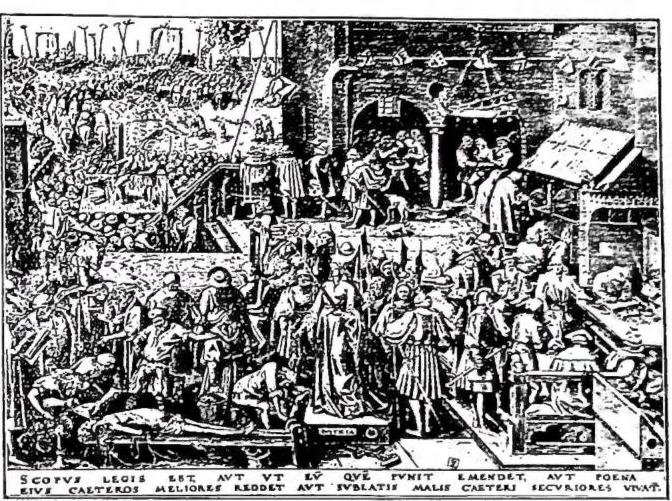
Among the peoples of antiquity, trials by ordeal and t. divided the field between them: the former prevailed where juridical life was dominated by mystical conceptions, the latter in those ages and countries in which such conceptions were yielding, for better or worse, to a form of realism. Documented only sporadically, unlike trials by ordeal, in the ancient East, in Greece and Rome t. (βασανισμός, quaestio per tormenta) underwent a historical development that may be described as parallel, allowing for a chronological lag of several centuries. After the use of trials by ordeal had soon disappeared, following a few isolated historical examples, classical Greek democracy and republican Rome knew and widely applied t. to slaves, whose statements were not considered sufficiently authenticated by an oath, as they were in the case of free persons, who were exempt from torture; within certain limits, this latter rule was set aside, on the one hand by the practice of the Greek and, even more, Hellenistic tyrannies, and on the other by Roman legislation in the imperial period. Alongside the t. of free persons, Roman law prohibited the t. of the accused persons’ slaves in caput dominorum (that is, so that they might testify against their masters), always out of respect for the personality of the free man; but this prohibition too was set aside from the time of the Republic, in very serious cases, and more broadly thereafter, when the privileges formerly belonging to all free persons were restricted to a few classes. The provisions of imperial law on this subject were condensed in the titles De quaestionibus of the Digesta (XLVIII, 18) and of the Codex (IX, 41). Outside every classification remain the t. inflicted during the great persecutions on Christians, not in order to make them confess themselves guilty of the offence of opinion imputed to them, but, on the contrary, to compel them to renounce their faith and sacrifice to the gods; the discussion of the logical or illogical character (from the standpoint of strict law) of this ferocious procedure extends from Tertullian, Minucius Felix and s. Cyprian down to the present day.
With the barbarian invasions, t. declined. It is disputed whether the barbarians knew it before coming into contact with the Roman peoples; what is certain is that in general they still adhered to trials by ordeal, the frequent practice of which they brought back to the lands of Europe. Nevertheless, the Salic, Visigothic, Bavarian, Burgundian and Alamannic laws admitted t. for slaves, and exceptionally also for free persons; perhaps the Lombards did not ignore II. Other peoples who, chiefly for geographical reasons, had remained outside Roman culture did not receive it into their laws;
and when that culture, after the brief Carolingian revival, was everywhere submerged by Germanic customs and conceptions, the legislative history of t. displays a gap of almost four centuries (IX-XII). Various scattered attestations, however, and its uninterrupted mention in the juridical compilations of the schools make it possible to hold that this gap did not correspond to an equally extensive interruption in actual practice.
From the twelfth century onward, the revival of Roman-law studies and the strengthened awareness of the authority and duties of the State drove trials by ordeal into the shadows and restored t. to prominence. Justice was removed from the precarious authority of feudal lords and from the private acts of vengeance and appearances before private persons; and, alongside the accusatory process, the inquisitorial process was introduced with increasing breadth. Both the laws of the great territorial states—beginning with Frederick II in Sicily, Louis IX in France and Alfonso X in Castile—and the statutes of the Italian communes—the first being that of Verona in 1228—as well as the corresponding laws or local customs (sometimes much earlier than any possible Romanist influence) of foreign cities, particularly French, Flemish and German ones, assigned t. a prominent place. The Holy See followed the current cautiously: the dictum of Gratian, of remote Pseudo-Isidorian origin, « quod... confessio cruciatibus extorquenda non sit » (Decr. Grat., C. 15, q. 6, § Quod vero), remained as a general principle; but already in decretals and doctrinal writings of the twelfth century, recourse to t. was, if not commanded, at least presupposed as admissible, and Innocent IV, in the bull Ad extirpanda (§ 25), provided, among other things—preceded in this by statutory legislation—that persons accused of heresy might be subjected to moderate t. (1252). This rule was subsequently applied extensively, for as long as the institution of t. remained in force, in keeping with the assimilation of heresy to lèse-majesté and the consequent application to it also of a procedure more severe than that for ordinary offences. But the juridical theory of t. was founded solely on Roman law—which most laws, and above all the statutes, intended merely to supplement rather than replace—and was elaborated by the interpreters, both civil and canon lawyers, with considerable freedom of approach, between the twelfth and eighteenth centuries. Azzone and Accursius, Bartolus and Baldus left unmistakable imprints upon it, and all the criminal lawyers of the period treated it in depth. Among the many monographs devoted to it, the Tractatus de tormentis by an unknown author of the Bolognese school (twelfth century) and the De indictis et tortura of F. dal Bruno (1495) stand out.
In the system of judicial t. as constructed by the doctors of the common law, the field of application of this means of proof was generally provided by the most serious criminal cases, and its normal passive subject was the accused. The seriousness of the case was usually determined according to the penalty prescribed for the offence, and the extent of its use varied enormously from place to place and from period to period, in keeping with the differing severity of penal systems. But t. could also be applied in certain civil cases, chiefly those arising from a delict or quasi-delict: the most frequent example was bankruptcy proceedings. And alongside the guilty party—that is, the accused or defendant, according to modern terminology—the witness could also be subjected to it when he wavered or contradicted himself in his testimony, or more simply when he appeared suspect because of his low social status or because he was infamous; in wholly exceptional cases, even the infamous or otherwise suspect accuser could be subjected to II.
T. could be applied only under certain conditions. In the normal case of the t. of the accused, it was required: first, complete certainty that the offence had been committed; second, a relative uncertainty concerning the identity of the guilty party—relative in the sense that one or more persons were burdened by various substantial indicia, or even by a single indicium, provided that it was of such urgency (as the expression went) as to constitute half-proof, while full proof had not yet been obtained; and finally, the absence of any other means by which the proof itself could legally be obtained. Of these conditions, all already indicated in the Roman sources, the interpreters constructed a complex theory intended logically to complete the system
of t. Analogous conditions applied to the t. of the defendant, the witness and the accuser, with due regard for their differing procedural positions and for the differing function that the application of torture served in their cases. The principle, already Roman, according to which the latter could not constitute the initiating act of a trial, was the summary—or rather the common foundation—of those conditions.
Not all persons for whom the conditions enumerated above were present could be indiscriminately subjected to torture. In classical Roman law, indeed, the very status of free citizen was sufficient to exempt one from torture. But from the imperial period onward, the substantial alteration in the relationship between the citizen and political power brought with it the emergence of a different principle, according to which subjection to torture was the rule and immunity the exception. Exemption on physical grounds was enjoyed by children (up to the age of 14, unless a different limit applied), the elderly (generally, those over 60 or 70), pregnant women (to whom the interpreters added women who had recently given birth, until the fortieth day after delivery, and nursing women), the sick, the wounded, and finally, insofar as they were unable to follow the interrogation, the insane and the deaf-mute. Moreover, apart from trials for high treason against divine or human majesty in the broadest sense, and subject to reservations concerning disputes from which none of the prerogatives in question was exempt, there were: an immunity of nobles, suppressed by many particular legislations, if not also (as in the case of the communal laws against the magnates in the thirteenth to fifteenth centuries) actually reversed; an immunity of men-at-arms, fiercely opposed by the jurists of the Renaissance; an immunity of men in government, often overcome and swept away by the course of political events; an immunity of churchmen, granted by Roman law but rejected by canonical doctrine; and finally an immunity of judges, advocates, doctors, men of science (and persons in any way useful to the community for their learning or valor), generally ignored by written laws but proclaimed repeatedly by the jurists.
The judge could not issue the interlocutory sentence ordering torture unless he had first notified the person concerned of the evidence established and of the other required conditions, and had given him, without result, time and opportunity to clear himself or in any event to defend himself. The interlocutory order, which was always appealable, could not, according to many procedures, be issued by a single judge; even in heresy trials within the jurisdiction of the Inquisition, prior agreement between the inquisitor and the ordinary of the place was required. The direction and responsibility for the torture and the interrogation likewise always belonged to the judge, assisted by the executioner for its physical application, by the clerk for the preparation of the official record, and often by the physician as a safeguard in the event of injury.
The forms of torture were extremely varied. The most common, which in everyday speech was confused with torture itself (just as had already happened with the wheel among the Greeks and the eculeus among the Romans, both being instruments to which the victim’s body was tied while all its joints were dislocated), was in Italy (less so abroad), during the centuries of the ius commune, the torment of the rope. This consisted in raising the subject into the air, with his hands tied behind his back, by means of a rope passed over a pulley fixed to the ceiling of the room, and keeping him in that position for a period varying from a few moments to an hour; in the more serious cases, he was then allowed to fall abruptly almost to the ground (rope drops). Other common torments were: the stanghetta, by which the ankle was compressed between two iron blocks; the cannette, which were placed between the fingers and tightened with a cord; fire, with which the feet, greased with lard, were scorched for a few moments; the vigil, in which the subject was forced to remain for many hours in an uncomfortable position (originally an essentially mental torture, later transformed); water, forced down by the liter; and countless others. All were graduated in different ways according to the gravity of the case and the subject’s capacity for physical resistance.
The judge was bound by laws and jurisprudence not to apply torments outside the prescribed cases, and even then to apply them ut moderatae rationis temperamenta desiderant (Arcadius Charisius, in D., 48, 18, 10, 3) and, more concretely, citra membri diminutionem et mortis periculum (Innocent IV, bull Ad extirpanda, loc. cit.); and his responsibility was not merely theoretical. In cases of abusive torture, as also in cases of excessive torments, appropriate penalties were prescribed, which could extend to death, particularly when illegal torture had resulted in the death of the tortured person. Nor was the omission of particular formalities established as safeguards of the accused’s rights exempt from punishment.
As regards its legal effects, when a witness was subjected to torture, his resistance was generally sufficient to confirm and validate even the suspicious testimony he had previously given while free from coercion; if he contradicted himself, however, this had the effect, subject to reservations and exceptions, of depriving his earlier testimony of credibility, since it had already appeared defective. When torture was used to compel an accused or convicted person to provide information about accomplices (something that in Roman law, and still in the ius commune until approximately the sixteenth century, was admitted only by exception for certain more serious offenses, but later became normal and constituted an autonomous legal category, the question préalable of the French), an inquisition could then be opened against those accused of complicity and, if other evidence was present, they too could in turn be subjected to torture. But in the most common case, as has been said, the passive subject of this procedure was the accused and its immediate aim was confession. If confession was obtained, the confessor was invited to ratify it in court, freely and at a distance from every torment, after a period of time (usually 24 hours); the ratification, and it alone, determined the fate of the confessed offender, because a confession extorted but confirmed was legally equivalent to a spontaneous confession, whereas a confession extorted and not confirmed was legally null, except as evidence, generally sufficient to justify, like any other new evidence subsequently arising, the repetition of the torture. The test could normally be repeated up to three times; if on every occasion the accused confessed and then refused to ratify the confession, and if, moreover, his confessions provided no elements by which his guilt could be established through logic alone, nothing remained but to set him free for insufficiency of evidence, imposing on him, if necessary, as a suspect, the provision of certain guarantees. Finally, the accused who maintained his innocence to the end, resisting the torments, earned a full acquittal. All the rules concerning the legal effects of torture, however, were never as rigid as they may appear from a rapid outline: between the result of the torture and the content of the sentence there was no relationship of necessary, automatic determination comparable to that which, in another historical setting, characterized proceedings based on judgments of God.
Such was the function of torture and its place in the trial according to theory. In practice, things often proceeded differently: practice itself, with its inconsistencies, injustices, and cruelties, kept alive those general problems, at once logical and moral, which learned theory had sought, for its part, to suppress or allay.
To the Greeks and Romans, the problem of torture was not unknown; but it did not leave the domain of cold juridical logic. A moral evaluation of the institution arose only with Christianity and, in the constant thought of the patristic tradition, was distinctly negative: Tertullian declares the application of torments unworthy of a Christian judge (De corona, chap. 11; De idololatria, chap. 17), while St. Augustine denounces the injustice of inflicting for an uncertain crime what is nevertheless a most certain punishment (De civitate Dei, 19, 6). Pope Nicholas I imposed upon the Bulgarian people the abolition of torture, which, though at the margins of great history, was the first known to human memory (Epistolae et decreta, 97, 86). But when the institution returned to full force throughout civilized Europe (13th century), ideal condemnation served only to restrain and moderate the renewed practice, by then firmly embedded in a legal system from which it could not be detached without endangering the stability of the entire structure; the long silence of civil and canon lawyers on the question of the foundations of torture is an indication not of disinterest, but of an awareness of that danger, and is in any event tempered by the repeated, insistent counsels of moderation that they addressed to judges and, generally, to men engaged in legal practice. A reconsideration of the problem, and its broadening in a social and political direction, occurred only in the 16th century, encouraged by a new humanist familiarity with ancient authors, both pagan and Christian, and stimulated by the intensification of criminal justice under absolute governments and by the proliferation of witchcraft trials: authoritative voices now rose against torture, and the idea began to gain ground that it was not a necessary evil to which one had to resign oneself, but a barbarity that could and ought to be dispensed with. The first books in favor of abolition began to appear not long afterward; all shared a lively religious inspiration, whether by Catholic authors, such as Fr. von Spee (Cautio criminalis, 1631), J. Schaller (Paradoxon de tortura in Christiana republica non exercenda, 1657), and A. Nicolas (Si la torture est un moyen seur à vérifier les crimes secrets, 1682), or by Protestants, such as J. Graefe (Tribunal reformatum, 1624) and M. Bernhard (De tortura ex Joris Christianorum proscribenda, 1705); from the beginning of the 18th century onward, they became too numerous to count. To the idea that these generous writers had succeeded in instilling in consciences, though not yet in laws, the Enlightenment of the 18th century finally contributed something no longer of thought but of action, which proved decisive: the proposals, petitions, polemics, and invectives of F. M. de Voltaire, C. Beccaria, P. Verri, and J. von Sonnenfels resulted almost immediately in the abolition of torture in some of the major states and in the emergence elsewhere of conditions that ultimately led everywhere to the same abolition between the last third of the 18th century and the first of the 19th.
The era of legal torture had thus ended; but torture had not thereby disappeared. This does not refer to individual abuses, but to a general fact. Exceptional in Europe and opposed by written laws and the common juridical conscience, procedures aimed at extorting confessions from defendants by breaking their nervous resistance through so-called third-degree interrogations, or even by depriving them of their moral freedom through the injection of drugs capable of temporarily suppressing full consciousness, have recently taken hold in judicial practice on the other side of the Iron Curtain and across the ocean. In such procedures the ancient mental torture lives again, in the fullest sense of the word, technically modernized and, unfortunately, deprived of those safeguards with which the old jurists always sought to temper it, as the most atrocious of all forms of torture.
There can be no doubt about the lawfulness of t. as an afflictive punishment, assuming the lawfulness of the death penalty and assuming the lawfulness of mutilation and flogging, which are likewise afflictive punishments. As intimidation directed against an innocent person in order to wrest a secret from him, it is doubly unlawful, both as an unjustified act of violence and secret (v.). The question of the lawfulness of applying t. as a means of judicial investigation to individuals already more or less seriously suspected, with the aim of extracting their judicial confession, has received different solutions.
For some, assuming the judge’s right to investigate in order to ascertain the truth of the facts, when, in particular circumstances, the ordinary means had been exhausted, the common good might require that the accused also be subjected to coercive means, such as t. This concerns society’s interest in determining the responsibility of a particular individual, and a right to proof. The individual’s right to remain silent and to express himself freely is not denied, but it yields to society’s right to know who threatens the common good and to vindicate the violated legal norm.
The failure to discover the perpetrator of a particular crime would at times cause society far greater harm than could result from violating freedom in demanding and requiring a particular individual to reveal himself (J. De Lugo, De iustitia et iure, disp. XXXVII, sect. XIII, ed. Fournials, VII, Paris 1869, p. 724).
Nevertheless, it is beyond doubt that, even within this school of thought, for t. to be lawful it must be kept within clearly defined limits: a) there must already be indications against the person concerned amounting to semiplena proof (an extrajudicial confession, the testimony of a witness above all suspicion, etc.); b) the person must be one who may be subjected to t. and must not be exempt from it, either by natural law because of particular circumstances or by prescription of positive law; c) every other milder means of investigation must have been attempted; d) t. must be neither absolutely nor relatively unbearable for the person upon whom it is inflicted; e) full freedom must be allowed for confirmation or retraction of the confession extorted (cf. s. Alfonso M. de' Liguori, Th. mor., IV, cap. 3 a. 3, n. 202, II). Today, however, the school of thought grounded in the safeguarding of the rights of the human person is prevailing. By virtue of these rights, the guilty person is entitled to inviolability in soul and body, and against this fundamental right no motives of a social nature or of the common good can prevail. Moreover, requiring the guilty person to confess his crime seems to go beyond what can be demanded of the ordinary capacities of human nature, and to enter a sphere in which heroism is required. And heroism, in the overwhelming majority of cases, may be counselled but not imposed. Furthermore, the guilty person has a right to his reputation, even if it is merely apparent and false. Reputation, in fact, is treated as an external good brought about by each person’s individual industry. In regard to this external good, when it is real, the human being may claim full and absolute right, to the exclusion of anyone else. The right to an apparent reputation, moreover, if it cannot be deduced from the same right of man, must be affirmed ex inconvenientibus that would follow from its denial, especially against peace and tranquillity, which would be compromised if it were obligatory and even lawful to reveal the hidden defects of others on every occasion.
Against this argument, which is undoubtedly the weakest, it must immediately be observed that the right to a false reputation is relative and limited: since it is founded on the common good, it could cease when the good of others precisely required II. Other reasons also carry considerable weight, especially today, when improved methods of investigation through scientific examinations, etc., make any recourse to such means, if nothing else, considerably less useful. Public opinion, which carries weight in the use of means to attain specific social ends, is today decidedly opposed to the use of t. Yet such a system cannot be said to have been entirely and everywhere banished in practice from judicial investigations or police systems. And it is doubly dangerous, because the safeguards that would legalize the application of t. are lacking. In any event, a truly civilized nation today would recoil from introducing it into its penal code.
What is debated, instead, is the advisability of introducing other investigative methods even more injurious to freedom of confession, such as narco-analysis (v.), in which the assault upon personality is still more insidious and total. In canonical procedure after the CIC, the use of any coercion to wrest the guilty person’s confession is no longer permitted; indeed, it is expressly stated that the guilty person is not bound to tell the truth when agitur de delicto ab ipso commissio (can. 1743 § 1; cf. also can. 1947).