
HUMANISTIC, SCRIPT, AND MINIATURE. — The humanistic movement, so rich in consequences for all expressions of civilization, could not fail to leave its mark even in the field of writing. Yet while the study of the new forms it engendered may appear straightforward in its essential lines, it presents in reality a formidable challenge to paleographic inquiry that seeks to pinpoint with precision the distinctive elements and criteria for dating humanistic script.
From the 15th century onward, in fact, the medieval concept of a scriptorium (v. scriptorium) declines, and the characteristics of schools either level out into a uniform appearance derived from a common source of imitation (though around certain scholars scriptoria with distinct peculiarities did form), or else are obliterated by the vigor with which personal, mutable elements—varying from individual to individual and no longer reducible to common geographical or chronological factors—assert themselves. Thus the recent attempt to extend to the script of the modern age the methods of investigation proper to medieval paleography does not seem acceptable (K. Pivec, Paläographie des Mittelalters - Handschriftenkunde der Neuzeit?, in Festschrift zur Feier des zweihundertjährigen Bestandes des Haus-, Hof- und Staatsarchivs, ed. L. Santifaller, I [Mitteilungen des Österreichischen Staatsarchivs. Ergänzungsband II], Vienna 1949, pp. 225-36), whereas a fruitful approach for this period is the study of the handwriting of individual figures (cf. A. Campana, Scritture di umanisti, in Rinascimento, Dec. 1950, pp. 227-56), from which a methodological framework for the problem of humanistic script as a whole may perhaps emerge in the future. A comprehensive overview is therefore necessarily incomplete; nonetheless, an effort will be made to establish some fundamental points, beginning with the impropriety of the expression “humanistic script,” since at least two distinct scripts must be distinguished, for which it will be advisable to retain here the traditional—though equally improper—names of “humanistic minuscule” (or humanistic book minuscule, or round humanistic) and “humanistic cursive.”
Humanistic Minuscule. — The general appearance of this script closely resembles that of the refined Carolingian minuscule (v.), often blending with II. This phenomenon is explained by the very origin of humanistic minuscule, which is not the result of an evolution from Gothic forms (though certain examples of Gothic minuscule with softened strokes and already anticipating a new style have been labeled “semi-humanistic”), but rather the product of a conscious and deliberate imitation of Carolingian minuscule, which Renaissance scholars mistook for “classical” script and accordingly termed “littera antiqua.” The manuscripts of the Carolingian and Ottonian ages, which the zeal of humanists uncovered in monastic libraries, directed the taste of copyists toward a return to the simple elegance of the rounded forms of Carolingian minuscule, in contrast to the barbaric harshness of Gothic script, which Petrarch had not spared his scorn (Ep. fam., XIII, 4; XXIII, 19). The “ad unguem” imitation of the codices antiqui became the aesthetic canon of the new script (cf. Ambrosii Traversari epistolae et orationes, ed. L. Mehus, Florence 1759, col. 501). Yet the experience of Gothic script ensured that humanistic minuscule would display certain unconscious differences from Carolingian minuscule: from the consistent use of diacritical marks on *i* to the more correct employment of diphthongs (often in ligature), from the reduction of abbreviations to the pronounced use of finishing strokes at the upper and lower ends of ascenders and descenders. As for particular letters, it may be observed that *a* is of uncial type, while *d* is of minuscule type (i.e., with a straight ascender); *r* appears sometimes in its straight form and sometimes in its rounded form; the round *s* (of majuscule type) is often found even within the body of a word; and the crossbar of *t* remains below the top of the vertical stroke. Humanistic minuscule spread from Florence throughout Italy, at least in centers of learning, but its brief life did not allow it to take hold beyond the Peninsula; its chronological limits may be set between the early 15th and early 16th centuries. With the spread of printing, it lost its function but left a lasting trace of itself in the roman typeface.
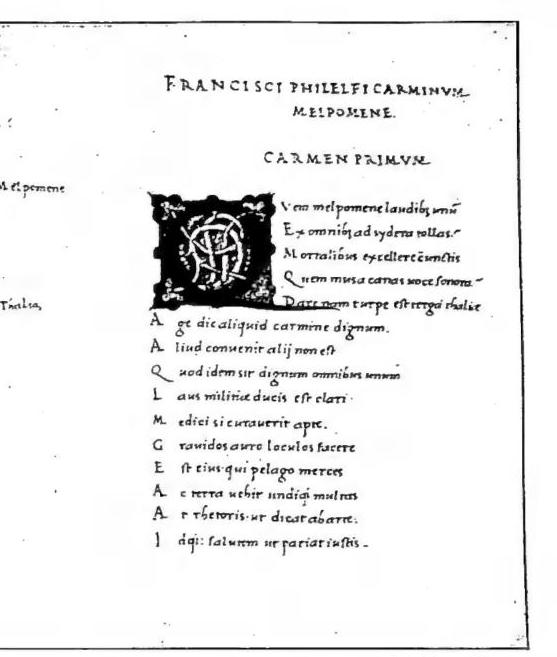
Humanistic Cursive. — Although it bears the imprint of minuscule, humanistic cursive must be considered separately, since it does not always represent the same script executed with a cursive ductus; in many examples it is nothing more than the result of an evolution from Gothic cursive, particularly the Italian variety. Yet since it is impossible to extend the name “humanistic” to all the numerous types of cursive script that emerged from the fragmentation of Gothic in various countries in increasingly personal forms and now beyond the reach of any school characteristics, the term “humanistic cursive” generally refers to a particular script that, though more fluid and rapid than minuscule, remains linked to it and preserves, along with its reflective character, the calligraphic composure of the latter. It served not only documentary purposes but also for books. Like minuscule, humanistic cursive left its mark on printing, giving rise to the italic typeface, consecrated by the editions of Aldo Manuzio; but unlike minuscule, it spread (perhaps precisely through printing) across Europe (except in the German lands), and from it all modern scripts subsequently developed. The general appearance is sometimes determined by a slant to the right, due either to oblique strokes or more often to the ligatures between each letter and the one before and after within individual words. Characteristic elements may be noted in: the closed *a*, of cursive type, whose lower curve narrows into a sharply acute angle; the *f*, which develops the initial and terminal strokes of the ascender into the characteristic form of two whiplash loops; the *r*, which shifts from the straight (minuscule) form—predominant in the earliest phase and preserved in print—to the rounded form, which acquires a distinctive aspect from which the minuscule of modern script emerges; the *s*, which adds the rounded (majuscule) form, and when a connecting stroke is made with the preceding letter gives rise to the modern minuscule; and the *t*, which tends to extend the vertical stroke upward. It is noteworthy that humanistic cursive was adopted by the Papal Chancery from the mid-15th century for briefs, while in privileges and bulls in general the Gothic chancery script developed into increasingly artificial forms that gave rise to the bullate script (v.).
Humanistic. SCRIPT AND MINIATURE
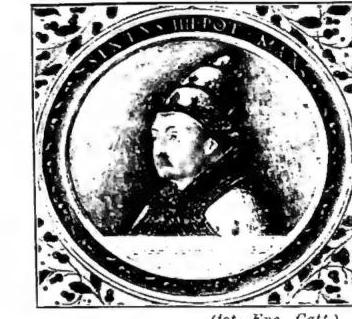
SIXTUS IV, Roundel adorned with the heraldic motifs of the Della Rovere, miniature from the Roman school, influenced by Melozzo da Forlì, which adorns the *Vitae of the Roman Pontiffs* by Bartolomeo Platina (1474–1484) — Vatican Library, ms. Vat. lat. 2044, fol. 2v
Illumination. — As with humanistic script, illumination in this period was above all an Italian glory, since in the other countries of Europe it developed essentially along the lines already indicated for the preceding period, especially in France, where Gothic illumination had attained in the preciousness of the Books of Hours and in the compositional elements of Breviaries and Bibles a decorative perfection difficult to surpass. Pursuing this direction, the French school and, under its influence, the English school gradually lost sight of the proper task of illumination, tending more and more to purely pictorial ends in full-page compositional panels; an approach that was then carried to its ultimate conclusions by the Flemish school.
In Italy, however, despite influences from elsewhere—particularly in the full-page engineering of Puglia—ornamental motifs retained their function, reviving decorative elements with vivid colors, enlivened by small but perfect genre scenes that interrupted the frieze enclosing the page, where intertwined foliage, animated figures, and ribbons achieved the preciousness of an enamel. The coat of arms of the patron often appeared at the center of the lower margin. It was above all the princely courts that kept this art alive through commissions for lavishly decorated codices: the Medici of Florence, the Este of Ferrara, the Montefeltro of Urbino, the Aragonese of Naples, and even the popes themselves eagerly enriched their libraries with sumptuous codices that bore witness to their patronage. Florence and Ferrara vied for supremacy with their workshops, which employed renowned artists and received commissions from all quarters; but Naples, Perugia, Siena, and other cities also boasted schools of the first rank.
Since it is not possible to summarize briefly the distinctive features of each or to cite the names of the leading artists and their most famous works, the reader is referred to the works listed in the bibliography. — *Cf.* pl. LXXII.
**
---
*Carmen primum* of the Odes by Francesco Filelfo, from the autograph paper codex in humanistic cursive — Vatican Library, cod. Urb. lat. 701, fol. 102r (1468).
Its modern form can be traced back to the 18th century, since neither Stoic cosmopolitanism nor Christian universalism—which saw in every man a brother—can be compared to II. At that time, descriptions of the noble savage became commonplace, and in drawing rooms people were moved by news of other peoples. The ideology of Rousseau and the Enlightenment in general, which elevated not man but the naturalistic sentiment to the center and measure of right and wandering, contributed greatly to its birth and expansion, so much so that it became almost fashionable in the 19th century, which was its period of greatest flourishing. The countries in which it took deepest root are those of the Anglo-Saxon world, perhaps because of the influence exerted by certain religious confessions, in which the cult of human life was one of the main themes of their propaganda.
Although, as has been said, humanitarianism has no doctrinal structure, beneath it one can discern certain guiding ideas. The most general is rationalistic naturalism; a philosophy little given to reflection that disregards transcendent values in order to focus exclusively on man and humanity, which it regards with a certain religious mysticism. This was Comte (v.), who, after denying revealed religion and dogma as contrary to the canons of scientific research, proposed as a substitute the so-called religion of humanity. With humanitarianism there is consequently linked an optimistic conception of human nature, of the kind devised by Rousseau, and it is not lacking in a certain tendency to attribute special value to what is spontaneous in man, whose perfection and happiness it sees as consisting in following his own impulses. These ideas, however, are confusedly mixed and intertwined, without acquiring distinct outlines, shrouded as they are in a vaporous sentimentality that does not allow them to be precisely distinguished.
Humanitarianism has given rise to numerous philanthropic initiatives and associations that, despite pursuing different aims, have had in common the relief of humanity. It has not been unrelated, for example, to the movement that led to the abolition of slavery, to measures adopted for the protection of women and children, particularly with regard to their working conditions, to the improvement of the treatment of prisoners and to the more humane and rational organization and maintenance of penal institutions, to the creation of the International Red Cross, and so on. It reached the limits of utopia in various pacifist movements, which often exaggerated the horror of wartime slaughter, proposing abstention from military service and civil disobedience (v. CONSCIENTIOUS OBJECTION) and advocating the necessity of abolishing borders, nations, and religious divisions as the principal causes of conflicts among peoples.
In sum, as a sentiment directed toward alleviating suffering and condemning cruelty, it can be said to be a derivation of the deepest human impulse toward solidarity, and, apart from its naturalistic foundation and the exaggerations to which popular sentiment is wont to lead, it can be said that its only virtue has been goodness, lacking, however, the supernatural breath that sustains and stimulates Christian charity.
UMBERTO I, king of Italy.
Born in Turin on 14 March 1844, died in Monza on 29 July 1900. Son of Victor Emmanuel, Duke of Savoy and later king of Italy, and of Maria Adelaide of Habsburg, he was left motherless at the age of eleven.
At fourteen he was a captain, at twenty-two a divisional general, and he distinguished himself in the battle of Custozza (24 June 1866), where he withstood the impact of a cavalry charge (the Villafranca square). On 22 April 1868 he married his cousin Margherita of Savoy-Genoa, by whom he had, as his only child, the future Victor Emmanuel III. When he ascended the throne on 9 January 1878, the twenty-two years of his reign marked a period of consolidation after the country’s attainment of unity. Umberto, unlike his father, favored Italy’s alliance with the Central Powers, especially after the serious Italo-French tension of 1881–82 over Tunisia. He desired that Italy have a colonial empire and supported Crispi’s African policy, which was shattered by the disaster of Adwa (1896). In domestic policy he aimed at strengthening the authority of the state, favoring in this field also the direction taken by Crispi: the repression of the 1894 riots in the Mezzogiorno and Lunigiana and the even harsher suppression of the “five red days” of Milan (1898), though they grieved his naturally kind heart, he saw them as necessary for the good of the state. He thus became the victim of a political and social crisis whose causes and demands he had failed to perceive. The various attempts on his life (Passanante, Acciarito, and Bresci), the last of which cost him his life, can indeed be interpreted as the expression of the spiritual malaise of the nation, which did not feel itself governed according to new exigencies and times. But they appear all the more heinous because they were directed against a sovereign who had constantly given proof of his concern for those struck by misfortune: the flood victims of the Veneto (1882), the earthquake victims of Casamicciola (1883), the cholera victims of the Mezzogiorno (1884) all had him as their consoler in their misfortunes, and he was always most generous in aiding the needy. Of rather free habits, he was certainly not inclined toward religion, although toward the end of his life he drew closer to it—thanks to the discreet work of his wife—and shortly before his death he obtained the Jubilee indulgences of the Holy Year 1900. More for political than spiritual reasons he desired reconciliation with the Holy See, so much so that he seems to have favored Abbot Tosti’s attempt in 1887; but when negotiations failed, he allowed Crispi to resume his anti-clerical policy, which saw in Catholic movements a danger as grave as that posed by the rising socialism. It must be ruled out, however—though it has been said—that he was a Freemason, as is shown by the fact that he received a religious funeral.
Fallen to the assassin’s bullet in Monza, his remains were taken to Rome and interred in the Pantheon, in the tomb erected to him according to a design by the architect Sacconi.