
Clemente III, as well as from the subscriptions of the acts of the Third Lateran Council. From the 13th century onwards, the series of bishops is almost complete, and they had long since taken to residing for long periods in S., so much so that a dispute arose between the canons of S. Pelino and those of S. Panfilo, settled in 1168 (cf. Ughelli, I, col. 1367 and Faraglia, p. 48), but reignited in the 13th century (cf. Faraglia, p. 63) and definitively resolved only by Urban VIII in 1628: from then on, the names of V. S. appear in the titles of the bishops always together. Already from the 15th century, however, the preeminence of S. had been established as the permanent residence of the ordinary. Among the bishops, Pompeo Zambeccari (1547-71) is still remembered for having participated in the Council of Trent, and Francesco Boccapaduli, who in 1638 enlarged the Seminary of S.
MONASTERIES. — The Benedictine monasteries of S. Clemente, mentioned by Alexander II in 1073 (PL 146, 1401), and of S. Maria in Cartiniano, near Bussi (cf. E. Gattula, Historia abbatica Cassinensis per saeculorum seriem distributa..., Venice 1733, pp. 319-21), have completely disappeared. Of others, once very famous, only scant remains survive: S. Benedetto in Perillis, between Popoli and Acciano, a Benedictine priory founded by Trasmondo, bishop of V., subject to the diocese in 1156, in commendam from 1443, united with S. Maria di Collemaggio of Aquila in 1448; S. Pietro ad Oratorium, a Benedictine monastery near Capestrano, subject to S. Vincenzo al Volturno, whose origins are fancifully altered by a series of forged documents: it preserves the magnificent church of the 13th century; S. Maria and S. Pellegrino in Bominaco (hamlet of Caporciano, currently within the territory of the diocese of L'Aquila), ancient churches subject to the abbey of Farfa, to which in 1001 Odorizio, count of V., appointed some Benedictine monks under the governance of a single abbot; in 1093 they passed under the jurisdiction of the bishop of V.: in 1222 Honorius III took the monastery of S. Maria under the protection of the Holy See, in 1352 Clement VI declared it exempt from the Aquilan bishop, in 1405 Innocent VII from that of Valva; but the same Pope, in the same year, revoked the exemption; in commendam from the 15th century, it was suppressed in 1762: today only the two churches remain. Still standing in all the grandeur of its monumental complex is the ancient abbey of S. Spirito at the foot of Mount Morrone, formerly the seat of the supreme abbot of the Celestine Congregation: the convent originated from the legacy of St. Peter Angeleri, later Pope Celestine V, who founded the monastery near the ancient chapel of S. Maria del Morrone. The conventual building was rebuilt by Charles II of Anjou at the end of the 13th century, embellished in the 16th, restored in the 18th after an earthquake: Baroque and 18th-century elements blend both in the structures and in the decoration with others preserved from the 15th and 16th centuries. Since 1807, when the Celestine Congregation was suppressed, the monumental building has been used for various purposes and currently houses a penitentiary. The Archive is kept at the abbey of Montecassino.
RELIGIOUS MONUMENTS. — The Valvan or S. Pelino basilica, a Romanesque church (11th-13th centuries), built on the ruins of an earlier one destroyed during the Saracen (9th century) and Hungarian (10th century) raids, was restored in 1280 after a fire and transformed internally in Baroque style between the 17th and 18th centuries; among the monuments, noteworthy is a pulpit from 1168, the work of a certain Idolorico. Attached to it is the oratory of St. Alexander I, pope, which houses a museum of confines antiquities.
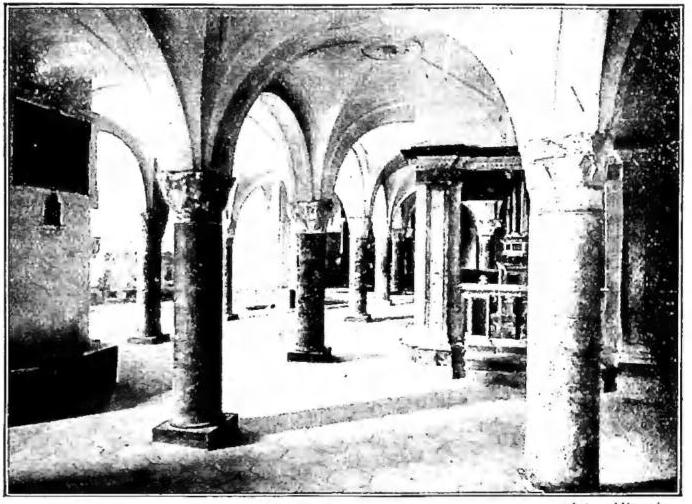
In S., the Cathedral, dedicated from the 9th century to St. Panfilo, stands on the site of a pagan temple, later transformed and consecrated to the Madonna: it underwent various restorations (11th-12th centuries, 13th, 15th-16th, 19th-20th) and presents a mixture of elements not always well fused; noteworthy are the crypt, from the 11th century, and the Treasury. Other interesting monuments of S. are: the churches of S. Francesco della Scarpa, of uncertain origin, remodelled several times, but which preserves on one side of the apse a grand Romanesque portal, and of S. Maria della Tomba, already mentioned in 1241, also variously defaced, but admired for its pointed arch portal and the rich rose window of 1400; the hermitage of S. Onofrio, on the slopes of Mount Morrone, a small 13th-century church, retreat of St. Celestine V, with interesting frescoes by Gentile da S. The most prized monument of S. is, however, the building of the Annunziata, which owes its origins (1320) to the homonymous Confraternity, dedicated to the care of the plague-stricken. It consists of the Palace, with a façade in which elements of the most diverse styles, from Romanesque, to Renaissance, to Baroque (years 1415, 1483, 1522, 1706) are harmoniously blended into a wonderful ensemble, and the church, rebuilt at the beginning of the 16th century and then again in 1710.
SHRINES. — S. Maria della Libera, at Pratola Peligna (feast on the first Sunday in May); S. Domenico di Foligno at Cocullo (feast on the first Thursday in May); for the procession, of great folkloric interest, V. ABRUZZO; S. Gemma of Goriano Sicoli (feast on 12 May); S. Venanzio, between Raiano and Vittorio (feast on 18 May): the small church, already existing in the 12th century, owes its origin to the legend that the Dalmatian saint would have stopped in this place on his way from Camerino to Rome). — See pl. XC.