
VENDLLO. – Slavic peoples who inhabited vast territories lying between the Elba and the Oder, bounded to the north by the Baltic Sea and to the south by Moravia.
Their evangelization was rather an affair of political character, desired by the German sovereigns of the 10th century, who aimed to subjugate the turbulent tribes through Christianity. The method employed consisted in establishing bishoprics, which would become missionary centers and would have Magdeburg as their metropolitan see. The evangelization of the pagans, combined with German colonization, encountered obstacles arising from racial issues. The meagre results obtained under Otto I (936–73) were wiped out by the Vend revolt under Otto II (973–86). There were only a few conversions to Christianity in the 11th century, and these only in the northern part of the territory. The faith spread later through the work of Moravian missionaries.
VENDELLO. – The Benedictine abbey of the Most Holy Trinity of V., in the Loir-et-Cher department of France, was founded in 1034 by Geoffrey, Count of Anjou.
V., now a subprefecture of Loir-et-Cher, was an ancient borough of Gaul, which the Romans replaced with the city of *Vindocinum*, whence the present name. By the end of the 10th century it had become an independent county founded by Bouchard I, called the Venerable; in the second half of the 12th century a long conflict raged there until the Treaty of Vendôme in 1227. It was taken and sacked by the English in 1362. By inheritance the county passed in 1375 to the House of Bourbon; in 1515 it became a duchy through the efforts of Charles I of Bourbon-Vendôme, paternal grandfather of Henry IV, who in 1589 dismantled its castle; in 1598 he donated it to his natural son, César de Vendôme; it was reunited with the crown in 1712.
The church was dedicated on 31 May 1040 by Geoffrey Martel, though work had begun in 1035. In 1063 the abbots of V. S. Prisca upon their election, with the obligation to ensure that twelve monks would provide service there. The monastery was placed directly under the Holy See; this exemption was accepted by Thierry, Bishop of Chartres, and confirmed in 1056 by King Henry I. It was visited by Hildebrand; Abbot Geoffrey came to Rome in 1094 from
V. de Carrières (1662–1717) republished it, paraphrasing the original text. The brief explanatory additions are inserted in italics. The work, enriched with notes and special dissertations by de Carrières and Calmet, enjoyed wide circulation. V. Bossuet. Despite the modest value of some parts and certain outdated or perplexing hypotheses, the work saw many editions, both with the translation or paraphrase alone and combined with extensive commentaries drawn from various authors: e.g., the *Ste Bible de V.* in Latin and French (5th ed., Paris 1827–33) comprises 27 volumes, of which the first consists solely of introductory dissertations, the twenty-fifth contains some apocryphal books, and the twenty-sixth writings of the Apostolic Fathers. This edition was also translated into Italian, though adapted to the Martini version (Milan 1830–40).
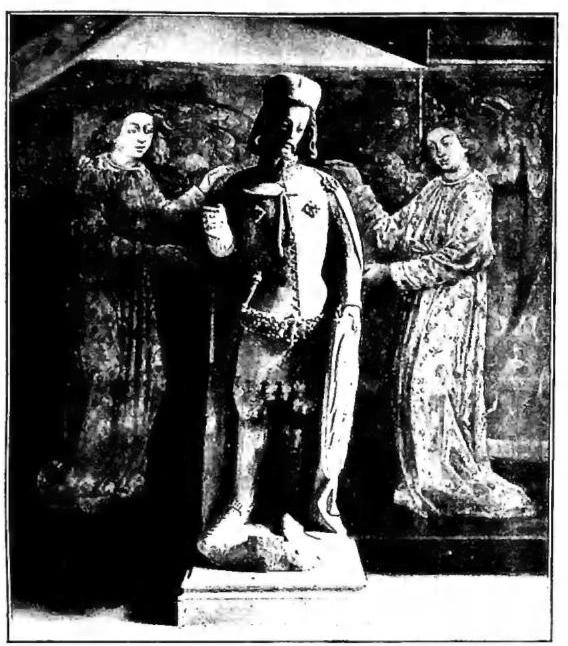
VENCESLAUS, St, martyr – Statue of St V. by Peter Parler (1373) – Prague, Cathedral of St Vitus.