
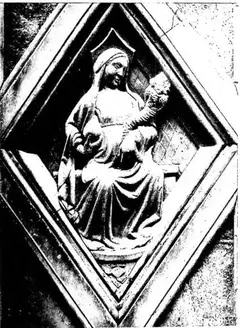
CHARITY. - The third of the three theological virtues.
I. THEOLOGY OF CHARITY.
I. NATURE OF CHARITY
In the Christian concept, c. is the highest of the three theological virtues, the one from which the love of God and of neighbor proceeds. According to Revelation and the definitions of the Church: it is an infused virtue, specifically distinct from the natural love of God, given at the moment of justification, never separated from sanctifying and habitual Grace, which makes us become adopted children of God. St. Paul says: «The c. of God has been poured into our hearts by the Holy Spirit, who was given to us» (Rom. 5:5) and he praises it most highly in 1 Cor. 13:1-13: «Even if I spoke the tongues of men and of angels, if I have not c., I am like a resounding bronze or a clanging cymbal... If I have not c., I am nothing... and if I sacrificed my body to be burned, if I have not c., all this profits me nothing». Indeed, without c., which is inseparable from sanctifying Grace, man is in a state of mortal sin; instead of loving God more than all things, he loves himself above all, his heart is turned in the opposite direction from that of the heart of God. On the other hand, when he receives sanctifying Grace and c., his sin being remitted, he becomes a child of God and a friend of God, acquiring within himself the seed of eternal life.
St. Paul goes on to show that c. inspires in the righteous man all the virtues while making them meritorious of eternal life: «C. is patient, is kind; c. is not envious, is not rash, is not puffed up with pride; it does nothing unbecoming, it seeks not its own interest, it is not irritated; it thinks no evil, it does not rejoice in injustice, but rejoices in the enjoyment of truth; it accommodates itself to all things, believes all things, hopes all things, endures all things. C. will never pass away... now remain faith, hope, c.; but the greatest of all three is c.». Together with sanctifying Grace it will last eternally, while faith will be succeeded by the immediate vision of the divine essence, and hope by the imperishable possession of God.
Various theologians, and more especially St. Thomas, have studied deeply the nature of c. As the latter explains (1ᵃ-2ᵃᵉ, q. 26, aa. 1, 2, 3, 4) love is the inclination or propensity of the appetite toward the good, in which it takes pleasure. When this love singles out a good, preferring it to another, it is called dilection. With the love of concupiscence or craving we desire a good either inferior or superior to us. With the love of benevolence we will the good to another person as to ourselves, and when it is reciprocal and is shown through communion of thought, will and action, it deserves the name of friendship. When the good sought is of the greatest worth, and the person for whom it is desired is most dear, the love of benevolence is called c.
Theologians have therefore raised the question whether the infused c. of which Sacred Scripture speaks is not fundamentally the supernatural friendship between God and the righteous man, as also among the adopted children of God. The affirmative answer is already contained in the Old Testament: Judg. 8:22; Wis. 7:27; Ps. 138:17 (according to the Septuagint and the Vulgate); and above all in Jesus' declaration: «You are my friends, if you do what I command you. I no longer call you servants, because the servant does not know what his master is doing; but I have called you friends, because everything I have heard from my Father, I have made known to you... What I command you is to love one another» (John 15:14). Indeed only through c. are we friends of God.
St. Thomas demonstrates (2ᵃ-2ᵃᵉ, q. 23, a. 1) that in c. the three conditions of true friendship are verified. This is in fact a love of benevolence, a reciprocal love of benevolence, and it is founded in the sharing of life, of a life between two. It presupposes mutual knowledge and common life, at least spiritually, through the exchange of thoughts and intimate feelings.
It is precisely these three characteristics of true friendship that we find in c., which unites us with God and with the souls in him.
Already the natural inclination, which subsists at the bottom of our will despite original sin, leads us to love more than ourselves, and above every thing, God, author of our nature (1ᵃ, q. 60, a. 5). But this natural inclination, weakened by original sin, cannot without healing Grace impel us to an efficacious love of God above every thing (1ᵃ-2ᵃᵉ, q. 109, a. 3).
Far above this natural inclination, we have received in Baptism sanctifying Grace and c., together with faith and hope. Now c. is precisely this love of mutual benevolence, which makes us will for God, author of Grace, the good that befits him, that is, his profound reign in souls, just as he wills our good for time and eternity. This is truly a friendship founded in the sharing of life, since God has communicated to us a participation in his intimate life by giving us his Grace, the seed of eternal life. Through sanctifying Grace, the root of infused c., we are «born of God» (John 1:13), we resemble God as children resemble their father. Now this life between two entails permanent union, which is sometimes only habitual, for example during sleep, and at other moments is actual, that is, when we make an act of love of God. There is then truly a life between two (convivere), that is, a true friendship with God, which begins on this earth; there is the meeting of God's paternal love for his child with the child's love for the father, which gives him life. This spiritual communion is the prelude to that of eternity.
C., even in its lesser degree, makes us love God more than ourselves and more than his gifts, with an efficacious love of esteem, because God is infinitely better than we are and than any created gift; nevertheless this efficacious love of esteem is not always felt, for example in moments of aridity; moreover at the beginning it does not yet have the intensity or impulse that it possesses in perfect men and above all in the blessed in heaven. Every Christian mother feels her love for her child more than that which she has for God, whom she does not see; nevertheless, if she is truly Christian, she loves the Lord with an efficacious love of esteem more than her own child. For this reason theologians usually distinguish between appreciative love and intensive love, the latter being generally greater toward the loved persons whom we see than toward those who are far away. The efficacious love of esteem, which subsists even in the great aridity of the senses, is therefore the complete opposite of sentimentalism, which is only an affectation of the love that one does not have.
C. is therefore the supernatural friendship with God, as also with the children of God, not excluding sinners who are called to conversion and to the beatitude of the righteous: although they do not have c., one must have it for them. C. makes us desire ever more the profound reign of God in souls. No learning is needed for this love of God; it is enough to know the Father of heaven through faith.
Whoever ceases to love him, through any mortal sin, goes toward perdition. God says: «I love those who love me and those who seek me diligently find me» (Prov. 8:17). And Jesus: «Whoever holds to and observes my commandments, he it is who loves me. And whoever loves me will be loved by my Father, and I will love him and manifest myself to him» (John 14:21). In defining c. as a supernatural friendship, theology does not deduce a new truth, but explains a revealed truth and allows it to be deepened.
II. OBJECT OF CHARITY
God is the first and principal object of charity, in conformity with the precept: "You shall love the Lord your God with all your heart, with all your soul, with all your spirit. This is the greatest commandment" (Mt. 22:37). The neighbor is the secondary object of charity: "The second commandment is like it: you shall love your neighbor as yourself" (ibid.).
Theologians have asked: for what formal reason do we love with charity God known in a supernatural manner? This reason is that God is infinitely good in himself, and therefore infinitely lovable. To love God for his benefits is not yet to love him for himself, but this disposes one to it and makes one think that the benefactor is good in himself, indeed infinitely better than his benefits.
Furthermore, the love of God and the love of neighbor both derive from the same infused virtue, since the formal reason for which we love the neighbor with charity is also God, insofar as he loves the neighbor and calls him to the same beatitude to which we are called. It is through charity that we desire that the neighbor belong to God, that he adhere to him, that he glorify him together with us, in time and in eternity. In fact, we cannot love God without willing that he be loved and glorified.
Just as in the natural order he who loves his friend also loves with the same love his friend's children, if not for their own sake, at least for their father's, and bears with them for his sake, so in the supernatural order, while we love God, our common Father, we must love for his sake all his adopted children, as well as all those who are called to become such. It follows that it is not with the supernatural love of charity that we love the neighbor when we love him for his natural qualities (Sum. Theol., 2a-2ae, q. 25, aa. 1, 4, 5, 8).
Fraternal charity is therefore nothing other than the extending and radiating of that which we must have for God. Hence it is the best sign of the progress of the love of God in us. "Love one another; this will be the sign that will make you be recognized as my disciples" (Io. 13:35). In Act. 4:32 the wonderful spectacle given by the first Christians through mutual love is described: "the multitude of the faithful was of one heart and one soul; no one considered his own what he possessed, but everything was held in common." In fact, the practice of fraternal charity is the thermometer of the interior life, that is, of the love of God; for it is visible while it proceeds from the same theological virtue of the love of God. Through charity we therefore have for the neighbor a love that is not only supernatural, but also theological, since in him we love the son of God.
III. CHARITY AND THE SUPREME PRECEPT
According to the supreme precept we must love God above all things and more than ourselves, with the love of esteem, which must be not only affective but also effective. From this point of view the love of God is the opposite of spiritual sloth, called by the name acedia, which is a bad sadness generated by the thought of God and by the work of sanctification; from it proceed the mocking of sacred things, tepidity, negligence with regard to the means of salvation and finally despair.
Theologians have asked, with regard to the supreme precept, whether it obliges all Christians to tend to the perfection of charity.
Some, such as Suarez (De statu perfectionis cap. 11, nn. 15-16), have thought that in order to observe even perfectly the supreme precept of the love of God and of neighbor, there is no need of a great charity. For them perfection would not be the aim of this precept, but would go beyond it, while it would consist in fulfilling certain counsels of charity, which would be superior to the first precept itself. In this way the latter would have a limit, which may seem true if we consider things superficially.
However, after St. Augustine, St. Thomas (Sum. Theol., 2a-2ae, q. 184, a. 3, in corp. and ad 2ii), as well as St. Francis de Sales (Traité de l'Amour de Dieu, I, III, cap. 1), Pius XI (enc. Studiorum ducem, 29 June 1923 for the 6th centenary of St. Thomas; enc. Rerum omnium perturbationem, 26 Jan. 1923 for the 3rd centenary of St. Francis de Sales), teach that all in general are obliged, it is understood not to be perfect, but to tend to the perfection of charity, each according to his own condition. "It would be wrong to imagine that the love of God and of neighbor is only up to a certain point the object of a precept, beyond which this love would become the object of a simple counsel. Not at all. The wording of the commandment is clear while it shows what perfection is: Thou shalt love the Lord thy God with all thy heart, with all thy soul, with all thy strength, with all thy mind" (St. Thomas, ibid.). There is therefore no limit, because, in conformity with the teaching of St. Paul (I Tim. 1, 5), charity is the aim of the commandment and of all the commandments. Now the aim is not willed by halves, up to such and such a point, and it is in this that it differs from the means, as Aristotle pointed out. The physician does not will the healing of the sick man by halves; what is measured is the medicine, and never the health, which is willed without measure. It is therefore clear that perfection consists substantially in the precepts. Hence it is said in the De perfectione iustitiae (attributed to St. Augustine), cap. 8: "Why then would this perfection not be commanded to man, although we cannot have it fully in this life?
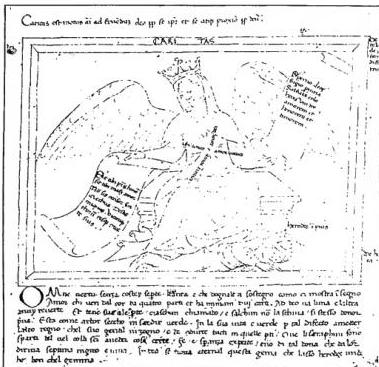
According to the commandment, we must all tend to it, while the three evangelical counsels are only instruments or means to reach it more surely and more quickly; therefore the counsels are subordinate to the supreme precept and not superior to it.
The best commentators on St. Thomas say together with Cajetan and Passerini: the perfection of charity is subject to the supreme precept, non ut materia, not as a thing to be realized immediately, sed ut finis, but as an aim to which we must all tend, each according to his own condition. This is a general obligation. Religious and priests have moreover in the case a special obligation, the former because of their vows, the latter because of their ordination and their priestly functions.
From this lofty doctrine two important consequences follow from the spiritual point of view. 1st He who does not go forward on the way of God, necessarily goes backward, since all have the duty to advance. 2nd In view of the loftiness of the first precept, ever new actual graces are offered to us to reach this aim, because God does not command impossible things. He loves us more than we think. We must therefore correspond to his love.
With most varied words Jesus incessantly recalls in the Gospel the supreme precept, which dominates all the other commandments as well as the counsels, that is, the precept of the love of God and of neighbor: "Thou shalt love the Lord thy God with all thy heart, with all thy soul, with all thy strength, with all thy mind and thy neighbor as thyself" (Lk. 10, 27). This precept, which dominates the Decalogue, is far superior to the ideal of dominating strength of the barbarian heroes, as well as to that of the speculative wisdom of the Greek philosophers, who did not think enough of rectifying the will to the depths, which cannot be brought about except through the love of God and of neighbor. Jesus taught it with all his life and in all his magisterium.
IV. CHARITY AND CHRISTIAN PERFECTION
St. Paul says: "Above all have c., which is the bond of perfection. Let the peace of Christ reign in your hearts, to which you have been called in [forming] one body, and be thankful" (Col. 3, 12).
C. is the "bond of perfection" because it is the highest among the virtues and unites our soul with God; it will endure eternally, and already it gives life to all the other virtues by making their acts meritorious and by ordering them to their ultimate end, that is, to its own object: God loved above all things. Therefore St. Paul says, I Cor. 13, 1: "Even if I spoke the tongues of men and of angels... even if I had the gift of prophecy... and a faith such as to move mountains, if I have not c. I am nothing." In fact without it the will of man turns away from God, and is already in a state of mortal sin; if he dies in this state, he is lost for eternity, even if he had the knowledge of angels. On the contrary, c., which presupposes faith and hope, unites us with God, and is accompanied by all the infused moral virtues and by the seven gifts of the Holy Spirit (Rom. 5, 5).
In conformity with revealed principles, Christian perfection coincides in the highest degree with c.: "each being is perfect insofar as it attains its own end, that is, its final perfection. Now the final end of human life is God, and it is c. that unites us with him, according to the words of St. John: 'He who remains in c. remains in God and God remains with him' (I Io. 4, 16). Therefore it is more especially in c. that the perfection of the Christian life consists" (Sum. Theol., 2ᵃ-2ᵃᶜ, q. 184, a. 1). Infused faith and hope can subsist in the state of mortal sin.
The infused moral virtues, which rectify us in regard to the means to be employed in pursuing the final end, presuppose c., which confers on us rectitude in regard to this end. "Perfection therefore resides principally in the love of God and of neighbor, both objects of the two great precepts of the divine law; in an accidental way it resides also in the counsels, insofar as these are the means, that is, the instruments of perfection" (Sum. Theol., 2ᵃ-2ᵃᶜ, q. 184, a. 3).
The Angelic Doctor observes, in order to explain this doctrine better, that on earth the love of God is more perfect than the knowledge of God, since, by means of love, our will tends toward the object loved, such as this is in itself, whereas we cannot know God here below otherwise than by imposing on him in some way the limit of our imperfect concepts (1ᵃ, q. 82, a. 3). Our love of God, on the other hand, does not draw God toward us, but rather draws us toward Him, so that we love in Him even what remains hidden from us (v. PARADISO).
V. THE INCREASE OF CHARITY AND PROGRESSIVE PURIFICATION
St. Paul recommends: "Grow in c." (Eph. 4:15); "I am praying that your c. may increase more and more" (Phil. 1:9); "may the Lord make you grow and abound in c. among yourselves and toward all, as we also do toward you" (I Thess. 3:12). C. must grow in us until death, because the Christian is here below a wayfarer (viator) who walks toward God with the "steps of love" (gressibus amoris, St. Gregory the Great), growing in love.
St. Thomas also says (Epist. ad Hebraeos, X, 25) that the Christian must tend more rapidly toward God as he draws nearer to Him. As a stone falls faster as it approaches the earth that attracts it, so souls in a state of grace must tend more swiftly toward God as they draw nearer to Him and are more attracted by Him. This law of gravitation and acceleration is applied to spirits as well. The last years of the saints' lives in fact show a much more rapid progress than the first. From the spiritual point of view there is no twilight for them, but an ever more rapid ascent up to their entry into heaven.
C. does not increase in us by addition, like a heap of grain, but grows in intensity like a quality, for example heat or light. It sinks ever deeper roots into our will, while by reducing and eliminating egoism it ever more inclines our will to tend toward God and to flee sin with more generous acts. (Sum. Theol., 2ᵃ-2ᵃᶜ, q. 24). The increase of c. is obtained through our merits, through prayer, through the Sacraments.
It is not the meritorious acts, which proceed from c., that increase it, since it is a virtue not acquired but infused, given at Baptism, restored by means of absolution to those who had lost it. But meritorious acts predispose and give a right to the increase of c. granted by God: "God gives the increase" (I Cor. 3:7). Prayer too can obtain this, and the Sacraments produce it ex opere operato, that is, of themselves, by the application of the fruits of the passion of the divine Savior. Principally the Eucharistic Communion increases c. in us and, with it, the infused virtues and the seven gifts.
Finally it is the passive purifications, of which St. John of the Cross speaks in the Dark Night, that have as their purpose to rid the infused virtues of any human alloy; more especially the passive purifications of the spirit aim at bringing strongly into relief the proper object and the formal motive of the three theological virtues, above any secondary motive. Thus the passive purification of faith and hope brings into relief the First Truth as revealer and the helping Omnipotence. The passive purification of c. disposes one to love only God for Himself, above all His gifts, and to love one's neighbor despite his slights and his ingratitude. During this passive purification the soul is often deprived of any spiritual consolation, for months and for years, although God becomes more intimately present in it and exercises in it a deeper action. God seems to abandon it, as God the Father seemed to abandon the soul of Jesus on the Cross. But precisely then it performs a great act of love for the one and only motive: God is infinitely better than any created gift whatsoever, while He has loved us first, He who cannot command impossible things and who never abandons us first. Following the example of His crucified Son, I must correspond to His love... St. Teresa of Avila says: "The soul is like one suspended in the air, who can neither set foot on the ground nor rise toward heaven; it burns with thirst, and this thirst is of such a nature that there is no water here below that can quench it" (Interior Castle, 6th dwelling, ch. 11);
At the end of this trial c. toward God and neighbor is purified of any alloy, as gold in the crucible is rid of its dross. The love of c. is in this way not only purified but notably increased. The love of God and of souls then becomes ever more disinterested, pure, strong and irresistible: it explains the heroic acts of the martyrs, the greatest works of the saints, which endure for centuries after their passing and amid which they were ever more configured to Christ in His hidden life, in His apostolic life, and in His life of sufferings, before being configured to Him in eternal glorious life.
Bibliography29 works
Reginaldo Garrigou-Lagrange
VI. CHARITY AND DISINTERESTEDNESS
Jesus Christ, in inculcating love of neighbor, had particularly insisted on its disinterested character. "If you love only those who love you...; if you do good only to those who do good to you...; if you lend only to those from whom you hope to receive in return, what credit is that to you? You must instead love even those who do not love you; you must do good and lend even without hope of any repayment; thus you will be children of the Most High, who does good even to the wicked and the ungrateful" (Lk. 6:32-35). The concrete model of the love that Jesus wants from his disciples is the good Samaritan, who gives without any interested aim; it is love that distinguishes the good shepherd who gives his life for the sheep from the hireling who seeks his own advantage. While Jesus Christ had limited himself to pointing out the disinterested character of love of neighbor, the Fathers insist also on the disinterestedness of the love of God. They commonly divide men into three categories from the point of view of their attitude toward God: the category of slaves, who fear in God the master who punishes; that of hirelings, who see in God the rich man who rewards; and finally that of sons, who see in God a Father whom they love. The Christian belongs to this third category.
Medieval theology explained and reaffirmed the traditional doctrine with its analysis of the formal motive of Christian charity and with the well-known distinction between love of benevolence and love of concupiscence. Even common sense conceives true love as the gratuitous self-giving of the lover to the beloved, as forgetfulness and sacrifice of self in favor of the beloved person; love ignores the "do ut des," it makes the beloved not a means but an end. The problem therefore arises: if the supreme law of Christian morality is disinterested love, what moral value have in the eyes of Christianity all those feelings and actions of man that are motivated by fear of punishment, or by the desire for one's own utility, whether eternal or temporal? The teaching of Jesus Christ and of the Fathers already contained a solution to the problem, in a sense favorable to the lawfulness and compatibility of interested feelings with charity. To those who love their neighbor is reserved the "reward" of the heavenly Father (Mt. 5:46; 6:1, 4, 6, 18); Christ promises a hundredfold in this life and the possession of eternal life to those who, in order to follow him, abandon everything (Mt. 10:29; Lk. 18:29); he expressly inculcates in them the fear of Gehenna (Mt. 5:29-30; 10:28); he exhorts them to be reconciled with their adversary, in order to avoid the consequences of a judicial process with the danger of a prison sentence and of a rigorous restitution (Mt. 5:25). The only interested aim condemned by Jesus Christ is that which makes the goods of this world the sole and ultimate purpose of human action (Mt. 6:1-6); which considers physical evil as the supreme evil to be feared (Mt. 10:28; Lk. 9:26). In the footsteps of the thought of Jesus Christ, that of the Church likewise remained. In the eyes of the Fathers the aforementioned categories of slaves and hirelings are indeed imperfect, but not unlawful, since fear of punishment and desire for reward dispose and lead man to love; and this love, once attained, does not suppress or exclude fear and interest, but infuses into them a new spirit.
The traditional doctrine of the Church has always recognized as lawful and salutary the repentance of sins motivated solely by fear of eternal punishment (v. ATTRITION) and has counted among the theological virtues, obligatory for every Christian, hope, that is, the desire for eternal happiness. The principal deviations from this traditional doctrine of the Church were concretized in Baianism, Jansenism and the semi-quietism of Fénelon. Baius and Jansenius made charity the sole and exclusive motive of every good action; they therefore considered as unlawful and sinful every motive of human action other than that of pure charity; sinful therefore and unlawful to do good with the sole aim of eternal reward, and sinful also and unlawful the mere attrition of sins. Unworthy therefore of receiving Communion were those who do not have perfect charity. The Church expressly condemned these doctrines (Denz-U, nos. 1300, 1303, 1305, 1313). Fénelon did not consider fear of punishment and desire for reward immoral, but simply as incompatible with the state of perfect charity, which is, in his opinion, the exclusive and sole principle of all the interior life and of every meritorious act. These theses too were condemned by the Church (Denz-U, nos. 1327, 1328, 1345, 1349).
The problem of the relations between charity and interest is inserted into the broader problem of the relations between charity and all the other virtues, both supernatural and natural.
VII. CHARITY AND THE OTHER SUPERNATURAL AND NATURAL VIRTUES
In the teaching of Jesus Christ and of the Fathers it is contained with complete clarity that charity is the supreme virtue, indispensably required for salvation; on the other hand, the precise relationship of charity to all the other virtues is not always indicated with equal clarity. Besides being the supreme virtue, is charity perhaps also the only true virtue required by Christian morality? Is a morally good virtue or act possible even where charity does not reign? Or is there no middle way between sin and charity? Does charity perhaps replace and eliminate the other virtues as superfluous, or does it require them? The teaching of Jesus Christ, of the Apostles and of the Fathers contained, it is true, an answer to all these problems, but not always a clear and explicit one; the unsystematic, occasional and fragmentary character of their teaching could give rise to equivocal and false interpretations; many centuries would have to pass before Christian thought would reach full light on these problems, dispelling doubts, equivocations and errors.
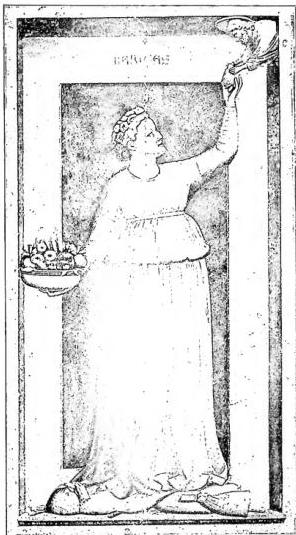
A lucid and precise exposition of traditional Christian doctrine on the relations of charity to the other virtues is provided for us by St. Thomas, and it may be summarized in the following points. Charity is the supreme ethical value, because it makes man capable of possessing the ultimate supernatural end (Sum. Theol., 1ᵃ-2ᵃᶜ, q. 66, a. 6; 2ᵃ-2ᵃᶜ, q. 23, a. 6); it is not, however, the only ethical value, since man can perform honest acts even without charity (ibid., 1ᵃ-2ᵃᶜ, q. 65, a. 2; q. 109, aa. 2, 4); the theological virtues of faith and hope themselves can be found in a man separated from charity (ibid., 1ᵃ-2ᵃᶜ, q. 65, a. 4). Nevertheless these ethical values, distinct and separable from charity, are in themselves imperfect, relative, not sufficing by themselves to make man capable of his ultimate end; only from charity do they receive the value of means proportionate to the attainment of the end. In this sense it may well be said that there is no true virtue properly speaking except where there is charity; not in the sense that where there is no charity there is always, in right and in fact, only sin: he who is deprived of faith, and consequently of charity, does not sin in his every action (ibid., 2ᵃ-2ᵃᶜ, q. 10, a. 4). All ethical values diverse and distinct from charity stand to it as the instrument to the hand that wields it, as the body to the soul that gives it life, as matter to form (ibid., 2ᵃ-2ᵃᶜ, q. 23, a. 8); the function of these ethical values in relation to charity is twofold: one is to prepare the ground favorable to charity, the other is to serve as a means, more or less necessary, to its exercise (ibid., 1ᵃ-2ᵃᶜ, q. 65, aa. 3, 5; q. 106, a. 1; q. 108, a. 1). Can man, without charity, love God naturally above all things? St. Thomas's thought on this point is variously interpreted, and the theology of today is divided. From St. Thomas onward there was no lack of extremist doctrines, which provoked the intervention of the ecclesiastical magisterium in defense of the traditional positions set out above. Some, such as, for example, the Beguines, from the character of most perfect virtue inherent in charity drew the consequence that a man endowed with charity is not bound to exercise the other virtues, nor to observe human, civil and ecclesiastical laws (Denz-U, nn. 473, 476). Those who made charity the supreme and exclusive virtue, condemning as intrinsically sinful every human action not inspired by charity, were Baius, Jansenius and Quesnel, echoed in Italy by the Synod of Pistoia. According to these, man either loves God and neighbor supernaturally, or he sins; there is no middle way. Therefore the natural love of God is impossible (Denz-U, nn. 1034-38, 1297, 1394-1400, 1523-24); it is impossible to perform any good action without charity (Denz-U, nn. 1390-96); it is impossible to separate faith and hope from charity (Denz-U, nn. 1302, 1407); it is impossible to observe any law without the influence of charity (Denz-U, nn. 1016).
All these theses were condemned by the Church as heretical, erroneous and subversive of Christian morality.
The ethical values distinct from charity do not all have the same relationship in regard to it; as St. Thomas rightly observes, some are necessary and indispensable means, by divine or natural law, for the conquest or the exercise of charity, such as, for example, the obligation to receive the Sacraments, to believe, to practice justice, etc.; others, on the other hand, are more or less free and opportune means, and are therefore left to the free determination of individual persons or of human authorities, according to times and circumstances, such as, for example, the ecclesiastical law of the festive rest, of abstinence, of ecclesiastical celibacy, etc. (Sum. Theol., 1ᵃ-2ᵃᶜ, q. 108, aa. 1-2). Of all the moral problems concerning charity, the most timely today is that concerning the relations of charity with justice. From the principles set out above concerning the relations between charity and the other virtues it follows that charity does not replace nor absorb justice into itself, but presupposes and requires it; which means that one cannot give to someone under the title of charity what is owed to him by right; it means further that there can be no true charity where right is trampled underfoot, and that charity awakens first of all the sense of rigorous justice and inspires its observance. On the other hand, charity cannot be entirely absorbed by justice: beyond the ethical relations circumscribed within the limits of right properly so called, the violation of which gives occasion for vindication, ethical relations irreducible to the category of justice are possible and do in fact exist among men; the offender, for example, has no right to forgiveness, the troublesome person has no right to be tolerated, yet Christian morality obliges the offended party to forgive and the one molested to patience: obligations of charity, but not of justice. In conclusion: charity is not the sum of all the virtues, but is an autonomous virtue, distinct in its specific motive from all the other virtues; these, in turn, are not so many aspects and effects of charity, but are autonomous ethical values, specifically distinct from charity by their formal motive; charity and the other virtues are nevertheless not entirely independent of one another, but are intrinsically harmonized with each other in a hierarchical whole, in which charity figures as the supreme and absolutely autonomous element, while the other virtues figure as subordinate elements, moved and directed by charity.
Christian morality, having in charity its inspiring principle, draws from it as its peculiar characteristics spontaneity, interiority, freedom, and heroism. It is of the essence of love not to be constrained but to be spontaneous: for one who acts out of Christian charity, the coercive force of the law becomes in a certain way superfluous, and the very binding force of duty is transformed into a spontaneous impulse of the heart; the much-celebrated autonomy of the Kantian categorical imperative does not stand comparison with the autonomy of Christian love. Spontaneity is inseparable from interiority: not the external action in itself, but the good or bad disposition of the heart is the principal criterion that distinguishes men as good or bad in Christian morality. Spontaneity and interiority joined together confer upon Christian morality a twofold freedom: moral freedom from every imposition that has no relation to the love of God and neighbor or that is even contrary to it; psychological freedom from every impulse or motive coercing the will of the acting subject (cf. Sum. Theol., 1ᵃ-2ᵃᵇ, q. 108, a. 1, ad 2). Love, finally, knows no measure, since it is not a means to perfection but perfection itself (ibid., 2ᵃ-2ᵃᵇ, q. 27, a. 6); from this derives the heroic aspect of Christian morality, which alongside duty proposes the counsel, and whose inspiring principle, love, impels man to the total dedication of himself both in the fulfillment of duty and in the practice of the counsel.
VIII. THE EXERCISE OF CHARITY
1. Charity toward God
It is exercised positively through acts of the love of God, negatively by combating contrary sentiments. A man who has reached the use of reason is not only bound to have a state of habitual friendship with God, but must also translate it into act, explicitly or implicitly. When toward the end of the 17th century the moral problem of the necessity of the actual love of God was expressly raised, certain moralists of a very broad tendency believed they could affirm that man is never bound in his life to elicit acts of charity, or that he is obliged to do so at most once in a lifetime; some, less broad, descended to narrow chronological specifications within a five-year period. The popes Innocent XI in 1679 and Alexander VIII in 1690 condemned such assertions as scandalous and practically harmful (Denz-U, nos. 1101, 1155-57, 1289). Modern moralists declare the explicit or implicit act of charity obligatory at the threshold of the moral life, in the face of death, in grave temptations directly threatening the love of God in himself, and with a certain frequency throughout life. Every chronological specification on the matter - whether one holds the act of charity obligatory every year, every month, or every Sunday and holy day of obligation - is judged by eminent moralists, and rightly so, superfluous and harmful: love is not measured with a dropper; and when it is present, the love of God spontaneously translates itself, even if indirectly, into an act in every good work performed by man with a right intention.
Among the sentiments directly contrary to the love of God, moralists especially point to hatred and sloth. Man is unhappily capable not only of hating God indirectly by committing any mortal sin, but also of hating him directly, detesting either his existence or his attributes. Proudhon's phrase: «Dieu, c'est le mal!», considered objectively, is the expression of a direct hatred of God. Sloth is the nausea, perceived and accepted, of God and of all that relates to him; it is an antipathy that disposes one to the hatred of God or flows from it, just as sympathy for God disposes the heart to love of him or follows from it. A victim of sloth, in the sense just defined, would be, for example, one who, though convinced of the truth of the Christian faith, regretted having received this gift and envied the lot of unbelievers.
2. Charity toward neighbor
a) Motive and extension. The love of neighbor is the necessary consequence of the love of God and could be defined as: the love of God in one's neighbor. In fact, according to Christian doctrine, all men are destined to participate in a supernatural way in the being and happiness of God, they are living images of him. This supernatural sharing in perfection constitutes the specific foundation of Christian love of neighbor. It does not exclude, but presupposes and ennobles all the other relations of honorable love possible among men; such as family love, love of country, friendship, etc. Since every living man belongs, in act or in potency, to the family of the children of God, Christian love extends to all men, indeed to all intelligent beings; excluded from it are only those who are definitively and irreparably separated from the supernatural society; such are the damned. Even sinners, therefore, as long as they live on this earth, are the object of Christian love, not certainly as sinners, but as men who can still recover the grace they have lost. Christian love therefore knows no racial or national barriers.
b) The order of charity. The universality of Christian love does not exclude inequalities and preferences. These can be deduced from different points of view: first, from the importance of the good that must be willed and procured for one's neighbor; second, from the more or less close degree of proximity; third, from the more or less grave need in which one's neighbor may find himself. From the first point of view the hierarchy of loves is modeled on the hierarchy of goods: eternal and spiritual goods precede material and temporal ones; one must therefore will and procure for one's neighbor first the former, then the latter, in the sense that material beneficence must never be an end in itself, nor still less hinder spiritual beneficence, but must implicitly or explicitly aim at the eternal good of one's neighbor. From the same point of view the love of neighbor prefers those more endowed with spiritual goods to those less endowed. From the second point of view the hierarchy of preferences of Christian love runs parallel to that of natural love, founded especially on bonds of blood: spouses, children, parents, blood relatives and relatives by marriage; or founded on bonds of common education, of beneficence, of friendship. From the third point of view those most in need have precedence over others, and among these those who find themselves in grave danger of being eternally lost. Other things being equal, the more grave and urgent needs are relieved first.
c) The love of enemies. The extension of love even to enemies is expressly commanded by Jesus Christ to his disciples with words and with example: «You have heard that it was said: you shall love your neighbor and hate your enemy. But I say to you: love your enemies and do good to those who hate you; and pray for those who persecute you and slander you» (Mt. 5:43-45). The supreme example of love toward enemies was given by Jesus Christ on the cross with the forgiveness of his crucifiers. The motivation of the love owed to enemies is indicated by Jesus Christ with the following words: «So that you may be children of your Father who is in heaven, who makes his sun rise and his rain fall on the good and the bad alike, on the just and the unjust» (ibid.). The precept of Jesus Christ was always considered obligatory for all Christians.
By enemy is meant one who nourishes in his heart hatred toward his fellow man, or who has violated his right, or who in any case malignantly opposes him. By virtue of the precept to love one's enemy, hatred toward him and unlawful vengeance are forbidden; instead, forgiveness of offenses and prompt reconciliation are commanded.
By hatred of the enemy is meant the deliberate aversion to his very person and to his goods; it is proper to hatred to wish to destroy and to make suffer. Hatred of the enemy is therefore not the spontaneous and indeliberate antipathy toward him; still less the aversion of the soul toward his bad qualities, his defects and his faults, all things which, saving certain other norms of charity, one can and must detest in him. It is instead the fruit and sign of hatred, for example, to wish one's neighbor eternal damnation, death, illness, poverty, infamy; or to rejoice that he is struck by these evils. As for bodily evils, it must be observed that they can be desired or delighted in insofar as a greater good can result or has resulted from them. Not every vengeance is forbidden by charity toward one's neighbor, but only that which seeks the evil of the offender, rather than his correction and the reparation of the justice that has been violated, with the eventual compensation of the damages suffered.
The forgiveness of offenses against one's neighbor was inculcated by Christ as an indispensable condition for obtaining from God the forgiveness of our sins: "Forgive us our debts as we forgive our debtors"; the parable of the servant, forgiven by his master a full ten thousand talents and yet so exacting toward his fellow servant who owed him the paltry sum of a hundred denarii, closes with this warning: "So will my heavenly Father do to you, if you do not forgive your brothers from your heart" (Mt. 18:21-33). An indication of refused forgiveness would be the denial to the offender of the common signs with which people, according to the times, circumstances, places and customs, express to one another their feelings of friendship, affection, and good accord, such as, for example, a greeting. A closed and reserved demeanor toward the offender may nevertheless be lawful in certain cases as a means inspired by charity itself for the purpose of correcting the offender. Reconciliation with one's neighbor is inculcated by Jesus Christ as a duty more binding than that of external religious worship itself: "If you are at the altar and there your heart reminds you of the rupture with your brother, leave your offering at the altar and go first to be reconciled with him" (Mt. 5:23). The duty of initiating reconciliation falls first of all upon the offender; if the offense was mutual, the initiative belongs to the first or more serious offender.
d) The works of charity. Those duties are called duties of charity which do not fall within the orbit of strict justice, since their fulfillment cannot be claimed by virtue of a corresponding true and proper right. Christian tradition has summarized the duties and works of charity in two groups of seven each: the seven works of corporal mercy and as many of spiritual mercy (v. MISERICORDIA). The traditional list is inspired in part by the very words of Jesus Christ (Mt. 25:35-45), in part by the Old Testament and the writings of the Apostles. The works of corporal mercy can all be summarized in the duty of almsgiving. Among the works of spiritual mercy, fraternal correction is counted in a special way.
e) The vices opposed to charity. Although every sin and vice is incompatible with charity, there are nevertheless sinful feelings and works directly contrary to it. The first is hatred of one's neighbor, of which mention has already been made above. There follow, according to the order established by St. Thomas (Sum. Theol., 2a-2ae, qq. 36-43), envy, discord, contention, schism, war, brawling, sedition, scandal, and cooperation in evil.
3. The love of oneself
The man who loves his neighbor because he is the living image, natural and supernatural, of God, cannot forget that he too is a creature and son of God; with this affective esteem of himself the Christian love of self begins. In Christian love one's own being is not the final and absolute term toward which love tends, but is a means for the love of God. The first effect of this love is to induce man to bring about in himself the most perfect likeness to God through the acquisition and increase of sanctifying grace, the avoidance of sin, and the exercise of the virtues.
Since the repression of the lower appetites of a nature corrupted by original sin is necessary for this purpose, a certain self-denial and hatred of self forms part of the Christian love of self, which is expressed above all in the mortification of the flesh. Within the framework of these ideas, the following paradoxical sayings of Jesus Christ reveal all their profound meaning: "Whoever wishes to save himself (therefore, whoever loves himself) will lose himself; but whoever loses himself (therefore, whoever hates himself) for my sake, will find himself" (Mt. 10:39; 16:24 ff.). Even more clearly in Lk. 14:26: "Whoever comes to me and does not hate... himself, cannot be my disciple."
Subordinately to the supreme good of supernatural likeness to God, prepared here below by a holy life and consummated in eternity with the beatific vision, man can and must love the values of the present life, both material, such as life, health, sensible pleasures, etc., and spiritual, such as knowledge, art, honor, etc.
IX. EGOISM, PERVERSION OF CHARITY
The true enemy of Christian charity is not hatred, but egoism, that is, love wrenched from its true order. The fundamental disorder of egoism consists in this, that man loves himself as the supreme and absolute good, subordinating everything else to this love as a means. The disordered love of self is the radical sin, of which all individual vices and sins are partial and diverse manifestations. St. Augustine saw in charity and in egoism the two antithetical forces that ultimately determine the tangled fabric of the history of the human race, which he synthetically summed up in these words: "Two loves have given birth to two races of men: the love of self, carried to the point of contempt for God, has generated the earthly race; the love of God, carried to the point of contempt for self, has generated the heavenly race" (De civitate Dei, XIV, 28).
Bibliography8 works
Gaetano Corti
II. HISTORY OF CHARITY
I. IN CHRISTIAN ANTIQUITY
1. Apostolic age
The Christian concept of love of neighbor is based exclusively on the teaching of Jesus Christ, whose doctrine presents a new character compared with other conceptions of the ancient world. The Old Testament insisted on love of neighbor; yet on the lips of Jesus it sounded like a new commandment (Jn. 13:34). For the Jews, the neighbor was a privileged category, opposed to another, that of enemies, whom every Israelite believed it legitimate to hate, since they were at the same time enemies of God (Mt. 5:13). It is true that after the decline of the Greek cities, the conquests of Alexander the Great and the influence of Stoic philosophy, a broader concept of human solidarity had made headway and the world was regarded as a city of men. In reality, however, this doctrine had been set aside by wars and slavery. Jesus was the first to illustrate the law and the prophets in this sense and to give it its perfection. Above all he was the first to give life to a speculative principle that had remained a dead letter, until love of neighbor was linked by him — and in this lies principally the originality of his teaching — to the love of God, the true hearth and supreme motive of charity.
The law of Christian love has brought down the barriers of religious or national particularism; since all are one in Christ, there is no longer either Greek or barbarian, free man or slave (Gal. 3:28).
From the very origins, the two precepts of the love of God and of neighbor became the fundamental charter of Christianity. St. John delights in fusing them into a single commandment (1 Jn. 4:20-21), while St. Paul recapitulates the whole substance of the Christian law in the second precept (Gal. 5:14; 6:2; Rom. 13:8).
This conception of human brotherhood inaugurated by Christ could not fail to have wide resonances in the thought and acts of the Apostles. St. Paul returns to it often in his catechesis: he insists on the equality of the slave with the master (Philem. 16); the abundance of the one who possesses must supply the indigence of the poor (2 Cor. 8:12). Charity, however, must be done in the spirit of Christ, who, being rich, became poor for man, therefore not by imposition, but freely, since God loves the cheerful giver (2 Cor. 9:7). On this effective side of operative charity St. James also insists, for whom the religion beautiful in the eyes of God consists not only in keeping oneself free from the contamination of the world, but in visiting orphans and assisting widows in their needs (Jas. 1:27). The principles of the Redeemer, faithfully guarded by the Apostles, soon passed into the practice of the daily life of the primitive Christian community, whether in Jerusalem or in Corinth, in Rome as in Asia Minor.
In Jerusalem there is found from the very beginning the voluntary community of the use of goods, destined to succor the Apostles intent on preaching the good news and the poor of the nascent Church (Acts 2:44 ff.; 4:32 ff.).
As soon as the work of material assistance undertaken began to hamper their spiritual mission, the Apostles elected seven deacons with the task of serving at the tables and providing for the needs of the widows (Acts 6:1-6). Thus the charitable function of the Church became specialized, while always remaining under the direct supervision of the pastors of the community. The very fact of the election of the deacons proves the great importance assumed in the life of the Church by the ministry of the poor. This concern was not restricted only to the needy of one's own community, but extended also to distant communities. Thus, during a famine, the Church of Jerusalem was assisted by the Christians of Antioch and by other churches of the gentiles (Acts 2:29; Gal. 2:10). The form of assistance particularly in vogue at that time was that of gifts in kind. But the utilization of such gifts was not done by dividing them into equal parts among the poor; a good part was reserved for the common tables, for which an order of public assistance was soon established in the creation of the deacons. Hence the origin of the so-called agape feasts, about which discussions are not yet closed. Assistance of a public character by means of the deacons was naturally integrated with the exercise of private charity, because the precept of love of neighbor is individual. St. Paul forbade the admission for the ministry of public assistance to the poor of widows neglectful of their duties toward their household and of hospitality toward the poor and travelers (1 Tim. 5:4 ff.). The individual is bound to succor the indigent members of his own family (1 Tim. 5:8), the indigent members of his own or of other communities, and finally non-Christians (Gal. 6:10). A moving picture of private beneficence in the primitive Christian community is offered by the account of the Acts concerning Tabitha (Acts 9:36).
2. Period of the persecutions
How alive this teaching had remained in the spirit of the Christian generations that followed the apostolic age is revealed by the writings of the Apostolic Fathers, in which the theme of charity is developed in various forms.
"Do not wonder if a man can become an imitator of God; — writes the author of the Letter to Diognetus — he who takes upon his shoulders the burden of his neighbor, and seeks in those things in which he is superior to benefit the inferior, who by providing to the needy the things received from God, is to the beneficiaries like a God, this man is an imitator of God. Then even while you are on earth it will be given you to see that God reigns in heaven" (ch. 10). And St. Justin in his Apology to the emperor Hadrian: "We who loved more than anything the expedients for acquiring riches and fortunes, now bring into common even those things we have and share them with every needy person; we who hated and killed one another and because of customs with those who were not of the same family did not share things in common, now, after the coming of Christ, live together in community and pray for our enemies, and seek to persuade those who unjustly hate us, so that they, living according to the beautiful commandments of God, may be full of hope of obtaining together with us the same goods from the side of God, Lord of all things" (Apol. 1:14).
The best picture of the practice of charity is offered by the Didaché or Doctrine of the Twelve Apostles, and by the Apostolic Constitutions. The first gives precious indications and prescriptions for bishops considered as fathers of the poor (cf. chs. 1, 3 and 4); the other insists on the same themes, partly accentuating them, partly broadening them (cf. chs. 1, 2, 4, and especially 8, where are contained the most ancient documents of the liturgy, the prayers for the sick and the needy).
From the whole it is deduced that individual believers have the duty to care for their fellow men, especially the poor, for whom the following rules hold: 1) the bishops and the deacons dependent on them have care of the poor. It is the duty of the deacons to inquire diligently after those who suffer in their flesh; they must point them out to the people, and if the latter is unaware of their infirmities, they must visit them and provide them with what is necessary, also taking care to inform the bishop of what they will have given them. 2) Such help given to the poor has the character of a sacrifice on the altar of Christ, because it is connected with the divine service. Thereby every shame is removed from honest poverty. 3) The bishops, as dispensers of the goods of the Lord, must distribute them with wisdom, to each according to his needs; first to widows and orphans, then to the abandoned and to all those who are in want. 4) Abuses of charity must be prevented by a serious inquiry and by asking newcomers for letters of recommendation; in doubtful cases the bishop decides. 5) To those who are able to engage in work, give a fixed position. Orphans are to be entrusted to Christian families that take care of their education; poor children, on the other hand, are to be placed under the authority of a craftsman who teaches them a trade. 6) Charity is something sacred, and therefore sinners must not take part in it.
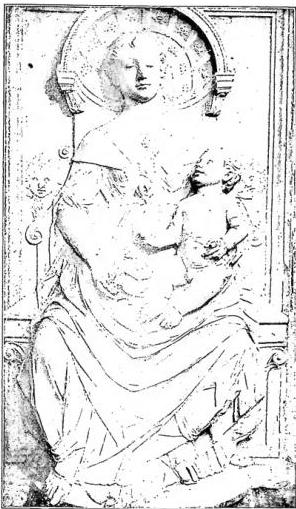
Let no one believe that he can substitute for penance for his own sins by gifts of money. 7) Those who are helped must pray for their benefactors.
The position of the bishop, whom St. Paul wants generous and disinterested toward orphans, widows and the unfortunate (I Tim. 3:2 ff.), appears preeminent in charitable provisions, especially in the writings of St. Ignatius of Antioch, who calls him the providence of widows (ad Polycarp., 4). As such, the offerings in favor of the poor are entrusted to him, and he disposes of them rendering account to God alone (Constit. Apost., I, 1; II, 25, 26, 57). The deacons ordained solely for the ministry of charity are the assistants, the echo of the bishop's voice, acting in dependence on him (Constit. Apost., II, 29-33). Widows who have contracted only one union, or virgins of prudent conduct, all however of advanced age, may attend, under the direction of the deacons, to persons of their own sex; these are the deaconesses (v. Constit. Apost., II, 17). What took place at Jerusalem was also practiced more or less in the other churches of Christendom.
The Church came to the aid of the needy: 1) by means of offerings in kind (oblata), presented by the faithful during the Offertory of the Sunday Mass. Each assistant, writes St. Justin, participates in "the distribution of the consecrated things, and they are sent through the deacons also to those not present. For the rich, and those who wish, each according to his pleasure, gives what he wants, and what is collected is deposited with the head; and he succors the orphans and the widows, and those who are in need through illness or for any other reason, those who are imprisoned and the foreign guests, and without exception he takes care of all" (Apol. I, 67); 2) with free periodic offerings to which the faithful bound themselves: Modicam unusquisque stipem menstrua die vel cum velit... appoint, wrote Tertullian (Apologeticum, 39). The amount of such offerings was not determined in any case, and everything went to the arca communis, of whose administration the bishop was responsible. 3) There were also extraordinary revenues coming from large donations in money or in real estate, made by the faithful on the occasion of their baptism or at the approach of death. Tertullian relates (De praescript. haer., ch. 30 and Adv. Marcionem, IV, 4) that Marcion, on the occasion of his baptism in Rome, gave the Church two hundred thousand sesterces, which were later returned to him, however, when he separated from its communion. 4) Furthermore there was the product of tithes, first-fruits for the maintenance of the clergy (Const. Apost., V, 20), and extraordinary collections made in moments of great necessity (cf. Cyprian, Epist., 60; PL 4, 359 ff.). 5) Fasting too brought the Church notable resources for the exercise of charity. For it was a common doctrine among the Fathers that fasting had no value for salvation unless accompanied by an alms equal to the ration of food of which one deprived oneself by fasting (cf. Pastor of Hermas, 5,3; Origen, Hom. X in Lev.; St. John Chrysostom, Sermo de Ieun.; St. Augustine, Sermo 208 in quadrag. etc.).
The offerings, if they were not immediately divided among the poor, as happened in time of persecution to withdraw them from the rigors of the fisc, were gathered in a common chest, which made it possible to meet the urgencies of daily life. In the first place care was taken of the confessors of the faith lying in prisons or condemned to the mines, then of widows and orphans, especially if children of martyrs, then of the aged and the sick in general. So that good order might be maintained in everything and abuses avoided, the system of the matriculae was practiced, which the deacons kept up to date. Thus in Rome, at the time of Pope Cornelius, the poor enrolled and maintained by the Church were 1,500 (cf. Eusebius, Hist. eccles., VI, 34).
Naturally public beneficence did not prevent private beneficence. How ample and cordial it was is proved by the passage of Aristides (ch. 15) in his Apology to the emperor Hadrian, which lets us glimpse the vast field of this activity. From hints of Tertullian (cf. De cultu femin., II, 11 and especially Ad Uxor., II, 4) one can also see what importance was attached to hospitality toward the brethren in the faith. In time of persecution it had to be practiced even at personal risk (Const. Apost., V, 3; VIII, 45), and one of the functions of the deacons was to make known to the bishop the arrival of foreign brethren so as not to leave them isolated in the midst of idolatrous crowds, often hostile.
But the spirit of dedication had a way of showing itself in exceptional circumstances, as, for example, in cases of epidemic. Carthage was struck by one in 252, and the bishop Cyprian traced a very gloomy picture of it in his De mortalitate (ch. 14: PL 4, 591-93). While others flee, Cyprian gathers his flock and reminds it of the duty of the hour. His appeal is answered in admirable fashion, but he himself is the first to give the example of what a father can do (cf. Vita Cypriani: PL 3, 1489 ff.). The same happened some years later at Alexandria, during an epidemic of typhus that broke out in 268. Priests, deacons, simple laymen exert themselves; many of them succumb in the exercise of charity (cf. Eusebius, Hist. eccles., VII, 22).
The duty of visiting the confessors shut up in prisons, so insistently inculcated by the Constit. Apost.
(VII, 1-3) and so alive in the pastoral concerns of St. Cyprian (cf. Epist., 37: PL 4, 326 f.), obliged the deacons especially to every expedient for eluding the surveillance of the police and for making contact with the prisoners, to whom they brought the necessary succor, after having placated the prison guards with money. The examples are known of the deacons Tertius and Pomponius in Africa and the charity exercised toward the martyrs Perpetua and Felicity (cf. Passio, in O. Gebhardt, Acta martyrum selecta, Berlin 1902, p. 66). The deacons and acolytes were also charged with this mission to those condemned to the mines (St. Cyprian, Epist., 78: PL 4, 433-34), and the Roman Church distinguished itself in these good works, with its subsidies to the martyrs of Egypt and Asia (cf. Eusebius, Hist. eccl., IV, 23) since the time of Pope Soter.
The crisis in which the empire was already struggling allowed barbarian tribes to make incursions into the frontier region; often Christians fell prisoner to pirates, who dragged them away after devastating their territory. This was the case of Numidia in 253. St. Cyprian collected a sum of 100,000 sesterces, the fruit of a collection in the Church of Carthage, and sent it to the bishops of Numidia, accompanying the offering with an incomparable letter, which is the exaltation of charity in action (cf. Epist., 60: PL 4, 359).
To this, which might be called the charity of exceptional circumstances, must be added that sum of daily services in favor of all forms of indigence, in which not only the authorized representatives, but simple faithful visit the sick at home, and pious women go from one quarter to another, in search of the filthiest hovels, where there is room only for charity (cf. Tertullian, Ad uxorem, II, 4).
3. Charity in the free Church
The edict of toleration, by granting the Church freedom, gave it the possibility of being able to organize charity better in a manner more consonant with its developments. Freedom of worship was followed by the Church's juridical capacity to possess; it indeed re-entered possession of all the goods confiscated by Diocletian (cf. Lactantius, De morte persecutorum, 48).
The position of the bishops was now strengthened; the Christian emperors, recognizing their own obligation to succor the poor, entrusted their representation to the pastors of the Church and to their delegates (cf. Corpus Iuris Civilis, Codex Iustinian., I, 2-3). Constantine himself had already entrusted to the bishops the administration of the customary annona in favor of orphans and widows, which, after the interruption under Julian, was partially restored by Jovian (Theodoret, Hist. eccl., I, 10: IV, 4). Later, bishops were also charged with visiting prisoners.
The councils, which from this moment could assemble freely, often reminded the bishops of their duties toward the poor, a task fulfilled admirably by all the great bishops of the post-Constantinian period. What St. Cyprian had done in a period of persecutions, in a regime of freedom was done, for example, by St. Basil, who, in his homilies, made the anguish of others' miseries his own and called the rich back to the duties of the Gospel (cf. PG 31, 277 ff.). During a famine he saved his people from hunger for an entire year and erected at the gates of Caesarea the Basileias, the oldest hospital known, of which people still spoke with wonder 70 years later (cf. Sozomen, Hist. eccl., VI, 34).
His emulator was St. John Chrysostom, who was not content with words to entice the well-to-do to do good, but organized relief for the poor by mobilizing the aristocracy of the Byzantine capital, where he found noble souls who followed him with generosity, such as Olympias, wife of the former prefect Nebridius, Petadia, Procula, Nicarete, etc. (cf. on this matter Ch. Baur, Johannes Chrisostomus und seine Zeit, I, Munich 1929, pp. 130 ff., 303 ff.; II, ibid. 1930, pp. 55, 73).
Numerous other testimonies prove that the average bishop was always absorbed by this concern. It suffices, among others, to recall the examples given by Epiphanius of Pavia, Acacius of Amida, Atticus of Constantinople, St. Martin of Tours, St. Aignan of Orléans, St. Caesarius of Arles, Maximus of Turin, Nicetius of Lyon. The bishops were concerned not only with distributing food and clothing, but also with reducing the severity of the laws and the harshness of state officials; they intervened with the tax collectors and pleaded in favor of the poor, always endeavoring to defend them from the rapacity of usurers. Several mitigations in civil legislation, such as, for example, the abolition of torture for insolvent debtors, were due to the at least indirect intervention of the Church. For the defense of the rights of the poor, the procuratores pauperum were established, and, more importantly, the bishops were made official defenders, whose protests the judges were bound to take into account (cf. S. Mochi Onory, Vescovi e città, Bologna 1933, pp. 25 ff., 55 ff.).
The right of asylum was also of great value, recognized by the State from Constantine onward and extended to the buildings of the churches.
Open proof in favor of the enormous influence exercised by charity in the social life of the time is found in a declaration of the emperor Julian the Apostate in 362 to the high priest Arsacius: "Why do we not turn our eyes to the institutions to which the impious religion of the Christians owes its growth, to its care for strangers?... Therefore have many xenodochia built in every city. I have given orders to distribute throughout Galatia 300 modii of grain and 60,000 sextarii of wine. A fifth shall belong to the priests... and the rest shall be for strangers and beggars. It is a shame for us, that among the Jews no one begs, and that the impious Galileans nourish not only their own poor, but also ours..." (Sozomen, Hist. eccl., V, 16). Thus by the middle of the 4th century the xenodochia must have had a particular importance in social life, if Julian calls them to the attention of a pagan high priest.
But these developed even better in the following decades, and even today the already mentioned Basileias is remembered, a hospital and hospice at the same time, founded by St. Basil with enormous difficulties at Caesarea (cf. Epist., 94: PG 32, 485; cf. also the funeral oration of St. Basil delivered by Gregory Nazianzen: PG 36, 578-79); the hospice for the poor at Ostia of Pammachius, and the hospital of Rome founded by Fabiola, extolled by St. Jerome (Epist., 77, ad Oceanum, 6: PL 22, 694); that of Autun, founded by Childebert; the hospice for the aged of Rome, founded by Pelagius II (577) and that of Sinai, erected by Isauria (St. Gregory, Registrum epist., XI, 6, in MGH, Epistolae, II, p. 261). All these hospices were considered as goods of the Church, with their own existence recognized by law, whose administration and foundation was likewise in the hands of the bishops (Cod. Iustin., I, tit. II, 19; tit. III, 35, 49; tit. VIII and XLIV, 36, 3), a characteristic this of the charitable movement from the 4th to the 8th century. Their importance was to be decisive especially in the Middle Ages.
These large-scale manifestations of public beneficence did not exhaust the exercise of private charity, of which eloquent documents are found in the cemetery inscriptions. Charity was held in honor among the representatives of the ancient high nobility, and Ammianus Marcellinus emphasizes that of the consul Lampadius, who in 367 celebrated his entry into office with lavish gifts in favor of the poor (Ammianus Marcellinus, XXVII, 3,5). Likewise the prefect of Constantinople Nebridius distributed his annual revenues to the poor, praised for this by St. Jerome (cf. Ep., 85). After his death, his wife Olympias devoted her life exclusively to beneficence. St. John Chrysostom received much from her for his apostolate among the poor.
Hosting strangers, caring for abandoned sick persons and the shamefaced poor was a ministry willingly practiced by noble families, and even by the imperial family itself (cf. Eusebius, Vita Constantini, I, 43; II, 13; III, 44; IV, 2). Placilla, wife of Theodosius the Great, personally cared for the maimed and the weak, visited the hovels of the poor, founded monasteries and xenodochia, and at her death left her possessions to the poor (cf. Theodoret, Hist. eccl., V, 18). St. Jerome noted the spirit of sacrifice of the noble Roman women, raised in a climate of great affluence, and in particular the example of the senator Pammachius and his wife Paulina, who died in 396. "The precious stones that once adorned her neck later served to feed the poor" (Ep., 66; PL 22, 641). "If your senators [O Rome] — wrote Paulinus of Nola (Ep., 13, ad Pann., 15; PL 61, 216) — give no other spectacles than these of beneficence and charity, then you may be glad to go immune [from the blows with which you are threatened]." Moreover, Paulinus too, a bishop since 400, had built, annexed to his episcopal residence, a series of cellae hospitalis (Ep., 29, ad Severum; PL 61, 329) and distributed little by little, ut facilius pauperes aleret, his possessions (cf. Vita; PL 61, 31 ff.).
Of the merits of Paulina, daughter of Paula, St. Jerome says that no poor person died who had not been clothed with her garments, no sick person who was not cared for at her expense (cf. Ep., 108). Particularly warm is the tone with which he recalls a scion of the Fabii: Fabiola (d. in 400; Ep., 77; PL 22, 690) who, after founding a hospital, wished herself to serve the poor. Even more eloquent is the example given by the relatives of Paulinus of Nola, Melania, and her spouse Pinianus, who deprived themselves of their immense fortune, valued in pre-war currency at over 100 million francs, to provide for the needs of the poor. Paulinus of Nola called the former a manly Christian woman (Ep., 29; CSEL, XXIX, 251; on this matter cf. M. Rampolla, S. Melania Giuniore, Rome 1905).
4. The ancient Popes and charity
In Rome the exercise of charity always maintained a primacy thanks to the vigilant activity of the Popes, who, the more the "patrimonium Petri" grew, the more they widened their solicitude toward the persecuted churches, until under Gregory the Great they reached a peak that has left in history a trail never forgotten. How charitable assistance functioned as a whole is told to us by Eusebius, who, referring to the times of Pope Cornelius (c. 250), mentions 150 members of the clergy and 1500 poor, the object of the care of the Church of Rome (Hist. eccl., VI, 43, 11). Also worthy of note is what Dionysius of Corinth wrote, around 170, to the community of Rome (Hist. eccl., IV, 23).
The Romans remained faithful to these traditions even in later times, especially after the conquest of freedom, which allowed the Church to take into its own hands, along with the entire system of state largesse in favor of the needy, the official care of these. Thus the squares and porticoes of the ancient frumentatio became designated places for the distribution of the Pontiff's alms (cf. H. Grisar, Roma alla fine del mondo antico, I, 2nd ed., Rome 1930, p. 344 ff.). The Pope, as father of the poor, comes to meet us in the person of Leo the Great and of Pope Gelasius. Of Symmachus the Lib. Pont., I, p. 263 records the foundation of 3 houses for the poor; Pelagius I was concerned that the patrimony of the Church should always be in a position to succor the needy (cf. Jaffé-Wattenbach, 684, 685), while his successor transformed his own house into a shelter for beggary (Lib. Pont., I, p. 306).
In these times the patrimony of the Church had reached a great extent. An orderly administration was undertaken by Gregory the Great, whose letters provide important particulars on the matter. In them the habitual theme is that the patrimony must serve for the poor (utilitates pauperum). The word pauperes recurs continually in the Gregorian register, which not only exhorted others, but was itself the first to give the example of a virtue rarely practiced in that degree in which he lived it.
II. IN THE MIDDLE AGES
After the pontificate of St. Gregory I, the first great event important for the history of charity was the crisis encountered under the last Merovingians in France. The situation became particularly grave under Charles Martel, who, in order to win vassals, forced the churches to cede their goods, which were constituted as lay benefices and consequently squandered.
Following the sovereign's example, the vassals trafficked in ecclesiastical property, no longer concerning themselves with the bishop who was its depositary. With the impoverishment of the churches and the general demoralization of the clergy that followed, the poor were forgotten and the charitable institutions of the previous age partly disappeared, partly were applied to other uses. The monasteries, which in the first period of Merovingian domination had fulfilled their task well, in the long run suffered from the general disorder provoked by secularization.
One of the tasks of the apostle of Germany, St. Boniface, was precisely to bring about improvements in this field; he indeed succeeded in obtaining recognition of the Church's superior ownership and in reserving to it an annual census from those who held those goods (Synod of Lestines, 745). Nevertheless, after the retirement of Carloman, the work of the councils of the mid-8th century was rendered vain; Pepin, left alone, modified his line of conduct and ecclesiastical goods were again secularized. This policy was also followed by his successor Charlemagne, who believed he could dispose of the Church's goods in complete freedom. He, however, knew how to check abuses, and with wise legislation, far from harming it, allowed the Church's work in favor of the weak and dispossessed to expand ever more, giving an example of social activity never seen until then. In practice he showed that he did not take lightly what he had promised in a capitulary, namely to be the protector and refuge of the weak (cf. MGH, Capitularia Regum Franc., I, 93).
Although economic vicissitudes had considerably restricted the Church's possibilities of intervention in favor of the poor, it nevertheless knew how to continue this work, encouraged by Charlemagne, and often in admirable fashion.
It exercised it not only in the ancient xenodochia and hospices that had been preserved intact in the ancient Italian cities and in the episcopal sees of western France, but above all taking into account the customs of the countryside. Churches and monasteries distributed aid to the poor to the extent of their material possibilities; thus the monastery of St. Riquier gave alms every day to 300 poor and 150 widows. The great abbeys generally had a refuge for strangers and often also a hospital. Here and there were also scattered leprosaria situated in secluded places: the abbey of St. Gall, for example, had one. Nor were refuges lacking in places difficult of access, such as that of the church of Chur on the Septimer. Charlemagne followed similar works in the social field closely, and his ordinances intended to promote, or to suggest measures of prudence or to correct abuses, are numerous.
The capitulary of Nijmegen of 806 contains important decisions against begging and fixes the duties of lords toward the poor of their domain. To those who, through the previous secularizations, had inherited xenodochia, it ordered that they maintain and administer them according to the intentions of their founders (cf. Capit. 46, 9 in MGH, Capit. Reg. Franc., I, 132). The numerous synods of the time express themselves in a similar manner: that of Reisbach (800) insists on almsgiving to the poor four times a year, public almsgiving, from which every thought of vainglory must be eliminated (can. 4); tithes must be divided into four parts, one of which is destined for the poor (can. 13); widows, the blind, orphans and the paralyzed must be assisted, according to the king's expressed will (MGH, Concilio Karolini Aevi, can. 14). The same prescriptions in that of Aachen (801-802: chaps. 7 and 27). The Council of Mainz of June 813 obliges the Church (chap. 6) to lend its support to orphans stripped of their inheritance so as to recover it, while that of Châlons of the same year forbids ecclesiastics to capitalize the surplus of the products of land exploitation, so as to destine it to the poor in time of famine (chap. 8). Again with the aim of defending the poor against usury, the Church renews the prescriptions of the councils of Gaul of the 6th century, which forbid ecclesiastics to make loans at interest (for the texts of the canons of these councils cf. MGH, Concilio Karolini Aevi, vols. I and II). The list could be lengthened for the period following the death of Charlemagne. It suffices to mention only the great synodal diets of Aachen (817) under Louis the Pious, which gave a strong impulse to the ecclesiastical care of the poor. Every bishop was to have a hospital erected for the poor and strangers and, at his own expense, provide it with what was necessary. At the direction of the hospital a regular canon worthy of that post was to be placed. Ecclesiastics were then obliged to give the tithe of their revenues for the maintenance of the hospital and to wash the feet of the poor during Lent in the hospitals (op. cit., I, 1, p. 416).
A great impulse to charitable activity was given by penitential doctrine. The Church did not make money from the sins of the faithful, but consented to supply the canonical penances due for certain grave faults with prayer, almsgiving, and the total or partial cession, in favor of the poor, of the goods of the guilty.
Similar public examples were highly moralizing and in harmony with the doctrine of early Christianity (1 Pt. 4, 8).
The teaching on charity during this period is connected in substance with that of the Fathers of the Church, often cited word for word. Among others it suffices to mention Aimo of Halberstadt, Rabanus Maurus, Ratherius of Verona. The doctrine that all superfluity must be employed for the benefit of the poor was taught by representative men of the time, such as St. Bede and Alcuin. Bishops and Christian doctors of the time often insist and remind princes, kings and magnates of the world that every power comes from God and that their subjects are brothers in Christ.
After Charlemagne charitable organizations decline; feudalism, arrogance, an almost continuous state of war, lack of scruples and the prevalence of force over right demoralize the civil order as well as the ecclesiastical. The general situation of Europe in the 9th and 10th centuries worsens: oppressed in the north by the invasions of the Normans who put to fire and sword the regions they invaded, in the south by the Saracens, in the east by the Magyars, who push into the Danube valley. Other struggles increase its ruins in England (Danish invasion), in Germany (rivalry among the successors of Charle-
Charle-magne), in Spain (invasion of the Moors and competitions of the Iberian kingdoms). The lack of strong central power causes absence of order and a habit of cruelty. Especially the lesser feudal nobility is harsh in its contact with the people. Although the spiritual leaders of the people in this chaos have become worldly, ignorant and avaricious; although ecclesiastics, like the nobles, often exploit their dependents while neglecting the poor, the Church nevertheless does not remain insensitive, and its will to put an end to the sufferings of the humble finds an echo in the laments of the councils repeated down to the 11th century.
Continuous efforts were made in favor of peace, often accompanied by threats of severe penalties against oppressors. From the end of the 10th century the councils strove to shield from violence the clergy, artisans, their tools of trade, women, merchants, travelers, sacred buildings, and livestock. The obligatory truces willed by the Church were not ineffective measures for the society of that time, to which Franciscan preaching was later to give a further contribution, tending to change the existing social order to the advantage of the lowly.
To social disorder one must add, in order to form an idea of the difficulties encountered by Christian charity in the Middle Ages, famines and epidemics. Still-primitive agriculture, frequent devastations, the lack of security and the difficulty of transport explain the terrible famines to which that era was often subject. With hunger came epidemics, whose spread was favored by marshes, narrow streets, unhealthy dwellings, and unhygienic burials in the cities. Diseases, which medieval chronicles designated under the generic name of plague, dominated unchallenged from the 10th century onward, especially in the maritime cities, which had regular commerce with the East. From time to time the scourge would be distinguished by the clarity of its symptoms and its violence, such as Vignis sucer or "St. Anthony's fire," the "Black Death" or "dense death," rapid in its attacks and deadly in its effects, and the sudor anglicus.
In these conditions the institutions of charity live and develop, especially hospitals.
Decadence does not mean absolute collapse; therefore it is no wonder if still at the end of the 9th century, around the bishop's house, the poor, the sick, lepers, and travelers gathered. The xenodochium is the usual form in which the multiple functions of charity are carried out. Bishops presided over these organizations, and many were equal to their task, despite the shadows of that period. Cathedrals continued to have, together with the principal parish churches, their own hospital, and similar charitable creations continued to spread in Europe as peoples entered the Christian family. Such was the case of Poland at the end of the 10th century.
Nevertheless, charitable assistance tended to establish itself in the monasteries more than in the diocesan clergy. The passing to the monasteries of tithes previously assigned to the parish clergy, the more humane treatment accorded by the monks to their dependents, and the practice of leaving legacies to the monasteries, above all the fact that Christian life increasingly centered around religious houses, are factors that contributed to this transformation. The Middle Ages are marked by this gravitation of healthy energies around the monasteries. They arose in every district, organized the religious life of the neighborhood, founded schools, were models in agriculture, supported the work of artisans, raised up the poor, succored the sick—in short, provided for all forms of bodily and spiritual infirmity. The charitable concerns already alive in the ancient cenobitic communities of contemplative life (cf. on this point the prescriptions of St. Anthony Abbot: PL 103, 423 ff.) are evident in the Benedictine Rule, one of whose most characteristic aspects is hospitality, which led to the creation of hospices attached to the monasteries. The statutes, customs, and cartularies of the great abbeys often speak of infirmarii, hospitaturii, magistri infirmorum, as directors of the wards for the sick in monasteries and hospitals, xii elemosinarii through whose hands passed all the alms that the abbey gave to the poor. This office was often assigned to the porter; in many monasteries he had funds and legacies at his disposal, from which he drew what was necessary to assist the indigent. Great merits were then acquired by the Cistercians, who in the teaching and practice of charity revived the spirit of the ancient Benedictine Rule (cf. on this point the testimonies of the Cistercian abbot Gunther: PL 212, 98 ff.).

For St. Bernard the riches of his abbey were the patrimony of the poor, the old, the infirm, and travelers. Almsgiving was practiced there in all its forms, and besides the regular distributions there were extraordinary ones when circumstances demanded. During a year of famine in Burgundy (1125) St. Bernard fed up to 2,000 poor at his own expense. All Cistercian abbeys likewise had their guesthouse where pilgrims, travelers, and the sick received lodging and, if necessary, medical care. The traveler was received by the porter with the customary greeting "Deo gratias," and the abbot did him the honors of the house after kneeling at his feet. Hospitality was thus raised to the level of an act of religion (cf. E. Vacandard, Vie de s. Bernard, 4th ed., I, Paris 1910, p. 454 ff.). Other foundations acted in the same spirit, such as, for example, the monastery of Heisterbach, which daily in 1197 distributed 1,500 portions of food to the needy; the abbey of Comp in the Lower Rhine, which had attached to it a hospital for the poor founded in the 13th century. Fine pages were also written for the history of charity by the Premonstratensians, among whom, besides the founder St. Norbert, St. Godfrey, abbot of Kappenberg, and the holy bishop Adalgott also distinguished themselves.
The influence exercised by the Franciscan movement on the spirit of the 13th century is well known; it is also of great importance for the history of charity. The teaching and example of St. Francis and his companions regarding poverty had the power to recall many souls from egoism and avarice to the simple and healthy ideals of Christian life, giving impetus to the charitable activity of the people and contributing to the very abolition of serfdom.
What the monasteries had done during the feudal period, the Franciscans and in general the Mendicant Orders did in the renewed communal climate. Through preaching they never tired of exhorting and manifesting their faith by works, and it must be said that such exhortations did not fall on deaf ears. Indeed, from the crises that led to municipal autonomies, religious sentiment had little to suffer. One may even affirm that in few historical periods was charity for the poor, the sick—in a word, for all forms of need—as great as in this period of the Communes. The poor were called "the friends of God," and the number of donations made for this purpose in the 13th century is enormous. Rarely in wills were the lowly forgotten. Popes, princes and kings, prelates, burghers and cities lavished charitable foundations of various kinds, all the more appreciable in that at that time the state was still too weakly organized, especially as regards the economy, to be able to intervene in the complex field of social assistance. Religion had deep roots, and one must not forget that the new society was founded in good part on those guilds of arts and crafts which bore a religious imprint, ensuring the true spirit of charity, the foundation and basis of its greatest strength: solidarity and mutual aid.
At the beginning of the Middle Ages this work of social assistance, as has been seen, was the work of bishops and monasteries which in the xenodochia exercised at one and the same time both hospitality and the care of the sick along with other works of temporal charity. Alongside them, however, similar civic institutions soon made headway, especially in Italy, from as early as the 8th century, in which assistance was applied with a greater range of services. We find several of them at Lucca, at Milan (787) for foundling children, at Siena (898), at Verona and especially at Rome, where there were also xenodochia, hospices and national foundations called scholae. But in the general decadence of the Church, the works of charity were profoundly undermined. It should be noted, however, that such institutions are all foundations of private origin, even if among the founders we find bishops or other churchmen. Yet the Church intervened in having the will of the founders carried out, and made the entity an ecclesiastical institution or at least a locus religiosus. In any case the hospitaller entity was, by its very purpose, placed under the high protection and supervision of the bishop, to whom belonged the appointment of its representatives or at least the confirmation in the case where the founder had reserved for himself the patronage of the entity with the related rights of appointment. In general, during the period preceding the 12th century, charitable institutions often appear to have been attached to other more important ecclesiastical entities, such as cathedrals or monasteries (cf. on this point L. Prosdocimi, Il diritto ecclesiastico nello Stato di Milano, Milan 1941, p. 205).
A prodigious numerical and substantive development of hospitaller institutions occurred with the dawn of the 12th century, due in part to causes common to those that gave rise to communal life, in part connected with the religious renewal to which the crusades and the rise of new monastic orders are also owed. An important evolution is marked by the appearance of numerous lay religious communities, dedicated to the care of the sick and to hospitaller service, some of which were organized as true religious orders, others instead with an autonomous character, all of them however living according to the Rule of St. Augustine.
Among the first are cited: 1) the Hospitallers of St. John of Jerusalem, to whom Raymond of Puy gave a rule, in which the sick man was considered lord and master of the house "quasi dominus" (cf. L. Le Grand, Les Maisons-Dieu, in Revue des questions historiques, new series, 16 [1896], pp. 95-134). Their hospitals became models to which other medieval hospitals conformed. 2) The Teutonic Knights, following their example, added to military service the obligation of caring for the sick and for pilgrims. 3) The Antonians had their beginnings in the hospital, already Benedictine, of Mons Maior in the city of Mota, diocese of Vienne, and were the most widespread hospitaller order in Europe. Boniface VIII transformed them into Regular Canons with vows. Of another kind was the institution of the 4) Crociferi, of which an Italian group was distinguished with its mother house at Bologna, later suppressed by Alexander VII in 1656. More important than the preceding ones for its developments was 5) the Order of the Holy Spirit, which had its cradle at Montpellier, where a certain Guy, descendant of a noble family, founded between 1170 and 1180 a hospital and a congregation whose ordinances he himself prescribed, taking his inspiration from the rule of St. John of Jerusalem. The house of Rome, which disputed with Montpellier its prerogatives as mother house, honored as its renewer Innocent III, who in 1204 had built in the vicinity of Ponte S. Angelo, on the site of the ruined Schola Saxonum, a hospital whose direction he entrusted to Guy of Montpellier and which took the name of S. Spirito in Sassia.
Alongside these hospitals kept by the hospitallers, municipal hospitals arose, different from the preceding ones both in origin and in organization. These were prepared by the hospitals kept by the Regular Canons, because in the 12th century, when the common life was abandoned, the hospitals separated from the Chapters on which they depended and remained entrusted, though still under the supervision of the bishop, to independent associations of laymen and converse sisters. Slowly, however, the cities sought to take the place of the bishops and to take over their administration. This development and transformation corresponds, moreover, to the general one of civilization and religious life, whereby what in the early Middle Ages had been done by bishoprics and monasteries was now accomplished by the cities, which were also centers of religious life favored by the presence of the Mendicant Orders. The means for the construction and founding of the new hospitals were found in the cities themselves, which had become ever more prosperous. For the most part they were founded by the bourgeoisie itself, and the foundation charters reveal the names of bankers, merchants, jurists, always guided by a religious idea. Often, however, the funds collected were the product of public subscriptions, for which the bishops granted indulgences. In Italy the most commonly used means was the establishment of Confraternities, in which the charitable character is generally more pronounced than in the others that arose in various regions of Europe. They had an unsuspected development, not only in number but also in quality. Almost all villages possessed one, and generally alongside their specific purpose they had the obligation of exercising charity in various forms, when this was not perhaps the very reason for their existence. One of the oldest was that of St. Leonard in Viterbo, which in 1144 founded the Franco hospital. A hundred years later the celebrated Compagnia della Misericordia was established in Florence, founded in 1244, according to an ancient tradition, by Piero Luca Borsi, head of the porters of the wool guild, with the fines imposed on his colleagues for every blasphemy uttered. It distinguished itself particularly in the terrible epidemic that struck Florence in 1320 (cf. P. Landini, Storia della ven. Arciconfraternita della Misericordia, Livorno 1871). The Company, still prosperous, concerns itself with the transport of the sick, of the dead and their burial. Led by 8 captains and 72 heads of guard, the service of charity is performed by more than 200 day-workers; but the confraternity numbers 3000 members and more. Other Misericordie arose in other cities of Tuscany.
The Compagnia del Bigullo also developed from as early as 1256 into a powerful charitable institution. The list could be considerably lengthened with references to the 42 confraternities of Rome, among which the principal one is that of the Holy Spirit attached to the hospital already mentioned (cf. C.L. Morichini, Degli istituti di carità... in Roma, Rome 1870). Charitable institutions also arose through the work of the guilds of the arts, but destined for the members of the guilds themselves. Thus in Florence arose the hospitals of S. Onofrio of the Dyers, S. Eligio of the blacksmiths; that of the bakers in Rome, where moreover, to assist the foreigners who came there on pilgrimage, the various national hospitals were founded. The tasks which charity fulfilled through its multiple initiatives during the Middle Ages can be summarized as follows: a) Night shelters for travelers and pilgrims. In the Middle Ages people traveled a great deal. When the purpose was not commercial necessity, the main aim was to visit famous sanctuaries, either in penance for sins committed or in fulfillment of a vow. As time went on, an ever-growing number of pilgrims passed through the Alpine passes and the Pyrenees. Hence the establishment of refuges situated at the gates of cities, which in those times used to close their gates or raise the access bridges at nightfall (cf. L. A. Muratori, Antiquitates Ital., dissert. XXXVII, p. 376). Pilgrims were then helped during their journey and provided with food, whence the origin and the reason for the small refuges, especially at the passes and difficult approaches, such as that of the Great St. Bernard, founded around the middle of the 11th century by St. Bernard of Aosta (v.), that of Hengelhartszell on the Danube near Passau, etc. The purpose of such refuges was to welcome all those who asked for hospitality, without distinction of origin.
For the assistance of pilgrims and travelers, pious associations soon came into being with the task of guiding them and aiding them on their journey. In Spain, for example, a congregation was founded at Burgos in 1122 for the pilgrims who went to St. James of Compostela, which maintained several hospices along the route through the Pyrenees and France. One such association in Italy was that of St. James of Altopascio, with the task of guiding pilgrims through the marshes of Lucca. This association also concerned itself with the maintenance of roads and bridges, which assumed great importance as traffic intensified. Associations of brother bridge-builders (Fratico Pontificio) were then formed for these indispensable and often costly works; they were not bound to a single center but arose according to local needs, and they enjoyed the protection of kings and barons, as well as the indulgences granted by bishops; for at that time such activities rose to the dignity of pious works on the same footing as the care of the sick.
b) The shelters of the poor, known in France under the name of Hôtel-Dieu, Maisons-Dieu, so numerous in the Middle Ages, welcomed all the poor of Christ without distinction: the sick, the wounded, the old, foundlings, pregnant women, etc. Only those afflicted with contagious diseases were excluded. In general, in these shelters the seven works of corporal mercy were practiced, as the Middle Ages conceived them.
c) Leper houses. Perhaps the most painful task for Christian charity was the care of lepers. This incurable disease was the terror of the populations, and those afflicted by it soon found themselves eliminated from civil society. Leprosy, already known before the crusades but far more widespread afterward, did not leave the Church indifferent, which through exhortations and indulgences spurred the faithful to take care of those stricken. The Christian spirit soon called them martyrs of Christ, the infirm of God. The isolation, made necessary to protect the healthy, led to the founding of refuges situated outside or at the gates of the city, where lepers were led in procession and clothed in a special habit. From the 13th century onward almost all cities had their leper houses. Their founding and maintenance were provided for by private individuals of all social classes through donations and legacies. The organization of the leper houses varied, as did that of hospitals in general. They were often entrusted to lay brothers and converse sisters living in community under special institutes inspired by the Rule of St. Augustine. Then came the Franciscans, who willingly devoted themselves to this difficult apostolate, and the Knights of St. Lazarus, who consecrated themselves to it in a particular way, erecting a great number of leper houses in Europe (it was said 3,000). It happened that there was no nursing personnel at all; the sick then lived in community under regulations of a monastic character. But even this kind of life was for them a true benefit, in that for these outcasts from society, embittered by their disease, it offered a new society in which they might not feel useless.
d) Other categories of the unfortunate for whom Christian society cared were the blind, for whom, more than a hospital, there arose from the time of Louis IX a domus hospitalitatis in Paris, called the Quins-Vingts. Similar institutions later arose elsewhere: at Hannover (1256); at Tournai (1351); at Padua (14th century). For the insane, on the other hand, provision was made later, and all the hospices reserved for them date from the 15th century. The first known in Italy was that of Mirandola, founded in 1400 (cf. M. Molinari, Gli Istituti più della città e antico ducato della Mirandola, Mirandola 1882, pp. 461-70).
e) Orphans and foundlings, to whom the Order of the Holy Spirit and the Hospitallers of St. John had dedicated part of their care, also had houses destined for their education. These were particularly widespread in Italy, where one is already known to have been founded by the archpriest Dacus as early as the 8th century, and two others founded in the 11th-12th centuries. In the 13th century they multiplied at Siena, Cremona, and Pisa; at Mirandola there was also a confraternity for their assistance. The children were ordinarily deposited at the doors of churches and abandoned to charity, or brought directly to the hospital that took them in. They were then given to a wet nurse for a period of 15 or 18 months and then taken back again until the age suitable for learning a trade. In the case of girls, they were directed, with a small dowry, toward married life, in the event that they had not manifested a desire for the religious state. The same was done for orphans. This custom, established in Italy, was not, however, followed equally elsewhere.
f) No less meritorious was the assistance given, from the 13th century onward, to prostitutes. Innocent III in 1198 called attention to this calamity, to which the crusades, goliardic life, and communal development had assured an increase never recorded until then. In Paris, where the trade was widely practiced, according to the testimony of James of Vitry (Hist. occidentalis, IV, 7), a priest named Fulk, of Neuilly, founded a house of redemption, from which in 1204 a religious Congregation was born with the Cistercian Rule. The example found imitators at Marseille, Rome, Bologna, Messina, and Acre. In Germany arose the Congregation of the sorores poenientes beatae Mariae Magdalenae, the first idea of which was born at the Council of Mainz of 1225, which sought to provoke a kind of general mission for the restoration of morality. After good results obtained from the preaching of the canon Rudolph at Hildesheim, Worms, and Strasbourg, Pope Gregory IX founded this Order for converts who wished to seek refuge in a convent. In the 13th century the institution already counted 50 houses.
g) Another work inspired by love of neighbor was that of the redemption of captives, motivated by the struggles sustained by Spain against the Mohammedans of the western coast of the Mediterranean. The first to devote himself to it was St. John of Matha. The Trinitarians founded by him and approved in 1198 by Innocent III did not limit themselves to the ransom of captives, but extended their work also to those who still remained in slavery and whose lot they sought to improve. A similar aim was pursued by the Order of Mercy, whose organization, at least at the beginning, differed little from the former. Founded by St. Peter Nolasco as a military Order, it later welcomed priests alongside laymen in its communities.
For the development of charitable works in the Middle Ages, another institution of the Church was providential: indulgences, which appear clearly especially after the Crusades. This institution is closely connected with the ancient practice of penance. The Church imposed works of reparation of different kinds for grave sins, in general rigorous fasting. With the passage of time this rigor was softened, and corporal penances were commuted into the imposition of works of good in favor of one's neighbor. It must be added, however, that at the basis of these works, done in a spirit of reparation, there is always the ancient Christian conception of satisfaction for sins committed (cf. N. Paulus, Geschichte des Ablasses im Mittelalter, 3 vols., Paderborn 1922-23). Moreover, during these centuries the Church remained faithful to the spirit of the Gospel, not only in practice, but also in doctrinal principles. The teaching on charity of the Catholic doctors of the medieval period is substantially that of the Fathers, reduced to greater systematicity and precision by scholasticism, and in particular by St. Thomas.
In no epoch of history has the conception of property as a social good been put into practice to such a large extent as in this one. Proof of this is the multitude of charitable institutions, foundations, etc., made for the glory of God and the good of one's neighbor.
III. IN THE MODERN EPOCH
The properly medieval period of the history of charity may be considered closed with the 14th century. This does not mean, however, that the Church from this moment restricted its activity to convents and religious associations; the entire structure of municipal charity drew inspiration from its directives and received its encouragement. The influence of the Church on social institutions continued just the same.
Thus the ban against usury (in those times in which money was more a means of satisfying the daily necessities of life than an instrument of production) was, before being a civil law, an ecclesiastical precept, and when the growing needs of civil life exposed large sections of the less well-off population to the extortions of usurious Jews, in order to remedy its ruin it established and encouraged the erection of the Monti di Pietà, patronized above all by the Franciscans. They developed especially in Italy in the 15th century through the work of Barnaba da Terni, St. James of the March, Ludovico da Verona, St. John of Capistrano, and, above all, of Bl. Bernardino da Feltre, who alone founded or renewed about thirty of them. The break with the Church in this field came later and was solely the work of the Protestant Reformation. But long before that, the separation of lay social assistance for charitable purposes began, whose object, it must be noted, was no longer the poor considered as a brother in Christ, but rather the citizen as such. Not the poor, but the citizens were at the basis of the interest of the communes. It was therefore not a question of a reform of charity, because everyone was content with the direction taken up to then by the Church, but of new aspects of a problem that had imposed itself as a consequence of recent economic-social developments. These currents of new orientation were strong in the Flemish cities, in the Rhenish region and in other free cities of the Empire, and also in Italy, where new charitable foundations were entrusted to the municipalities in ever greater number, rather than to the Church. Thus in the course of the 14th-15th centuries a portion of the institutions of public assistance passed into the hands of the lay authority, which, concerned with civic interests, organized their administration drawing inspiration from new currents of reform imposed by the social necessities of the moment. That this movement was not in contrast with the spirit of the Church is shown by the fact that the latter did not oppose such intervention at all. Liese cites in this regard the cases of certain German cities such as Strasbourg, Cologne, Dortmund, Frankfurt, Freiburg, Munich, etc. (cf. Geschichte der Charitas, I, pp. 232-34). In Italy we have analogous cases, for example, in Milan. Until the whole of the 14th century the hospital institutions are still under the exclusive control of ecclesiastical authority, even if the civil authority does not entirely disinterest itself from them. But toward the end of this same century one already notes the true and proper intervention of the State in their regulation, an intervention which, while marking a step toward the laicization of the administration of many institutions of public assistance in the Milanese territory, also gives rise to an epoch of coordination and unified direction of the same, sanctioned later by a bull of Pius II in 1458.
This may be said to be the case of Italy, where the more or less spontaneous collaboration of civil and religious power was maintained until the 18th century and did not fail to give good results. But where the lay power burst in with violence and unilaterally violated the rights of the Church, the consequences were grave. This is the case of the countries of the North where the Protestant Reformation imposed itself. The great increase of pauperism, if in part it must be explained by the rapid decline of the feudal system and the vicissitudes of agriculture, in part must also be attributed to the confiscation of monasteries and of the other sources from which Catholic charity drew, on the part of an arbitrary lay power.
The decline of charity brought about by Protestantism is an immediate consequence of the fundamental principle of Lutheran doctrine enshrined in art. 4 of the Augsburg Confession, by which works are declared in substance devoid of salvific value. It weakened the spirit of goodness, which in the last centuries of the Middle Ages had manifested itself nobly in the founding of hospitals and other charitable institutions. Luther wanted the poor box, supplied by the community, to take its place. But the poor successes that befell him personally discouraged him to the point of confessing that "under the papacy everyone ran with all zeal to give alms to the poor; now all have become cold and insensitive" (cf. other analogous passages in H. Grisar, Lutero, Italian trans., Turin 1933). Liese rightly observes (op. cit., p. 251) that the ancient Catholic charitable maxims and practices continued to assert themselves even among the Protestants, whereas among the latter, and especially in their beginnings, one can hardly speak of a revival of assistance to the poor.
Today historians agree on these two points: 1) Protestantism did not promote charity, indeed it damaged it greatly; 2) on the contrary it placed a strong obstacle to public assistance of the poor, as is demonstrated by the numerous civic ordinances concerning the poor that appeared from 1520 to 1530.
Around this time the increase of misery, the relaxation of certain works of charity directed by the clergy, and also the contagion of certain ideas put forth by the reformers, drive many minds to the study of questions regarding vagabondage, mendicancy, and works of assistance under the direction of the public authorities. Numerous are the works published on this subject by various scholars, and their influence is manifest in the ordinances of Charles V, Francis I and Henry IV.
Notable above all is the work of the Spanish humanist Juan Luis Vives, De subventione pauperum; sive de humanis necessitatibus, libri II (Bruges 1522; Italian trans., Venice 1545). Some have sought to see an influence of Vives's work in the ordinances of Ypres, but the evidence is lacking. Less well known than that of Vives is that of the Benedictine Juan de Medina, published at Salamanca in 1545, De la orden que en algunos pueblos de España se ha puesto en la lindísima para remedio de los verdaderos pobres. The thesis of these writers is substantially that begging must be abolished by authority, and the true poor gathered into large public institutions; an idea which was given an attempt at organization in the communes of Flanders and in the Spanish lands in the 16th century. These did not fail to stir up heated polemics and protests, of which the most authoritative voice was that of the Dominican D. Soto in his Deliberación en la causa de los pobres (Salamanca 1545; cf. A. Muller, La querelle des fondations charitables en Belgique, Brussels 1909). While in the meantime these questions of practical application were being debated, subject to the circumstances and needs of the moment, in Italy for some decades new forces had been at work, sprung from the very bosom of the Church, which, carrying on a work of Catholic renewal, later received their sanction in the assemblies of the Catholic reform: the Council of Trent. The consequences for the renewal of the charitable spirit were incalculable.
Not content with solemnly reaffirming the validity of a doctrinal principle — that faith is not enough without works to be justified — the Church, above all in her practice, with the numerous works of mercy despised by the innovators, would indirectly proclaim the primacy of charity. By works and not only by faith are the saints justified in Michelangelo's Last Judgment, in which the spirit of the Catholic rebirth already breathes. Faith in the efficacy of works, moreover, impressed the 16th and 17th centuries so vividly as to influence profoundly even artistic activity. One need only think of the paintings of Murillo and Valdés Leal in the chapel of Charity in Seville (cf. E. Mâle, L'Art religieux après le Concile de Trente, Paris 1932, pp. 87-96). The origins of this renewal must be sought in the Compagnie del Divino Amore, which arose between the last years of the 15th century and the beginning of the 16th.
In order to exercise a deeper action, Thiene and Carafa founded the Theatines, who became the prototype of numerous religious families of Regular Clerics, which by their mobility and freedom of action were admirably suited to the tasks of charity. Indeed, these new societies had the care of the poor much at heart; they visited the sick in hospitals, cared for the afflicted, assisted the dying, protected orphans and widows. After the Theatines came the Jesuits, who, although they did not have works of charity as the principal aim of their activity, distinguished themselves in this ministry, largely exercised by St. Ignatius and his first companions (cf. A. Bélanger, Les Jésuites et les humbles, Paris 1901).
The principal aim of charitable activity was the foundation of the Somasca Congregation of St. Jerome Emiliani, and of the Order of the Fatebenefratelli of St. John of God, for whom the care of the sick is sanctioned by a solemn vow. This Order was soon to spread through Spain, Germany, Italy, Hungary and Portugal with hundreds of hospitals. In the same year in which John of God died (1550), Camillus de Lellis was born, the popular founder of the "Ministers of the Sick," who, instituted to assist the poor in their homes, were soon led to serve also in hospitals, and their work became heroic in times of epidemics. On fields bordering on charity there also developed the Piarists, founded by St. Joseph Calasanz, and the Barnabites of St. Anthony M. Zaccaria. On the charitable activity carried out by the Capuchins, Pastor speaks at length and often (IV, II, 596-600). They were second to no one. For the diocese of Verona the aforementioned Giberti founded a Società di C. (1539); he appointed visitors for the parishes with the task of registering and subsidizing the poor from the funds of a common chest; he founded (1528) a great Xenodochium Misericordiae, for orphans and the sick; he revived numerous Monti di Pietà, provided for the rehabilitation of fallen women, and at his death left 6000 gold florins for charitable purposes. In his undertakings he was assisted by the Veronese Ludovico di Canossa, formerly bishop of Bayeux.
Many prescriptions of Giberti to his clergy became part of the provisions of the Council of Trent, which gave precise rules to residential bishops on the care of the poor, the visitation and administration of hospitals and charitable institutions in general, such as pious places and monti di pietà (cf. on this matter session XXII, De Reformatione, chaps. 8-9). After the Council, among the bishops the one who knew how to identify himself with the work and spirit of the Tridentine legislation was St. Charles Borromeo, who in the 11 diocesan synods and 6 provincial synods over which he presided regulated the care of the poor with a sense of the very highest responsibility of the office of pastor, which recalls the best times of the Church. His wise and energetic legislation was followed by his works, for, mindful of the saying that the goods of the Church are the goods of the poor, he destined to them all the revenues of his episcopal mensa. He supported the new society of the Ursulines of Brescia, which arose for the instruction of the children of the poor, and promoted in every way the development of the numerous houses existing in Milan for the rehabilitation of fallen girls. The Oblates of St. Ambrose, founded by him (1578), had as their aim the care of souls and charitable institutions. Above all, his work on behalf of the poor sick during the famine of 1570 and the plague of 1576 is unforgotten. Besides giving personal example, he demanded of the clergy also the sacrifice of life in order to assist those struck by the disease (cf. Delle cure della peste. Istruzione di s. Carlo card. di Santa Prassede ed arcio. di Milano, Vicenza 1630). The terrible epidemics to which the populations of Europe were subject during the 16th and 17th centuries are well known, especially in those regions which commerce placed in continuous relations with North Africa, Constantinople and Asia Minor. At more or less intermittent periods they paid a harsh tribute to the disease, which by its rapid propagation, its contagious and violent character, inspired a profound terror in the populations who, often the victims of hallucinations, saw malefactors everywhere spreading the contagion at will. The case of the plague-spreaders of the plague of Milan of 1630 is well known. During these exceptional periods, religious often pay dearly with their lives for their spirit of charity, which leads them to assist those struck down. They are the Fatebenefratelli, Ministers of the Sick, Capuchins, Jesuits, etc.
Another phenomenon no less worrisome for European society at that time was pauperism, due to complex causes of economic and political origin, which it is not the place here to investigate. Numerous laws, edicts and declarations of governments form, from the 16th century onward, an uninterrupted chain of testimonies which reveal the scourge of begging and the ever-growing multitude of vagabonds, against whom attempts were made to act first with general prohibitions, then with the threat of corporal punishments, and even of the death penalty itself (England, the Netherlands, Flanders).
Such interventions by the secular power, however, did not produce the results that were expected; on the other hand, the need to offer shelter to the homeless, the sick, and the unemployed imposed new attempts at a solution, namely the concentration of beggars in establishments destined for this purpose, where it would also be possible to find an occupation suited to the inmates. Such hospices are found scattered everywhere: Sixtus V founded one near Ponte Sisto, but it lasted only a short time for lack of funds; the idea was later taken up again by Innocent XII and Clement XI with greater success. In Spain arose the albergues advocated by Christoval Perez de Herrera in 1598 (cf. Discursos del amparo de los legitimos pobres, y reducción de los fingidos..., Madrid 1598), but they produced no tangible results; in England the workhouses developed, but only at the end of the 17th century. For a certain time the attempts made in France were also fruitless, where begging was a widespread scourge as elsewhere. In Paris alone 40,000 beggars were counted, partly come from other regions. The results, however, were quite different when the great figure of St. Vincent de Paul emerged to direct the works of charity, the purest and most characteristic representative of Catholic charity in modern times, called not wrongly "le ministre de la charité nationale, le grand aumônier de la France." Thanks to his work the 17th century was the golden age of public assistance in France. St. Vincent's principal merit was that of having introduced into the service of charity, but in a more complete manner and with a more independent action than had been practiced until then, the woman, to whom he gave all the strength of the interior life of the ancient religious communities, but at the same time so free that she felt herself first a servant of the poor and only then a religious. With this he gave to charity unsuspected forces of dedication and sacrifice. The Daughters of Charity founded by him with the collaboration of St. Louise de Marillac, today number more than 50,000 — an army — marvelously dispersed throughout all parts of the Catholic world: in schools, in orphanages, in hospices for the poor elderly, in hospitals, in prisons, and even on battlefields among soldiers, everywhere an object of common admiration. The saint also influenced indirectly numerous other foundations that arose around this time for charitable purposes, such as the Daughters of St. Genevieve of Francesca de Blosset, the Daughters of the Holy Family of Marie
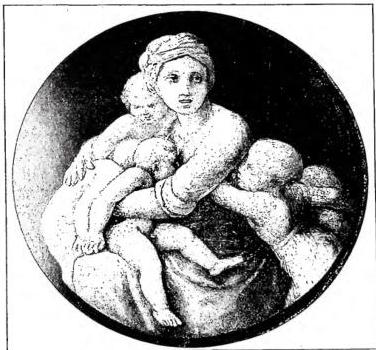
Miramion, the Daughters of the Providence of God, etc. But directly he was the great initiator of the Compagnies des dames de la Charité, with which the lay apostolate of women of the world in the service of charity was called back to life. In France, before St. Vincent, there existed in the city and in the countryside the so-called Charités, or charitable institutions governed by local administrations, and the Confréries de charité, true mutual aid societies for those who were part of them. Not a few, however, had disappeared during the wars of religion, and it is to St. Vincent that we owe their reconstruction and restoration to honor.
Many ladies of the aristocracy took part in them, and soon they spread throughout all the provincial cities of France (cf. P. Coste, S. Vincent de Paul et les dames de la Charité, Paris 1917). Thanks to the tireless and ingenious activity of this man, the provisions of public assistance for the repression of mendicity had better results than elsewhere. In 1653 he founded in Paris the Hospice du St Nom de Jésus (today Hospice des Incurables) for the elderly; three years later it was the turn of the Hôpital Général to receive the beggars of Paris and put them to work. For this purpose Louis XIV assigned an immense complex of buildings, the largest then known, which received up to 10,000 poor and foundlings. The example of the capital was imitated in the provincial cities, where, by order of the king, general hospitals were to arise. For such foundations Louis XIV appealed to the cooperation of the clergy, which did not fail him, especially among the Jesuits. Father Chaurand in 30 years of apostolate founded no fewer than 123 hospitals; Father Guevarre, who succeeded him after his death, worked with success in Gascony, Languedoc and Piedmont until his death, which occurred in Turin in 1724 (cf. Ch. Joret, Le p. Guevarre et la fondation des bureaux de charité du XVIIe siècle, Toulouse 1899).
The general hospitals destined to suppress mendicity at first aroused enthusiasm; slowly, however, they shifted begging without destroying it. In time they returned to the natural function of simple shelters for the genuinely poor, the sick, orphans, and women. The shelters thus conceived during the 16th-18th centuries multiplied everywhere. In France there also spread that kind of assistance practiced in the Hôtel-Dieu, where a kind of assistance more generous than wise was exercised, open to all kinds of misfortunes and kinds of unfortunate persons (the poor, the sick, orphans, etc.). Through that of Paris alone, as many as 25,000 persons passed in a year. The same criterion prevailed, for example, in the Hospital of St. James in Augusta at Rome, or at St. Eligius of Naples. In others, however, the exclusion of certain categories of the needy was frequent, for whom special houses were destined. Thus, to cite the example of what happens in Italy, foreigners in Rome are housed in the national hospitals. Piazza (Opere pie di Roma, Rome 1679) counted 22 of them, of which 7 were later than the 15th century. For pilgrims St. Philip Neri founded the hospital of the Trinity in Rome and a confraternity to take care of it; an institution analogous to that of Naples, where the statutes recommend to the members the greatest humanity in welcoming wayfarers.
For orphans the Somaschi have worked since their foundation, and foundations destined for the moral preservation of the child are numerous in Rome (17), in Naples (22), in Pavia, Milan, Bologna, Florence, etc. No less importance is attached to the rehabilitation of prostitutes, gathered in rehabilitation shelters in Florence, Naples, Palermo, Rome, etc. The discussion could be lengthened for other classes of the handicapped, such as the insane, the demented, epileptics, the deaf and mute, the blind, prisoners, etc. For some kinds of unfortunate persons the effort of charity also tended toward the adaptation of systems of care, the fruit of the most advanced technique and of experience.
On the whole it can be said that all these works prospered until the French Revolution; many even managed to survive the harsh trial of the end of the 18th century. They had been consolidating thanks to numerous bequests, legacies, donations, etc. (besides the sporadic subsidies of daily contributions), which had as a consequence the increase of mortmain, against which there was an outcry in many European states of the 18th century. Hence the tendency to unblock the real estate of pious foundations, especially hospital ones, in order to convert it into income securities guaranteed by the State.
The states, now strong in their absolute power proclaimed by Enlightenment theories, believed themselves authorized to dispose of such goods in order to direct them to other purposes or to suppress them entirely. In France this operation was carried out on a grand scale by the Revolution of '89, but the consequences were disastrous: with the decline of all the great works of charity, the poor were thrown back onto the street. The revolutionary government, which had even outlawed private charity itself, judged humiliating for humanity, had to reverse course and appeal to the gentle and active charity of the nuns, while awaiting the moment when Napoleon, by reviving the teaching congregations, would implicitly disavow the destructive work of ten years and have recourse to the Church to prevent the poor from dying. Nevertheless the backlash suffered by the works of charity was very serious, all the more so because the laws to secularize public assistance made the rounds of the European states. And since in their practical application the secular laws were inadequate to the need, a new vast field reopened to Catholic charity in the 19th century. Many religious congregations arose again and associations of laypeople multiplied, some of which still prosper today. Among the many, let us recall the one founded in Paris in 1801 through the work of some students of medicine and law under the direction of the former Jesuit Delpuits, the Congregation of the Madonna under the title Auxilium Christianorum, to which the paternity of the modern achievements of French charity is today claimed (cf. G. de Grandmaison, La Congrégation, Paris 1902). Once this had disappeared in the Revolution of 1830, Providence raised up a second, whose developments no one at the time could have foreseen: the Conférence de charité, destined to become the worldwide work of the Conferences of St. Vincent de Paul, through the work especially of Frédéric Ozanam. Founded in 1833 in the offices of the Tribune Catholique in Paris, it today numbers more than 15,000 conferences scattered across 80 nations with more than 210,000 active members, intent on relieving all social miseries without distinction of creed and without investigations humiliating for those assisted (cf. the commemorative volume: Ozanam, Le Livre du Centenaire, Paris 1913). In Italy there arose shortly afterward, likewise with the same purpose, the Women's Society of St. Vincent de Paul, founded in 1856 by Celestina Scarabelli in Bologna.
The initiatives of the Catholic laity multiplied and were perfected little by little in the following decades, and thus there arose, in an endless series, works of assistance for newborns, mothers of families, orphans, abandoned children, homeless women, for the various categories of employees, such as domestic servants, railway workers, etc., on which statistics and information are found in the Annuaire de l'Office central des oeuvres charitables, founded in Paris in 1890 by Léon Lefebvre, and especially in the Manuel des Oeuvres, Institutions religieuses et charitables de Paris et des départements (Paris 1912). Alongside the lay initiatives there developed those properly religious, likewise numerous. It suffices to cite here the principal ones: the Sisters of St. Joseph of Cluny (1807) founded by Anne-Marie Javouhey, for the care of children and the sick; the Sisters of the Good Shepherd, of St. Euphrasia Pelletier (1835) for the rehabilitation of fallen women, girls in danger and female prisoners. Unique in their kind, the Little Sisters of the Poor for the assistance of abandoned old people of both sexes, founded in 1840 by Jeanne Jugan at St-Servan in Brittany. Their daily heroism was immortalized by the book of Maxime du Camp: La charité privée à Paris, just as L. Arnould in Ames en prison extolled the work of the Sisters of Wisdom for the deaf-mute. To the consumptives were consecrated the Sisters of Mary Help of Christians (1854), to the incurably ill the Ladies of Calvary, to the blind the Blind Sisters of St. Paul (1852), etc. At the end of the last century in France, including the colonies, there were 214,037 members of religious communities, of whom 183,001 were women: two thirds, that is about 120,000, were dedicated to charitable activity. Italy did not lag behind in this rebirth of charity, thanks above all to the tireless work of two saints, which has had resonances throughout the world: Cottolengo and Don Bosco. The former, in 1828, gave beginning to that admirable institution of the Little House of Divine Providence in Turin which today shelters about 8,000 handicapped people of every kind, and founded 14 religious associations for charitable purposes (cf. Fr. P. Gastaldi, I prodigi della carità cristiana... Turin 1910); and Don Bosco ensured the perpetuity of his many institutions and provisions in favor of poor youth through the foundation of the Pious Salesian Society (1859) and the Daughters of Mary Help of Christians (1874). Charity had also inspired Blessed Maddalena di Canossa, who in 1808 founded in Verona the Daughters of Charity, commonly called Canossians, and Blessed Bartolomea Capitanio, who in 1813 founded the Sisters of Charity. At the same time other works of the kind arose: at Domodossola in 1828 the Institute of Charity of Antonio Rosmini; at Chiavari in 1829 the Daughters of Mary of Bishop Gianelli of Bobbio; at Verona in 1830 the Society of Mary of Fr. Antonio Provolo; in 1840 at Brescia the Handmaids of Charity of Paolina di Rosa. Particular mention is due to the Marquise Giulia Falletti di Barolo, mother of the poor, the sick and abandoned children, for whose education she founded the Daughters of St. Anne of Providence in Turin in 1834, and the Association of the Daughters of St. Anne founded at Piacenza in 1866 by Rosa Gattorno. Still popular are the names of Fr. Ludovico da Casoria, the friend of the lazzaroni of Naples, founder of the Gray Friars and of the Elizabethans; of the bishop of Piacenza Giovanni B. Scalabrini, deserving of praise for assistance to Italian emigrants; and among recent ones, of Fr. Luigi Guanella, of the lawyer Bartolo Longo, of Fr. Luigi Orione.
In the United States of America the charitable activity of Catholics has developed notably in the last fifty years; but the promising beginnings go back a century, especially in the cities of Philadelphia, Baltimore, Boston and then Chicago, New York, St. Louis, Detroit, etc., when various local religious congregations for charitable purposes also arose. Today charity there has reached an excellent degree of organization thanks to the National Conference of Catholic Charities, which since 1910 has become a permanent institution with its seat in Washington. In 1922 the Directory of catholic charities in the United States was then published for the first time. But it was in Germany, thanks to this technical organization, that the works of charity had reached an unsuspected development, before the advent of Nazism smothered it.
Founded in 1897 through the work especially of the prelate Lorenz Wertmann, who directed it until his death (1921), the Deutsche Caritasverband, recognized by the German episcopate as the organ of the charitable activity of Catholics, had as its purpose the study of all the currents of the care of the public good in order to increase, through the most varied manifestations, the love of Catholics for the good of their neighbor. Up to 1931 it counted more than 600,000 adherents, had a central organ at Freiburg, which had at its disposal a rich specialized library with 40,000 volumes and numerous journals. Among its tasks was the study of all the currents directed to the good of one's neighbor, publications of works, of periodical journals, drafting of programs of common work; questions of interest to charity and public assistance in Germany were discussed, means were collected to succor the needy, and the living forces in the service of charity were trained, which in 1921 amounted to more than 60,000 working in more than 2,000 institutes.
The list of the other forces and means at work in the world, where the Church can labor unobstructed by adverse laws, would be very long. Suffice it to say that in 1930 Catholic charity worldwide could provide these figures: for private assistance, 29,100 nursing homes with 1,420,000 beds and 260,000 units of assisting and directing personnel; for semipublic assistance: 96,300 various organizations with 2,400,000 daily visits; for public assistance: 140,000 institutions. In all, 150,000 nuns, 32,000 lay religious, 120,000 directors, and 6,650,000 persons are consecrated to the service of charity, dedicated to the voluntary service of the needy (v. also BENEDICT XV and PONTIFICAL COMMISSION FOR ASSISTANCE).
Bibliography55 works
Mario Scaduto
III. ICONOGRAPHY OF CHARITY
Prudentius in the Psychomachia imagined her in the act of fighting against Avarice. The miniaturists of the 10th century represented her as a warrior, with helmet and cuirass, and so did painters and sculptors from beyond the Alps between the 11th and 12th centuries (facades of the churches of Amiens, Paris, Aulnay, Reims). In
In France, it was also depicted as an angel. Its representations in Germanic territory are scarce (it receives a crown in the "Hortus deliciarum" of Herrad of Landsberg of the 10th century; and it appears as a young woman in a relief of the Strasbourg cathedral of the 13th century). Even in England its representation is not frequent (illustrations of the Psychomachia and a 12th-century ivory binding in the British Museum, London).
While in France in the 13th century the representation of c. in a peaceful attitude is still rare, in Italy it became common from the 13th century and often had as attributes the heart, the horn of plenty, wings and the crown (holy water font of S. Giovanni Fuorcivitas in Pistoia, tabernacle of Orsanmichele by Orcagna, miniatures).
Particularly worthy of mention is the image of c. painted by Giotto (Scrovegni Chapel, Padua): it is dressed in red, and symbolizes human love in dispensing coins and the products of the earth and divine love in offering a heart to God.
Very frequent is its representation in tombs and funerary monuments of the 14th century (St. Peter Martyr in S. Eustorgio in Milan, St. Augustine in S. Pietro in Pavia, Angevin tombs in Naples, Scaliger tombs in Verona) and of the 15th (Monuments of John XXIII, Sixtus IV and Innocent VIII), in cassoni and in frescoes (Viterbo, Padua).
Nor were there lacking beyond the Alps images of c. in the figure of a man giving alms (Dürer) or pouring a drink for a beggar (Holbein, Basel museum).
The c. defined by Raphael in the predella of the Deposition (Vatican Picture Gallery), as a young woman who welcomes some children with a loving gesture, is the figuration later most commonly followed in all times by painters and sculptors.
In the 17th century the representations of c. became ever more widespread and were frequent especially in funerary monuments (of Urban VIII, Alexander VII, [Rome, St. Peter's], work of G. L. Bernini). The subsequent eras added nothing to the traditional iconography (Lamoricière monument in Nantes and Demidoff monument by Bartolini in Florence). - Vedr Tav. XLIX.
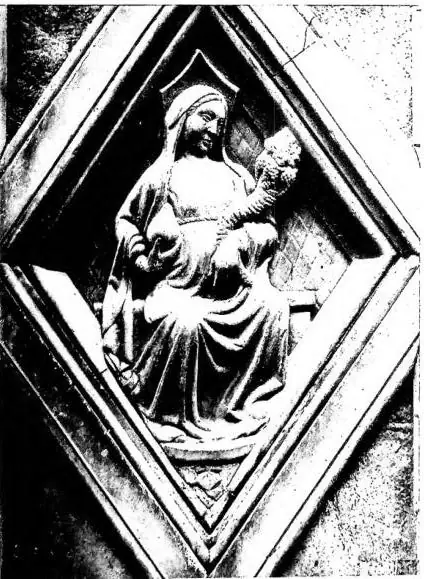
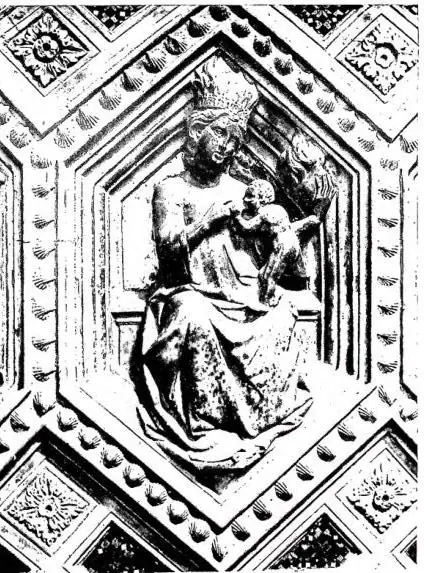
Bibliography2 works
Fabia Borroni