MODERN VERSIONS. - a) Italian: Poesie bibliche tradotte da celebri italiani, 3 vols., Milano 1832-34; C. Negroni, prefazione a La B. volgare, Bologna 1882; S. Minocchi, Italienes (Versions de la Bible), in DB, III, cols. 1012-38; A. Abbruzzese, Il Cantico dei Cantici in alcune paraffrasi poetiche italiane, Trani 1904; E. Teza, Le biblie italiane del Malermi e del Diodati racconciate nel Settecento, Padova 1905; M. Betts, Life of Giovanni Diodati, Genese theologian, translator of the Italian Bible 1907, Londra 1905; C. Confalonieri, Mons. Martini e la sua versione della S. Scrittura, Firenze 1911; I. Carini, Traduzioni italiane della B., in F. Vigouroux and L. Bacocci, Manuale Biblica (Italian translation), I, S. Pier d'Arena 1912, pp. 255-313; G. Luzzi, La versione diodatina della B. e i suoi ritocchi, in Bilychnia, special issue 1916; G. Castoldi, Moderne versioni italiane della B., in Scuola cattolica, 1922, II, pp. 86-94; A. Vaccari, B. protestanti e B. cattolica, in La Civ. Catt., 1923, I, pp. 343-51; U. Cassuto, La tradizione gindco-italiana per la traduzione della B., in Atti del I Congresso nazionale delle tradizioni popolari, Firenze 1930. - b) French: S. Berger, La Bible française au Moyen-âge, Parigi 1884; E. Mangenot, Françaises (Versions de la Bible), in DB, II, cols. 3346-73. - c) German: W. Walther, Die deutsche Bibelübersetzung des Mittelalters, 3 vols., Braunschweig 1889-92; id., Luthers deutsche Bibel, Berlino 1917; J. Gassar, Vierhundert Jahre Zwingli-Bibel, Zurigo 1922; F. Schulze, Deutsche Bibeln. Vom ältesten Bibeldruck bis zur Lutherbibel, Lipsia 1934; A. Bea, Neue Bibelübersetzungen aus dem Uitsch, in Biblica, 20 (1939), pp. 73-81. - d) English: H. Pope, The Origin of the Douay Bible, in The Dublin Review, 147 (1910), II, pp. 97-118; A. W. Pollard, Records of the English Bible, Documents Relating to... the Bible in English 1525-1617, Oxford 1911; W. F. Moulton, The History of the English Bible, Londra 1911; B. F. Westcott, A General View of the History of the English Bible, there-New York 1916; J. Keating, The Westminster Version of the Sacred Scriptures, in The Catholic World, 98 (1919), pp. 54-66; E. J. Goodspeed, The Making of the English N. T., Chicago 1925; J. Baikie, The English Bible and its Story, Londra 1928; C. M. Chavasse, The English Bible in English History, there 1938; C. J. Callan, Some English Idioms in the English Bible, New York 1940.
READING OF THE B. — J. B. Malou, La lecture de la Ste Bible en langue vulgaire, 2 vols., Lovanio 1846; E. Ranke, Das kirchliche Pericopentystem, Berlino 1847; F. Fabi Montani, La lettura della S. B. in volgare, Roma 1857; S. Beissel, Geschichte der Evangelienbücher in der ersten Hälfte des Mittelalters, Friburgo in Br. 1906; id., Entstehung der Perikopen des römischen Messbuches, ibid. 1907; N. Peters, Kirche und Bibellenen, Paderborn 1908; A. Harnack, Über den privaten Gebrauch der heiligen Schriften in der alten Kirche, Lipsia 1912; A. Rahlfs, Die alttestamentlichen Lektionen der griechischen Kirche, Berlino 1915; B. D. Gorce, La lectio divina e des origines du cénobitisme à il Benoît et Cassiodore, I, Parigi 1925; M. M. Förster, Abendländische Grahelaßphase für Psaltervulstagung, Heidelberg 1929; A. Vaccari, La lettura della B. alla vigilia della Riforma, in La Civ. Catt., 1933, III, 313-25; 420-40; 437, II, 231-43; H. Vollmer, Die Bibel im deutschen Kulturleben, Salisburgo 1938; H. Rost, Die Bibel im Mittelalter, Augusta 1939.
Giuseppe Ricciotti
XI. THE BIBLE IN THE DIVINE OFFICE
From the earliest Christian times, the Bible, together with the Eucharistic sacrifice, constituted the central part of the liturgy. It provided the Church with the means of instructing the faithful and with words of praise to address to God. The historians of the liturgy agree in observing that the predominant place occupied by the Bible in the liturgy in general and in the Divine Office in particular is due to the fact that both derive in part from the use of the prayers of the Temple and from Jewish synagogue practice.In addition to sacrifices, Jewish public prayer included the reading of the Bible, commanded in Deut. 21, 9 ff. and solemnly applied in Eid. 8, 2 ff. It seems that the practice began with reading each Saturday the corresponding verses of Lev. 23, as is evident from the Miñāh 4, and that subsequently a passage from the Pentateuch was assigned to each Saturday; divided into 167 sections, it was read over a period of three years (H. Thackeray, The Septuagint and Jewish Worship, Oxford 1921, p. 43 ff.). A concluding prophetic passage (Hebr. Haphifrāh) was added after the Pentateuch, in the form of a reading or a song (op. cit. p. 45). Another biblical passage is the so-called Sēma, a profession of monotheistic faith, composed of Deut. 6, 4-9; 11, 13, 21; Num. 15, 37-41. It takes its name from the initial words Sēma Tisrā'el and, as a liturgical formula, dates at least from the time of Christ and probably from earlier (W. O. E. Oesterley, The Jewish Background of the Christian Liturgy, Oxford 1925, p. 44 ff.). Another brief biblical text that soon became liturgical (2nd cent. B.C.7) is the so-called Qēdūfāh, that is, the Trisagion of Is. 6, 3, with the addition of Ez. 3, 12 and Ps. 146, 10. The psalms occupied an important place in the liturgy of the Temple and in synagogue worship. Some of them (145-50) were recited daily (Talmud, Sōphērim 17, 11), while others were assigned to the days of the week in the following order (numbers according to the Vulgate): 23, 47, 81, 93, 80, 92, 91, bearing the title: Psalm, a song, for the sabbath (Miñāh, Tāmīh VII, 4). Other psalms were distributed according to the feasts: 46 for New Year; 76 and 117, 25 to the end, for the Feast of Tabernacles; and 103 for the new moon, etc. (Talmud, Sōphērim 17, 11; 18, 2; 19, 2; etc.; cf. S. Bäumner, Geschichte des Breviers, Fribourg in Br. 1895, p. 36 ff.). However limited our knowledge of Christian worship in the earliest period of the Church may be, it is nevertheless known that the Apostles did not entirely abandon Jewish practices, but merely completed them with specifically Christian worship: the Eucharist (Lc. 24, 52 ff.; Act. 2, 46; 3, 1). It is not impossible—in fact, it is probable—that the formal part of apostolic worship, including the Eucharistic worship that was not celebrated in the Temple, used the Old Testament from the beginning as a source of prayer forms. One may suppose that the Apostles, repeating in the Eucharist itself Christ’s Last Supper, also recited, for example, the so-called great Hallel (Ps. 115-117). The use of psalms, hymns, and songs, among which the biblical Psalms may also have been included, is recommended by s. Paul (Eph. 5, 19; Col. 3, 16).
It must also be borne in mind that a large part of the apostolic preaching developed in synagogue gatherings, where, like Christ (Lc. 4, 16 ff.), the Apostles drew material for Christian instruction from readings of the Law and the prophets » (Act. 13, 15; 15, 21). Clearly, they continued to follow the same method even after the believers had separated from the synagogue. Thus the Bible (for Christians, the New Testament as well as the Old Testament) came to constitute the principal part of Christian worship. Justin, one of the earliest authors to describe the liturgy, expressly mentions the reading of the « memoirs of the Apostles » and of the « writings of the prophets » (Apol. I, 67: PL 6, 429). Tertullian, in addition to mentioning biblical readings in the liturgy, adds that of the singing of psalms: prout Scripturae leguntur aut psalmi canuntur (De An., 9). From this period onward, witnesses to the use of the Bible in the liturgy multiply: the homilies of the Fathers indicate the biblical readings and songs that had entered the liturgy.
With the rise and development of monasticism, forms of non-Eucharistic worship multiplied throughout the day, and thus the Bible gained an even more extensive and intensive penetration into the monastic liturgy, which was longer than the cathedral liturgy. According to the testimony of Egeria (P. Geyer, Itinera Hierosolym.: CSEL, 39, p. 71 ff.), the singing of psalms first underwent great development: the monazontes and the parthenae sang them at night vigils not only on Sundays but daily. The readings from the other biblical books received little prominence, and only on Sunday did the bishop read a single Gospel passage, although it could be followed by commentaries from more than one of the priests present (op. cit., p. 74). Both on Mount Sinai and in Egypt, the practice was introduced of reciting the entire psalter (s. Benedict, Regula Monachorum, 18), a practice imitated at Milan on the eve of certain feasts (M. Magistretti, Beroldus sive Ecclesiae Ambrosianae Mediol. Kalendarium, Milan 1894, p. 57 ff.).
The Nestorian monks went so far as to recite it twice in twenty-four hours: once at the night vigils and once during the hours of the day. Gradually, however, more limited forms were reached, in the Pachomian system, which initially established 12 psalms during the day, 12 in the evening, and 12 at night; s. Benedict (Reg., 9, 18) set the number of psalms at 12 for the night vigils, 6 for Lauds, 3 for all the minor hours, and 4 for Vespers, thereby approaching the more moderate forms of the Divine Office followed by the secular clergy. Outside Jerusalem, the 12 readings of the Easter vigil provided a precedent that became daily practice and was often extensively developed in the monastic centers of Syria and Egypt with regard to biblical readings in the Office. After each series of psalms, an entire book of Sacred Scripture was often read (the abbot Giovanni and Sofronia at Sinai read one of the canonical letters of s. James, s. Peter, or s. John after every 50 psalms). Gradually, however, shorter forms were adopted again, especially because of the lectio continua (v. appresso), while still ensuring that all Scripture was read over the course of the year; and finally extremely brief forms were adopted when the Breviarium Romanae Curiae spread through the work of the Friars Minor (v. BREVIARIO).
When the cycle of readings for the Mass was established, the biblical readings of the Office were adapted to its order. During the Easter season, for example, the more zealous read the New Testament at the night Office (Cassian, De Coenobiorum instit., II, 6: PL 49, 90), just as it was read at Mass (s. John Chrysostom, In principio Actor., 4,5-6: PG 51, 105; s. Augustine, Sermo 315, 1, 1: PL 38, 1426).
Even today this concordance can be seen not only during the Easter season (although in a more abbreviated form), but also on other days of the year, for example, on the Sunday before Lent, and always on Sundays and feast days with regard to the Gospel reading. In general, however, the principle of the lectio continua took shape and prevailed, whereby the whole Bible, with the exception of the psalms, was read in passages over the course of the entire annual cycle, just as the psalter was recited in full over the weekly cycle. The Bible, thus divided into pericopes, replaced the so-called lectionaries.
With the emergence of the breviaries, the order of the biblical readings remained, but often only their beginning was and still is read, so that today the whole of Scripture is read in the canonical Office only nominally.
The great importance attributed by the Church to the reading of Sacred Scripture in the Office has a profound rationale. The Bible is for the Church the written Word, just as Christ is the “Word who appeared among men,” and just as the Eucharist and the Sacraments are the presence of the Word in the Church (s. Leone Magno, Serm. 52, 1: PL 54, 314: « religiosis et piis cordibus non aliud sit audisse quae lecta sunt quam vidisse quae gesta sunt »).
Scripture, especially in monasticism, is interpreted as the true Christ, and therefore reading the Bible is, in some way, receiving the mystery of the Body and Blood of Christ (Evagrio Pontico, Speculum Monachorum, nn. 118-20: ed. H. Gressmann, Mönchspiegel [*Texte u. Untersuch., 39], Lipsia 1913, p. 163; s. Girolamo, In Eccles.*, 2 e 3: PL 23, 1033 e 1039: « hoc solum habemus in praesenti saeculo bonum, si vescamur carne eius et cruore potemur, non solum in mysterio [Eucharistia] sed etiam in Scripturarum lectione »).
In this sense cf. D. Gorce, La « lectio divina », I: St Jérôme et la lecture sacrée, Parigi 1925, p. 336 sgg.; O. Casel, Mysteriengegenwort, in Jahrbuch f. Liturgiemwissenschaft, 8 (1928), p. 208 sgg.
Salvatore Marsili
XII. THE B. IN ART. — In the B., the divine book par excellence, artists have always found, and will always find, an inexhaustible source of inspiration.
The development of biblical iconography, from the earliest representations in the catacombs and in the codices of the early Middle Ages to the great works of the foremost geniuses of art, from Michelangelo to Raffaello, Dürer, Rubens, Rembrandt, and Tiepolo, traces the very path followed by art through centuries upon centuries of figurative civilization.
1. Biblical scenes. — That the sacred texts of both the Old and the New Testament should immediately have presented themselves as the principal source of inspiration for Christian artistic creations cannot cause surprise. Among the ways of making use of them, however, the new art had to choose between the purely illustrative and the symbolic or typological. Having matured in milieus long accustomed to seeing the history of the life and death of simple mortals reflected in the legends of gods and goddesses, it decisively chose the symbolic mode. The new events, introduced into the symbolic decorative whole inherited from the classical world, would serve as paradigms of the new faith. Although certain chronological uncertainties still do not always permit a rigorous classification of the surviving figurative material, it may be said that in the painting of the catacombs, soon followed by the sculpture of sarcophagi and even by the decoration of places of worship, this was, from the beginning, despite the diversity of nuances and aspects, the principal aim: to document through the deeds of the Old and New Testament the certainty of eternal salvation for the faithful follower of Christ.
Alongside the primitive themes of Noah in the ark, Daniel among the lions, and Jonah saved, in which the concept of deliverance through divine intervention predominates, representations were created such as Moses striking the rock, the Baptism of Christ or baptism in general, the resurrection of Lazarus, and so forth. Beside the sacrifice of Abraham, the three youths in the furnace, and the story of Susanna, the first prophecies soon appear, as does the classical scene, with its clearly Christological meaning, of the Epiphany, as well as the conversation with the Samaritan woman. In the attic of a hypogeum beneath S. Sebastiano, the parable of the Good Shepherd is flanked by the miraculous feeding of the crowds in the desert and the healing of the demoniac near the Sea of Tiberias. Even before the middle of the third century, the so-called Christian chapel of Dura Europeo gathers around the Good Shepherd the scenes of Adam and Eve, the pious women at the tomb, the paralytic, Peter saved from the waves, the Samaritan woman, and David and Goliath: a transparent series of themes alluding to death to sin in the waters of Baptism on Easter Day. Even when, with the end of the third and in the first half of the fourth century, the biblical repertoire reached its full development, the principal orientation remained firm: namely, to illustrate, through eclectic groups of biblical events, the work of salvation prepared among the chosen people, accomplished by Christ working on earth, and continued by means instituted by Him within His Church. The scenes relating to the creation and sustenance of man, the offering of Cain and Abel, the blessings of the patriarchs, Moses loosening his sandals and receiving the Law, the rain of manna and the fall of the quails, Job, Tobias with the fish, the three youths before Nabuchodonosor, Habakkuk with food for Daniel, Daniel with the serpent of the Babylonians, Elijah taken up into heaven, the vision of Ezekiel, Balaam with the ass, enlarge the cycle of the Old Testament. With the Angel’s announcement, the Magi viewing the star, the Nativity, and the Sermon on the Mount, the Christological cycle develops and is completed with the first scenes relating to the Passion, such as the entry into Jerusalem and Jesus before Pilate. Christ’s miracles extend to the raising of Jairus’s daughter; the healings of the blind man, the paralytics, the possessed man, the leper, the woman with the hemorrhage, the daughter of the Canaanite woman, and the crippled woman; and a prominent place is occupied, not without special intentions, by the blessing of the loaves and fishes and the miracle at Cana. To Peter, head of the Church, now intimately associated with the figure of the
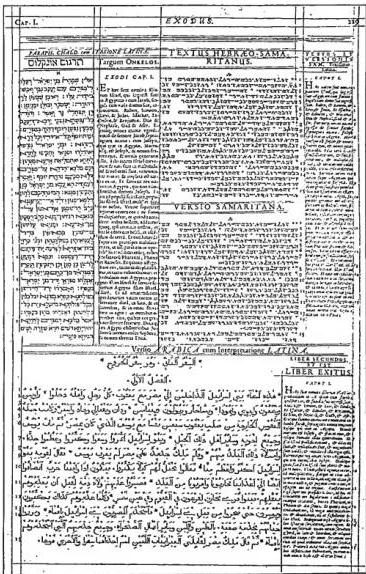
BIBLE — Walton’s Polyglot, London 1637. Ex. 1:1–15. Rome, copy of the Pontifical Biblical Institute.
To the Master, with a manifest tendency to form a cycle, were reserved the prediction of the denial, the so-called cathedra Petri, his arrest, and the miracle of the spring, the latter two events probably drawn from apocryphal sources.
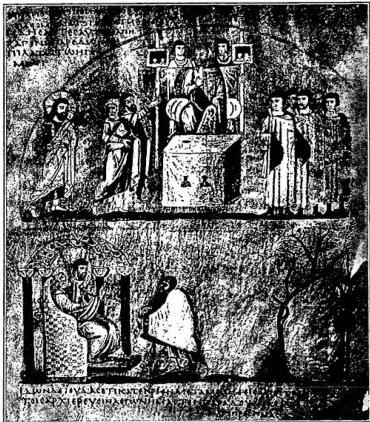
Such broad and frequent use of biblical scenes in the most important branches of art could not fail to have repercussions on all genres of the “minor arts.” These scenes acquire a particular character when employed as mere figurative illustrations of manuscripts of the sacred books (the Quedlinburg Italia, the Vienna Genesis, the B. Cottoniana, the Joshua Roll, the Rabbùlà Codex, the Rossano Codex, that of Sinope, etc.), in which, naturally, art seeks a realistic representation, and therefore one that is also more extensive and free of any symbolism, of the events narrated. It is very probable that the miniatures were not without influence, at least formally, on the biblical cycles adorning ancient houses of worship, although these did not renounce typological aims and examples of monumental creations composed on the site itself are not lacking. Thus, for example, the scenes on the triumphal arch of S. Ma-
Maria Maggiore in Rome and those of Abel, Abraham, and Melchizedek at S. Vitale in Ravenna clearly go beyond narrative aims. Even the compositions of the wooden doors seem to obey certain programmatic laws. It was common on the walls of the central nave to juxtapose a cycle from the Old Testament with one from the New Testament, both provided with legends or tituli; this custom would lead to the “concordances” between the two Testaments.
Luciano De Bruyne
2) Codices and editions. — The oldest codices of the Old and New Testaments have as their essential ornament the beauty of the script and the preciousness of the material. Nevertheless, the great decorative cycles that appear in the churches of Rome and Milan as early as the fourth century lead us to suppose that illustrated codices (v. MINIATURA) of the Old and New Testaments also existed in Italy before that period; to that period, in any event, the B. of Quedlinburg must be assigned, the work of an Italian master from northern Italy who does not seem to have depended, for its illustrations, on earlier exemplars. The surviving leaves of the B. of Cotton, now in the British Museum in London, belong instead to the sixth century and to a clearly Byzantine pictorial current. Other biblical representations, such as those of the Genesis (v.) of Sinope, Book (v.) of the monk Rabbùlà, and the purple codex of Rossano, also belong to the various gradations of Oriental art between the fifth and sixth centuries.
With the seventh century, it would seem that all activity in this field died out in Italy, whereas beyond the Alps, especially in the British Isles, codices with biblical representations of great interest were produced, such as the B. known as the Amiatina (Florence, Laurentian Library, Cod. Am. 1), which Ceolfrid, abbot of Yarrow in England, presented to the Vatican basilica. Of very particular interest is the complex group of illuminated Bibles produced in numerous centres in more or less direct relation to the imperial court of the Carolingians (v. ARTE), all reflecting, to varying degrees, the elements of the renewed classical taste. At that time, between the eighth and ninth centuries, codices in Italy had as their exclusive decoration ornamented initials, some echoing Oriental forms, others those in use in transalpine circles.
During the Romanesque period, the production of illuminated codices became increasingly active throughout Europe, assuming different aspects in the various centres according to the development of the local schools of painting. This did not prevent antiquated forms from continuing to be repeated in many codices: thus in a B. of the charterhouse of Calci and in another very beautiful one preserved at Perugia (Municipal Library, cod. L. 59), a work of the twelfth century. At Montecassino, during the time of Abbot Desiderius (1058–87), the same characteristics of contemporary painting also asserted themselves in the miniatures of biblical texts (v. ARTE).
During the Romanesque period, certain workshops producing illuminated codices must have been very active at the monasteries of Rome, Farfa, and Subiaco, because there is a notable group of Bibles whose miniatures reflect the manner of contemporary Roman painting. Thus the Bible of the monastery of S. Valentino near Amelia (Parma, Palatine Library, cod. 386), that of the cathedral of Todi (Vatican Library, cod. Vat. lat. 10405), and another originating from S. Cecilia in Traste-
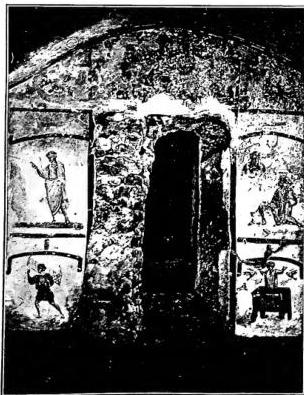
BIBBIA - Moses striking the rock, the Paralytic, the Canaanite woman, Noah in the ark (4th century) - Rome, cemetery of SS. Marcellino and Pietro.
The one from the end of the 11th century (there, Cod. Barb. lat. 587) and another originating from the Pantheon (there, Cod. Vat. lat. 12.958). These Bibles, of the largest format and therefore called Atlantic Bibles, resemble one another also in their script and frequent illustrations. Also belonging to the Roman group and produced between the 11th and 12th centuries is the Bible that Enrico IV (1111–34) donated to the Abbey of Hirsau in Germany (Munich, Staatsbibl., Cod. 13001). The Vatican Library also possesses an Atlantic Bible originating from Farfa and decorated by a Catalan illuminator (Cod. Vat. lat. 5629); others produced in the monastery of Grottaferrata repeat the features of Byzantine codices. Among the Tuscan Bibles that reflect the various currents of the pictorial taste of that region, particularly interesting are one preserved in the municipality of Montalcino, perhaps originating from S. Antimo, whose initials also relate to the French Romanesque style, and one in the Bibl. Cap. of Lucca (Cod. 1), which has features similar to those of the Pisan school of painting of the 13th century. During the 1200s there are no Bibles of certainly Roman provenance, but the one called the Corradino Bible, formerly in the Spitzer collection, and especially the other in the Bibl. Com. of Catania, have Cavallinian features. Among the Bibles produced between the 13th and 14th centuries, mention should also be made of the Vatican Bible (Cod. Vat. lat. 36), almost certainly illuminated in Rome, and another in the library of the rr. pp. Franciscans of Freiburg.
During the period of Gothic art, the production of illuminated Bibles intensified, but with few changes in the method of illustration.
Especially beautiful, in any case, is the moralized Bible said to be that of S. Luigi, now divided between the British Museum (Harley 1526–27), the Bibl. Naz. of Paris (Cod. lat. 11560), Oxford (Bodl. 270 B.), and the Treasury of Toledo Cathedral. It is the work of a French illuminator of the late 13th century and contains no fewer than 5,000 miniatures, arranged within eight medallions per page, which set opposite one another the narrative and the allegorical meaning of the Bible verses.
Among the 14th-century Bibles, mention should be made of that in the Cantonale Library of Lausanne and the Bible of Venceslao, in German, which is in the library of Vienna (Cod. 2759–60). Very numerous are the Bibles splendidly illuminated during the 15th century. Mention should be made of the one in the Library of Geneva, the work of Guyart des Moulins, who also produced the other one in the Vatican (Barb. lat. 613), and—among all, surpassing even that of the duke of Urbino, produced by Attavante degli Attavanti and now likewise in the Vatican (Cod. Urb. lat. 1–2)—that of Borso d’Este (Modena, Bibl. Est.), illuminated between 1455 and 1462 by a group of Emilian illuminators who shared in the tradition of Pisanello and Mantegna.
Also worthy of mention is the Bible in 7 volumes in the archive at Lisbon, commissioned in Florence and produced by the illuminators of the Attavante Workshop. In the second half of the 1400s, the production throughout Europe of splendidly illuminated codices was prodigious, among them some extremely valuable Bibles, when the triumphant discovery of the art of printing took place. Between 1453 and 1455, Johann Gutenberg and his partner Johann Fust composed their first book at Mainz: a beautiful Bible, of which as many as 45 copies survive, 12 on parchment, almost all now in public collections. The copy in Paris (B. Mazarina), decorated with miniatures by Henricus Cremer, is generally cited. In 1460, from the same workshop