
and especially of St Cyprian (De Unitate Ecclesiae, cap. 8).
b) The episcopate is monarchical by the will of God. – This is asserted with particular insistence by St Ignatius, in various forms: he demands absolute obedience to the bishop (Eph., 2, 2; Trall., 13, 2; Philadelph., 3, 2; Smyrn., 8, 1), on the ground that this is the will of God (Eph., 5, 3; 6, 1; Trall., 2, 1; Smyrn., 9, 1). He therefore warns that nothing can be done in the Church without the bishop (Philadelph., 7, 1: «sine episcopo nihil faciatis»; cf. Magn., 4, 1; 6, 1; Trall., 2, 2; 7, 2; Smyrn., 8, 1; Polyc., 4, 1). The same concept is developed by Hegesippus (in Eusebius, Hist. eccl., IV, 11; PG 20, 350), by St Irenaeus (Adv. Haeres., III, 3, 1; IV, 26, 2; PG 7, 848 and 1055), by Tertullian (De praescriptione haereticorum, 32; PL 2, 52-53), above all by St Cyprian (Ep., 6, 7 ad Florentium Pappianum) and by the whole Western and Eastern tradition of the following centuries.
As to the constitution of the Church in the first century, while the Apostles were still living, there is still an ongoing controversy arising from the synonymy of the terms πρεσβύτεροι and ἐπίσκοποι (Acts 20, 17 and 28) and from the fact that monarchical episcopacy does not appear clearly constituted. Whatever solution one may accept, it remains beyond dispute, as has been said (v. ORDER, II), that the Apostles, before their death, laid down precise norms for the monarchical government of the Church and established that there should be everywhere successors to their apostolate.
II. POWERS AND DIGNITY OF BISHOPS
Bishops, as successors of the Apostles in the ordinary government of the Church, have received the three powers conferred by Christ upon the Apostolic College at the moment of His Ascension: ‘Go therefore and make disciples of all nations, baptizing them... and teaching them to observe all that I have commanded you’ (Mt. 28, 19-20), that is, the power to teach (magisterium), to sanctify (ministerium), and to govern (imperium). Bishops are ‘true teachers or masters’ (can. 1326), who perpetuate in time the divine-apostolic teaching: ‘He who hears you hears me’ (Lk. 10, 16).The power of sanctifying of bishops is referred to in the words of the Roman Pontifical: ‘It behooves the bishop to judge, consecrate, ordain, offer, baptize and confirm.’ To judge pertains chiefly to the penitential system of the ancient Church, in which the beginning (confession), the carrying out (satisfaction) and the conclusion (absolution) of the penance of the faithful were reserved to the bishop, who later, with the increase of pastoral duties, was assisted by priests as penitentiaries (v. PENANCE).
To consecrate relates to the consecrations of the baptismal font, the holy oils, and the churches, which, in principle, were and are reserved to bishops, even though, after the establishment of parishes, they have been, in part, granted to simple priests.
To ordain is the incommunicable function of the bishop (v. ORDER, III), that by which he is essentially distinguished from the priest. To offer, that is, the celebration of the Eucharist, was initially the function of the bishop (cf. St Justin, I Apol., 65). To baptize and to confirm were functions predominantly episcopal, especially confirmation, of which the bishop remains the ordinary minister. As to Baptism, although from the beginning deacons also exercised this function (Acts 8, 36-38), it was, however, the proper and ordinary office of the bishop (cf. St Ignatius, Smyrn., 8, 2), that is, of the summus sacerdos (Tertullian, De Baptismo, 17, who also recalls priests and deacons as subordinate ministers).
The power of jurisdiction (the sacred principate or imperium, to which every form of magisterium exercised in the Church by other members of the clergy is subject) is the most conspicuous power of bishops. ‘The Holy Spirit has placed bishops to rule the Church of God’ (Acts 20, 28: the text, even though in its historical context does not refer exclusively to bishops, has, however, been reserved to them by tradition); this power is today regulated by precise norms of canon law.
By reason of these spiritual powers the figure of the bishop appears, from the beginning of Christianity, invested with particular dignity and worthy of special reverence. For St Ignatius of Antioch the bishop is ‘the image of the Father’ (Trall., 3, 1), since he recalls the presence of the invisible Father of Jesus Christ’ (Magn., 3, 1). In the Didascalia of the Apostles, II, 26, 4-8 the bishop is praised as ‘the prince of the priests, the minister of the Word, the mediator, the teacher, the father before God, he who regenerates by Baptism, the head and guide... he who holds the place of God’. According to the unknown author of the Adversus aleatores (PL 4, 827) the bishop has received from God ‘apostolatus ducatum’, ‘vicariam Domini sedem’, ‘originem authentici apostolatus’ which ‘he bears in his superior’. In the judgment of St Hilary of Poitiers (Contra Constantium, 11: PL 10, 589) the bishop is Christ Himself. According to St Thomas Aquinas (IV Sent., d. 24, q. 2, a. 1, qc. 1) the bishop is the ‘sponsus Ecclesiae’ (cf. G. M. Monsabré, Esposizione del dogma cattolico: L'Ordine, XIV, trad. it., Torino 1929, pp. 148-185).
III. ERRORS AND DEFINITIONS
Aërius (v. 4th cent) was the first to deny any difference between the bishop and the priest: ‘For there is one order, the same honour and dignity, of both’ (St Epiphanius, Haeres., 75, 3: PG 42, 509). This error is reported by Marsilius of Padua (Denz-U., 498), by Wyclif and Huss (ibid., 675) and aggravated by Luther and Calvin (Instituti religionis christianae, IV, 4, 2): indeed the latter denied the episcopal and hierarchical constitution of the Church (cf. H. Dieckmann, De Ecclesia, I, Freiburg in Br. 1928, pp. 472-80). Modern Protestant liberals and rationalists hold that the episcopate is an institution of purely human origin, arising from the influence of various historical circumstances. On the various theories of Baur, Rothe, Hatch, Harnack, Sohm, Sabatier, cf. F. Prat, Evêques. Origine de l'episcopat, in DThC, V, cols. 1694-99. Notable for its apparent simplicity is the theory of Renan, according to which the ecclesiastical hierarchy would be the effect of a threefold abdication: of the primitive Christian community in favour of the presbyters, of the presbyters in favour of the bishops, of these in favour of the Pope (Les Evangiles, Paris 1877, p. 332).The Church has, on various occasions, expressed her mind concerning the origin and powers of bishops. The Council of Trent (sess. XXIII, cap. 4) declares: ‘The sacred Synod declares... that bishops, who have succeeded to the place of the Apostles, pertain especially to this hierarchical order’ (Denz-U., 960). The same concept is repeated by the Vatican Council (sess. IV, cap. 3: ibid., 1828). The decree Lamentabili (3 July 1907) condemns the modernist theory of an episcopate constituted for purely practical reasons, independently of its mission to continue the work of the Apostles (ibid., 2050). The anti-Modernist oath explicitly asserts that bishops are successors of the Apostles (ibid., 2147), while the Code of Canon Law affirms their divine institution (can. 329 § 1).
BISHOP
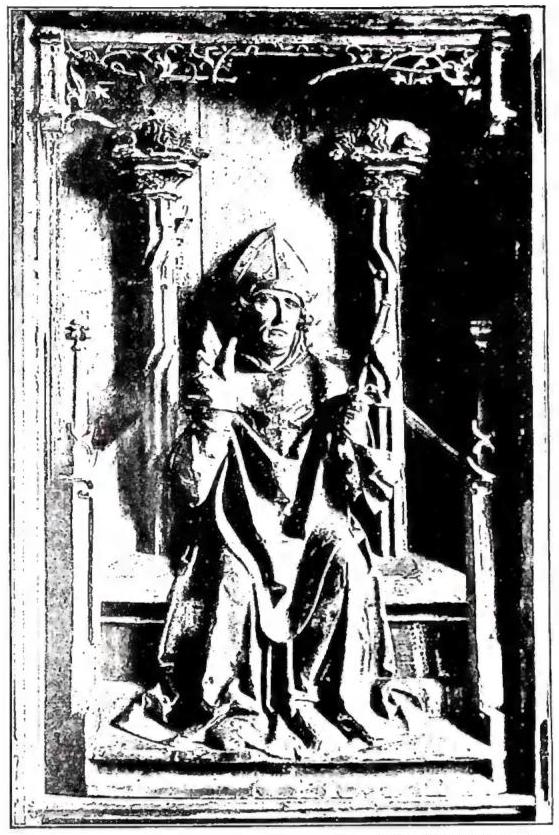
Bishop — V. seated on a throne. Wooden carved panel by Benedetto Dreyer (c. 1510–20) — Hannover, Museum.
Some of them were of Irish nationality (Scotti) and prepared the foundation of new episcopal sees.
Later, particularly after the 12th century, when entire regions fell or lapsed under Muslim rule, bishops of those Latin sees, who could neither govern nor reside there, were appointed to assist in the governance or exercise of episcopal functions (vicarii in pontificalibus) of the bishops of major Western dioceses, and even to replace them when they failed to reside. These were also called titular bishops or bishops in partibus infidelium. From the 16th century onwards, ancient sees long suppressed (e.g., in Africa) or occupied by schismatic or heretical bishops were also assigned as titular sees to such bishops, in order to prevent the abuse that was gaining ground of creating bishops in ecclesia Dei, i.e., without any determined title.
The title of suffragan, which according to canon law belongs to bishops subject to a metropolitan, was also usurped by such bishops, who today are instead called auxiliary bishops. Coadjutors, on the other hand, are even today those titular bishops who share in the governance of the diocese and are appointed by the Holy See with or without the right of succession.
According to the most recent norms, the following are required for election to the episcopate: legitimacy of birth, the state of celibacy, the age of at least thirty years, at least five years of priesthood, purity of morals, aptitude for governance, zeal, a degree or at least a license in theology or canon law, or proven expertise in sacred disciplines (CIC, can. 331). The consecration of a bishop is reserved to the Pope (can. 953), and no bishop may perform it without an apostolic mandate. The one elected is bound to receive it within three months of the appointment and to take possession of his diocese within four months. It is conferred during solemn Mass on Sundays and feast days of the Apostles, and as a rule with the assistance of two other bishops. The taking of possession, which marks the beginning of the exercise of jurisdiction over the diocese, does not involve any liturgical rite. The new bishop performs it personally or through a proxy, presenting the bull of appointment to the Chapter in the cathedral church and immediately taking his seat on the episcopal throne, receiving the homage of the members of the cathedral Chapter. When the one elected was consecrated in his episcopal see, he immediately took possession of his office; today he could take possession even before his consecration, provided he has made the profession of faith and the oath of obedience to the Pope.
In the exercise of the power of order, the bishop is bound to follow the liturgical prescriptions of his own rite. He may not confer sacred Orders except on his own subjects and with the required safeguards, nor may he administer Confirmation, nor exercise episcopal functions outside his own diocese unless requested to do so by the competent authority.
The bishop exercises his office with ordinary jurisdiction (v.) in both the internal and external forum, and sometimes also as a delegate of the Apostolic See. He is bound to observe ecclesiastical laws and may perform within his entire diocese whatever a parish priest may perform in his parish. He may, for a just cause, grant dispensations from the observance of general laws in cases where this is permitted by the laws themselves; conversely, he may not forbid what the laws themselves permit. By virtue of this ordinary authority, he exercises the following powers: a) legislative, by promulgating laws, without depending on others except in those cases where the canons require prior consultation or even the consent of the cathedral Chapter, and for which he convenes the diocesan synod (v.) according to canonical norms; b) judicial, by presiding over a tribunal as first instance judge in disputes among his subjects and in matrimonial cases, and also as second instance judge if he is a metropolitan, with the power to issue sentences; c) coercive against the disobedient, whether clergy or laity, imposing temporal penalties, censures, and other punishments. As teacher in his Church, the bishop preaches and regulates the preaching of his clergy, directs religious instruction especially of the young, supervises the press, particularly on matters of faith and morals, and reserves to his direct approval whatever his clergy intends to publish. He is responsible for the administration of ecclesiastical goods, decides on the establishment of ecclesiastical offices and pious institutions, oversees their functioning, and above all directs the governance of the seminary. Everything that contributes to the religious and moral progress of the clergy and people is the object of his pastoral care. To enable him to fulfill these duties, canon law obliges him to reside actively (v.) in the diocese and particularly in the episcopal city, and to carry out the pastoral visitation of the diocese at the prescribed times and in the prescribed manner. He submits a written report on the state of the diocese to the Holy See, particularly on the occasion of the periodic visit ad limina Apostolorum (for European bishops every five years) to the basilicas of SS. Peter and Paul in Rome and to the Pope. For the governance of the diocese and the dispatch of business, curia (v.), and he is also permitted to levy certain taxes (v. CATTEDRATICO) and fees; he receives the income of the mensa for his own and his household’s support. He also enjoys certain honorary rights, such as that of the portable altar, the throne with baldachin, precedence over other prelates, bishops, and archbishops in the diocese (except his own metropolitan and the legates of the Holy See); he may grant indulgences up to one hundred days.
in Coll. Brug., 23 (1923), pp. 203-205, 292-94; J. Warichez, Les nominations épisc. au dioc. de Tournai, in Coll. Tournai., 19 (1923-24), pp. 145-64; E. Garnier, Adnotationes ad usum episc., in Per. de re mor. can. liturg., 1924, pp. 99-121; V. MARTINO G, La choix des évêques dans l'Égl. lat., in Rev. de sc. relig., 4 (1924), pp. 221-64; M. G. Carbó, Comment. breve regiminis pastoralis, ecc., Roma 1930; id., Episcopalis audientia. L'attività giurisdizionale del vescovo, Milano 1937; C. Magni, Questioni controversie in torno allo svolgimento delle ele. episc. in Italia prima della lotta delle investiture, in Riv. di st. del dir. ital., 4 (1931), pp. 421-38; U. Mozzoni, Il vescovo nel diritto ecc. ital. concordatario, Roma 1935; J. Haring, De iure remonstrationis episc. contra iura et mandata Sedis Ap., in Misc. Vermeersch, I, 1936, pp. 321-26; L. Bragner, Die Besetzung der bischöf. Stühle in Deutschland. auf Grund der Konkordate für Reich und Länder, ibid., p. 355 sqq.; E. Galea, Esemblea del Conc. Trid., Cadice 1944; R. Adam, Le pouvoir coercitif de l'évêque, Québec 1946; A. M. Franquesa, La construcción de la potestad apostólica en los obispos que asisten a la consagración episcopal, in Rev. esp. de el. der. can., 12 (1947, II), pp. 209-38; T. Jedin, Il tipo ideale di vescovo secondo la riforma catt., Brescia 1950; J. Conson, L'évêque dans les communautés primitives, Paris 1951; M. Crovini, Adnotationes ad Decr. de consecr. episcop. de provisione canon., in Monitor eccles., 5 (1951), p. 221 sqq.; A. De Luca, Jus remonstrandi dei vescovi contro gli atti legislativi del Pontefice, in Studi in onore di V. GIUDICE, I, Milano 1953, pp. 243-73; M. Castellano, De decreto episcopal administrativo, in Monitor eccles., 6 (1952), p. 7 sqq.; G. Oesterle, Facultas Ordinarium ritus latini dispensandi orientales, ibid., p. 105 sqq. Pio Paschini.
V. Archaeology
Christian epigraphy offers a series of sepulchral inscriptions of bishops with an indication of their dignity. Among the Greek inscriptions, mention may be made of those of the bishops of Rome in which one reads EIIICK(οπως) as, for example, in the epitaphs of Pontianus (230-35), Eutychian (275-83), Gaius (283-96), or simply EIIIC(οπως) as in that of Faibianus (236-50); the full form is found in the sepulchral inscription of M. Julius Eugenius of Laodicea (επισκοπος) from the first half of the 4th century (P. Franchi de' Cavalieri, Marco Giulio Eugenio di Laodicea di Licaonia nel sec. IV, in Note agiografiche, 3 [Studi e testi, 22], Roma 1909, pp. 59-73). In Latin, the oldest inscription is that of St. Cornelius (251-53) in which the abbreviation EP(iscopus) is found.Damasus also uses antistes, adding sedis apostolicae or Christi (A. Ferrúa, Epigrammata Damasiana, Città del Vaticano 1942, n. 4); thus Damasus himself is called in an inscription placed in St. Anastasia (G. B. De Rossi, Inscr. christ., II, 1, Roma 1888, pp. 24-25); antistes Domini is said of John I (523-26); antistes John II (533-35), sacrosanctae legis antistes is said of Hilary of Arles (CIL, XII, 949); antistes is also said of Novatus of Setif (CIL, VIII, 8634) and Peter of Sulci (CIL, X, 7533). Antistes Dei is said of a bishop of Caesarea, the present Cherchel (CIL, VIII, 20975). Pope (v.) is said of Marcellinus in the inscription of the deacon Severus, Liberius in the epitaphs of Euplia (G. B. De Rossi, Roma sott., III, Roma 1877, p. 361 and pl. 29, n. 48) and of Legitima (CIL, XI, 4975) and in the poem attributed to Liberius, and pope is also called Damasus by Furius Dionysius Philocalus (A. Ferrúa, op. cit., n. 46). To the bishop of Scutari is wished: “papa vive Deo” (E. Le Blant, Inscr. chrét. de la Gaule, Paris 1856, n. 572).
Damasus uses pastor for Sixtus II, who with his sacrifice “numerum gregis ipse tuetur” (A. Ferrúa, op. cit., p. 124). Pastor is found in the inscriptions of Boniface II and Gregory the Great; bonus pastor is said of Andrew, bishop of Formia (CIL, X, 6218). Pastor is also said of the bishops Achille of Spoleto, John of Ravenna (CIL, XI, 301); Celso of Vercelli is called custos gregis omnia Christi (CIL, V, 6725). Boniface II invokes himself as sancte pater (G. B. De Rossi, Inscr. chr., I, Roma 1861, n. 1029). Pontifex is very frequent; at Sulci, it is said of Antonius: Pontificis XPI (CIL, X, 7533). Celestine I is called praesul apostolicae sedis (G. B. De Rossi, Inscr. christ., II, 1, p. 62, 1); Simplicius is also called praesul (id., loc. cit., p. 55, 12). Praesul is also found written of Januarius in Carnia, d. 490 (CIL, V, 1858), of Cassius of Narni d. 536 (CIL, XI, 4164); of Sabinus of Atripalda (CIL, X, 1194). Damasus uses rector as a synonym (A. Ferrúa, op. cit., nn. 15, 17-18, 25, 40, 42, 44) and often also sacerdos (A. Ferrúa, op. cit., nn. 16, 57, 66-68), a title given to Liberius (summus sacerdos) in the poem attributed to him, where also the expression divinae legis magister is found (G. B. De Rossi, Inscr. chr., II, 1, Roma 1888, p. 83, 26); to Siricius (ibid., p. 102, 30), to John I. + Signifer Ursus is said of the bishop of Ficulae contemporary with Innocent I.
In the aforementioned inscription of Eugenius of Laodicea, his 25 years of episcopate are recalled: εὔκοσι πέντε ὅλους ἔτεσιν τὴν ἐπισκοπὴν.
At Turin is found episcopavit (CIL, V, 7136); sedit is used of Agnellus of Ravenna, of Aurelian of Nola (CIL, X, 1366), of Misenus of Pozzuoli (CIL, X, 3229), of Victor of Capua (CIL, X, 4502), of the bishop Adocatus buried in 569 in St. Alexander; sedit episcopatum is used of Valens of Verona (CIL, V, 3866); of the bishop Arcadius d. at Chiusi is said pontificatum tenens (in Notizie degli Scavi, 1888, p. 487); vixit in episcopatu: Boethius of Carpentras (CIL, XII, 1213); Palladius of Tebessa (CIL, VIII, 2009); Rutilius of Macart (CIL, VIII, 11894); Gallus of Aosta, d. 5 Oct. 546 (CIL, V, 6858); mansit in episcopatu: Sylvester of Besançon (CIL, XIII, 5407); duravit in episcopatu: Sylvester of Rusignia (in Comptes rendus de l'Acad. des Inscr. et belles lettres, 1900, p. 51); implevit in episcopatu: Reparatus of Tanarumis near Tipasa (CIL, VIII, 9286).
Thus one has: vixit in sacerdotio for Spes of Spoleto (CIL, XI, 4967); fecit in sacerdotio for Reparatus of Orléansville (CIL, VIII, 9709); of Nemesianus of Ala Miliaria it is said that sacerdotium Domini administravit (CIL, VIII, 21570). Of Boniface of Caralis it is read that sedit cathedra (CIL, X, 7753). Among the oldest representations of bishops, mention may be made of the mosaic portrait (5th century) of St. Ambrose ([v.], cf. A. Ratti, Il più antico ritratto di S. Ambrogio, in Ambrosiana, Milano 1897, p. 20); of the 6th century the ss. Sixtus II, Cornelius, Cyprian and Optatus near the tomb of St. Cornelius in the Catacomb of Callistus (Wilpert, Pitture, V. indice) and St. Maximian at Ravenna; in the 8th century in the paintings of Sta. Maria Antiqua. In Christian art the bishop is dressed in a tunic, paenula and pallium, and carries the book of the lex christiana. The series of portraits of bishops was in use in ancient churches such as Naples, in Rome in St. Peter’s, in St. Paul’s; later also at the Lateran, but not before Nicholas III (1277-80). Enrico Josi