
VOLFGANG (Wolfgang), Saint. — Benedictine, Bishop of Regensburg and Abbot of St Emmeram, born c. 924 in Swabia, died at Pupping (Upper Austria) on 30 October 994.
He received a careful education, first at the Abbey of Reichenau and then (from 950) at the cathedral school of Würzburg. In 956 Henry of Babenberg, Archbishop of Trier, appointed him head of his cathedral school and prefect of the clergy. After the archbishop’s death (965), V. Einsiedeln, where he was ordained priest (968). He undertook a missionary expedition to Hungary, but stayed there only a year (970–971) with little success, owing to jurisdictional disputes with Bishop Pilgrim of Passau. On his return from Hungary, he was appointed by Emperor Otto I Abbot of St Emmeram and Bishop of Regensburg (972), and was consecrated by the metropolitan Frederick I of Salzburg on 1 or 6 January 973.
His pastoral and civil activity (as a prince of the Empire) was among the most fruitful. He devoted himself zealously to the spiritual and material rebuilding of his diocese, promoting monastic reform, founding new monasteries and restoring decayed or devastated ones, erecting churches and castles, and building villages. He worked hard to raise the level of education and culture not only among the clergy and monks but also among the people. An indefatigable preacher, he travelled throughout his diocese and the vast eastern regions (the future Austria), where his see held many possessions. In 973 he separated Bohemia from the jurisdiction of Regensburg by erecting the bishopric of Prague, a move that favoured the rapid Christianisation of the Bohemian people. In 975 he effected a clear separation between the episcopal see and the monastery of St Emmeram. When the rebellion of the Bavarian duke Henry II, surnamed “the Quarrelsome,” broke out in 974, V., loyal to Emperor Otto II, was forced to flee and took refuge in the distant abbey of Mondsee, which was later to become the centre of his cult. While on an inspection journey along the Danube, he died at Pupping and was buried in the crypt of the monastery of St Emmeram in Regensburg. There, on 7 October 1052, his solemn canonisation was celebrated by Leo IX.
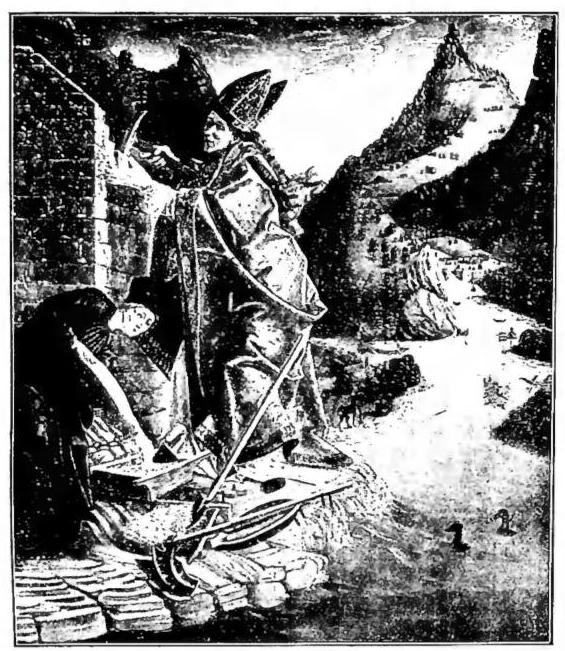
The centre of his cult, however, developed (c. 1200) near Mondsee. In a solitary and picturesque spot on the Abersee, which later took the name of Wolfgang, there stood a little church of St John, believed by the people to have been built by the saint on the spot where he had lived in solitude, indeed he was said to have built it with considerable help from the devil. The first mention of the little church dates from 1183; by 1194 it already bore the name of St V.; in 1315 a large house for pilgrims was built there; between 1330 and 1350 the church was enlarged, only to be destroyed by fire in 1429. Soon afterwards, under the care of the abbots of Mondsee, arose the magnificent Gothic church with two naves and a spacious choir that still stands today and houses the grand Gothic high altar of carved, gilded and painted wood, a masterpiece by Michael Pacher, the fruit of ten years’ work (1471–1481). In the Baroque period (1675–76), another great sculptor, Thomas Schwanthaler, erected in the middle of the church the other masterpiece, the double altar of St V. and the Holy Family. The pilgrimage to St Wolfgang, as the whole place came to be called, was one of the most famous in central Europe in the 17th and 18th centuries.