
S. WUNIBALD (*Wunniß*, *Wynnebaldus*), saint. — Of Anglo-Saxon origin, in 720 he went on pilgrimage to Rome with his brother Willibald (v.), where he lived a monastic life.
In 739 his cousin St Boniface took him back to Germany on the return journey and ordained him priest. Thus he became a missionary in a part of Thuringia, residing at Sülzenbrücken. He was then sent to the Vils region (Upper Palatinate), where he worked without success for three years. Mainz was later his missionary field, but finding himself uncomfortable there he went to Eichstätt to his brother the bishop.
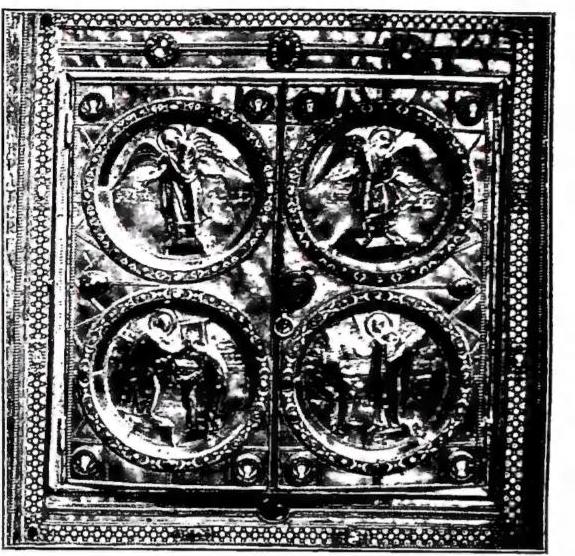
VULVINIUS — Detail of the rear part of the golden altar of V. Note the two roundels with the donor Angilbertus, wearing a square nimbus, and the artist, both crowned by St Ambrose (for the front part of the altar V. vol. IX, pl. XLVII). Milan, basilica of St Ambrose.
The monastery of Heidenheim was the starting point of his new apostolate in the Sulafeld. He died on 18 Dec. 761 and was buried by his brother Willibald in the choir of the church at Heidenheim. Feast, 18 Dec.