Machine translation of the 1948–1954 Italian original. The original text is authoritative.
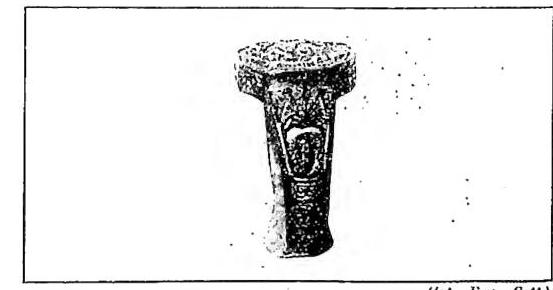
ANELLO del Pescatore - Seal of Nicholas III. Museo Sacro of the Vatican Library.
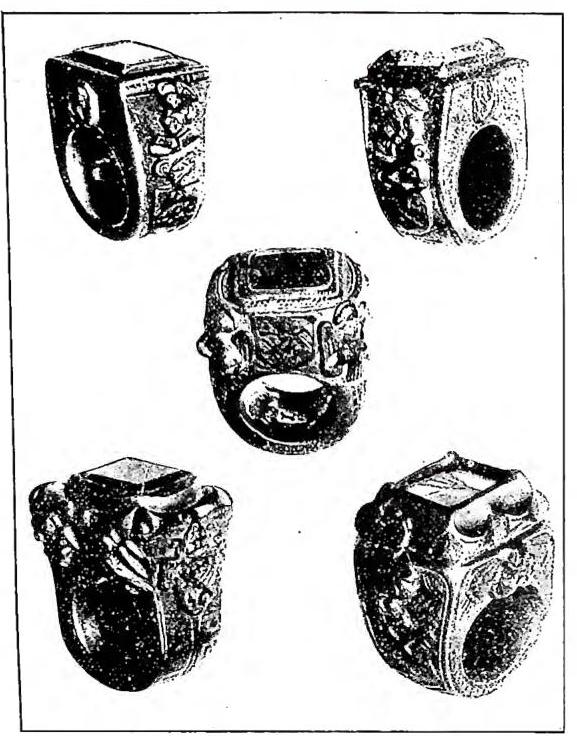
(from Dalton, Catalogue of the finger rings) ANELLO - Papal rings of the Renaissance.sign of mutual love and pledge of indissoluble union. Its use passed into Christian liturgy from Roman antiquity.
BIBL.: F. Liceri, De annulis antiquis, 2nd ed., Udine 1645; J.-A. Martigny, Des anneaux chez les premiers chrétiens et de l'anneau épiscopal en particulier, Mâcon 1858; M. Deloche, La port des anneaux dans l'antiquité romaine et les premiers siècles du Moyen-âge, in Mém. Acad. Inscript, 33 (Paris 1896).
Enrico Dante
A. DEL PESCATORE. - It is used as a seal in papal briefs, of which it constitutes one of the principal characteristics, and in other acts drawn up by the apostolic secretaries, such as cedulae and consistorial sentences. The name derives from the figure of the impression, which represents St. Peter the fisherman.
Its origin is linked to the very origin of briefs. The first mention is found in two letters of Clement IV from 1265 and 1266 (Potthast, 1905; and 1938) as a secret seal used in letters of a private character in place of the bulla plumbea, which was the official and solemn seal. The first surviving example is a seal of Nicholas III (1277-80) in red wax, oval in shape, about 2.5 cm high, appended to a reliquary of the Sancta Sanctorum at the Lateran, now kept in the Vatican Library's Museo Sacro; on it is depicted a beardless youth standing, holding a fishing rod with a fish at the end of the line, and around it reads: † SECRETUM NICOLAI PP. III. However, until the pontificate of Nicholas V, the secret seal did not always bear the figure of the fisherman: the golden a. of the antipope Clement VII (1378-94), also kept in the Vatican, bears his coat of arms surmounted by the tiara and keys; and the seal of Eugenius IV (1431-47) used in certain briefs presents the heads of the Princes of the Apostles («anulus capitum Principum Apostolorum»). In the briefs of Boniface IX (1389-1404) the a. piscatoris is called «anulus fluctuantis naviculæ».
With Nicholas V (1447-55) the type became constant: oval, impressed on red wax, about 2 cm high, with the figure of St. Peter leaning over in the boat in the act of pulling the net, and in the sky the name of the Pope followed by the ordinal number. Around the wax (except at the bottom) a parchment braid was attached to protect the seal from rubbing.
In 1842 the adhering wax seal was replaced by a round red stamp, which preserves the representation of the a. piscatoris.
BIBL.: K. A. Fink, Untersuchungen über die päpstlichen Breven des 15. Jahrhunderts, in Römische Quartalschrift, 43 (1935), p. 80 ff., where the previous bibliography is reported, among which V. especially F. Cancellieri, Notizie sopra l'origine e l'uso dell'a. piscatorio, Roma 1828; Ed. Watterton, On the Annulus piscatoris or Ring of the Fisherman, in Archaeologia, 40 (1866), pp. 138-42.
Giulio Battelli
A. IN ART. - With the advent of Christianity, the symbols and pagan figures that adorned the seal gave way to others of a sacred subject that were in close relationship with the iconographic repertoire of the catacombs; in the vast majority of specimens - the collection of the British Museum in London being interesting for its variety of types - the execution is rather summary and crude. The bishop's ring originated from his need to affix his own seal to official acts; in the course of time it acquired the meaning of the seal of the true faith and became a symbol of union between the pastor and his diocese. Already in the 7th century it was a normal episcopal attribute in Spain, and such it became in France in the 9th, and a little later in all other regions of the West. In relation to the new meaning and the different orientation of taste, the engraved seal was generally replaced by a bezel with a colored stone, sometimes engraved; not infrequently, cameos or worked stones of pagan antiquity were also used. During the Renaissance the ring reached a high level of art, also due to the combination of various techniques such as niello and enamel; it appears more massive in the bezel during the Baroque era. The Fisherman's Ring, whose shape has remained unchanged at least since the 15th century, deserves special mention; it is generally a ring of gilt bronze with rock crystal engraved with the representation of the boat and the name of the Pontiff, who uses it to affix the seal to briefs; immediately after his death it is destroyed.
BIBL.: E. Molinier, Histoire générale de l'art appliqué à l'industrie, I, Parigi 1902; H. Leclercq, s.V. in DACL, J. coll. 2174-2223; O. M. Dalton, Catalogue of the Early Christian Antiquities in the British Museum, Londra 1911, pp. 1-33.
Guglielmo Matthae
Cite this article
“ANELLO DEL PESCATORE.” Enciclopedia Cattolica, vol. I (1948), p. 747. Azione Romana digital edition, https://azioneromana.com/article/anello-del-pescatore.