
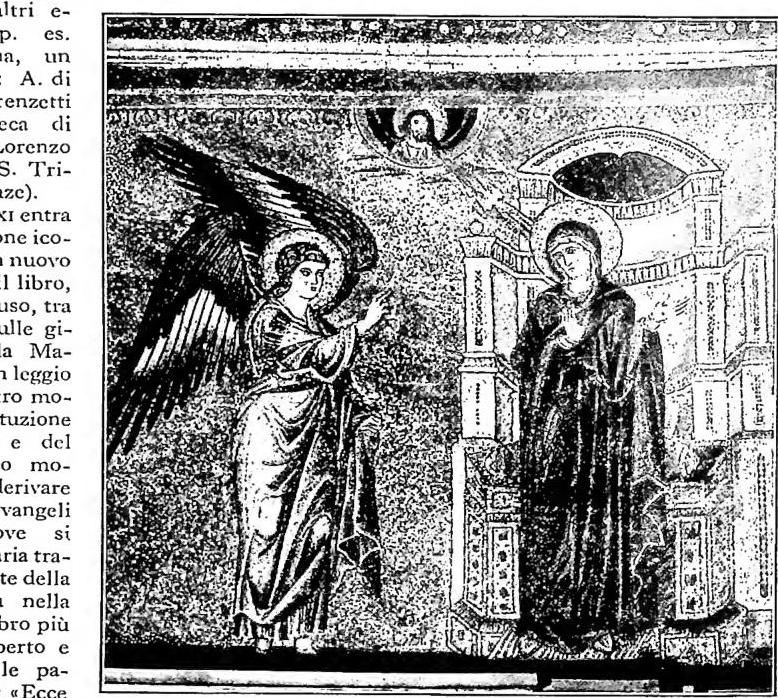
ANNUNCIATION — Musician of the triumphal arch of the basilica of St Mary Major (432-40) — Rome.
The angel Gabriel — “sent by God” — comes to Mary. After the greeting (v. AVE MARIA), whose grandeur astonishes the humble Virgin, the angel reveals God’s design for her, chosen to be the mother of the Messiah: “Behold, you will conceive in your womb and bear a son, and you shall name him Jesus.” Framed in phrases and concepts drawn from ancient prophecies (cf., e.g., 2 Sam 7:16; Ps 88:30-37; Isa 9:7 [Heb 6]; Mic 4:7; Dan 7:1-27), the angel’s announcement outlines the figure and mission of the promised Redeemer (cf. Mt 1:21).
Reassured by the angel (“The Holy Spirit will come upon you, and the power of the Most High will overshadow you”; cf. Gen 1:2), Mary gives her consent, declaring herself “the handmaid [δούλη] of the Lord.” And at that instant, according to the unanimous conviction of theologians, “the Word became flesh and dwelt among us” (Jn 1:14), thus fulfilling Isaiah’s oracle regarding the ALZON, EMMANUEL D' (v.).
Literarily, the evangelical episode — whose dialogue exhibits Hebraic stylistic traits — is among the most tender and dramatic. The angel delivers the announcement, and our cause is imperiled; Mary seems to hesitate, and our fate hangs in suspense; she consents, and our salvation is secured.
The theological importance of the narrative is supreme, forming the foundation of the entire theology of grace. Antithetical counterpart to the Fall in Eden (Gen 3), the mystery of the A. marks the “fullness of time” (Gal 4:4; Eph 1:10) and the dawn of the “New Covenant” (Jer 31:31). “Fixed term of eternal counsel” (Dante, Par. 33:3), co-worker in the divine plan of Redemption, “new Eve,” Mary rises above the world like the dawn, harbinger of the “Sun of justice” (Mal 4:2). Dante portrays the A. as the sublime exemplar of humility (Purg. 10:28-45).
Rationalist criticism rejects wholesale the Gospel of Infancy (v. SALVATORE, VANGELO DELLA), but its special target is verses 34-35 on the virginal conception: A. Loisy, H. Usener, A. Harnack regard them as interpolations by Luke in the primitive document or by a later redactor. The arguments, drawn from style and content, are inconsistent (cf. E. Ruffini, Introductio in S. Scripturam, N. T., Rome 1925, pp. 118-24).
2. IN THE LITURGY
In the Roman liturgy the "Annuntiatio B. Mariae Virginis", in the Byzantine liturgy δυσύλη, δε δυσύλη, δε δυσύλη, δε δυσύλη, δε δε δε δε δε δε δε δε δε δε δε δε δε δε δε δε δε δε δε δε δε δε δε δε δε δε δε δε δε δε δε δυσύλη, δυσύλη, δυσύλη, δυσύλη, δυσύλη, δυσύλη, δυσύλη, δε δε δε δε δε δε δε δε δε δε δε δε δε δε δε δε δε δε δε δε δε δε δε δε δε δε δε δε δε δε δε δυσύλη, δυσύλη, δυσύλη, δυσύλη, δυσύλη, δυσύλη, δυσύλη, δε δε δε δε δε δε δε δε δε δε δε δε δε δε δε δε δε δε δε δε δε δε δε δε δε δε δε δε δε δε δε δυσύλη, δυσύλη, δυσύλη, δυσύλη, δυσύλη, δυσύλη, δυσύλη, δε δε δε δε δε δε δε δε δε δε δε δε δε δε δε δε δε δε δε δε δε δε δε δε δε δε δε δε δε δε δε δυσύλη, δυσύλη, δυσύλη, δυσύλη, δυσύλη, δυσύλη, δυσύλη, δε δε δε δε δε δε δε δε δε δε δε δε δε δε δε δε δε δε δε δε δε δε δε δε δε δε δε δε δε δε δε δυσύλη, δυσύλη, δυσύλη, δυσύλη, δυσύλη, δυσύλη, δυσύλη, δε δε δε δε δε δε δε δε δε δε δε δε δε δε δε δε δε δε δε δε δε δε δε δε δε δε δε δε δε δε δε δυσύλη, δυσύλη, δυσύλη, δυσύλη, δυσύλη, δυσύλη, δυσύλη, δε δε δε δε δε δε δε δε δε δε δε δε δε δε δε δε δε δε δε δε δε δε δε δε δε δε δε δε δε δε δε δυσύλη, δυσύλη, δυσύλη, δυσύλη, δυσύλη, δυσύλη, δυσύλη, δε δε δε δε δε δε δε δε δε δε δε δε δε δε δε δε δε δε δε δε δε δε δε δε δε δε δε δε δε δε δε δυσύλη, δυσύλη, δυσύλη, δυσύλη, δυσύλη, δυσύλη, δυσύλη, δε δε δε δε δε δε δε δε δε δε δε δε δε δε δε δε δε δε δε δε δε δε δε δε δε δε δε δε δε δε δε δυσύλη, δυσύλη, δυσύλη, δυσύλη, δυσύλη, δυσύλη, δυσύλη, δε δε δε δε δε δε δε δε δε δε δε δε δε δε δε δε δε δε δε δε δε δε δε δε δε δε δε δε δε δε δε δυσύλη, δυσύλη, δυσύλη, δυσύλη, δυσύλη, δυσύλη, δυσύλη, δε δε δε δε δε δε δε δε δε δε δε δε δε δε δε δε δε δε δε δε δε δε δε δε δε δε δε δε δε δε δε δυσύλη, δυσύλη, δυσύλη, δυσύλη, δυσύλη, δυσύλη, δυσύλη, δε δε δε δε δε δε δε δε δε δε δε δε δε δε δε δε δε δε δε δε δε δε δε δε δε δε δε δε δε δε δε δυσύλη, δυσύλη, δυσύλη, δυσύλη, δυσύλη, δυσύλη, δυσύλη, δε δε δε δε δε δε δε δε δε δε δε δε δε δε δε δε δε δε δε δε δε δε δε δε δε δε δε δε δε δε δε δυσύλη, δυσύλη, δυσύλη, δυσύλη, δυσύλη, δυσύλη, δυσύλη, δε δε δε δε δε δε δε δε δε δε δε δε δε δε δε δε δε δε δε δε δε δε δε δε δε δε δε δε δε δε δε δυσύλη, δυσύλη, δυσύλη, δυσύλη, δυσύλη, δυσύλη, δυσύλη, δε δε δε δε δε δε δε δε δε δε δε δε δε δε δε δε δε δε δε δε δε δε δε δε δε δε δε δε δε δε δε δυσύλη, δυσύλη, δυσύλη, δυσύλη, δυσύλη, δυσύλη, δυσύλη, δε δε δε δε δε δε δε δε δε δε δε δε δε δε δε δε δε δε δε δε δε δε δε δε δε δε δε δε δε δε δε δυσύλη, δυσύλη, δυσύλη, δυσύλη, δυσύλη, δυσύλη, δυσύλη, δε δε δε δε δε δε δε δε δε δε δε δε δε δε δε δε δε δε δε δε δε δε δε δε δε δε δε δε δε δε δε δυσύλη, δυσύλη, δυσύλη, δυσύλη, δυσύλη, δυσύλη, δυσύλη, δε δε δε δε δε δε δε δε δε δε δε δε δε δε δε δε δε δε δε δε δε δε δε δε δε δε δε δε δε δε δε δυσύλη, δυσύλη, δυσύλη, δυσύλη, δυσύλη, δυσύλη, δυσύλη, δε δε δε δε δε δε δε δε δε δε δε δε δε δε δε δε δε δε δε δε δε δε δε δε δε δε δε δε δε δε δε δυσύλη, δυσύλη, δυσύλη, δυσύλη, δυσύλη, δυσύλη, δυσύλη, δε δε δε δε δε δε δε δε δε δε δε δε δε δε δε δε δε δε δε δε δε δε δε δε δε δε δε δε δε δε δε δυσύλη, δυσύλη, δυσύλη, δυσύλη, δυσύλη, δυσύλη, δυσύλη, δε δε δε δε δε δε δε δε δε δε δε δε δε δε δε δε δε δε δε δε δε δε δε δε δε δε δε δε δε δε δε δυσύλη, δυσύλη, δυσύλη, δυσύλη, δυσύλη, δυσύλη, δυσύλη, δε δε δε δε δε δε δε δε δε δε δε δε δε δε δε δε δε δε δε δε δε δε δε δε δε δε δε δε δε δε δε δυσύλη, δυσύλη, δυσύλη, δυσύλη, δυσύλη, δυσύλη, δυσύλη, δε δε δε δε δε δε δε δε δε δε δε δε δε δε δε δε δε δε δε δε δε δε δε δε δε δε δε δε δε δε δε δυσύλη, δυσύλη, δυσύλη, δυσύλη, δυσύλη, δυσύλη, δυσύλη, δε δε δε δε δε δε δε δε δε δε δε δε δε δε δε δε δε δε δε δε δε δε δε δε δε δε δε δε δε δε δε δυσύλη, δυσύλη, δυσύλη, δυσύλη, δυσύλη, δυσύλη, δυσύλη, δε δε δε δε δε δε δε δε δε δε δε δε δε δε δε δε δε δε δε δε δε δε δε δε δε δε δε δε δε δε δε δυσύλη, δυσύλη, δυσύλη, δυσύλη, δυσύλη, δυσύλη, δυσύλη, δε δε δε δε δε δε δε δε δε δε δε δε δε δε δε δε δε δε δε δε δε δε δε δε δε δε δε δε δε δε δε δυσύλη, δυσύλη, δυσύλη, δυσύλη, δυσύλη, δυσύλη, δυσύλη, δε δε δε δε δε δε δε δε δε δε δε δε δε δε δε δε δε δε δε δε δε δε δε δε δε δε δε δε δε δε δε δυσύλη, δυσύλη, δυσύλη, δυσύλη, δυσύλη, δυσύλη, δυσύλη, δε δε δε δε δε δε δε δε δε δε δε δε δε δε δε δε δε δε δε δε δε δε δε δε δε δε δε δε δε δε δε δυσύλη, δυσύλη, δυσύλη, δυσύλη, δυσύλη, δυσύλη, δυσύλη, δε δε δε δε δε δε δε δε δε δε δε δε δε δε δε δε δε δε δε δε δε δε δε δε δε δε δε δε δε δε δε δυσύλη, δυσύλη, δυσύλη, δυσύλη, δυσύλη, δυσύλη, δυσύλη, δε δε δε δε δε δε δε δε δε δε δε δε δε δε δε δε δε δε δε δε δε δε δε δε δε δε δε δε δε δε δε δυσύλη, δυσύλη, δυσύλη, δυσύλη, δυσύλη, δυσύλη, δυσύλη, δε δε δε δε δε δε δε δε δε δε δε δε δε δε δε δε δε δε δε δε δε δε δε δε δε δε δε δε δε δε δε δυσύλη, δυσύλη, δυσύλη, δυσύλη, δυσύλη, δυσύλη, δυσύλη, δε δε δε δε δε δε δε δε δε δε δε δε δε δε δε δε δε δε δε δε δε δε δε δε δε δε δε δε δε δε δε δυσύλη, δυσύλη, δυσύλη, δυσύλη, δυσύλη, δυσύλη, δυσύλη, δε δε δε δε δε δε δε δε δε δε δε δε δε δε δε δε δε δε δε δε δε δε δε δε δε δε δε δε δε δε δε δυσύλη, δυσύλη, δυσύλη, δυσύλη, δυσύλη, δυσύλη, δυσύλη, δε δε δε δε δε δε δε δε δε δε δε δε δε δε δε δε δε δε δε δε δε δε δε δε δε δε δε δε δε δε δε δυσύλη, δυσύλη, δυσύλη, δυσύλη, δυσύλη, δυσύλη, δυσύλη, δε δε δε δε δε δε δε δε δε δε δε δε δε δε δε δε δε δε δε δε δε δε δε δε δε δε δε δε δε δε δε δυσύλη, δυσύλη, δυσύλη, δυσύλη, δυσύλη, δυσύλη, δυσύλη, δε δε δε δε δε δε δε δε δε δε δε δε δε δε δε δε δε δε δε δε δε δε δε δε δε δε δε δε δε δε δε δυσύλη, δυσύλη, δυσύλη, δυσύλη, δυσύλη, δυσύλη, δυσύλη, δε δε δε δε δε δε δε δε δε δε δε δε δε δε δε δε δε δε δε δε δε δε δε δε δε δε δε δε δε δε δε δυσύλη, δυσύλη, δυσύλη, δυσύλη, δυσύλη, δυσύλη, δυσύλη, δε δε δε δε δε δε δε δε δε δε δε δε δε δε δε δε δε δε δε δε δε δε δε δε δε δε δε δε δε δε δε δυσύλη, δυσύλη, δυσύλη, δυσύλη, δυσύλη, δυσύλη, δυσύλη, δε δε δε δε δε δε δε δε δε δε δε δε δε δε δε δε δε δε δε δε δε δε δε δε δε δε δε δε δε δε δε δυσύλη, δυσύλη, δυσύλη, δυσύλη, δυσύλη, δυσύλη, δυσύλη, δε δε δε δε δε δε δε δε δε δε δε δε δε δε δε δε δε δε δε δε δε δε δε δε δε δε δε δε δε δε δε δυσύλη, δυσύλη, δυσύλη, δυσύλη, δυσύλη, δυσύλη, δυσύλη, δε δε δε δε δε δε δε δε δε δε δε δε δε δε δε δε δε δε δε δε δε δε δε δε δε δε δε δε δε δε δε δυσύλη, δυσύλη, δυσύλη, δυσύλη, δυσύλη, δυσύλη, δυσύλη, δε δε δε δε δε δε δε δε δε δε δε δε δε δε δε δε δε δε δε δε δε δε δε δε δε δε δε δε δε δε δε δυσύλη, δυσύλη, δυσύλη, δυσύλη, δυσύλη, δυσύλη, δυσύλη, δε δε δε δε δε δε δε δε δε δε δε δε δε δε δε δε δε δε δε δε δε δε δε δε δε δε δε δε δε δε δε δυσύλη, δυσύλη, δυσύλη, δυσύλη, δυσύλη, δυσύλη, δυσύλη, δε δε δε δε δε δε δε δε δε δε δε δε δε δε δε δε δε δε δε δε δε δε δε δε δε δε δε δε δε δε δε δυσύλη, δυσύλη, δυσύλη, δυσύλη, δυσύλη, δυσύλη, δυσύλη, δε δε δε δε δε δε δε δε δε δε δε δε δε δε δε δε δε δε δε δε δε δε δε δε δε δε δε δε δε δε δε δυσύλη, δυσύλη, δυσύλη, δυσύλη, δυσύλη, δυσύλη, δυσύλη, δε δε δε δε δε δε δε δε δε δε δε δε δε δε δε δε δε δε δε δε δε δε δε δε δε δε δε δε δε δε δε δυσύλη, δυσύλη, δυσύλη, δυσύλη, δυσύλη, δυσύλη, δυσύλη, δε δε δε δε δε δε δε δε δε δε δε δε δε δε δε δε δε δε δε δε δε δε δε δε δε δε δε δε δε δε δε δυσύλη, δυσύλη, δυσύλη, δυσύλη, δυσύλη, δυσύλη, δυσύλη, δε δε δε δε δε δε δε δε δε δε δε δε δε δε δε δε δε δε δε δε δε δε δε δε δε δε δε δε δε δε δε δυσύλη, δυσύλη, δυσύλη, δυσύλη, δυσύλη, δυσύλη, δυσύλη, δε δε δε δε δε δε δε δε δε δε δε δε δε δε δε δε δε δε δε δε δε δε δε δε δε δε δε δε δε δε δε δυσύλη, δυσύλη, δυσύλη, δυσύλη, δυσύλη, δυσύλη, δυσύλη, δε δε δε δε δε δε δε δε δε δε δε δε δε δε δε δε δε δε δε δε δε δε δε δε δε δε δε δε δε δε δε δυσύλη, δυσύλη, δυσύλη, δυσύλη, δυσύλη, δυσύλη, δυσύλη, δε δε δε δε δε δε δε δε δε δε δε δε δε δε δε δε δε δε δε δε δε δε δε δε δε δε δε δε δε δε δε δυσύλη, δυσύλη, δυσύλη, δυσύλη, δυσύλη, δυσύλη, δυσύλη, δε δε δε δε δε δε δε δε δε δε δε δε δε δε δε δε δε δε δε δε δε δε δε δε δε δε δε δε δε δε δε δυσύλη, δυσύλη, δυσύλη, δυσύλη, δυσύλη, δυσύλη, δυσύλη, δε δε δε δε δε δε δε δε δε δε δε δε δε δε δε δε δε δε δε δε δε δε δε δε δε δε δε δε δε δε δε δυσύλη, δυσύλη, δυσύλη, δυσύλη, δυσύλη, δυσύλη, δυσύλη, δε δε δε δε δε δε δε δε δε δε δε δε δε δε δε δε δε δε δε δε δε δε δε δε δε δε δε δε δε δε δε δυσύλη, δυσύλη, δυσύλη, δυσύλη, δυσύλη, δυσύλη, δυσύλη, δε δε δε δε δε δε δε δε δε δε δε δε δε δε δε δε δε δε δε δε δε δε δε δε δε δε δε δε δε δε δε δυσύλη, δυσύλη, δυσύλη, δυσύλη, δυσύλη, δυσύλη, δυσύλη, δε δε δε δε δε δε δε δε δε δε δε δε δε δε δε δε δε δε δε δε δε δε δε δε δε δε δε δε δε δε δε δυσύλη, δυσύλη, δυσύλη, δυσύλη, δυσύλη, δυσύλη, δυσύλη, δε δε δε δε δε δε δε δε δε δε δε δε δε δε δε δε δε δε δε δε δε δε δε δε δε δε δε δε δε δε δε δυσύλη, δυσύλη, δυσύλη, δυσύλη, δυσύλη, δυσύλη, δυσύλη, δε δε δε δε δε δε δε δε δε δε δε δε δε δε δε δε δε δε δε δε δε δε δε δε δε δε δε δε δε δε δε δυσύλη, δυσύλη, δυσύλη, δυσύλη, δυσύλη, δυσύλη, δυσύλη, δε δε δε δε δε δε δε δε δε δε δε δε δε δε δε δε δε δε δε δε δε δε δε δε δε δε δε δε δε δε δε δυσύλη, δυσύλη, δυσύλη, δυσύλη, δυσύλη, δυσύλη, δυσύλη, δε δε δε δε δε δε δε δε δε δε δε δε δε δε δε δε δε δε δε δε δε δε δε δε δε δε δε δε δε δε δε δυσύλη, δυσύλη, δυσύλη, δυσύλη, δυσύλη, δυσύλη, δυσύλη, δε δε δε δε δε δε δε δε δε δε δε δε δε δε δε δε δε δε δε δε δε δε δε δε δε δε δε δε δε δε δε δυσύλη, δυσύλη, δυσύλη, δυσύλη, δυσύλη, δυσύλη, δυσύλη, δε δε δε δε δε δε δε δε δε δε δε δε δε δε δε δε δε δε δε δε δε δε δε δε δε δε δε δε δε δε δε δυσύλη, δυσύλη, δυσύλη, δυσύλη, δυσύλη, δυσύλη, δυσύλη, δε δε δε δε δε δε δε δε δε δε δε δε δε δε δε δε δε δε δε δε δε δε δε δε δε δε δε δε δε δε δε δυσύλη, δυσύλη, δυσύλη, δυσύλη, δυσύλη, δυσύλη, δυσύλη, δε δε δε δε δε δε δε δε δε δε δε δε δε δε δε δε δε δε δε δε δε δε δε δε δε δε δε δε δε δε δυσύλη, δυσύλη, δυσύλη, δυσύλη, δυσύλη, δυσύλη, δυσύλη, δε δε δε δε δε δε δε δε δε δε δε δε δε δε δε δε δε δε δε δε δε δε δε δε δε δε δε δε δε δε δε δυσύλη, δυσύλη, δυσύλη, δυσύλη, δυσύλη, δυσύλη, δυσύλη, δε δε δε δε δε δε δε δε δε δε δε δε δε δε δε δε δε δε δε δε δε δε δε δε δε δε δε δε δε δε δε δυσύλη, δυσύλη, δυσύλη, δυσύλη, δυσύλη, δυσύλη, δυσύλη, δε δε δε δε δε δε δε δε δε δε δε δε δε δε δε δε δε δε δε δε δε δε δε δε δε δε δε δε δε δε δε δυσύλη, δυσύλη, δυσύλη, δυσύλη, δυσύλη, δυσύλη, δυσύλη, δε δε δε δε δε δε δε δε δε δε δε δε δε δε δε δε δε δε δε δε δε δε δε δε δε δε δε δε δε δε δυσύλη, δυσύλη, δυσύλη, δυσύλη, δυσύλη, δυσύλη, δυσύλη, δε δε δε δε δε δε δε δε δε δε δε δε δε δε δε δε δε δε δε δε δε δε δε δε δε δε δε δε δε δε δυσύλη, δυσύλη, δυσύλη, δυσύλη, δυσύλη, δυσύλη, δυσύλη, δε δε δε δε δε δε δε δε δε δε δε δε δε δε δε δε δε δε δε δε δε δε δε δε δε δε δε δε δε δε δε δυσύλη, δυσύλη, δυσύλη, δυσύλη, δυσύλη, δυσύλη, δυσύλη, δε δε δε δε δε δε δε δε δε δε δε δε δε δε δε δε δε δε δε δε δε δε δε δε δε δε δε δε δε δε δε δυσύλη, δυσύλη, δυσύλη, δυσύλη, δυσύλη, δυσύλη, δυσύλη, δε δε δε δε δε δε δε δε δε δε δε δε δε δε δε δε δε δε δε δε δε δε δε δε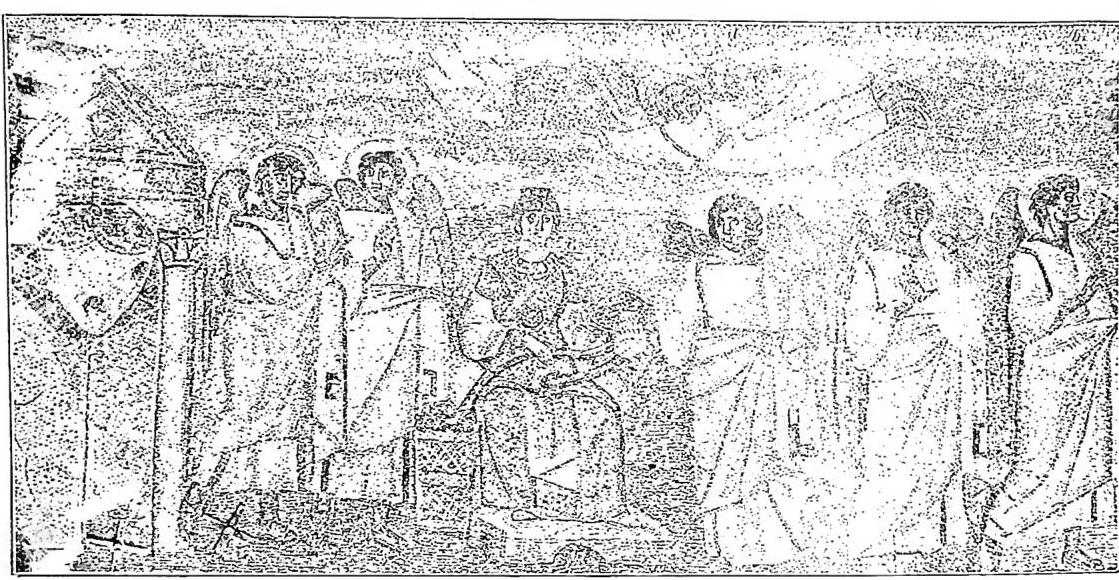
Annunciation – Mosaic of the triumphal arch of the basilica of St Mary Major (432-40) – Rome.
« distant », for the 18th of December, eight days before Christmas (can. 1: Mansi, XI, 33). But this interpretation of the Toledan canon is debated: according to M. Jugie the feast of the A. would have been introduced into Spain following the example of Rome.
The Ambrosian Church admitted a twofold celebration of the mystery: on the 25th of March and on the sixth Sunday of Advent, which immediately precedes Christmas Eve. St Charles, respecting the canon of not celebrating feasts of Saints during Lent, abolished the solemnity of the 25th of March, and left, as the only and official solemnity of the A., that of the Incarnation, on the sixth Sunday of Advent. But in 1897 (cf. decree of the S.C. of Rites, in Acta S. Sedis, 29 [1937], p. 566 sq.) the feast was restored in Lent (25th of March), without, however, its object being well defined, since the liturgy of the day has the double title In festo Annunciationis B. Mariae Virginis: Solemnitas Domini.
For the Roman Church, as already for the Eastern Church, considerations of a liturgical nature in relation to Lent were outweighed by the traditional 25th of March, as the beginning of the new Christian era;
whereby in the Middle Ages this day was also chosen as the beginning of the civil year (ab Incarnatione Domini).
whereby in the Middle Ages this day was also chosen as the beginning of the civil year (ab Incarnatione Domini).
3. IN ARCHAEOLOGY
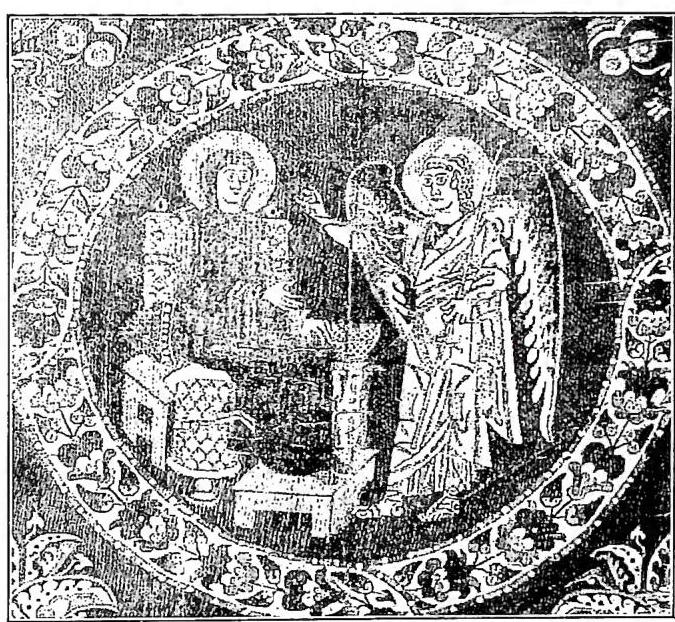
In Christian funerary art the only image of the A. is painted on the vault of a cubiculum in the cemetery of Priscilla on the Via Salaria; the BOSONE (v.), but was recognized as a scene of the A. Bottari (v.). Before the seated Virgin stands a young man in tunic and pallium with his right arm outstretched; the painting is now much deteriorated and is datable to between the end of the 2nd and the beginning of the 3rd century. Also in Rome, in the museums of the triumphal arch of S. Maria Maggiore (432-40), the scene of the A. is inspired by the Protoevangelium of James: from above hovers the dove, while the archangel Gabriel flies toward the seated Madonna as she is spinning purple wool for the temple of Jerusalem; around her are three winged angels. The same Protoevangelium inspired the scenes on the side of a sarcophagus in Ravenna and in the museum of the cathedral of Parenzo (6th century). The A. appears repeatedly in miniatures, as in the Gospels of Etchmiadzin and of Rabula; in ivories, as in the throne of Maximian in Ravenna, in the diptych of Murano, in the binding of the treasure of the cathedral and in the Trivulzio collection in Milan; in the civic museum of Bologna; in textiles, mostly of Alexandrian or Syrian origin, donated by the popes between 750 and 860 to churches in Rome and recorded in the Liber Pontificalis on six occasions, besides the one found in the treasure of the Sancta Sanctorum, now in the Museo Sacro of the Vatican Library.4. IN ART
While the earliest depictions of the A. are limited to representing the Angel and the Virgin with attitudes and attributes drawn faithfully from the account of St Luke, from the 5th century onward the representation is enriched with other elements derived either from the imagination of the artist or from the apocryphal Gospels of James and of Pseudo-Matthew and from the Book of the Nativity of St Mary. These sources provide the following iconographic themes: a first A. at the fountain where Mary was accustomed to draw water; a second in Mary’s house, where the Angel, appearing as a youth of incomparable beauty, comes to the Virgin as she is spinning purple wool for the temple of Jerusalem; the Virgin, as in St Luke, is first troubled, and then, reassured by the Angel’s words, humbly accepts the announcement. The Book of the Nativity shows the Virgin in her little chamber, who “not at all frightened by the sight of the Angel, as one who was used to seeing him often,” opens her arms and raises her eyes to heaven, pronouncing the “Ecce Ancilla Domini.”From these arise two orders of pictorial motifs, which appear either isolated, fused, or variously combined, and which, as time progresses, become ever more enriched: the more properly narrative or episodic (the scene of the fountain, the descent and entrance of the Angel, to which is added the departure of the Angel from the Empyrean — *missus est Angelus*, Lk. 1:26 — the tools for the work of wool, etc.); and the psychological (the attitude of the Angel and, above all, the Virgin’s reaction — surprise, bewilderment, or acceptance, seated, standing, or kneeling).
The episode of the fountain is encountered fairly frequently at the beginning and then becomes increasingly rare (5th-century ivory in the treasury of Milan Cathedral, 12th-century mosaic).
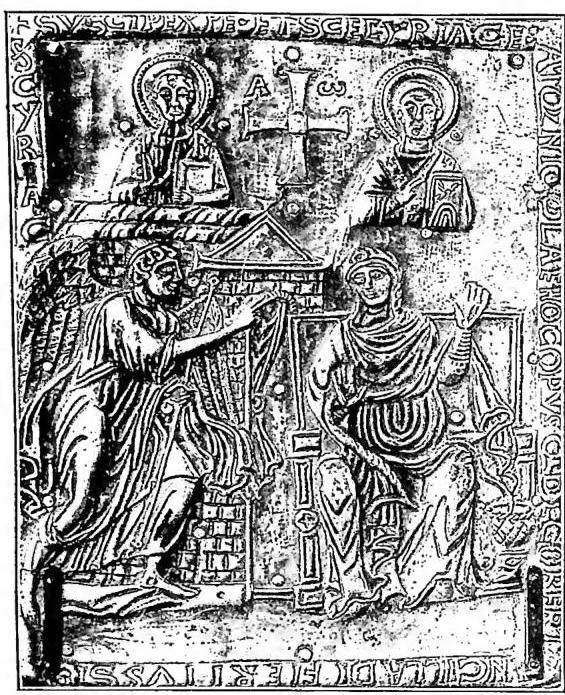
ANNUNCIATION — Silver-gilt Evangelary cover from Saturday (11th century) — Rome, Treasury of S. Maria in via Lata.
In the West, the scene is often represented with the angel on the left and the Virgin on the right, sometimes with the angel kneeling before her (e.g., in S. Marco in Venice); at other times it is combined with a scene inside the house (homiliary of Giacomo, monk of the Bibliothèque Nationale in Paris). More common is the scene of Mary intent on spinning or having laid aside her spindle in the basket beside her (mosaic of the triumphal arch of S. Maria Maggiore, 5th century; fresco in S. Maria Antiqua, 6th century, etc.).
The Virgin is normally placed on the right; the position on the left is always rather rare, even in the earliest representations, though it persists for a long time in the schools of Cappadocia and in Syrian circles. Probably the Virgin’s position on the right was reinforced, until it became almost constant, by the tradition according to which it was desired to recognize in the sanctuary of Nazareth the precise position of the angel and the Virgin, a position still marked today by two columns, of which that of the Virgin (now suspended from the vault of the chapel) is on the right (cf. Daniel Abbas, 1106–1107, in B. de Khitrovo, *Itinéraires russes en Orient*, Geneva 1889, p. 69; and in general writers after the Crusades).
The anecdotal iconographic trend spreads both in the East and in the West and is destined for greater development, especially as a “story” linked to other episodes in the life of Mary; it almost always precedes the Visitation or Nativity (e.g., in the fresco of the church of Appiano, 12th century, or in the pulpit of the cathedral of Cagliari by Guglielmo) and is also found connected with the Tree of Jesse, as in a page of the Bible in the British Museum.
But alongside this trend, from the earliest centuries, another emerges, of a more courtly style, still tied to the narrative of Mary’s life; this style is characteristic of Byzantine artists who represent the Virgin as sovereign, hieratic, and solemn—a conception that persists until the 13th century, so that we find it again in a panel by P. Cavallini in S. Maria in Trastevere (before 1291), where the Madonna is seated on a sumptuous architectural throne, and in the mosaic by Jacopo Torriti in S. Maria Maggiore (1295), with the Madonna standing framed by a rich throne.
From the year 1000 onward, the A. [Assumption] is sometimes depicted apart from the other episodes in the life of Mary. She is represented not only in isolation or as a single episode in the life of the Savior, or at the sides of the Redeemer enthroned (a 959 fresco in the Grotta di Carpignano), or with the Ascension, almost as a compendium of the entire life of Jesus (a 1300 miniature in the library of the Siena cathedral); but she is also considered as a generic presupposition of the Redemption and thus introduced as a premise to stories of entirely different subjects (e.g., a panel with stories of St. Peter by the Sienese school of the 13th century in the Pinacoteca of Siena), or in any case associated with heterogeneous depictions, as in the silver binding of an evangelary in the Vatican Christian Museum (11th century), where, above the A. endowed with traditional attributes, two busts of saints and the cross with the A and the Ω stand out. Very rarely, however, is she depicted with the crucifixion, unless this scene is considered the culminating episode of Mary’s life (a 14th-century triptych in the Blumenthal collection in New York).
Given the widespread understanding of the subject, facilitated by the abundant repetitions and the simplicity of the essential figurative elements—well characterized—representations of the A. could be reduced to extreme simplifications (sometimes, even when part of a narrative of the life of Mary, there is a complete lack of any environmental definition or allusion, as for example in the architrave of S. Giustina in Padua [12th century], where the figures, following French models, are in full round on a smooth background); and thus it lent itself to being composed according to more decorative than strictly illustrative aims. Often, indeed, the angel and the Madonna are represented separately on the corbels of triumphal or apse arches (a 12th-century mosaic in the Torcello cathedral); and even when at the apex of the arch other attributes of the A. intervene that constitute an ideal link between the two figures (12th-century mosaics of the Martorana and the Palatine Chapel in Palermo), it is clear that in these cases the composition is subordinated to a decorative intent of abstract symmetry. Singular is the A. of S. Vincenzo al Volturno (826–53), where the angel and the Virgin are separated by a window and are conceived, pictorially, in an antithetical manner: the angel flies tempestuously, while the Madonna, by contrast, is enthroned and surrounded by a triple nimbus.
Based on this iconographic scheme, which alludes only to the Gospel narrative but is resolved decoratively, one arrives at representing the two essential figures entirely separate (in the 13th-century relief of the Split cathedral, for example, between the two arches containing the Angel and the Virgin, a third arch is interposed, occupied by an altar); and subsequently the figures are included in independent ciboria, even as half-figures, in accessory panels on the shutters of tabernacles, in the pinnacles of altarpieces; and this especially among the Sienese painters of the 14th and early 15th centuries, who were particularly sensitive to decorative taste (e.g., the polyptych at the Pieve of Arezzo by P. Lorenzetti, panels and polyptychs by A. Vanni, Paolo di Giovanni Fei, Taddeo di Bartolo, Sano di Pietro, Sassetta, etc.). The two figures independent of each other are already found, moreover, in the 12th and 13th centuries, as in those embedded among the meanders of a Romanesque capital in S. Andrea in Pistoia; and often on the façades of Gothic churches (Reims cathedral) in the form of isolated statues aligned with others of entirely unrelated subjects.
The narrative taste, however, never wanes and indeed, from antiquity onward enriches the representation with ever new elements: for example, the maidservant seated apart, spinning or lifting the curtain or eavesdropping from an adjoining room, which is already found in Carolingian ivories and then in Rome at S. Urbano alla Caffarella (11th century), in Pistoia on the pulpit by Guido da Como (where the Madonna is on the left), in Benevento on the bronze door of the Cathedral (13th century), in the pulpit of the cathedral of Berga (13th century), and again in the Annunciation by Barna da Siena at S. Gimignano (1381). The introduction of this figure may perhaps be due to the Gospel of Pseudo-Matthew, which tells that five maidens lived with Mary and justified her before Joseph; but it appears above all suggested by human indulgence for anecdote, which increasingly emphasizes the character of intimate gathering in the scene.
To this same requirement is due the transformation of the architectural setting; in fact, in the series of Annunciation scenes represented outdoors, the oldest have as a backdrop a basilica, in which one can recognize a documentary or topographical intent, since this basilica is meant to be that of Nazareth (built over the Grotto of the Annunciation) which was identified, through a literal interpretation of peregrine texts, with the house of Mary («Domus sanctae Mariae basilica est.» Anon. Placentinus, in P. Geyer, Itinera Hierosolymitana saeculi III-VIII, Vienna 1898, p. 161). Soon the basilica was reduced to a portico along a nave (Parenzo cathedral, 6th century), then to an isolated portico, and finally to a baldachin (which
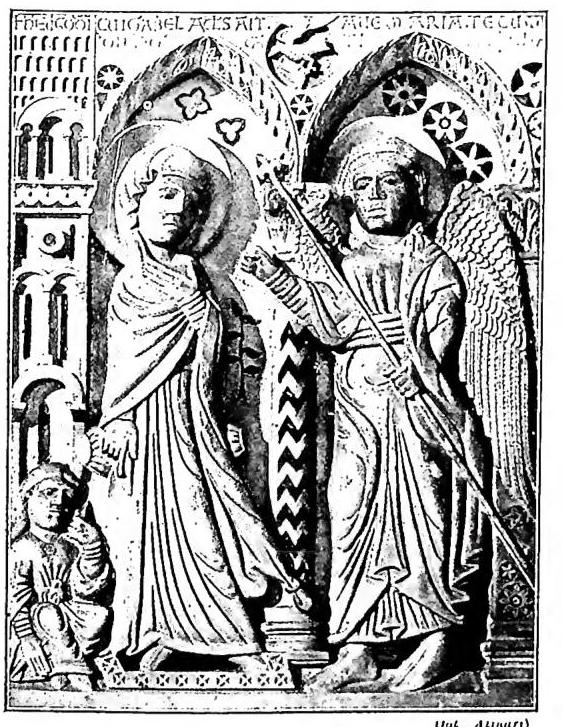
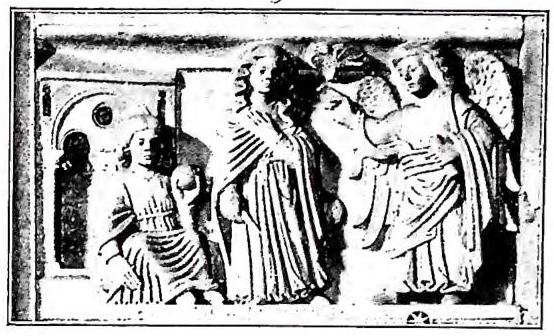
UENCIAZIONE - Particular of the pulpit by Guido da Como (13th cent.) - Pistoia, church of S. Bartolomeo in Pantano.
remains for a long time, as is proved, for example, by the form: that of the door of the cathedral of Pisa by Bonanno, 12th cent., singular also for the position to the left of the standing Madonna, for a hint of landscape naturalism beside the baldachin and for the prophecy of the salutation which occupies much of the smooth background; between the 9th and 11th centuries it is transformed into a house, to reopen in the 12th (mosaic of the work of the cathedral in Florence); but perhaps it is still hinted at, in the 13th century, in the grandiose building which occupies the background of some A., such as that of the Master of the Magdalene (13th cent., Paris, museum of decorative arts) and that cited of the author of the stories of St Peter.
But the preference for narration, constantly imbued with motifs of intimacy and sweetness, has meant that more often artists preferred to combine the interior of the house with an exterior, in which to allow the Angel to stand out; hence the house contracts into a loggia or becomes an aedicula, a pergola, a portico, or is reduced to an atrium through which, sometimes, other rooms can be glimpsed, rich in furnishings and domestic furnishings, while the exterior is adorned with greenery and later takes shape in a landscape and even in a view (Bonifacio Veronese at the beginning of the 16th century, places, between the two celestial personages, the piazza of S. Marco, which he reserves for the appearance of the Eternal: fragmentary canvas in the galleries of the Accademia in Venice).
During the evolution of the setting, which, however, does not stray significantly from iconographic tradition until the 15th century, the attitudes of the characters vary with ever greater freedom and their attributes change. The Angel gradually loses the primitive character of his clothing (which was in the Greek style, with a pallium and buskins, and was completed with a stephane on the head), following the evolution of costume; at first he holds in his hand the rod or the herald’s sceptre; then the rod becomes flowered, finally transforming into a lily. Notable for testifying to this transition is the 14th-century A. by the Master of the codex of S. Giorgio (Stockel collection, Brussels) and that a little later by Orcagna in Orsanmichele, in which the lily has respectively slender and still closed corollas and therefore closely resembles a sceptre. Also common becomes the olive branch (Lippo Memmi in the Uffizi, Taddeo di Bartolo in the Accademia in Siena), as well as the palm (A. Lorenzetti in the Accademia in Siena) according to the tradition taken up by Dante («For he is he who bore the palm — down to Mary»: Par., XXXIII, 112). The very frequent motif of the lily, then, which recalls the *inviolabile castitatis lilium* of St Bernard, is often replaced or repeated by a
flower vase, placed on the ground between the Angel and the Virgin; it is adopted especially by Sienese painters (the greatest example being Simone Martini’s at the Uffizi), well suiting their ornamental taste. Lippo Vanni (14th century) depicts the Angel offering the Virgin a basket of flowers.
The flower vase also serves to create a separation between the two figures, accentuating the Virgin’s untouchability; this separation, which in scenes with the Angel alone outdoors is naturally achieved, is often deliberately effected by other means as well (e.g., a column, a tree, etc.; A. and P. Lorenzetti at the Pinacoteca of Siena; Lorenzo Monaco at S. Trinità in Florence).
In the 11th century a new element enters the iconographic tradition: the book, open or closed, held in the Madonna’s hands or on her lap, on a lectern or another piece of furniture, replacing the distaff and spindle; this motif is still derived from the apocryphal gospels, which recount that Mary spent part of her day in reading. The book is most often open and bears the words of Isaiah: «Ecce virgo concipiet et pariet filium». This
well accords with the purpose of religious painting, especially medieval, which is to illustrate and make evident the meaning of the representation; for the same reason, from the 14th century onward it becomes very common to write the words of the greeting on a scroll held by the Angel, or in a breath emanating from his mouth toward the Madonna (Simone Martini), and likewise in a breath her reply (Ambrogio Lorenzetti). Later the words are transferred to the halos or the frames.
In general, as time passes, ever more numerous mystical and allegorical elements appear, deriving also from the syncretism of the “legends” (e.g., the Legenda aurea) and other literature.
Indeed, if from the earliest representations the Dove, symbol of the Holy Spirit, appears alongside the Angel and the Madonna, in the 12th century the hand of the Eternal emerges from a semicircle with three concentric rings, symbol of the Trinity (musical chapel of the Palatine in Palermo), and within the semicircle the figure of the Father is more often found, from whom rays proceed towards the Virgin, either enclosing or bearing the Dove (works by Jacopo Torriti and Pietro Cavallini). The Eternal (often only His arm) appears later almost always either in a glory of cherubim or through a rift in the clouds; sometimes the Redeemer is represented as He commands Gabriel to deliver the divine message (Spinello Aretini in S. Francesco in Arezzo, where, however, the bust of the Eternal remains in the canopy covering the Virgin, dominating the scene). Subsequently, even the detail of the Dove tends toward greater realism and is therefore depicted as flying through an open window or alighting on Mary’s shoulder. At times the ray extending from the Father to the Virgin reaches her ear; this mystical motif signifies the spirituality of Christ, who, as the “Verbum,” is thus received. Exceptional is the representation of a winged point darting from on high, launching the Dove (Spinello Aretini, church of the Santissima Annunziata in Arezzo), and it seems to foreshadow the late motif of the infant Jesus walking along the usual ray, carrying the cross on His shoulders (works by Giovanni dal Ponte in the Vatican Pinacoteca, Giovanni Santi in Brera, Domenico Panetti in the Pinacoteca of Ferrara, Hans Baldung in the museum of Colmar). This strange iconographic novelty was reproved by St. Antoninus of Florence (“quasi non esset ex substantia Virginis corpus eius assumptum,” Stumm. hist., III, tit. 8, 4, 11) and Pope Benedict XIV prohibited it as an erroneous depiction.
From the 14th century onward, the scene becomes more complex with additional representations, such as that of Adam and Eve driven from Paradise, to emphasize the meaning of Redemption from original sin, conceived as a “felix culpa,” in accordance with the liturgical exclamation (works by Fra Angelico in Cortona and its immediate derivations, by the Master of S. Miniato in Settignano, by Neri di Bicci in S. Trinita in Florence). B. Bonfigli (15th century) places between the Angel and the Madonna St. Luke crouched, who, as an eyewitness, writes the Gospel narrative (work in the Pinacoteca of Perugia); other painters add a group of patrons (works by Filippo Lippi in Palazzo Venezia, by Filippo Lippi in S. Maria sopra Minerva, by Nicolò da Foligno in the Pinacoteca of Perugia); Antoniazzo Romano (church of the Minerva in Rome) inserts an episode so heterogeneous that it renders the Virgin’s attitude entirely foreign to the representation of the Annunciation.
In Germanic countries one often finds, alongside that of the A., also the representation of the unicorn (v. ANIMALE), which sometimes replaces the Angel (antiphonary of the convent of Einsiedeln); or the two representations merge and Gabriel takes on the aspect of a hunter, accompanied by four dogs symbolizing the four virtues: justice, mercy, truth, and peace (Gothic altarpiece in the cathedral of Lu- beck, altarpiece in the Museum of Weimar, c. 1410) under the influence of popular sacred plays.
It is obvious that a figurative theme so dear to artists and so frequently repeated not only has a complex iconographic tradition but also offers ample possibilities for free interpretation: thus the attitudes of the figures and the expression of their sentiments vary so widely as to elude any precise iconological framework. When, moreover, the subject is treated by artists of exceptional creative power, the figurative schemes are overwhelmed by their personalities and in any case undergo profound and sometimes radical derogations, destined either to alter the tradition by enriching it or to remain isolated. This process of evasion or deviation from iconographic currents was furthered by the gradual loss, on the part of art, of the intention to illustrate Holy Scripture and to instruct, which had been its own in the Middle Ages and which disappears entirely after the Renaissance (see therefore the entries on individual artists or artistic periods).
Thus, choosing from among the innumerable examples, Giovanni Pisano in the pulpit of S. Andrea in Pistoia (1290–1301), while following in general outline Nicola (pulpit of the baptistery of Pisa, 1260) and thus placing the Angel, the dove, and the Virgin with an architectural background (the basilica?) among the crowd of figures from other stories of the Madonna, gives the scene dramatic character, exalting his own unmistakable style. And almost contemporaneously Giotto (first five years of the 14th century), who places the Virgin and the Angel on the corbels of the arch of the Scrovegni Chapel in Padua, accentuates the abstract exigency of symmetry by giving the two figures identical architectural backgrounds and balancing their masses, but cannot certainly be included in the so-called courtly current or linked to Byzantine modes; for every element resolves itself into the concrete massiveness typically Giottesque, which confers, especially upon the Virgin’s human femininity—kneeling and with head held high—an incomparable monumentality. These figurative types, inimitable even if slavishly copied by imitators (Taddeo Gaddi in S. Croce in Florence), elude any classification, whereas the A. by Simone Martini in the Uffizi, which is perhaps the most celebrated, though constituting the quintessence of the Master’s style, especially through Sienese painters, instigated an abundant iconographic series.
Even the Angelico, whose Annunciations are among the most famous, imprints the traditional data with surprising and inimitable novelty, especially when, after the Cortona panel (with the ancestors in the background) and that of the corridor of the museum of S. Marco in Florence (in which the typological elements of the Angel between the blooming greenery of a garden and the full-length Madonna reading under a Brunelleschian portico are formally infused with spatial and perspectival research typical of Humanism), he places the sacred scene between the two walls of a convent cell (this Annunciation is indeed frescoed in a cell of the S. Marco convent), without any ornamentation, entrusting all the lyricism of the subject to the most measured attitude of the figures and to the sense of proportion that renders the atmosphere vast and rarefied, almost in a moment of complacent ecstasy, evident also from the contrast offered by a Dominican figure appearing on the threshold.
Similarly Botticelli (Annunciation in the Uffizi) draws inspiration from the descent of the Angel and the Virgin’s disturbance to express the tormented movement of linearism that defines his style, complicating the drapery and breaking the forms, while at the same time unfolding the new achievements of aerial perspective in the landscape that stretches beyond the open window in the background.
In the same century, Andrea della Robbia (Santuario della Verna), in keeping with the popular tone of his art and the technique of his school, adheres to conventions—though placing the Madonna on the left—depicting the kneeling Angel, the intervening vase of lilies, the dove among light clouds, and the Eternal among angels.
Leonardo (panels in the Uffizi and the Louvre) takes the scene as an opportunity to achieve effects of sfumato and counter-torsion, placing both figures outdoors, in an environment and beside furnishings of studied and precious refinement. Raphael documents, with his youthful Annunciation (predella of the Coronation, Vatican Pinacoteca), the harmonious balance of cinquecento taste and his human figurative order with the definitive results of Piero della Francesca’s abstract researches (S. Francesco in Arezzo, Pinacoteca in Perugia), through the teaching of Perugino.
The 16th century definitively breaks with every iconographic tradition: already the Ferrarese, the Venetians, the Marchigians, etc., had superimposed on the theme the most evident characteristics of their schools (one need only recall the Annunciations by Cosmè Tura, Carpaccio, Crivelli, the latter laden with garlands, isolated fruits, precious objects and garments); so much so that the iconographic freedom of Titian, Tintoretto, and Paolo Veronese is not surprising, the latter of whom (Galleria dell’Accademia in Venice) frames the figures within an opulent architecture.
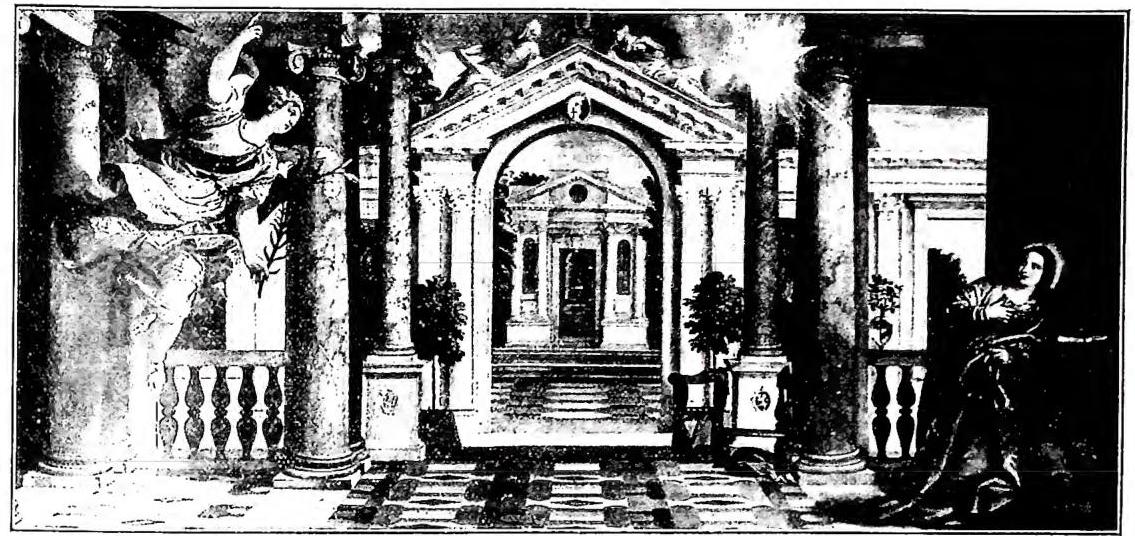
(photo, Alinari)
The profane aestheticism, steeped in outward mysticism, which characterizes the manner of the Pre-Raphaelites (v. PRERAFFAELLISMO). Contemporary art, while not renouncing the peculiarities of current pictorial taste, through the very few noteworthy examples, seems in some way to revert to traditional iconography (see, for example, the work of Cercchini, a cartoon for the church of Segozia).