
St. BERNARDO of CHIARAVALLE – A miniature depicting St. B. – Book of Hours in use at Mâcon (late 15th century). The text contained in the scroll, once attributed to St. B., is now claimed for Arnaldo of Bonneval, his friend.
full of biblical allusions and phrases. Barely three years after entering the monastery, he was entrusted with founding a new religious colony at Absinthe, on the left bank of the Aube (Champagne), placed under the patronage of the Most Holy Mary and later called Chiaravalle (Clairvaux), which he governed for 38 years as abbot, dividing his prodigious activity between his abbey and the other foundations that followed, the Church of Rome, and all Christendom. For about ten years, B. devoted himself almost exclusively to the organization of his Order: he interpreted the Rule of St. Benedict with austerity; he demanded rigorous mortifications, poverty, absolute separation from the world, and full obedience, leaving much time for manual labor. In 1118, the Charter of Charity was drawn up, the fundamental statute of the Cistercian Order, officially confirmed in 1119 by Pope Callistus II. B. had to defend its austerity against the criticisms of the Cluniacs (cf. Apologia ad Guillelmum, abbot of St-Thierry): thus arose the famous literary controversy between the "white" and "black" monks, embodied in St. B. and Peter the Venerable, abbot of Cluny (cf. Epist., I, 28: PL 189, 112 ff.), which ended in mutual understanding. B. vigorously exhorted his monks not to stop at externals; Peter the Venerable, in turn, carried out a wise reform in his monasteries (cf. St. Hilpisch, Geschichte des Benediktinischen Mönchtums, Freiburg im Br. 1929, pp. 213-26). B. also concerned himself with the religious and monastic life of many other Orders (v. infra), and had friendly relations with a great number of eminent figures
for sanctity and learning, such as St. Hildegard of Bingen, St. Malachy, archbishop of Armagh in Ireland, and the celebrated theological schools of the time, especially that of Paris. Often he traveled as legate, peacemaker, and counselor among emperors and kings, popes and bishops; three times he undertook the journey to Italy on behalf of Innocent II, fought for the Pope and the cause of the Church, suffering anxieties, opposition, combating various heresies and errors; he preached the Second Crusade. He was present wherever his counsel or intervention was necessary, or where the good of the Church and the State required it; he seemed tireless. In the last years of his life, B. suffered greatly, especially after the failure of the Crusade, due to the discord of its leaders and the lack of organization. Grieved by the death of dear friends (Hugh of Auxerre; the faithful Suger, d. 1151; Theobald, d. 1152; and other bishops and abbots); by the loss of Hugh, abbot of Tre Fontane, detained in Rome and made a cardinal; by abuses and serious faults of his secretary and confidant Nicholas (cf. Epist., 284); by disagreements with Eugene III, once his disciple, and above all by the weight of the labors he had borne, he was forced to rest (end of 1152). He still found the strength to go to Lorraine as a peacemaker between the bishop of Metz and Matthew, duke of Lorraine, finally succeeding, after violent struggles and massacres, in securing the acceptance of peace: the last work with which he crowned a prodigious activity for his Order and for the whole Church and his century. He died indeed at Chiaravalle on 20 August 1153, leaving in his abbey 700 persons and 165 monasteries of his Order, of which 68 were founded by him, scattered throughout Europe. Odo, abbot of Morimond, left us an incomparable document on the common grief for the loss of this man of God (cf. Hüffer, pp. 21-24). Dante (Par., XXI, 33), choosing him as his final guide in the paradisiacal journey and placing in his mouth the sublime prayer to the Virgin, gave B. the highest and most fitting praise. Countless are the praises of the Popes, among which notable is that of Pius XI in the Constitution Unigenitus Dei Filius (AAS, 16 [1924], p. 142), which concerns the spiritual formation of religious; Mabillon called him ultimus inter Patres, primis certe non impar.
Cult. — Alexander III canonized B. in 1174, and Pius VIII, on 23 July 1830, in consideration of the depth and purity of his doctrine, gave him the title of Doctor of the Church. His relics, in 1790, were transferred to Ville-sous-la-Ferté; the head, since 1813, has been in the cathedral of Troyes (cf. Ch. Lalore, Reliques des trois tombeaux saints de Claireaux, Troyes 1877-78). The cult of St. B. is very popular, not only in his Order, which had long venerated him as a Doctor, but in the universal Church itself: he is the patron of Gibraltar and Liguria, of wax chandlers and bees; he is invoked in favor of the possessed, against harmful beasts, and, in a 15th-century blessing, also against storms (cf. H. Bächtold-Stäubli, Handbuch des deutschen Aberglaubens, I, Berlin 1934, pp. 1087-91).
BIBL.:
- Hüffer, Der heilige Bernhard von Clairvaux, Münster 1886;
- Vacandard, Vie de saint Bernard, 2 voll., Paris 1927;
- Gilson, La théologie mystique de saint Bernard, Paris 1934;
- Leclercq, Saint Bernard mystique, Bruges 1948;
- e inoltre V. CISTERCIENSI; CLUNY; CROCIATE; EUGENIO III; INNOCENZO II; MONACHESIMO; PIETRO IL VENERABILE; TEOLOGIA.
A. M. Walz
II. WRITINGS
The works of St. Bernard constitute a true sum of spirituality, hence their wide diffusion.1. Epistolae (PL, 182, 67-662): an initial corpus epistolarum was compiled by Geoffrey, his secretary and later abbot of Clairvaux, containing 243 letters (cf. PL 185, 526); others were later discovered and added. Currently, approximately 540 are known, forming—due to the variety of their content, recipients, and length—one of the most interesting collections of documents on ecclesiastical history from 1120 to 1153, as well as on pastoral theology, ethics, and asceticism.
(cf. E. Vacandard, s. V. in DThC, II, col. 737 ff.; chronological list in E. Vacandard-M. Sierp, II, pp. 611-16; P. Rassow, Die Kanzlei St. Bernhardi von Cl., in Studien und Mitteilungen aus dem Benediktinerorden, Salzburg 1913; G. Hüffer, p. 184 ff.). The principal manuscripts are nos. 18.119 and 17.463 in the Bibliothèque Nationale de Paris, no. 242 in Grenoble, no. 852 in Troyes, and no. 154 in Dijon.
2. Sermones: all were delivered to religious communities and constitute a rich source for spiritual life. PL 183; new edition: B. Gsell and L. Janauschek, Xenia Bernardina (4 vols., Vienna 1891). The principal codex is no. 12.323 in the Bibliothèque Nationale de Paris; they have been translated into several languages. They include: 86 De tempore, expounding the liturgical character of feasts, among which the celebrated sermons Super minus est for Advent; 17 on Psalm 90 for Lent; 43 De Sanctis, including 11 on Mary, with the gem De aquaeductu, and 6 for the anniversary of the dedication; 125 De diversis, generally on biblical texts, among which 8 are spurious; 86 In Cantica Canticorum, an allegorical-mystical exposition of the Song of Songs, chapters 1-2, the primary source for his mysticism, with some allusions to contemporary events (25,1; 64-66; 80) and to the claustral life of Clairvaux (3, 6; 26, 3-14).
3. Tractatus: a) ascetical-mystical: De gradibus humilitatis et superbiae (PL 182, 941 ff.), addresses on chapter 7 of the Rule of St. Benedict, composed around 1121, in which he contrasts the 12 degrees of humility with the 12 degrees of pride. De diligendo Deo (PL 182, 973 ff.), ca. 1126, responds to the question: why and how God is to be loved; a masterpiece of great importance. De conversione ad Clericos (PL 182, 833-56), a sermon delivered in Paris in 1140 against the corrupt morals of students and their consequences (chapters 2-9), describes the requirements and happiness of conversion (chapters 10-18), the responsibility of the priesthood (19-20), and concludes with an exhortation to leave the world and become a monk. De moribus et officiis episcoporum (PL 182, 809 ff. = Epist., 42), ca. 1127, addressed to Henry, archbishop of Sens, clearly outlines the duties of bishops, even in relation to secular authorities, and touches on certain abuses by abbots. De consideratione (5 books), his most mature work (PL 182, 727 ff.; O. Malfranci, Brescia 1932), composed between 1149-53 and dedicated to Eugene III, is a manual for the perfect Pontiff, touching on various dogmatic truths, the manner of contemplation, and the sanctification of the Pontiff, while offering a broad plan for the reform of the Roman clergy and ecclesiastical discipline. — b) monastic: Apologia ad Guilelmum, abbot of St-Thierry (PL 182, 895 ff.), ca. 1126, defends the right of various forms of monastic life, particularly those of the Cistercians and Cluniacs. De laude novae militiae ad milites Templi (PL 182, 921 ff.), ca. 1132-36, dedicated to Hugh of Payens, master of the Templars, expounds his ideas on the legitimate war of Christians against infidels and establishes the rules, directives, and theological principles of the Templars, who united the duties of the religious state with those of knighthood. De praecepto et de dispensatione (PL 182, 859 ff.), ca. 1142, a series of solutions to questions on the obligation of the Rule proposed by the monks of St. Peter of Chartres. — c) liturgical: Epistola seu dialogus super Antiphonarium Cisterciense (PL 182, 1121 ff.), concerning the edition of the Antiphonary and Gradual of the Cistercians, which he prepared at the request of the General Chapter of 1132 (cf. H. Kienle, in Gregoriuablatt, 26 [1901], p. 2 ff.; E. Vacandard, S. B. et la réforme cistercienne du chant Grégorien, in Compte rendu du Congrès scientifique, cathol., IIᵉ sect., Brussels 1894-95, pp. 305-309). De correctione Antiphonarii, ca. 1132, establishes the laws of liturgical chant in the Cistercian Order (cf. Isagoge in musicam melliflui Doctoris s. B., Leipzig 1517; Hommey, Supplementum Patrum); Officium de S. Victore (PL 183, 371 ff.), uncertain date of composition; in the accompanying letter to Abbot Guido of Montiéramey, St. Bernard expounds his principles on liturgical matters. — d) dogmatic and apologetic: De gratia et libero arbitrio (PL 182, 1001 ff.), ca. 1127, expounds the relationship between grace and free will. Tractatus ad Hugonem de S. Victore de Baptismo aliisque quaestionibus (PL 182, 1031 ff. = Epist., 77), between 1136-40, probably against the innovations and assertions of Abelard. Contra quaedam capitula errorum Abaelardi (PL 182, 1049 ff.),
dedicated to Pope Innocent II (Epist., 190), ca. 1140, especially against Abelard’s Trinitarian and reconciliatory doctrine and his concept of faith; a profound and often excellent exposition aimed at securing the condemnation of the innovator. — e) hagiographical: Liber de vita et rebus gestis S. Malachiae Hiberniae Episcopi (PL 182, 1073 ff.), after 1148, his only historical work, meticulous and a valuable source for the conditions of Ulster in 12th-century Ireland, though somewhat credulous regarding strange miracles; it also served as a source for some antiphons in the Office of St. Bernard.
BIBL.:
E. Vacandard, Vie de Saint Bernard, 2 voll., Paris 1895; J. Leclercq, Recueil d’études sur saint Bernard et ses écrits, Rome 1962; Id., Saint Bernard mystique, Bruges 1948; Id., Saint Bernard et l’esprit cistercien, Paris 1966; B. Scott James, St. Bernard of Clairvaux, London 1957; J. Calmette - H. David, Saint Bernard, Paris 1953; A. Dimier, Saint Bernard de Clairvaux, Paris 1964; G. G. Meersseman, Introductio in opera omnia S. Bernardi, Roma 1947; H. U. von Balthasar, Gloria. Una estetica teologica, III, Milano 1975, pp. 235-310; F. Gastaldelli, Bibliografia Bernardina (1891-1990), Roma 1990.
A. M. Caplet
III. THOUGHT
1. Religious Life. — In his spirituality, St. Bernard shows himself a perfect disciple of St. Benedict, who undertook the task of leading souls, by the way of humility, to the highest degree of love for God (cf. Reg. s. Bened., ch. 7 at the end). Humility was truly the fundamental virtue of St. Bernard, a virtue he consistently spread through example and word. He sought to preserve it through the austerity of life and love for Christ, whose sweetness softens the weight of austerities and makes one more generous in bearing, indeed in seeking, the crosses that are a participation in His passion and glorification. The supreme degree of humility is at once the first degree of truth: the individual, knowing his own misery, attains knowledge of his neighbor’s misery with the desire to help him; he then ascends to a third degree, that is, to a love in which he loves God in every person and thing (cf. De grad. humil., 4-6). With singular clarity, St. Bernard expounds the true relationship between Grace, will, and personal merits: free will is necessary, but Grace is also necessary: tolle liberum arbitrium, non est quod salvetur; tolle gratiam, non est quo salvetur. With the fall of the first parents, man did not lose his freedom (libertas a necessitate or arbitrii), but is capable of choosing either beatitude or misery; however, the lost libertas comilii or freedom from sin is restored only through Grace, and only by cooperating with Grace does man obtain freedom from misery (cf. De gratia et lib. arb.). The affections and passions, whose manifestations and struggles he describes with powerful psychological depth, follow the vicissitudes of the will. Merits, possible only with antecedent and concomitant grace, are gifts of God, and God wishes to reward their use (cf. In Cant. Serm., 67, 10; De grat. et lib. arb., 13 and at the end); grace descends into the souls of the faithful through the Sacraments, and especially through the Eucharist, and, in a certain sense, renders them similar to Christ. The spiritual exercises that aid the soul in ascending the degrees of divine love are principally meditation and prayer: the former shows us what we lack, the latter obtains it from God (cf. Serm. I in festo s. Andreae, n. 10). Famous is the mysticism of the Saint: the degrees that form the mystical ladder by which one ascends in the love of God are expounded in ch. 8 of the De diligendo Deo (PL 182, 973); here is the list: self-love or carnalis, the lowest degree; love of God for the many benefits man receives from God; love of God for Himself, propter Deum; pure love that forgets itself and loves all and everyone in God (ibid., 2-11). Self-love, «quo ante omnia homo diligit se ipsum propter se ipsum» (ibid., 8), in its principle is legitimate because natural, but too easily exceeds its limits and drifts into pleasures, from which man must withdraw by returning to his own conscience, restraining curiosity, and through humility; self-love, to be just, must strip itself of its egoistic character and become common and social. The highest degree of love, mystical union, is a divine operation that elevates the soul already established in perfect charity,destroying what is proper in fallen man, and frees it from all covetousness and fear, illuminating the spirit through a more perfect understanding of Holy Scripture: adhaereus Deo anima unus spiritus est cum eo (cf. E. Gilson, La théologie mystique de s. B., Paris 1934). Characteristic of St. Bernard’s spiritual life is the Credo ut experiar and the alternation between action and contemplation (cf. J. Ries, Das geistliche Leben nach der Lehre des hl. B., Freiburg im Br. 1906).
2. Theology. — Man is created in the image and likeness of God. To attain sanctification after the fall, he therefore needs a restoration of his resemblance to God, and this is the work of the Divine Redeemer and Mediator between God and men, Jesus Christ. Before Christ, only a few had a clear prophetic knowledge of the Son of God and His redemptive work; meditation on the mysteries of the earthly life of the Incarnate Word is a most powerful means to enliven love and offers at the same time the model to which we must conform. Characteristic of Bernardine Christology, therefore, is devotion to Christ as the Infant in the manger and the Victim on Calvary.
In his Mariology, the Abbot of Clairvaux first celebrates divine motherhood, the reason for Mary’s other prerogatives (cf. Sermo in Assumpt., Dom. infra Assumpt., In vigilia Nativ. Dom., LII de diversis); the principal virtues by which she attracted God’s complacency are humility (cf. Sermo 3 in Annunciat., n. 9; 4 in Assumpt., n. 7) and virginity (cf. Serm. 3 in Assumpt., Serm. 2 in Adventu, n. 4). The union of divine motherhood with virginity is exalted several times with the words of the liturgy taken from Sedulius (PL 19, 599): «Gaudia matris habens cum virginitatis honore, nec primam similem visa est nec habere sequentem». He also enunciates the universal mediation of the Virgin, theologically founded on the fact that Mary gave the world in Jesus the source of all grace; Mary serves as a channel, an aqueduct, and it is God’s will that all things come to us through Mary, an idea that the Cistercian Office «B. M. V. in sabato» was later to inculcate again (De aquaeductu, n. 7; cf. P. Aubron, La Mariologie de s. B., in Recherches de science reli, 24 [1934], pp. 543-77; D. Nogues, La Mariologie de s. B., Paris 1934). Though yielding to the doctrinal prejudice of many of his time and not accepting the doctrine of the Immaculate Conception (cf. E. Campana, Maria nel dogma cattolico, 3rd ed., Turin 1928, p. 437 ff.), St. Bernard is the knight and singer of Mary; indeed, the liturgical lessons for Marian feasts are in part drawn by the Church from his sermons in honor of the Madonna.
In his doctrine on the Sacraments, St. Bernard defends the theory that children of Christian parents, like unbaptized adults who nonetheless believe, can be saved even without Baptism and outside of martyrdom: only contempt for the Sacrament is worthy of punishment. Furthermore, he holds that sinful actions committed without awareness of sin are nonetheless culpable (cf. De Bapt. [1, 2: PL 183, 1032-38]; cf. E. Vacandard, V. BERNARDO di CHIARAVALLE in DThC, II, cols. 745 and 774).
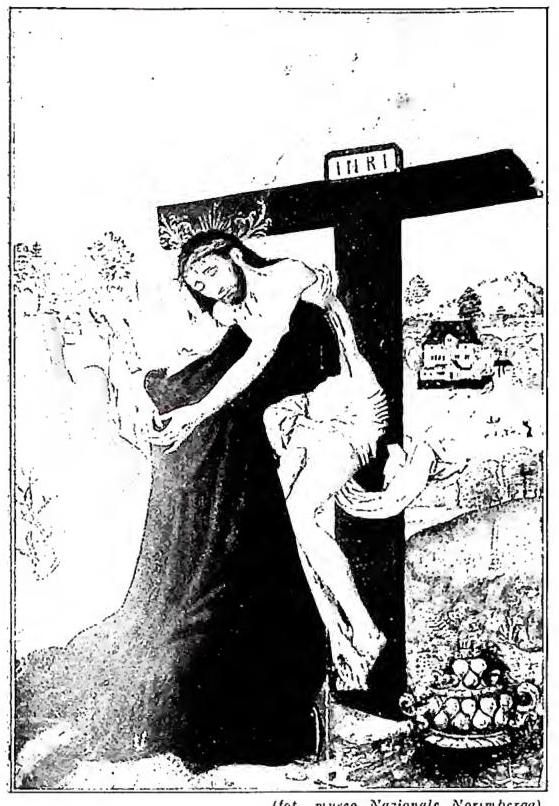
Papacy and empire must draw near and support
BERNARDO DI CHIARAVALLE, santo - Vision of St. Bernard of Clairvaux, School of Nuremberg (1487) - Nuremberg, Germanisches Nationalmuseum.
one another. The Pope possesses supreme and full power in the Church and can, if necessary, depose, change, transfer, or excommunicate even bishops without having to state the reasons; however, inferiors too, within their own sphere, have their inalienable rights before God and their responsibilities.
St. B. explicitly accepts the famous symbol of the "two swords," one of which, the spiritual, belongs entirely to the Church; the other, the temporal, must be wielded by civil powers, not without a certain oversight and authority on the part of the Church. He resolutely defends the Pope's infallibility against Abelard (PL 182, 1953); however, he clarifies that what is unjust in itself does not become just by papal approval (cf. Epist. 7, 7. 8; 178 and 231). On theological problems cf. E. Vacandard, s. V. in DThC, II, coll. 761-84; on Bernardine political thought cf. A. Steiger, Der hl. B. V. Cl., Brünn 1908; J. von Kozlowski, Kirche, Staat und Kirchenstaat im hl. B. V. Cl., Poznan 1916; F. Millosevich, Le idee politiche di s. B. di Chiaravalle, in Boll. di Studi storico-relig., 1 (1922), nn. 5-6; Ricerche religiose, 1 (1925), nn. 4-5. On the importance of liturgy for practical Christian life cf. A. Le Bail, S. B. docteur de la vie liturgique, in Revue Liturg. et Monast., 16 (1931), pp. 26-35. For his eschatology cf. F. Radke, Die eschatologischen Anschauungen B. V. Cl., Würzburg 1922.
BIBL.:
E. Vacandard, Vie de saint Bernard, 2 voll., Paris 1895; J. Leclercq, Saint Bernard mystique, Bruges 1948; A. Dimier, Saint Bernard de Clairvaux, Paris 1948; G. G. Meersseman, S. Bernardo e la liturgia, in Collectanea Ord. Cist. Ref., 10 (1948), pp. 5-24; further bibl. in Dictionnaire de Spiritualité, II, coll. 397-424; Dictionnaire de Théologie Catholique, II, coll. 749-84.
A. M.
IV. INFLUENCE
1. Religious Influence. - St. BERNARDO is the great reformer of religious life in his time. About a quarter of his letters deal with monastic matters, for his first and principal affection was for his Order. With his noble spirit, in which virgin chastity, generosity, virility, piety, and clemency intertwined, and with the fervor of his love for God and his eloquence, B. attracted men of every age, condition, and profession: from every journey he indeed brought back to Clairvaux a great number of candidates, and he elevated them to such monastic perfection that the fame of his monastery seemed to surpass that of Cluny. In this way, he contributed greatly to the renewal of religious-ecclesiastical spirit. In 1116, for example, he conducted a fruitful preaching in Châlons-sur-Marne, recruiting many novices, among whom were also religious and secular priests; in 1140, he was invited by the bishop of Paris to preach to the students; of his listeners, about twenty immediately left for the novitiate. Indeed, after the sermon for the crusade in the Rhineland, he brought back to Clairvaux approximately 350 young aspirants. One should not be surprised, therefore, if Clairvaux, usually overpopulated, could accept multiple requests for foundations: the 68 abbeys founded by St. B. soon became new centers of light and important hearths of spiritual life in France, Italy, Portugal, Spain, Belgium, England, Ireland, Germany, Austria, Sweden, Denmark, etc.; in 1153, the year of St. B.’s death, his monks reached the most distant and still barbaric lands. The influence of St. B. was alive everywhere, whether due to his annual visits and his presidency in abbatial elections, or through his letters and his delegates. St. B. also contributed greatly to improving the religious life of other Orders; from all sides, he was asked for advice or interventions: by the Carthusians (his influence on the Order of St. Bruno is known from his visit to the Grande Chartreuse [cf. PL 185, 305] and from his correspondence, especially Epist. 11); by the Premonstratensians, to whom he ceded land (Epist. 253; cf. 56, 178, 355); by the Regular Canons of St. Augustine; by the Benedictines (for example, at Cluny he eradicated certain disorders); in 1137, he settled the affairs of Montecassino. Finally, he is found in Italy, England, and the Rhineland, introducing salutary reforms in monasteries; he strongly supported the expansion of the ideals of the Regular Canons of St. Victor of Paris and Arrouaise and personally intervened among the Canons of St. Stephen of Dijon. On the occasion of the Council of Troyes (1128), he gave the Templars the Rule of St. Benedict adapted to the needs of military life; he was also a wise legislator for the Order of Calatrava. Several monasteries sought to affiliate, if not through the Rule, at least in spirit, with the reform of Cîteaux: St. Mary of York in England, St-Denis in Paris, Argenteuil, Compiègne, Ste-Geneviève, St-Sépulcre of Cambrai, Ponthières, and others. Other military orders, which arose in the following century, aligned themselves more or less closely with Cîteaux: those of Alcantara (1156), Aviz (1162), St. Michael or de l'Aile (1205), Montesa (1314), the Order of Christ (1319), St. George of Alfama, and several others. On his third journey to Italy, B. also founded the Third Order of the Humiliati in Lombardy.His counsel or intervention, not only in guiding souls but also, very often, in political, diplomatic, and ecclesiastical affairs, was highly desired by bishops and Popes, emperors and lay nobles (cf. J. Thiel, Die politische Tätigkeit des Abtes Bernhard V. Cl., Königsberg 1885). A good number of letters were addressed to bishops: he wanted the episcopate to be steeped in sacred literature, imbued with knowledge, humility, chastity, and charity, so that, thus purified, it might continue the reform of Gregory VII; he desired true shepherds of souls, and therefore often intervened in the election of worthy bishops: at Langres (1138), and shortly after at Reims, he urged Bishop Henry of Verdun to abdicate due to serious accusations (cf. MGH, Scriptores, X, p. 506 ff.); in 1128, he intervened in favor of the bishop of Paris with Pope Honorius III and King Louis VI of France; in 1145, he secured the election of the bishop of York against the protection of the bishop of Winchester; he exercised great and beneficial influence in the election of Bishop Alan of Auxerre; in 1133, he decided the double archiepiscopal election at Tours in favor of Hugh; he reconciled the bishop of Beauvais with Louis the Younger; he was a peacemaker between the bishop of Metz and Duke Matthew of Lorraine, etc.
He successfully sought to improve discipline, and especially chastity, among the lower clergy: his famous sermon De conversione ad clericos provides an eloquent example. He intervened in a great number of chapters, synods, and councils, always exercising great influence in decisions: at Troyes (1128), Châlons (1129), Étampes (1130), Reims (1131), Jouarre (1133), Pisa (1135), Sens (1140), Paris (1147), Reims (1148), to name only the principal ones. He refused the episcopate offered to him several times (in Genoa in 1130; in Milan in 1135; in Reims in 1138, etc.) and even the cardinalate.
2. Political Influence. — With Count Theobald of Champagne, in whose domains the lands of his Order lay, and in general with the nobility of the time, he always demonstrated prudent firmness, which often allowed him to intervene on behalf of the oppressed weak. In 1131, he reproached Emperor Lothair for arrogating to himself the right to invest bishops; in 1140, he intervened in the struggle against Louis the Younger and the count of Champagne over the investitures of Aquitaine (cf. J. M. Canivez, s. V. in DHG, VIII, coll. 624-26). A peacemaker even among the great of the world, he reconciled, for example, Louis the Younger of France with the count of Anjou and with the duke of Normandy; Emperor Lothair of Germany with Conrad of Sweden and Roger of Sicily with the Pope and the emperor; William of Poitiers with his king, as well as the cities of Pisa and Genoa, Milan, etc. Everywhere, the apostolate of St. B. sought, without distinction, among the great and the small, the observance of the laws of God and the Church. Above all, B. sought to confirm and propagate, with all his strength, the authority of the Holy See. At the Council of Étampes (1130), where the legitimacy of the two pontiffs simultaneously elected in Rome, Innocent II or Anacletus II, was discussed, B.’s intervention was decisive in favor of the former: his arguments, though contestable, convinced the king of France, then those of England and Germany-Italy, and these, with their countries, recognized Innocent, in whose favor B. twice moved King Lothair to a military expedition in Italy (cf. ibid., coll. 626-30; and particularly now P. F. Palumbo, Lo scisma del MCXXX, Roma 1942). B. often stirred the crowds with his eloquent enthusiasm (cf. E. Vacandard, S. B. orateur, Rouen 1877; E. Gérouzez, Essai sur l'éloquence et la philosophie de s. B., Paris 1839); he undertook arduous journeys, fought amid anxieties and oppositions, to support the Pontiff and the Church, until, on May 29, 1138, amid the joy of the Roman people, who proclaimed B. pater patriae, the saint witnessed the solemn submission of the antipope Victor IV, successor of Anacletus (cf. E. Amélineau, S. B. et le schisme d'Anaclet II, in Revue Quest. Hist., 30 [1881], p. 47 ff.). His expertise in canon law, and even more his ecclesiastical sense and his great efforts for the extinction of the schism, had made him an influential advisor to the Pope.
BIBL.:
In addition to the works already cited, see: J. Leclercq, S. Bernard et l'esprit cistercien, Paris 1944; E. Vacandard, Vie de S. Bernard, 2 voll., Paris 1927; J. von Walter, Die ersten Wanderprediger Frankreichs, Leipzig 1903-1906; A. Wilmart, Les sermons de S. Bernard sur le Cantique des Cantiques, in Revue Bénédictine, 47 (1935), pp. 289-308; G. G. Meersseman, S. Bernard de Clairvaux et la réforme des moniales, in Collectanea Ord. Cist. Ref., 1 (1934), pp. 101-120; A. Dimier, Recueil de plans d'églises cisterciennes, Paris 1949; L. Janauschek, Originum Cisterciensium tomus I, Vienna 1877; P. Schmitz, Histoire de l'Ordre de S. Benoît, Maredsous 1942-1956; H. Grundmann, Religiöse Bewegungen im Mittelalter, Berlin 1935; F. Stegmüller, Zur Literaturgeschichte der Schule von S. Victor, in Zeitschrift für kath. Theologie, 58 (1934), pp. 497-521; J. de la Croix Bouton, Les fondations de l'Ordre de Cîteaux en France au XIIe siècle, in Cîteaux, 1 (1950), pp. 5-36; M. Pacaut, Louis VII et les élections épiscopales dans le royaume de France, Paris 1957; G. Constable, The Second Crusade as seen by Contemporaries, in Traditio, 9 (1953), pp. 213-279; J. R. Sommerfeldt, The Spiritual Teachings of Bernard of Clairvaux, Kalamazoo 1991.
A. M. ZIMMERMANN
3. Defender of the Faith. — Upon his return to France, inflamed with zeal for the purity of the faith and unyielding in the defense of its theoretical and moral principles, he opposed the neo-Manichaeans in France and along the Rhine. These heretics denied the Church any authority over matters of faith and morals, suppressed the Priesthood and other Sacraments, and propagated the free interpretation of Holy Scripture. Bernard compelled their leaders, Enrico of Lausanne and Pietro of Bruys, to submit. At the Council of Sens (1140), he also secured the condemnation of fourteen articles by Abelard (cf. Hochland, 5 [1908], pp. 527-45; P. Lasserre, Un conflit religieux au XIIᵉ siècle, Paris 1930), and in 1148, at Reims, the condemnation of Gilberto de la Porrée (v.). He won over the heretical sects of the Apostolics and the Petrobrusians more through gentleness than severity, preaching and reconciling en masse the deceived in Toulouse, Bergerac, Périgueux, Sarlat, Cahors, Albi, and elsewhere. In Mainz, his intervention put an end to the bloody persecution of Jews; he was less successful, however, in Cologne, Worms, Speyer, Strasbourg, and other places. While recognizing the need for an interior renewal of ecclesiastical society—his observations against certain avaricious priests are particularly well-known—Bernard held the Church’s political rights and its possessions inviolable from lay encroachment. Thus, Arnaldo da Brescia (v.) and his reform, as well as those who usurped the Church’s and the Pontiff’s goods, a struggle marked by bloody revolts, especially in Rome in 1144.
He also directed his efforts toward defending the Church against the Muslims. Commissioned by Eugene III, he preached the Crusade for the liberation of the Holy Places in 1146-47 with such zeal and success in France and western Germany that approximately 200,000 men, led by Conrad III and Louis VII the Younger, took up arms (cf. G. Hüffer, Die Anfänge des zweiten Kreuzzuges, in Histor. Jahrbuch, 8 [1887], p. 391 ff.; K. Neumann, B. V. Cl. und die Anfänge des zweiten Kreuzzuges, diss., Heidelberg 1882). He wished the entire Christian world to participate in this endeavor—it appeared to him as a realization of the moral unity of Christendom through the military cooperation of individual states—and thus sought to draw England, Bohemia, Bavaria, Poland, Sweden, Norway, and Denmark into the movement. When the first enterprise failed, he began preaching a second Crusade; indeed, he had already been elected leader of the new expedition when the other Cistercian abbots forbade him from carrying it out. The extraordinary success of his preaching was greatly aided, as often on other occasions, by the fame of miracles attributed to him (cf. G. Hüffer, Die Wunder des hl. B. und ihre Kritiker, in Histor. Jahrbuch, 10 [1889], pp. 23-46, 748-806).
4. Theological Influence. — In the intellectual renewal of the 12th century, St. Bernard, alongside Hugh and Richard of St. Victor, essentially represents ascetic mysticism, characteristic of medieval religiosity. He was not a theologian in the technical sense of the word; rather, he was a magnificent exponent of the Church’s traditional values and a great orator. A man of profound sentiment, St. Bernard found neither Aristotle nor the dialectical-speculative method—recently introduced into theological truths by St. Anselm of Canterbury—satisfactory, though he himself employed it with great skill, for example, against Abelard. With his clairvoyant spirit and sure theological judgment, he grasped almost intuitively both the true and deeper meaning and the full beauty of these truths, which were guaranteed to him by Holy Scripture and the doctrine of the Holy Fathers (especially Augustine, Ambrose, and Gregory the Great). With tender affection, nourished by a deep spirit of recollection and prayer, he knew how to propose them to others, so much so that from the 15th century onward he was called the Doctor mellifluus.
5. Ascetic Influence. — St. Bernard’s ascetic influence on the spirituality of the following centuries, up to the present day, was vast and enduring. Among medieval authors, he was one of the most read and studied: already by 1891, the total and partial editions of his works had reached the impressive number of 500, and over 2,000 works had been written about him (cf. L. Janauschek, Bibliographia bernardina [Xenia bernard., 4], Vienna 1891); many others have been added since. A great number of works were also attributed to him: Janauschek (op. cit., part 4°, pp. IV-XIV) lists 120 in prose and 57 in poetry, including the hymn Iesu dulcis memoria (cf. B. Haureau, Sur les poèmes latins attribués à s. B., Paris 1882 and 1890; E. Vacandard, Les poèmes latins attribués à s. B., in Revue quest. hist., 49 [1891], p. 218 ff.; M. Herold, B.'s von Clairvaux Hymnen, in Realent. f. protest. Theol. u. Kirche, II, p. 638 ff.; A. Wilmart, Le « iubilus » sur le nom de Jésus dit de s. Bernard, in Ephemerides liturgicae, 57 [1943], pp. 3-285), and a Tonale (a treatise on the eight tones of Gregorian chant and their characteristic differences), written in dialogic form (M. Gerbert, Scriptores ecclesiastici de musica sacra potissimum, II, Sankt Blasien 1784). The Flores excerpti, collections of excerpts from the Saint’s writings, indicate that various categories of souls had taken him as a master of spiritual life and his works as objects of meditation. To these must be added anonymous and apocryphal books on the life and Passion of Christ and the sorrows of the Blessed Virgin Mary. With his considerations at the end of the treatise for the Templars, St. Bernard had indeed created a new kind of meditation: that is, to dwell upon the person and life of the Divine Redeemer, since the work of redemption is, more than any other subject, capable of exciting feelings of love in the redeemed. Nearly all theologians, preachers, and ascetics from the 13th century to the present day have drawn inspiration from his writings: foremost among them Peter Lombard, St. Thomas Aquinas, Gerson, and many others. The Imitation of Christ is not only nourished by Bernardine quotations and thoughts but even appears in certain manuscripts as his work. Even among Protestants, St. Bernard has his admirers, from Luther and Calvin to the present day. He is therefore rightly called the father of Western mysticism, particularly Christocentric mysticism, and of the mystical marriage of the soul with the Word of God. Various schools have preserved or developed his doctrine: the Cistercian School and the celebrated Schola Claravallensis, with the works of William, abbot of St-Thierry, Aelred, abbot of Rievaulx in York, Guerric, abbot of Igny, Isaac, abbot of l'Étoile (de Stella), and others. The moral commentaries on the Song of Songs found continuators and imitators in Gilbert of Hoyland (d. 1172), Thomas of Cîteaux (ca. 1180), Baldwin, abbot of Ford and later archbishop of Canterbury (d. 1188), and many others.
BIBL.:
J. Leclercq, S. Bernard mystique, Bruges 1948; E. Vacandard, Vie de S. Bernard, 2 voll., Parigi 1895; J. von Walter, Die ersten Wanderprediger Frankreichs, Lipsia 1903-06; A. L’Huillier, S. Bernard et son temps, Parigi 1889; T. Merton, The last of the Fathers, New York 1954; G. Hüffer, Der hl. B. von Clairvaux, Münster 1886; L. Janauschek, Bibliographia bernardina, Vienna 1891; E. Amélineau, S. B. et le schisme d’Anaclet II, in Revue Quest. Hist., 30 (1881), p. 47 sgg.; P. Lasserre, Un conflit religieux au XIIᵉ siècle, Parigi 1930; G. Hüffer, Die Anfänge des zweiten Kreuzzuges, in Histor. Jahrbuch, 8 (1887), p. 391 sgg.; K. Neumann, B. V. Cl. und die Anfänge des zweiten Kreuzzuges, Heidelberg 1882; G. Hüffer, Die Wunder des hl. B. und ihre Kritiker, in Histor. Jahrbuch, 10 (1889), pp. 23-46, 748-806; B. Haureau, Sur les poèmes latins attribués à s. B., Parigi 1882 e 1890; E. Vacandard, Les poèmes latins attribués à s. B., in Revue quest. hist., 49 (1891), p. 218 sgg.; M. Herold, B.’s von Clairvaux Hymnen, in Realent. f. protest. Theol. u. Kirche, II, p. 638 sgg.; A. Wilmart, Le « iubilus » sur le nom de Jésus dit de s. Bernard, in Ephemerides liturgicae, 57 (1943), pp. 3-285.
A. M. Amelli
still (cf. F. Cavallera, in DSp, I, col. 1494 ff. with bibliography; P. Pourrat, La spiritualité chrétienne, II, Paris 1928, pp. 183-92; A. Wilmart, La série et la date des ouvrages de Guillaume de St-Thierry, in Revue Mabilon, 1924, pp. 157-67; F. Bliemetzrieder, Isaac de Stella. Sa spéculation théologique, in Recherches de théol. anc. et médiévale, 4 [1932], pp. 134-59). St. Bonaventure, citing approximately 400 texts of the abbot of Clairvaux (cf. J. C. Didier, La dévotion à l'humanité du Christ dans la spiritualité de s. B., Paris 1920), with the Franciscan School became the promoter of the considerations on the mortal life of Christ, initiated by St. B. (cf. St. du Chambon-Feugerolles, La dévotion à l'humanité du Christ dans la spiritualité de s. Bonaventure, Lyon 1932, ch. 11 and bibl.); as for the influence of St. B. on Franciscan writings of the Middle Ages, cf. F. Vernet, La spiritualité médiévale, Paris 1929, pp. 32 and 77, and for the modern era, e.g., p. Costantino de Barbançon, Les secrets sentiers de l'amour divin, Douai 1623, new ed. Tournai 1932. The nuns of Helfta then, led by St. Gertrude and St. Mechthild, who toward St. Bernard had "specialem habebant devotionem propter mellifluorum verborum ipsius praerogativam" (St. Gertrude, Legat. div. pietatis, 4, 49), completing the master's doctrine with devotion to the Sacred Heart of Jesus, represent, at the end of the 13th century, one of those numerous communities that, with the aid of liturgical texts and under the spiritual direction of St. B., contemplate the love of Christ manifested to us in the mysteries of his humanity. Another nun, Beatrice of Nazareth (d. 1268), in describing the seven degrees of love, not only follows St. B. but employs his very formulas (cf. De seven maniere van minne, Louvain 1926, p. 3 ff.). The distinction made by St. B. in mystical experience — raptus, excessus, mystical marriage — has become classical.
Debtors to the great abbot of Clairvaux include: besides the great mystics of Germany, Eckhart, H. Seuse, J. Tauler, the celebrated French school of de Bérulle, with its principles: conformation to the Incarnate Word, interior states of Jesus, servitude of the humanity of Christ; Jan van Ruysbroeck, who follows St. B. in the seven degrees of love, as he does in the images he employs for the assimilation of the soul to God and especially in the description of the excessus (cf. Melline d'Asbeck, La Mystique de R. l'Admirable, Paris 1930, pp. 87-90), and the School of the devotio moderna with its leader Geert Groote and his brethren of the Congregation of Windesheim (cf. H. Gleumes, Gerhard Groot und die Windesheimer als Verehrer des hl. B. V. Cl., in Zeitschrift f. Aszese und Mystik, 10 [1935], p. 90 ff.), who draw much from Bernardine inspiration (cf. I. Huijben, Aux sources de la spiritualité française au XVIIe siècle, in La Vie Spirit, 25 [1930]: part Etudes et documents, Dec. 1930, p. 126).
6. Philosophical Influence. — Of philosophical problems, those that interested St. B. particularly were those having a direct relation with practical religious life. Thus, St. B. considers the nature of man always in intimate relation with original sin and the grace of redemption, and therefore condemns all that is demanded in the name of nature and recommends the mortification of the body and the senses. His theories, then, on Christian freedom and free will, on law and Christian morality, on intention, conscience, and obligation; his ideas on love and its object, especially how man knows himself and ascends from self-love through various degrees to the love of God; his psychological doctrine on seeking and finding God, on the structure of the soul and its qualities, and on the fact that man was created in the image and likeness of God and is therefore capable of participating in the majesty and happiness of God (anima capax Dei), all this and other philosophical-religious speculations give St. B. a preeminent place in the philosophy he channeled toward Catholicism, preparing the ground for the great Thomistic synthesis of the following century (cf. E. Gérouzez, Essai sur l'éloquence et la philosophie de s. B., Paris 1839; E. Gilson, L'esprit de la philosophie médiévale, 2 vols., Paris 1932, passim). Not without reason, therefore, is St. B. called the father of Christian philosophy.
The first printed edition of the works of St. B. was edited by A. Bocard, un publica melliflui devotique doctoris s. Bernardi scripta (Paris 1508); subsequently, more accurate editions appeared, such as those of J. Merlo Horst, S. Patris B. opera omnia (2 vols., Cologne 1641) and of J. Mabillon, S. Bernardi... opera... post V. I. M. Horstium ad varios codd. mss. collata (9 vols., Paris 1667), reprinted in 1690 and in 1719 (posthumously) by Massuet and Le Texier, reproduced by Migne (PL 182-85), where a very complete enumeration of manuscripts is also found (182-83: genuine writings; 184: false and spurious); useful is the Chrestomathia bernardina by E. Piszter (Turin 1939).
An accurate and nearly complete list of the bibliography on St. B. up to 1891 is found in G. Hüffer, Die Wunder des hl. B., in Hist. Jahrbuch, 10 (1889), pp. 23-46, 748-807; in the appendix of L. Janauschek, Xenia Bernardina, Vienna 1891. - L. Chomton, S. B. et le château de Fontaine-lès-Dijon, 3 vols., Dijon 1891-95; J. Jobin, S. B. et sa famille, Poitiers 1891; E. Vacandard, Vie de s. B., Abbé de Clairvaux, 2 vols., Paris 1895, last ed. 1927 (fundamental work); J. Jobin, S. B., Paris 1904 (useful anthology of the most significant passages extracted from the works of St. B.); J. Bernhart, Eucharische und bernhardische Mystik in ihren Beziehungen und Gegentätzen, Kempten 1912; U. Berlière, L'Ordine monastico dalle origini al sec. XII, trans. ital. M. Zappalà, Bari 1928, p. 126 ff.; G. Goyau, S. B., trans. ital. G. Decca, Brescia 1928 (popular); [Various auth.], S. B. et son temps. Recueil de mémoires et communications présentés au Congrès de Dijon 1927, 2 vols., Dijon 1928; P. Miterre, S. B. de Cl. Un moine arbitre de l'Europe au XIIe siècle, Genval 1929; id., La doctrine de s. B. Le théologien, l'ascète, le mystique, le docteur de l'Église, Brussels 1932; E. Gilson, La théologie mystique de s. B., Paris 1934; W. Williams, St. B. of Clairvaux, Manchester 1935; J. Leclercq, S. B. mystique, Paris 1948.
Other works are cited by J.-M. Canivet, s. V. in DHG, VIII, cols. 610-44; by M. Mahler, s. V. in DSp, I, cols. 1454-1499; and by J. Schuck, s. V. in LThK, cols. 197-201; E. Vacandard, s. V. in DThC, II, cols. 761-84. Filippo Oppenheim