
CANCELLERIA. — This is the office in which “the acts of the public authorities are drawn up” (C. Paoli) and the operations connected with this function are carried out.
The name does not predate the ninth century, when for the first time we find the dignity of the cancellarius (v. CANCELLIERE) elevated to the direction of this office; but the structure of the medieval c. is directly connected, without interruption, with that of the Eastern Roman Empire,
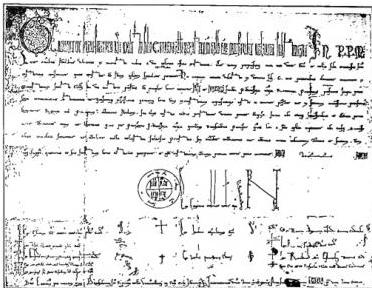
(from Steffens, Lateinische Paläographie, pl. 73 a)
CANCELLERESCA, SCRIPT — Privilege of Gregory IX, dated 5 May 1234. S. Gallo, abbey archives.
senatorial, between the age of Diocletian and that of Constantine, the duties of the c. passed to persons of senatorial rank, as demonstrated by the title of clarissimi attributed to them: these functions were subordinate to the magister officiorum (Notitia dignitatum, Occid. IX, 15, ed. Seeck, p. 145 = ed. Böcking, p. 43). At the court of Byzantium, the c. appears to have consisted of four sections (scriina), three presided over by a magister (ab epistolis; a libellis; memoriae), and one by a comes (dispositionum), under the authority of the magister officiorum (Notitia dignit., Orien. XI, 13–16, ed. Seeck, p. 32 = ed. Böcking, p. 38) and later of the quaestor sacri palatii, who directly represented imperial authority. Each section had a college of notarii principii (cf. Cod. Iustitu., XII, tit. 7) of various ranks and, from the 5th century, a college of referendarii (reporters of petitions before the emperor, custodians of the seal, and signatories of documents).
The organization of the Byzantine imperial c. was adopted by the Romano-barbarian rulers: notarii and referendarii are found, with approximately the same duties, among the Ostrogoths, the Lombards (where, however, the referendarii appear only rarely and their responsibilities cannot be specified), and the Merovingians. Under the latter, the maior domus acquired a pre-eminent function, to such an extent that one of these officials, Pepin, would usurp the royal power and initiate the Carolingian dynasty (752). Pepin the Short, and even more so Charlemagne, brought about an important transformation in the c., drawing its personnel exclusively from the ecclesiastical rank and dividing it into two categories: the notarii, whose task was to compose or dictate the document, and the scriptores, who attended to the physical drafting of the documents. It was during this period that the head of the office came to be the cancellarius, who signed the document.
THE IMPERIAL C. — With the foundation of the Holy Roman Empire, an imperial c. was also reconstituted in the West, preserving the organization of that of the Carolingian kings. The title of the person presiding over this office does not appear to have been constant: in the documents he is designated now as the notarius, now as the protonotarius, now as the cancellarius, and sometimes also as the magister. It also happens that different designations are found in the text and in the subscription of one and the same act. Nevertheless, the office of notarius is distinct from that of cancellarius, and subordinate to the latter. Under Ludovico II, son of Lotario I, the title of archicancellarius appears for the first time, applied to the subdeacon Dructemiro (851–61), formerly notarius in the c. of Lotario: an element of great importance, because the archchancellor gradually became a court office. No less innovative was the action of Ludovico II il Germanico, son of Ludovico il Pio and king of Germany from 843 to 876, who in 854 placed the archchaplain Grimoldo, formerly abbot of Weissenburg and subsequently of S. Gallo, nominally at the head of the c. This precedent, which was subsequently widely followed, contributed on the one hand still further to transforming the office directing the c. into a court office, while on the other it brought about a certain change in the internal structure of the c. itself. Although the relations between chapel and c. had already previously been close (the chaplains were, moreover, custodians of the royal archive), and although the archchaplains never became deeply involved in the running of the c., it is natural that particular directives issued by the same person to both offices should tend to make their structures uniform, modifying one on the model of the other.
Under Ottone I, the practice arose of dividing the c. according to the various regions of the empire: in 962, alongside a c. for Germany, a c. for Italy was thus established, and in the 11th century, under Enrico III, a third was added for Burgundia. At times a single archchancellor, who was also archchaplain, supervised two c., but more often the offices were distinct and were conferred upon various bishops of the empire. In time, however, they tended to become attached to a particular see, and from Lotario di Supplinburg onward the archchancellorship of Germany is found entrusted to the archbishop of Magonza, and that of Italy to the archbishop of Colonia. Under Enrico VI, the archchancellorship of Burgundia also became attached to the bishopric of Vienne, and then, from 1257, to that of Treviri, with the title of archicancellarius per regnum Arellatenae (Arles), and subsequently for Gaul. The increasing political influence of these dignitaries induced Enrico VII to undertake a new reform: from that time onward, the archchancellors appointed a single chancellor for the entire empire, who exercised his office in the three c. in the sovereign’s name, while remaining, for purposes of appointment, bound to the aforementioned bishops.
Under Federico I Barbarossa, the title of protonotarius appears for the first time, applied to an official whose duties overlap with those of the chancellor, whom he entirely replaces in the latter’s absence. The distinction between employees as notarii and scriptores, on the other hand, continued in the tradition of the Carolingian c.
THE PONTIFICAL CHANCERY. – The origins of the pontifical chancery are somewhat obscure, given the scarcity of documents on the subject. It is certain that Christian communities soon had notarii, on the model of pagan institutions; the origin of the papal chancery seems to be connected with them. By the 5th century it undoubtedly had a defined organization of its own: the presence of a fixed formula and the use of specific rhythmic clauses in the pontifical letters that have come down to us through collections provide certain evidence of this (cf. F. Di Capua, Il ritmo prosaico nelle lettere dei Papi e nei documenti della c. romana dal IV al XIV sec., I, Rome 1937, p. 201). Toward the end of the 6th century, the period to which the first reliable evidence dates, under the pontificate of Gregory the Great, the chancery officials are found bearing the title notarius et scrinarius, which, according to the most widely accepted view, indicates that they also performed the office of archivists. They were united in a corporation (schola), based at the Lateran, headed by a primicerius and, subordinate to him, a secundicerius; among them, a prominent position was held by the notarii regionarii, that is, those of Rome’s seven ecclesiastical districts.
From the 8th century, and more precisely from the pontificate of Hadrian I (772–95), the officials, who began to subscribe the documents, are found divided into the two traditional categories of “daters” and “writers,” and within their sphere they had particular duties, as can be seen from the title accompanying their names in the subscriptions: notarius, scrinarius, nomenclator, cancellarius, bibliothecarius. The latter office gradually absorbed the functions of the primicerius, and the bibliothecarius soon came to head the chancery: from the pontificate of Gelasius II (1118–19), we see this office consistently conferred upon persons of cardinal rank. At the same time, however, under the influence of the imperial chancery, the office of cancellarius also rose to great power, so that under Leo IX (1049–54), who introduced substantial changes both with regard to the document itself and to the staffing of the chancery, one finds, as in the imperial chancery, the archicancellarius. This title, conferred upon the archbishop of Cologne, was for a certain period combined with that of bibliothecarius; then, under Lucius II (1144–45), it became entirely independent and alone represented the highest authority in the chancery, remaining linked to the dignity of cardinal.
With Innocent III (1198–1216), another period begins in the history of the pontifical chancery: the new organization, which in its broad outlines remained unchanged until the pontificate of Leo XIII, is extensively documented in the continuous series of the “Registers,” which begins precisely in 1198. The “secretaries” were attached to the chancery, and from them were issued the litterae secretae, of a private nature and without the formalities of the litterae de curia; then the office of vicecancellarius, which had previously been temporary in character, became permanent and acquired defined functions, until in 1213 it led to the suppression of the dignity of cancellarius. Although the direction of the office remained with the “vice-chancellor,” it was no longer entrusted to a cardinal; but in the 14th century, under John XXIII (1316–34), the “vice-chancellor” too attained that dignity. The establishment of the “regent” also dates from the same century: he was appointed by Gregory XI in 1377 to replace the “vice-chancellor,” who had remained at the Avignon see, and the office subsequently became permanent. In this period, which was perhaps the era of the pontifical chancery’s greatest activity, it was constituted as follows: a cardinal “vice-chancellor,” head of the office; a regent; several protonotarii (corresponding to the ancient notarii); and various minor officials, divided into four categories corresponding to four distinct sections: the breviatores, who prepared the drafts; the grossatores, who transcribed the document in fair copy (in grossam litteram); the registratores, who carried out the registration procedures; and the bullatores, who affixed the seal. There was also a corrector, exclusively responsible for the formal revision of the acts.
In the following century, with the spread of a new type of document, the “brief (v.),” whose external and internal characteristics differed entirely from those of the “bulls,” it became necessary to establish a new office, the Secretariat of Briefs, which absorbed many of the chancery’s responsibilities. The breviatores (or abbreviatori [v.]), while partly assuming the functions of the protonotarii, also acquired new duties of a jurisdictional nature that lay outside the sphere of the chancery. Subsequently, the minor offices disappeared, being definitively suppressed by Leo XIII in 1901.
The current organization of the pontifical, or “apostolic,” chancery is regulated by Pius X’s constitution Sapienti consilio, which reduced its proportions in accordance with the new requirements, restoring for its head the ancient name of cancellarius and linking it to the cardinalatial title of S. Lorenzo in Damaso.
Canon 260 of the CIC establishes the following with regard to the apostolic chancery: “The proper office of the Apostolic Chancery, presided over by the cardinal chancellor of the Holy Roman Church, is this: to issue apostolic letters or bulls for the provision of consistorial benefices and offices, for the establishment of new provinces, dioceses, or chapters, and for the execution of other major affairs of the Church.”
These letters or bulls are issued only on the mandate of the Congregations: the Consistorial Congregation, the Congregation for the Oriental Church, the Congregation of Propaganda Fide, etc., or of the Supreme Pontiff; in individual cases, the terms of the mandate itself are observed.
At the head of the chancery is the cardinal chancellor of the Holy Roman Church, assisted by the regent and a few officials. Throughout the Middle Ages, the organization and regulations of the pontifical chancery frequently served as a model for episcopal chanceries, which even reproduced the external characteristics of their acts: the archiepiscopal diplomas of Benevento offer a typical example.