
with the major work De hierarchia et hierarchis (Rouen 1641), directed against Petrus Aurelius (that is, Saint-Cyran) and Hallier. Condemned by the Assembly of the clergy for certain new or strange propositions, he escaped condemnation by the Sorbonne through a retraction: Propositiones aliquos ex libro De hierarchia (Paris 1641), which he later attempted to mitigate in his Hararum subsecivarum liber singularis (ibid. 1648). The De hierarchia was placed on the Index in 1642 «donne corrigatur» (the manuscript documentation of the case is held in the Vatican Library, Barberini collection XXXIX, 54). Much later, in 1732, the same fate befell, on account of certain appendices, his vigorous Historia Gottes- chalci praedestinationis (ibid. 1655).
The c. was discovered in 1665 by Hooke in cork and observed in animals and plants by Leeuwenock (1632–1723); in 1675 Malpighi regarded the c., which he called utricles, as the fundamental constituents of plants.
In 1831 Brown considered the nucleus a fundamental constituent of the c.; in 1850 Mohl observed cell division.
(propr. Enc. Catt.)
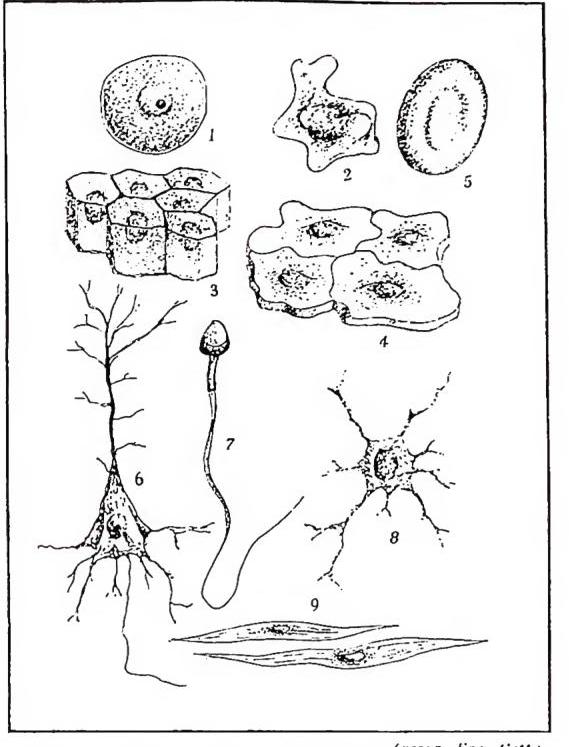
CELLULA. — Some types of differentiated cells: 1. oocyte (egg cell); 2. amoebocyte (leukocyte); 3. cuboidal epithelium; 4. squamous epithelium; 5. erythrocyte; 6. nerve cell; 7. spermatozoon; 8. connective-tissue cell; 9. muscle cells.
rest, although some consider the axial filament or chromonema to be present, since this is a condition regarded by some as highly important for explaining the transmission of hereditary traits. The number of chromosomes is constant in all the cells of individuals of a given animal or plant species, in a simple (haploid) or doubled (diploid) complement.
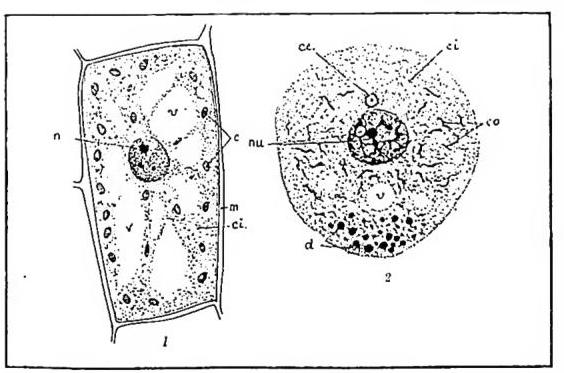
From a purely structural point of view, in the resting nucleus one sees clumps of chromatin immersed in the nuclear sap. Chemically, chromatin is composed of nucleoproteins and ribo- and deoxyribonucleic acid (or thymonucleic acid). Other organelles and structures are found in the cytoplasm: the chondriome, formed of granules or filaments consisting of phospholipoproteins, which is of great importance in many cellular processes, including the elaboration of secretions and the formation of differentiative structures; the ergastoplasm, the denser part of the cytoplasm, regarded by some authors as the upper cytoplasm (Garnier); the sphere apparatus, which is radially shaped and, during cell division, divides into two parts that move toward the poles. The reticulum or Golgi apparatus, the lacunome, the paranuclei, etc., represent other formations of great importance for the expression of the vital phenomena of the cell. The structure of the primary cell membrane is particularly important because, although it possesses the physical attributes of physical membranes, it has special properties that we can only define as vital, such as the power of selection, which no physical membrane possesses.
From a chemical point of view, the fundamental cytoplasm is a complex of proteins and lipids (lecithins and sterols) imbibed with water and containing mineral salts.
(property of Enc. Catt.)
CELLULA. — Undifferentiated plant (1) and animal (2) cell, m. cellulose membrane; c. chloroplasts; e. vacuoles; n. nucleus; d. deutoplasm (the egg’s reserve substance); ci. cytoplasm; co. chondriome; ce. centrosome (in relation to the sphere apparatus); nu. nucleoli.