
EFESUS ("Ephesos"). — A city on the Ionian coast of Asia Minor, of Mycenaean origin as attested by archaeological remains, situated almost at the mouth of the Cayster and endowed with an excellent port that sustained its commerce from the sea to the mountains of Taurus. It was successively occupied by Croesus, king of Lydia, by the Persians (545), by the Macedonians (334), and in 133, by the will of King Attalus III, it passed to the Romans, under whom it became the richest and most commercially active city in Anatolia.
E. was the native city of Heraclitus, the iambic poet Hipponax, the elegiac poet Callinus, and the painter Parrhasius. The principal deity worshipped at E. was the Great Mother, depicted standing with hands on hips, adorned with many breasts, signifying her inexhaustible fertility. The Greeks identified her with Artemis, who in turn was assimilated to the Italic Diana. Her Ionic dipteral temple burned in 356 at the hands of Herostratus but was rebuilt more splendidly (Strabo, XIV, 1, 22; Pausanias, IV, 31, 8; VII, 2, 6). Within the temple precinct stood a sanctuary dedicated to Augustus, symbolizing the union of provincial and imperial cults (cf. V. Chapot, *La province romaine proconsulaire d'Asie*, Paris 1904). From the Ephesian sanctuary derives the *Ephesia grammata*, formulas believed to possess magical power for those who pronounced or carried them.
The site of E. destroyed in the Byzantine era by the Seljuk Turks (1116) corresponds to the present Turkish village of Ayaşoluk, a corruption of *Ἀγιος Θεολόγος*, referring to the Apostle St. John, who labored at E. and there had a basilica, now in ruins, around which the devotion of the Christian people developed, and where Italian merchants thronged the bustling markets.
Nicolò Turchi
I. E. IN THE NEW TESTAMENT. — E. was the scene of the activity of St. Paul, and later of St. John.
St. Paul was at E. for a few days at the end of his second missionary journey (52–53). His warm reception in the synagogue led him to promise to return. Meanwhile, Aquila and Priscilla remained to prepare for the Christian conquest of E. (Acts 18:18–21). Soon after, Apollos (v.) arrived, a fiery apostle but imperfectly instructed in Christianity, whom the couple fully instructed and baptized. About a dozen "disciples" found themselves in a similar state when Paul returned to E. in 54 (third journey): instructed and baptized, they joined the nascent community (Acts 19:1–7). The break with the synagogue occurred after three months of disputation over the "kingdom of God." Paul moved to the school of a certain Tyrannus, one of the many rhetors abundant in the great cities of the East. It is uncertain whether the hall, which, according to a variant in Codex D in Acts 19:9, was at Paul's disposal from the fifth to the tenth hour (= 11 a.m.–4 p.m.), was provided free of charge. Two years of fruitful apostolic labor, which, due to the influx of foreigners and probable dispatch of disciples to other cities of proconsular Asia (Col. 1:7; 4:13), extended far beyond the boundaries of E. (Acts 19:26), aroused the jealousy of the Jews (Acts 19:13–17) and the concern of those economically invested in maintaining the cult of Ephesian Artemis (v. Diana). Indeed, as Paul prepared to leave Asia, Demetrius and the guild of silversmiths provoked the riot, during which some Asiarchs, Paul's friends, also intervened on his behalf (Acts 19:31). As to whether Paul suffered a prolonged imprisonment at E., ending in condemnation to the beasts (cf. 1 Cor. 15:32), and wrote his prison epistles from this city, V. PRISON, EPISTLES OF THE.
On his return from Asia to Jerusalem, Paul summoned the Ephesian presbyters to Miletus, where in a farewell discourse he defended his conduct (Acts 20:17–35) and announced that this would be their last meeting (Acts 20:25, 38). He returned to E., however, between his first and second Roman imprisonments, leaving Timothy there as bishop (1 Tim. 1:3). The last care Paul showed for the faithful of E. and the sorrows he endured on their account are mentioned in 2 Tim. 1:15–18. From his second Roman imprisonment Paul (2 Tim. 4:12), probably to facilitate Timothy’s journey to Rome, sent Tychicus to E., who had already undertaken other missions there (Eph. 6:21–22).
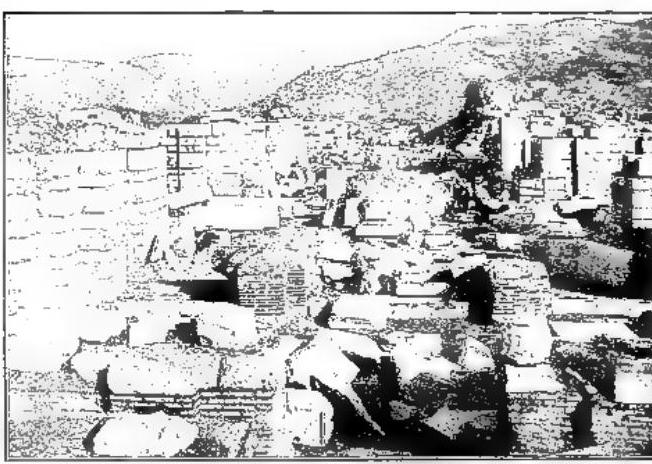
Of the monuments of E. uncovered by excavations at the end of the 19th and early 20th centuries, the Acts mention only the theater, where the frenzy stirred by Demetrius’s speech erupted. The so-called "Prison of St. Paul" can at most represent a confused memory of an imprisonment.
The only passage in the New Testament implying a connection between E. and the Apostle St. John is the first of the seven letters of the Apocalypse (2:1–7), addressed to the angel of the church in E. From it one may infer a directive and supervisory role exercised by the Evangelist over this and the other Asian communities. More clearly, it appears that toward the end of the apostolic age the church at E. was troubled by the erroneous propaganda of false apostles, and though it resisted these attacks fairly well overall, it had nonetheless declined from its original love. A trace of the tradition of John’s activity at E. is also found in the name of the present village Ayaşoluk (Ἀγιος Θεολόγος).
II. THE COUNCIL OF E
The third ecumenical council, held in 431.1. Occasion and preliminaries
The Council of E. arose from the controversy stirred in late 428 by Nestorius, patriarch of Constantinople, concerning the legitimacy of calling the Blessed Virgin *Theotokos*, "Mother of God," a title by which she had long been honored especially in Egypt and Cappadocia.Nestorius considered the term harmful, since it might suggest that Mary had given birth to the Godhead. He preferred the term *Christotokos*, "Mother of Christ," since this specification called to mind the two natures, divine and human, of the incarnate Word.
Nestorius’s strong aversion to the title *Theotokos* stemmed from his adherence to the heretical concept of the union of the two natures in Christ, recently elaborated by Theodore of Mopsuestia to combat the Apollinarian heresy. According to Theodore, “Mary bore Jesus but not the Word, the Logos; the Logos has always existed, never having had a beginning, though he dwelt in Jesus in a wholly special manner. Mary is therefore the Mother of Christ and not the Mother of God. One may speak of her thus figuratively, since God was in Christ in a wholly special way” (PG 66, 993).
These words essentially express the entire ecclesiological doctrine of Nestorius (v.) and constitute his heresy. He splits Jesus Christ into two subjects of attribution, into two persons, no doubt closely united, but at the same time coexisting as distinct within the union. One may well speak of a single personality, a single purpose of the Word and of the man Jesus, of divinity and humanity: but this single personality is of a moral and juridical order and does not suppress the duality in the physical persons; in Christ there are two beings who say “I,” “me,” on different planes. Narses well reduced his thought when he said that the Word was not born twice.”
This conception is already sufficiently visible in the homilies he delivered at the beginning of the controversy, but it is better manifested in his work, rediscovered in our day in the Syriac version, under the title: *The Book of Heracleides of Damascus* (published in the original text by P. Bedjan and in French translation by F. Nau, Paris 1910).
Nestorius’s preaching against the *Theotokos* caused a great stir and aroused protests from all sides, soon reaching Rome and Alexandria.
Alerted by representatives he had in Constantinople, St. Cyril of Alexandria promptly exposed the new heresy, at first not mentioning the author of it, then addressing himself directly to him (v. CIRILLO D'ALESSANDRIA, SANTO). Pope Celestine, fully informed both by the African Marius Mercator, resident in Constantinople, and by Cyril and Nestorius himself, pronounced against the innovator at the Roman Council of 11 August 430, ordering him, under pain of excommunication and deposition, to retract within ten days after notification of the Roman sentence by the bishop of Alexandria. Cyril did not hasten to carry out the delicate mission entrusted to him and greatly complicated the situation by submitting to Nestorius for signature a series of twelve anathemas, in which there were expressions that were novel up to that time and in full conflict with the terminology used by the Antiochene school. The bearers of the Roman sentence and of the letter of anathemas reached Constantinople only on 7 December 430. Meanwhile, Nestorius, foreseeing the blow that threatened him, had adroitly averted it by obtaining from the emperors Theodosius II and Valentinian III the convocation of an ecumenical council to examine his case. The decree of convocation, dated 19 November 430, fixed the opening of the Council at Ephesus for Pentecost 431, which fell on 7 June. The Pope, for the sake of peace, accepted the convocation of the Council, while writing on 7 May 431 that the execution of the Roman sentence against the innovator was postponed. Moreover, he appointed three legates—Bishops Arcadius and Projectus and the deacon Philip—to represent him at the future assembly, giving them very precise instructions on the conduct to be observed. This did not revoke the previous delegation of Cyril; however, the Pope exhorted him to make every effort to settle the controversy peacefully with the cooperation of the other prelates (Alunsi, IV, 1292). Indeed, the assembly promised to be tempestuous, since Cyril’s anathemas had unleashed a veritable storm among the Easterners of the patriarchate of Antioch.
2. History of the Council
Since many bishops had not yet arrived, the Council could not open on the appointed day, 7 June 431, and a two-week wait was necessary. Finally, on 22 June, even though neither the Easterners of the patriarchate of Antioch nor the Roman legates were present, Cyril held the first session, disregarding the protests of the imperial magistrate, Count Candidian, and the request for a further postponement advanced by an imposing group of more than 150 bishops. Summoned three times to appear, Nestorius refused. The trial was then conducted, with numerous documents concerning him being read—letters from Rome and Alexandria, letters and extracts from Nestorius’s own writings. Cyril’s second letter to Nestorius (the one beginning with *Katastasis*) was declared in conformity with the Nicene Symbol and solemnly approved, while Nestorius’s reply to it was condemned as heretical. The third letter of Cyril to the innovator, the one ending with the twelve anathemas, was also read—though nothing in the acts indicates that it received special approval from the Council, as had happened with the *Katastasis* letter. This was followed by a long patristic florilegium on the union of the two natures in Christ, in which some quotations from pseudepigraphic writings of Apollinarian origin are noted. Finally, the sentence of deposition and excommunication was pronounced: “Necessarily constrained, as they said, by the canons and the letters of our holy father and colleague Celestine, bishop of the Church of Rome, we have come with tears to pronounce this sad sentence against Nestorius: Our Lord Jesus Christ, whom he has blasphemed, decrees by this most holy Council that he be excluded from the dignity of bishop and from the entire priestly college” (Mansi, IV, 1212). The people of Ephesus, most devoted to the Virgin Mary, enthusiastically welcomed the condemnation of the adversary of the *Theotokos*: the city was illuminated, and the bishops were accompanied to their dwellings with torches and incense (cf. Epistle 87 of Cyril to the clergy and people of Alexandria: *PG* 77, 138).
Thus the triumph of orthodoxy was achieved in a single day. But the formalities had not been observed. The haste could only give rise to a schism among the bishops. On 26 June, John of Antioch arrived with his followers. Informed of what had taken place and invited to subscribe to the deposition of Nestorius, the Easterners refused. On the contrary, they met in a private council, condemned Cyril and Memnon, bishop of Ephesus, as guilty of Arian and Apollinarian heresy, and excommunicated their partisans.
Meanwhile, the Roman legates also arrived and presented to the Cyrillian Council a letter from Pope Celestine, while requesting communication of the acts of the first session. Four sessions were held with them (10, 11, 16, and 17 July), and in the last, on 17 July—the fifth in the series—John of Antioch and his followers, who had refused to appear and explain themselves, were excommunicated. Thus two opposing groups came into being, each anathematizing the other. Each party diligently informed the emperor in order to win him to its side. Greatly displeased, he ordered each side to send delegates to Constantinople to discuss before him, after which he would decide accordingly. This was done. The two delegations met not in Constantinople but in Chalcedon, without reaching an agreement, while Theodosius II, annoyed, declared the Council dissolved (end of October 431). Far from restoring concord, it had matured a schism; union could be restored only after two years of long and troublesome discussions. Finally, on 1 August 433, a formula of compromise, called the *Act of Union*, was subscribed to by both parties. In conclusion, the decisions of the first session remained in force: namely, the proclamation of the divine maternity of Mary and the deposition of Nestorius—precisely what Pope Celestine had already decided before the Council, whose convocation might well have been dispensed with.
3. Principal decisions
The Council of Ephesus’s principal decision was evidently the proclamation of the divine maternity of Mary, that is, the canonization of the Theotokos, which struck at the root of what was called the Nestorian heresy.Another decision, destined to become famous in the history of the Filioque controversy between Greeks and Latins, and one that also had importance in the Monophysite construction, is that presented at the sixth session (22 July 431) on the composition of creeds different from the Nicene Symbol: “The holy Council has decreed that no one shall be permitted to present, write, or compose any creed (ἐτέραν πίστιν) other than that which was fixed by the Holy Fathers assembled with the Holy Spirit at Nicaea...” (Mansi, IV, 1361 ff.). On this decree and its importance in the history of theological controversies, see M. Jugie, Le décret d’Éphèse sur les formules de foi et la polémique anticatholique en Orient, in Échos d’Orient, 30 (1931), pp. 257–270.
From the complicated and eventful history of this Council, the Roman primacy, the superiority of the Pope over an ecumenical council, is rather the imposing result of the entire Council without the Pope’s participation or presidency, brought vividly to light.
In the end, the Council was the executor of Roman decisions. For everything it did outside the program traced by the Pope, even with the approval of his legates, ultimately came to naught, since neither Celestine nor his successor Sixtus III approved the mutual anathemas exchanged by the two opposing parties.
“Impelled by the letter of Celestine,” the Fathers pronounced, during the first session, the deposition of Nestorius; as the acts record, at the beginning of each session, Cyril of Alexandria “holds the place of the bishop of the Church of Rome.” The Roman legates, arriving late, demanded that the first session be repeated before them, and were obeyed. And when all was concluded, one of these, the deacon Philip, made the following solemn declaration, which the assembly received with its approving silence: “No one doubts, or rather, it is a fact known throughout all ages that the holy and blessed Peter, the fisherman and chief of the Apostles, the pillar of the faith, the foundation of the Catholic Church, received from Our Lord Jesus Christ, the Saviour and Redeemer of the human race, the keys of the Kingdom, that power to bind and loose sins was granted to him; he himself lives and judges unto this day and forever in his successors” (Mansi, IV, 1296). The Vatican Council, as is well known, adopted the words of the legate of Ephesus, incorporating them into the holy constitution *Pastor Aeternus*.
Among the Council’s decisions should also be noted: the condemnation of the Pelagians and in particular of Caelestius, whose name is coupled with that of Nestorius in canons I and IV, presented at the seventh session on 30 August (Mansi, IV, 1471; though the acts give no particulars on this condemnation, cf. M. Th. Disdier, Le pelagianisme au Concile d’Éphèse, in Échos d’Orient, 30 (1931), pp. 314–33); and the declaration of the autonomy of the Church of Cyprus with respect to the patriarchate of Antioch, ratified at the same seventh and final session (Mansi, IV, 1465–76).
The memory of the Council of Ephesus is perpetuated in Rome by the great basilica of St Mary Major, which Pope Sixtus III (432) had built after the Council and dedicated to the Mother of God, adorning it with precious mosaics that have recently been restored; and also by the inscription that one of Celestine’s legates, the deacon Philip, had carved in the church of St Peter in Chains (cf. G. B. De Rossi, *Inscriptiones Christianae*, II, Rome 1887, p. 110).
The fifteenth centenary of the Council was solemnly celebrated in Rome in 1931. On that occasion, Pope Pius XI issued the encyclical *Lux Veritatis* of 25 December 1931, by which he extended to the universal Church, under the rite of a double feast of the second class, the feast of the divine maternity of the Blessed Virgin fixed for 11 October.
Ancient sources: Socrates, *Hist. eccl.*, VII, 29–34; Evagrius, *Hist. eccl.*, I, 2–7; Theodorus, *Hecatæ*, IV, 12; Liberatus, *Breviarium causae Nestorianorum et Eutychianorum*, 2–9. Other sources recently edited or completed: F. Loofs, *Nestoriana. Die Fragmente des Nestorius gesammelt, untersucht und herausgegeben*, Halle 1905; Nestorius, *Il libro di Eudocia di Damasco*, edited by P. Bedjan with translations of the Council, E. Gerland and V. Laurent, *Corpus notitiarum episcopatum Ecclesiae orientalis graecae*, I: *Le liste conciliari*, fasc. 2, Cádiz-Cologne 1936; Barhadbesciabba (a Nestorian bishop from the beginning of the eighth century), *Storia dei SS. Padri perseguitati per causa della verità*: PO 9, 439–631.
Tra i numerosi studi e monografie relativi alla questione nestoriana ed al Concilio di E. cfr. per gli antichi: Hefele-Leclercq, II, pp. 234-48, 295, 379; Per i recenti: M. Jugie, La primauté romaine au Concile d'Éphèse, in Echos d'Orient, 14 (1911), pp. 136-46; id., Nestorius et la contreverse nestorienne, Parigi 1912; F. Loofs, Nestorius and his place in the history of christian doctrine, Cambridge 1914; R. Devreesse, Les actes du Concile d'Éphèse, in Revue de sciences philosophiques et théologi- giques, 18 (1929), pp. 233-42, 408-31; id., Après le Concile d'Éphèse: Le retour des Orientaux à l'unité, in Echos d'Orient, 30 (1931), pp. 271-92; E. Amann, Nestorius, in DTHC, XI, coll. 76-157; A. d'Ales, Le dogme d'Éphèse, Parigi 1931; V. Grumel, Le Concile d'Éphèse: Le Pape et le Concile, in Echos d'Orient, 30 (1931), pp. 293-313; U. Th. Disdier, Le théologien au Concile d'Éphèse, ibid., pp. 314-33; H. du Manoir, Le Symbole de Nicée au Concile d'Éphèse, in Gregorien, 12 (1931), pp. 104-37; P. Galtier, Le centenaire d'Éphèse: Rome et le Concile, in Recherches de science religieuse, 21 (1931), pp. 160-192; J. Lebon, Autour de la définition de foi du Concile d'Éphèse, in Ephemerides theologicae Louvainenses, 8 (1931), pp. 309-412; A. Bernareggi, S. Ambrogio davanti al Concilio di E., in Storia della cattolicità, 2 (1931), pp. 42-57; E. Stéphanou, L'Eglise orthodoxe et la primauté romaine d'Éphèse, in Echos d'Orient, 32 (1931), pp. 57-78, 204-27; Fiche-Martin-Frutaz, IV, pp. 179-201.
III. LATROCINIO DI E
Il papa s. Leone I chiamò con questo appellativo il Concilio tenuto al E. dall'8 al 22 ag. 449, presieduto da Dioccoro, vedovo di Alessandria. L'assemblea era stata convocata da Teodosio II il 30 marzo 449, per riesaminare il processo di Eutiche, archimandrita d'un monastero di Costantinopoli, condannato come eretico nel Sinddo permanente di Costantinopoli (nov. del 448), presieduto da Flaviano, vescovo della città. Secondo l'idea del Imperatore, questo Concilio doveva essere comunico. Il papa s. Leone, benché avesse già approvato la sentenza del Concilio di Costantinopoli, dopo il controllo degli atti e della lettera di convocazione inviata dallo stesso Eutiche, accondiscuse a farsi rappresentare nel futuro concilio da tre legati: Giulio, vescovo di Pozzuoli, il prete Renato, che morì in viaggio, e il diacono Ilario. Fra le lettere affidate ai legati vi era quella per il vescovo Flaviano, che diventò poi famosa con il titolo di Tomo di Leone e Lettera a Flaviano. Vi era esposta magistralmente la dottrina cattolica sull'Incarnazione, prescindendo dalle terminologie orientali circa il mistero. I legati avevano l'ordine di leggerla nella riunione plenaria.gli alessandrini ed i loro seguaci intendevano nel senso di soggetto concreto, di natura-persona, di ipostasi, mentre i latini, gli orientali antiocheani, Flaviano ed Eusebio l'intendevano nel senso di natura propriamente detta, considerata cioè come distinta della persona. Con il latrocinio di E. comincia la lunga logomachia monofisita, che travolse poi nello scisma e nell'eresia l'Egitto, l'Etiopia, la Siria, l'Armenia.
(Ad J. K. L. Vormaßen Bericht über die Arbeiten von Alten d. ephésichein in Alibandung Von Alten d. ephésichein in Alibandung Von Alten d. ephésichein in Alibandung Von Alte d. ephésichein in Alibandung Von Alte d.)
(Ad J. K. L. Vormaßen Bericht über die Arbeiten von Alten d. eph
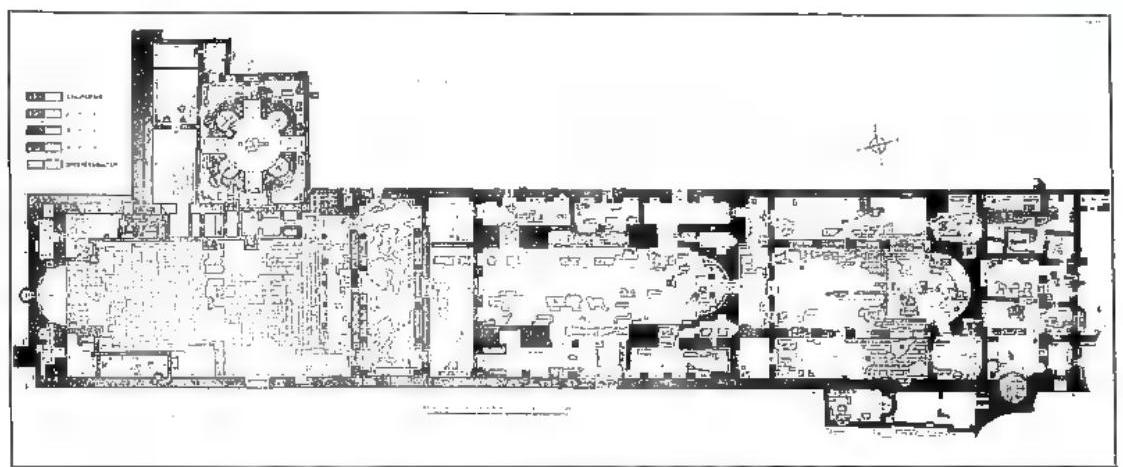
tiva = colonne, rimasta ad oriente della chiesa a pilastri. Quest'ultima divenne l'atrio del nuovo edificio, con cui comunicò, mediante una porta aperta al centro dell'abside. La nuova chiesa ebbe parimenti nantecce, tre navate divisa da pilastri, ed abside, corrispondente quest'ultima all'abside della chiesa primitiva. Nel mezzo della navata fu costruito il presbiterio, con ambone sporgente, e nel centro dell'abside una memoria impiantata su un basamento quadrangolare e ornata di otto colonne. Matroneli correvano sopra le navate laterali e sopra l'antecce. Alla basilica era appoggiata dal lato sud una piccola cappella absidata, forse sepolcrale; l'abside della cappella, come altresì le pareti della chiesa, erano ornate di pitture.
Ulteriori mutamenti subì ancora la seconda chiesa (quella a cupola e pilastri) in un periodo posteriore.
All'edificio di culto erano unite dalla parte di levente costruzioni di carattere civile (grande sala e colonne con bacino, sale minori, ecc.), nelle quali, secondo ogni reviso, si deve riconoscere il palazzo di abitazione del vescovo.
Quando tutto il grandioso complesso monumentale andò in rovina, e cessò di servire al culto, furono in esso dapprima adattate costruzioni profane, poi su tutto si sovrapposero delle tombe.
Le chiese descritte seguono tutte, come si è visto, il tipo basilicale originario = sviluppo longitudinale, con navate divisa da colonne.
Elementi di maggiore originalità presenta invece il secondo grande edificio cristiano di E.: la chiesa di Giovanni Evangelista sulla collina di Ayasoluk (corruzione di "Ayos" 6006yog).
Cominciata a scavare nel 1921-22 durante l'occupazione greca dell'Anatolia da G.A. Sotiriou, fu poi compiutamente esplorata fra il 1927 e il 1930 da J. Keil, Fr. Milton e H. Hörmann: dell'edificio = dello scavo si hanno però finora soltanto le piante e le notizie sommariate date nei brevetti raggiungibili del Beiblatt degli Yahrselefte dell'istituto arch. austriaco.
In the 4th, if not already in the 5th century A.D., above a group of underground chambers, in which tradition venerated the place of the Apostle’s burial (a well almost in the centre of them was said to have served for drawing manna, and a large terracotta pithos nearby to contain the water rendered sacred by the proximity of the tomb), there was built a square memoria (18 m. on each side) covered by a groin-vault supported on four columns and with four doors on each side: at a later stage the door on the eastern side was replaced by an apse. The type of construction is still perfectly in line with classical tradition: whether a pyramid-shaped crown rose above the vault remains only a hypothesis suggested by the analogy of the monument with mausolea of the classical age.
The main memory of the bishop was the church of Ilica, cruciform in shape, of which it formed the centre and one might say the raison d’être. The basilica, oriented east-west with its façade to the west, had a front part with three naves, preceded by a narthex, an héroon-narthex and a deep portico marked at the entrance by two columns; the side arms of the cross likewise had three naves; the hall to the east of the memoria, which one might call the presbytery, had five naves and ended naturally in an apse. The form of the building is connected with that of others in Syria and Palestine, built like this around a monument which for one reason or another enjoyed particular veneration. Of considerably greater size and with a much more complex plan, with elements that constitute a kind of passage ring from the paleochristian basilica to the Byzantine church of Hagia Sophia, was the building constructed by Justinian above the bishop’s church. Maintaining the same orientation, the new church likewise had the form of a Latin cross, with the memoria of the Saint at the intersection of the arms, but no longer, as in the previous church, enclosed within its original walls, but completely open and therefore in direct relation with the whole of the rest of the building. This was preceded by a quadrangular atrium surrounded by columns on three sides, the fourth side opening freely onto the façade of the actual church: at a later stage a propylaeum was added in front of this. Before the construction of this, three doors led into the narthex, covered by barrel vaults or perhaps also by small domes (tradition attributed eleven domes to the church), and from the narthex five doors, three corresponding to the central nave and two to the side naves, opened into the church; other doors were opened in the long southern and northern walls. The hall was over 93 m. long, and had a maximum width (corresponding to the arms of the cross) of over 62 m. In the front part, on six piers, the two central ones larger, rested two domes of elliptical shape, corresponding to two large bays of the central nave: four columns on each side of each of these bays divided the central nave from the side naves; some of the capitals recovered from these columns still preserve traces of gilding and colour and bear the monogram of Justinian and Theodora. A similar system recurred both in the two arms of the cross and in the space to the east of the central crossing towards the apse, with the sole difference that the domes covering these and this were perfectly circular, not elliptical; another similar dome covered the central crossing above the bema and the memoria of the Saint. The arms of the cross and the presbytery likewise had three naves. At the sides of the presbytery, closed by the apse, were two quadrangular chambers (modified by later additions), behind which stairs led up to the matronea. The walls were revetted below in marble, above in mosaic, as were the vaults: decorative elements have been found in the excavation, but in rather limited quantity. This can be explained by thinking that the building, although no longer used for worship, did not immediately fall into ruin, but was gradually stripped of its ornaments.
Other lesser Christian monuments of the city are: a small apsed chapel, hardly anterior to the bishop, adapted in a private house, situated on the terrace above the theatre; a Byzantine fountain with sculptured spouts (6th century), and a group of four columns, perhaps originally supporting statues, on the Arcadian Way, which rest on polygonal bases adorned with shell-shaped niches, according to the scheme known from the ambo of San-onico, also probably of the 6th century.
Of Christian cemeteries, that situated on the eastern slope of Panajir Dag has been extensively explored, near the cave where local tradition placed the legend of the Seven Sleepers. The cemetery developed above and around a kind of catacomb consisting of a series of ten vaulted chambers distributed on the sides of a short crypt, which evidently passed for those where the seven martyrs were said to have reposed: but if they served from the beginning as a place of burial, this must have been outside any coffin or bier, and that with the use of embalmed bodies: for coffins indeed no trace is found except, for the later depositions, when above the floor and against the original walls of many of these chambers masonry tombs were built. One of the chambers, however, seems to have remained as a chapel: its walls were adorned with paintings, probably representing the martyrs. A niche on the side of the staircase descending to the catacomb, also decorated with paintings, perhaps contained the tomb venerated as that of Mary Magdalene. Above the catacomb there arose, presumably around the middle of the 5th century, when the legend of the Seven Sleepers was formed, the first nucleus of the cemetery, consisting of a building partly in opus craticium and brick, partly hewn out of the rock itself of the mountain, and formed by a quadrangular room, flanked on the two sides, to east and west, by two smaller rooms of the same shape, of which that to the east, ending in an apse, was particularly destined for worship. All the rooms, including this one, were occupied by tombs: niche coffins, built into the floor or dug below it or in the walls. A large quadrangular space to the west served almost as an atrium, and was also occupied by tombs, like the two large and irregular niches opened on the southern side.
Attached to the north was instead a sort of quadrangular mausoleum with a central plan and three niches in the walls. Gradually, the cemetery expanded onto the terraces around the original nucleus, eventually containing about seven hundred tombs. The last part of it is represented by the so-called mausoleum of Abradas, so named from the name, inscribed above a lintel, of this personage, who is described as ἀγαθόφρονος, and who is said to have had it prepared. This mausoleum, like all the other elements of the sepulchre, partly built of masonry and partly cut into the rock, differs from the others because while these are all inspired by the concept of the building in an elongated form and covered with a vault, it instead presents the central-plan scheme. The possibility that the adoption of this scheme was inspired by the Justinian Basilica of S. Giovanni would lead one to date this mausoleum to around the middle of the 6th century, or in the following decades. All the buildings were generally paved with marble slabs, and had walls and vaults plastered, sometimes decorated with paintings and mosaics. During the excavation of the cemetery, rough earthenware jars were found, and above all a very large number of lamps; relatively few were the sepulchral inscriptions. From the descriptions of travellers and the inscriptions of visitors on the walls, it can be established that the cemetery remained visible until the 15th century. Some paintings at the entrance of the catacomb are to be attributed to the 13th century: on the vault, the blessing Christ within a mandorla medallion supported by two Angels, and on the western wall the Virgin and Saints.
The name of the “tomb of St. Luke,” which the first excavator of Ephesus, J. T. Wood, gave to a monument located on the slope of the hill called Panayır is absolutely arbitrary: it is a monument of classical age, of circular form, which in Christian times was adapted into a church.
A ruined Byzantine chapel is situated about 15 km from the city on the Ala Dag, at the place called Panagia Kapuli: a local tradition, lacking historical foundation, supported by the visions of Catherine Emmerich, claims to recognize here the site of the Virgin’s house and the place of her death.
E. ha scritto opere esegetiche seguendo il metodo anticohenico. Così i commentari al Gen., all'Ex. (= AS IV) Diatessaron (v.), importantissimo questo'ultimo per stabilire il testo attraverso la versione armena (AU). Di indole dogmatico-polemica sono invece le opere in prosa e verso contro gli gnostici (MI), 59 inni contro le eresie (AS V), 4 inni contro Giuliano l'Apostata (OV), 3 poemi sulla fede (AS VI) = sopratutto gli 8o inni = sulla fede contro gli scrutatori = (AS VI), forse il capolavoro di E. come teologo. Vi sono poi molti altri scritti, generalmente in versi, che riguardano temi liturgici, ascetici, biografici e vari. Così, per non citare che i principali, gli inni misbenti (BI), quelli sul Natale (LA II), sul digiuno (LA II), sugli azzimi (LA I), sulla crocefissione (LA I), sulla Pasqua (LA II), 15 inni su s. Abramo Qidunaja (LA III) e 24 su s. Giuliano Saba (LA III). 51 inni sulla verginità e sui misteri di Cristo (LA II, IV), 52 inni sulla Chiesa (AS V, VI; LA II, IV), canti su Nicomedia (I. Rahmani, Studia Syriaca, II, p. 21) e sull'assedio di Nisibi (ibid., p. 114). I libri liturgici attribuiscono ancora a E., e in questi casi la critica non sa decidere con certezza, bellissimi inni sul Bartesimo (LA I) e sulla Madonna (LA II), come anche 15 inni ai martiri (LA III), 5 inni ai 40 martiri di Sebasti (AS VI) ed inni funebri, o meritoria (AS VI).
III. DOTTRINA
E. insegna nei suoi scritti una dottrina costantemente ortodossa anche in questioni teologiche, come quella dell'unione delle nature in Cristo, ancora non illustrate dalle controversie. Degnissima di rilievo è la mariologia di E., che gli ha procurato il titolo di doctor Marianus. Anche se non adopera un titolo che equivalga al Theodokos, ha però delle espressioni in cui si allude alla maternità divina di Maria. Oltre poi a difendere la sua verginità prima del parto e nel parto, sostiene con una chiarezza fino allora unica la sua verginità dopo il parto. A questo scopo rifiuta ad una ad una le obiezioni principali contro questa verità tolte dal Nuovo Testamento. E. è stato il primo Padre ad affermare esplicitamente l'immunità completa di Maria da ogni peccato, con espressioni che escludono anche il peccato originale:"Tu (o Cristo!) e la tua Madre siete sali ad essere belli da ogni parte, poiché nessuna immondezza v'è in Te, o Signore, e nessuna macchia nella tua Madre" (BI, p. 123). Recenti tentativi di togliere forza a questo testo per la ragione che E. non abbia avuto idee molto esatte sul peccato originale sono da considerarsi vani, dato che, trattandosi di una proposizione negativa, basta che l'autore escluda ogni macchia pur concedendo che egli non abbia avuto perfetta conoscenza della natura di queste macchie. Maria poi è causa del bene (LA II, 246), "causa della vita" (ibid.); per essa è stata lacerata la scrittura dei nostri debiti verso il serpente (loc. cit., p. 550).
E. ha trattato diffusamente i profondamente la cristologia. Il Verbo è una sola cosa con il Padre (dove tuttavia E. non adopera un termine parallelo all'elocutio), è il suo vero Figliuolo, poiché bisogna capire le sentenze della Scrittura con semplicità e non seguendo le cavillazioni degli "scrittori". Il Verbo assunse una vera umanità pur rimanendo persona divina. In Cristo vi sono la divinità e l'umanità intimamente unite fra di loro. E. parla qualche volta di "mistura", che però, secondo il contesto, non significa una vera fusione o alterazione. E. risenta anche, seppure con una certa oscurità, la questione delle due volontà in Cristo.
Ecco altri punti della teologia di E. V'è un solo Dio, invisibile, onnipresente, trino nelle Persone. Lo Spirito Santo è persona divina e procede dal Padre. I testi citati per provare che E. dichiara la processione dello Spirito dal Figlio non sono autentici o non sono chiari. Nell'uomo E. distingue, con i Siri coevi, il corpo, l'anima e lo spirito. Il peccato di Adamo è passato a tutti gli uomini; il suo lievito ha corrotto tutta la massa. Vi sono testi di E. che sembrano supporre l'assopirsi dell'anima (non dello
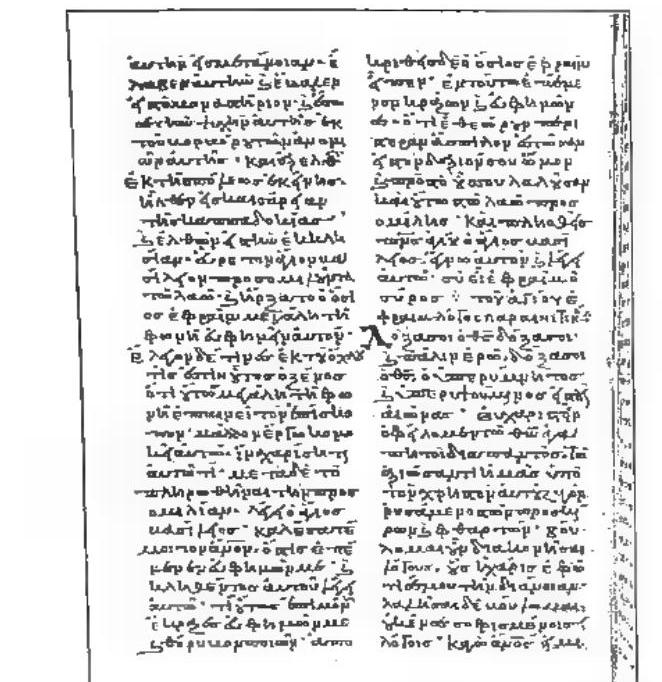
Efrem - Paraenetes - Biblioteca Vaticana, cod. Vat. grec. 1812. 1. 149" (anno 1023).
spirito) vicino al corpo morto, ossia l'ippospichia. Altri luoghi parlano invece del destino ormai raggiunto dalle anime. Vicino al paradiso E. riconosce anche una regione in cui alcune anime «subiscono le pene tassate per le colpe». La Chiesa è una, è il Corpo di Cristo, infallibile, santa, perpetua. Chiaramente viene espresso il primato di S. Pietro, mentre niente si dice di Roma. Note- voli poi le testimonianze sul Battesimo, sull'Unzione con- seguente, sull'Eucaristia e sull'Ordine. Qualche testo parla della Penitenza, ma non si sa se sacramentale. Si allude anche alla legittimità del Matrimonio. - Vedi tav. VIII.
BAL.: Oltre alle opere citate nell'articolo cf. A. Baumstark, Geschichte der syrische Literatur, Bonn 1922, pp. 37-52; G. Ricciuti, S. E. Sira, Torino-Roma 1925; F. Nau, Ephrem (saint), in DTHC, V, coll. 188-93; S. Euringer, Der locus classicus des Primats (Mt. 1, 6) und der Diätessanortext des hl. Ephr., in Beitr. s. Gesch. d. christl. Altertums, Bonn 1922, pp. 141-70; A. Vaccati, S. E. dottore e poeta, in Civ. Catt., 1923, II, pp. 494-51; A. Merk, Ephr. Kommentar zur Apostelgeschichte, Zeitschr. f. kath. Theol., 48 (1924), pp. 37-38, 236-60, 406-65; G. Ricciotti, Alcuni punti della teologia di S. E. in La Scuola Cattolica, 52 (1924), pp. 267-71; 448; id., S. E. siro: biografia, scritti, teologia, Torino 1923; J. Bover, S. E. doctoris Syri testimoniae de universali B. M. Virginis mediatio- ne, in Eph. theol. Lounanienses, 4 (1927), pp. 161-79; M. Ginnetti, Un precursore di Efeso, S. E. e la sua narrologia, in La Scuola Cattolica, 59 (1931), pp. 28-44, 81-90, 170-89; Fr. S. Müller, De wubefekte Empfängnis Mariae in der syrischen n. armenischen Überlieferung, in Scholastik, 9 (1934), pp. 161-220; I. Ortiz de Urbina, La martiologia nei Padri siriaci, in Or. Christ. Periodica, 1 (1935), pp. 110-13; I. Hammersberger, Die Mariologie der ephemischen Schriften, Innsbruck 1938; G. Ricciotti, S. E. Euni alla Vergine, Torino 1939; E. Beck, Die Theologie des hl. E. in seinen Hymnen über den Glauben, Città del Vaticano 1949.
Ignazio Ortiz de Urbina